 Add to Chrome
 Add to Firefox
 Add to Edge
DVM: A Bytecode Virtual Machine Approach for Dynamic Tensor Computation
Apr 02, 2026
Dynamism is common in AI computation, e.g., the dynamic tensor shapes and the dynamic control flows in models. Due to the long compilation time, existing runtime compilation damages the model efficiency, while the offline compilers either suffer from the long compilation time and device memory footprint to cover all the possible execution instances of a dynamic model, or sacrifice optimization opportunities for usability. In this paper, we rethink the feasibility of runtime compilation for dynamic models and identify that the key for it to work is to speed up the compilation or hide the compilation overhead. To do this, we propose a real-time compiler, DVM. In DVM, we design a runtime operator compiler based on a bytecode virtual machine to perform effective and efficient compilation for each dynamic operator instance given its input. Specifically, instead of compiling programs into machine code, we encode the operator program into bytecode on the CPU and decode the bytecode into virtual instructions for direct execution on the NPU. Based on the runtime operator compiler, we further propose an operator fuser, which performs symbol-deduction-based fusion on static graphs and runtime fusion on dynamic graphs. Both pattern- and stacking-based fusion are supported to increase fusion opportunities. Evaluation on operators, subgraphs, and models shows that, compared with TorchInductor, PyTorch-eager and MindSpore-graph-O0, we are up to 11.77$\times$ better in terms of the operator/model efficiency and up to 5 orders of magnitude faster in terms of the maximum compilation time.

DVM: Real-Time Kernel Generation for Dynamic AI Models
Mar 25, 2026Dynamism is common in AI computation, e.g., the dynamic tensor shapes and the dynamic control flows in models. Due to the long compilation time, existing runtime compilation damages the model efficiency, while the offline compilers either suffer from the long compilation time and device memory footprint to cover all the possible execution instances of a dynamic model, or sacrifice optimization opportunities for usability. In this paper, we rethink the feasibility of runtime compilation for dynamic models and identify that the key for it to work is to speed up the compilation or hide the compilation overhead. To do this, we propose a real-time compiler, DVM. In DVM, we design a runtime operator compiler based on a bytecode virtual machine to perform effective and efficient compilation for each dynamic operator instance given its input. Specifically, instead of compiling programs into machine code, we encode the operator program into bytecode on the CPU and decode the bytecode into virtual instructions for direct execution on the NPU. Based on the runtime operator compiler, we further propose an operator fuser, which performs symbol-deduction-based fusion on static graphs and runtime fusion on dynamic graphs. Both pattern- and stacking-based fusion are supported to increase fusion opportunities. Evaluation on operators, subgraphs, and models shows that, compared with TorchInductor, PyTorch-eager and MindSpore-graph-O0, we are up to 11.77$\times$ better in terms of the operator/model efficiency and up to 5 orders of magnitude faster in terms of the maximum compilation time.
DIDS: Domain Impact-aware Data Sampling for Large Language Model Training
Apr 17, 2025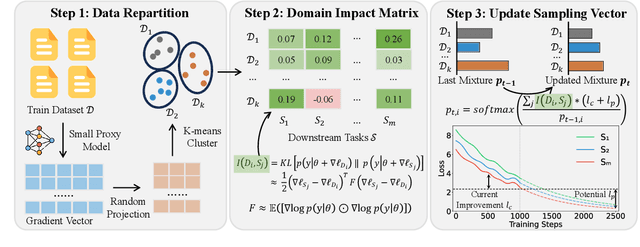
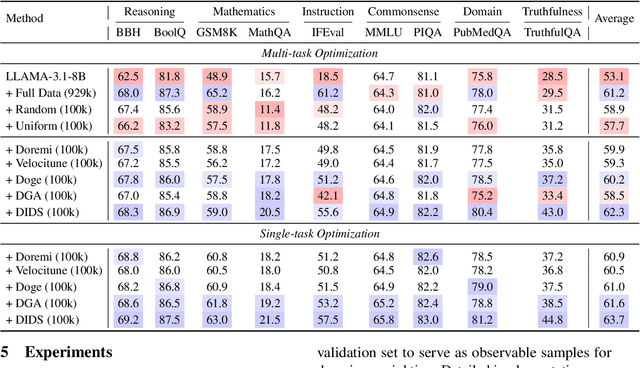
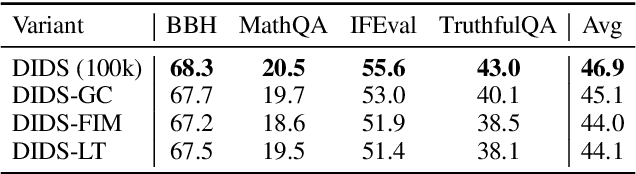
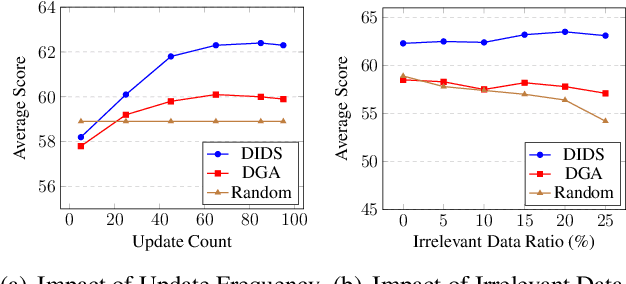
Large language models (LLMs) are commonly trained on multi-domain datasets, where domain sampling strategies significantly impact model performance due to varying domain importance across downstream tasks. Existing approaches for optimizing domain-level sampling strategies struggle with maintaining intra-domain consistency and accurately measuring domain impact. In this paper, we present Domain Impact-aware Data Sampling (DIDS). To ensure intra-domain consistency, a gradient clustering algorithm is proposed to group training data based on their learning effects, where a proxy language model and dimensionality reduction are employed to reduce computational overhead. To accurately measure domain impact, we develop a Fisher Information Matrix (FIM) guided metric that quantifies how domain-specific parameter updates affect the model's output distributions on downstream tasks, with theoretical guarantees. Furthermore, to determine optimal sampling ratios, DIDS combines both the FIM-guided domain impact assessment and loss learning trajectories that indicate domain-specific potential, while accounting for diminishing marginal returns. Extensive experiments demonstrate that DIDS achieves 3.4% higher average performance while maintaining comparable training efficiency.