 Add to Chrome
 Add to Firefox
 Add to Edge
MosaicQuant: Inlier-Outlier Disaggregation for Unified 4-Bit LLM Quantization
Jun 14, 2026
4-bit quantization significantly reduces the memory footprint and accelerates the inference of large language models (LLMs). However, its limited bit-width representation struggles to faithfully capture both dense common values (\emph{inliers}) and rare large-magnitude values (\emph{outliers}), causing substantial accuracy degradation. Existing mixed-precision methods mitigate this by retaining outliers in high precision, but at the cost of breaking the uniformity of low-bit execution, introducing precision conversion and extra data movement that undermine practical speedup. We propose \textbf{MosaicQuant}, a unified 4-bit LLM quantization paradigm built on a novel principle of \emph{inlier--outlier disaggregation}. Rather than elevating outlier precision, MosaicQuant quantizes the full weight matrix into a dense 4-bit base component, where inliers are captured faithfully while outlier are inevitably quantized. A sparse 4-bit residual component is then introduced to compensate for these quantization errors, selectively targeting the most error-critical weight blocks where output distortion is shown to be concentrated. However, a unified representation alone is insufficient, as naïvely executing the sparse residual as a separate kernel still breaks the unified low-bit inference pipeline. To bridge this gap, we introduce \textbf{ZipperEngine}, which fuses sparse block computation into the dense 4-bit GEMM kernel via an overlapped pipeline, unifying not only the representation but also the execution into a single coherent low-bit inference pipeline. Extensive experiments on LLaMA3 and Qwen3 demonstrate that MosaicQuant preserves near-FP16 accuracy while achieving up to $1.24\times$ speedup over the W16A16 baseline.

Kernel-Smith: A Unified Recipe for Evolutionary Kernel Optimization
Mar 30, 2026We present Kernel-Smith, a framework for high-performance GPU kernel and operator generation that combines a stable evaluation-driven evolutionary agent with an evolution-oriented post-training recipe. On the agent side, Kernel-Smith maintains a population of executable candidates and iteratively improves them using an archive of top-performing and diverse programs together with structured execution feedback on compilation, correctness, and speedup. To make this search reliable, we build backend-specific evaluation services for Triton on NVIDIA GPUs and Maca on MetaX GPUs. On the training side, we convert long-horizon evolution trajectories into step-centric supervision and reinforcement learning signals by retaining correctness-preserving, high-gain revisions, so that the model is optimized as a strong local improver inside the evolutionary loop rather than as a one-shot generator. Under a unified evolutionary protocol, Kernel-Smith-235B-RL achieves state-of-the-art overall performance on KernelBench with Nvidia Triton backend, attaining the best average speedup ratio and outperforming frontier proprietary models including Gemini-3.0-pro and Claude-4.6-opus. We further validate the framework on the MetaX MACA backend, where our Kernel-Smith-MACA-30B surpasses large-scale counterparts such as DeepSeek-V3.2-think and Qwen3-235B-2507-think, highlighting potential for seamless adaptation across heterogeneous platforms. Beyond benchmark results, the same workflow produces upstream contributions to production systems including SGLang and LMDeploy, demonstrating that LLM-driven kernel optimization can transfer from controlled evaluation to practical deployment.
LocRef-Diffusion:Tuning-Free Layout and Appearance-Guided Generation
Nov 22, 2024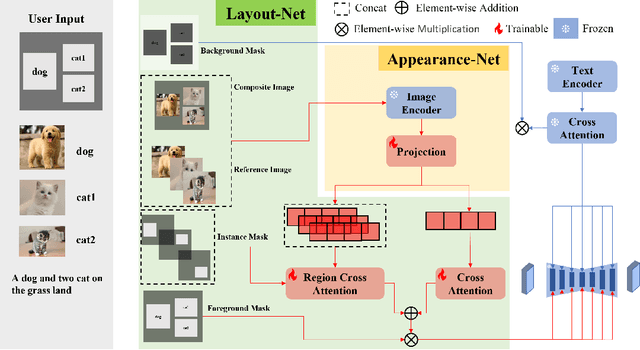
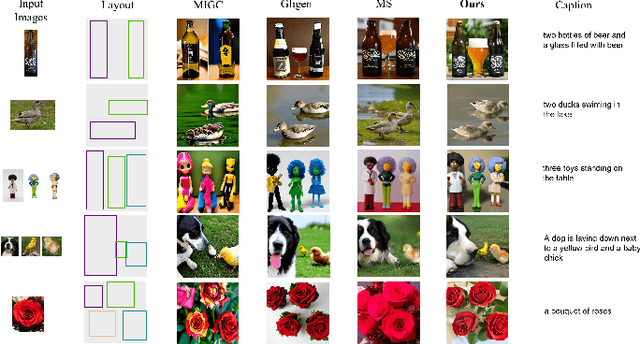
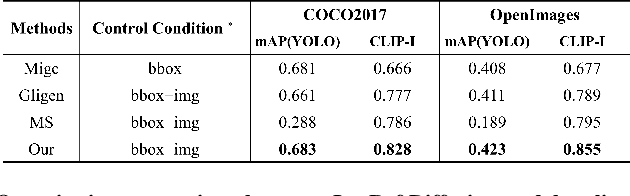
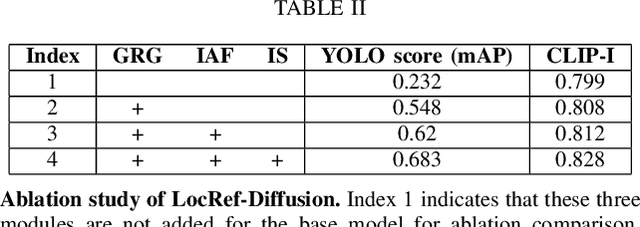
Recently, text-to-image models based on diffusion have achieved remarkable success in generating high-quality images. However, the challenge of personalized, controllable generation of instances within these images remains an area in need of further development. In this paper, we present LocRef-Diffusion, a novel, tuning-free model capable of personalized customization of multiple instances' appearance and position within an image. To enhance the precision of instance placement, we introduce a Layout-net, which controls instance generation locations by leveraging both explicit instance layout information and an instance region cross-attention module. To improve the appearance fidelity to reference images, we employ an appearance-net that extracts instance appearance features and integrates them into the diffusion model through cross-attention mechanisms. We conducted extensive experiments on the COCO and OpenImages datasets, and the results demonstrate that our proposed method achieves state-of-the-art performance in layout and appearance guided generation.
AquilaMoE: Efficient Training for MoE Models with Scale-Up and Scale-Out Strategies
Aug 13, 2024In recent years, with the rapid application of large language models across various fields, the scale of these models has gradually increased, and the resources required for their pre-training have grown exponentially. Training an LLM from scratch will cost a lot of computation resources while scaling up from a smaller model is a more efficient approach and has thus attracted significant attention. In this paper, we present AquilaMoE, a cutting-edge bilingual 8*16B Mixture of Experts (MoE) language model that has 8 experts with 16 billion parameters each and is developed using an innovative training methodology called EfficientScale. This approach optimizes performance while minimizing data requirements through a two-stage process. The first stage, termed Scale-Up, initializes the larger model with weights from a pre-trained smaller model, enabling substantial knowledge transfer and continuous pretraining with significantly less data. The second stage, Scale-Out, uses a pre-trained dense model to initialize the MoE experts, further enhancing knowledge transfer and performance. Extensive validation experiments on 1.8B and 7B models compared various initialization schemes, achieving models that maintain and reduce loss during continuous pretraining. Utilizing the optimal scheme, we successfully trained a 16B model and subsequently the 8*16B AquilaMoE model, demonstrating significant improvements in performance and training efficiency.