 Add to Chrome
 Add to Firefox
 Add to Edge
Global-Aware Monocular Semantic Scene Completion with State Space Models
Mar 09, 2025
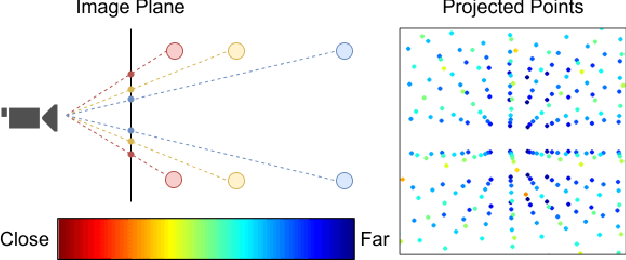
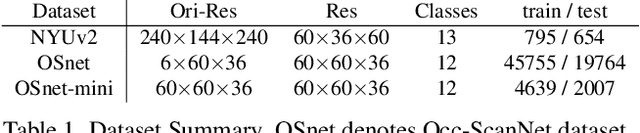
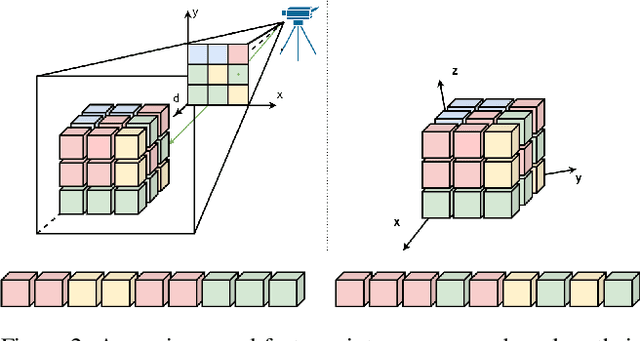
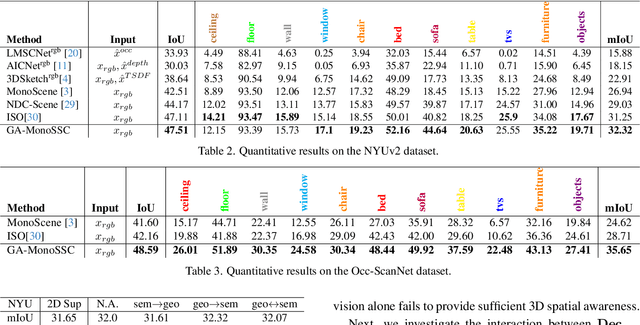
Monocular Semantic Scene Completion (MonoSSC) reconstructs and interprets 3D environments from a single image, enabling diverse real-world applications. However, existing methods are often constrained by the local receptive field of Convolutional Neural Networks (CNNs), making it challenging to handle the non-uniform distribution of projected points (Fig. \ref{fig:perspective}) and effectively reconstruct missing information caused by the 3D-to-2D projection. In this work, we introduce GA-MonoSSC, a hybrid architecture for MonoSSC that effectively captures global context in both the 2D image domain and 3D space. Specifically, we propose a Dual-Head Multi-Modality Encoder, which leverages a Transformer architecture to capture spatial relationships across all features in the 2D image domain, enabling more comprehensive 2D feature extraction. Additionally, we introduce the Frustum Mamba Decoder, built on the State Space Model (SSM), to efficiently capture long-range dependencies in 3D space. Furthermore, we propose a frustum reordering strategy within the Frustum Mamba Decoder to mitigate feature discontinuities in the reordered voxel sequence, ensuring better alignment with the scan mechanism of the State Space Model (SSM) for improved 3D representation learning. We conduct extensive experiments on the widely used Occ-ScanNet and NYUv2 datasets, demonstrating that our proposed method achieves state-of-the-art performance, validating its effectiveness. The code will be released upon acceptance.

Future-Aware Interaction Network For Motion Forecasting
Mar 09, 2025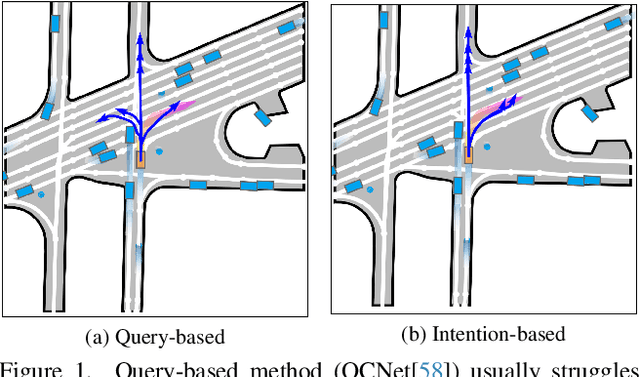
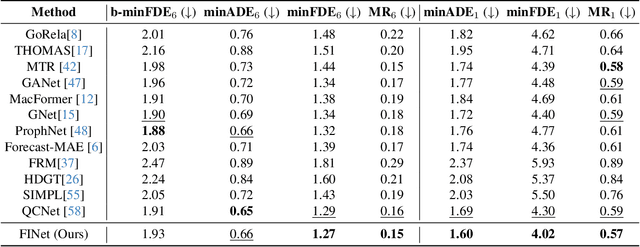
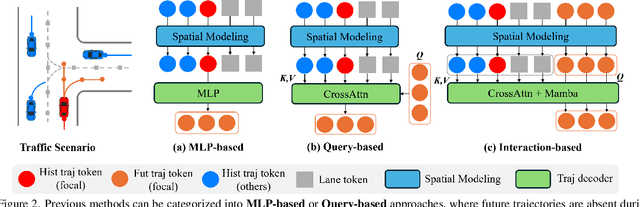
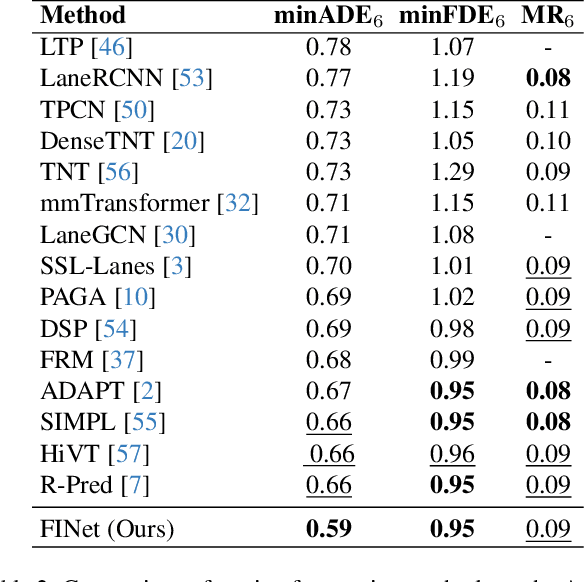
Motion forecasting is a crucial component of autonomous driving systems, enabling the generation of accurate and smooth future trajectories to ensure safe navigation to the destination. In previous methods, potential future trajectories are often absent in the scene encoding stage, which may lead to suboptimal outcomes. Additionally, prior approaches typically employ transformer architectures for spatiotemporal modeling of trajectories and map information, which suffer from the quadratic scaling complexity of the transformer architecture. In this work, we propose an interaction-based method, named Future-Aware Interaction Network, that introduces potential future trajectories into scene encoding for a comprehensive traffic representation. Furthermore, a State Space Model (SSM), specifically Mamba, is introduced for both spatial and temporal modeling. To adapt Mamba for spatial interaction modeling, we propose an adaptive reordering strategy that transforms unordered data into a structured sequence. Additionally, Mamba is employed to refine generated future trajectories temporally, ensuring more consistent predictions. These enhancements not only improve model efficiency but also enhance the accuracy and diversity of predictions. We conduct comprehensive experiments on the widely used Argoverse 1 and Argoverse 2 datasets, demonstrating that the proposed method achieves superior performance compared to previous approaches in a more efficient way. The code will be released according to the acceptance.
Efficient and Context-Aware Label Propagation for Zero-/Few-Shot Training-Free Adaptation of Vision-Language Model
Dec 24, 2024Vision-language models (VLMs) have revolutionized machine learning by leveraging large pre-trained models to tackle various downstream tasks. Despite improvements in label, training, and data efficiency, many state-of-the-art VLMs still require task-specific hyperparameter tuning and fail to fully exploit test samples. To overcome these challenges, we propose a graph-based approach for label-efficient adaptation and inference. Our method dynamically constructs a graph over text prompts, few-shot examples, and test samples, using label propagation for inference without task-specific tuning. Unlike existing zero-shot label propagation techniques, our approach requires no additional unlabeled support set and effectively leverages the test sample manifold through dynamic graph expansion. We further introduce a context-aware feature re-weighting mechanism to improve task adaptation accuracy. Additionally, our method supports efficient graph expansion, enabling real-time inductive inference. Extensive evaluations on downstream tasks, such as fine-grained categorization and out-of-distribution generalization, demonstrate the effectiveness of our approach.
Utilizing the Mean Teacher with Supcontrast Loss for Wafer Pattern Recognition
Nov 27, 2024The patterns on wafer maps play a crucial role in helping engineers identify the causes of production issues during semiconductor manufacturing. In order to reduce costs and improve accuracy, automation technology is essential, and recent developments in deep learning have led to impressive results in wafer map pattern recognition. In this context, inspired by the effectiveness of semi-supervised learning and contrastive learning methods, we introduce an innovative approach that integrates the Mean Teacher framework with the supervised contrastive learning loss for enhanced wafer map pattern recognition. Our methodology not only addresses the nuances of wafer patterns but also tackles challenges arising from limited labeled data. To further refine the process, we address data imbalance in the wafer dataset by employing SMOTE and under-sampling techniques. We conduct a comprehensive analysis of our proposed method and demonstrate its effectiveness through experiments using real-world dataset WM811K obtained from semiconductor manufacturers. Compared to the baseline method, our method has achieved 5.46%, 6.68%, 5.42%, and 4.53% improvements in Accuracy, Precision, Recall, and F1 score, respectively.
On the Adversarial Risk of Test Time Adaptation: An Investigation into Realistic Test-Time Data Poisoning
Oct 07, 2024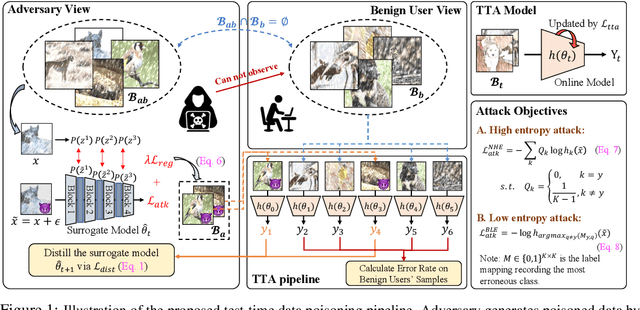


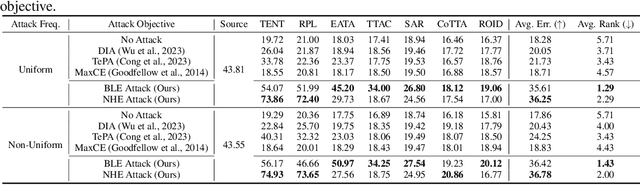
Test-time adaptation (TTA) updates the model weights during the inference stage using testing data to enhance generalization. However, this practice exposes TTA to adversarial risks. Existing studies have shown that when TTA is updated with crafted adversarial test samples, also known as test-time poisoned data, the performance on benign samples can deteriorate. Nonetheless, the perceived adversarial risk may be overstated if the poisoned data is generated under overly strong assumptions. In this work, we first review realistic assumptions for test-time data poisoning, including white-box versus grey-box attacks, access to benign data, attack budget, and more. We then propose an effective and realistic attack method that better produces poisoned samples without access to benign samples, and derive an effective in-distribution attack objective. We also design two TTA-aware attack objectives. Our benchmarks of existing attack methods reveal that the TTA methods are more robust than previously believed. In addition, we analyze effective defense strategies to help develop adversarially robust TTA methods.
GS-EVT: Cross-Modal Event Camera Tracking based on Gaussian Splatting
Sep 28, 2024Reliable self-localization is a foundational skill for many intelligent mobile platforms. This paper explores the use of event cameras for motion tracking thereby providing a solution with inherent robustness under difficult dynamics and illumination. In order to circumvent the challenge of event camera-based mapping, the solution is framed in a cross-modal way. It tracks a map representation that comes directly from frame-based cameras. Specifically, the proposed method operates on top of gaussian splatting, a state-of-the-art representation that permits highly efficient and realistic novel view synthesis. The key of our approach consists of a novel pose parametrization that uses a reference pose plus first order dynamics for local differential image rendering. The latter is then compared against images of integrated events in a staggered coarse-to-fine optimization scheme. As demonstrated by our results, the realistic view rendering ability of gaussian splatting leads to stable and accurate tracking across a variety of both publicly available and newly recorded data sequences.
Exploring Human-in-the-Loop Test-Time Adaptation by Synergizing Active Learning and Model Selection
May 29, 2024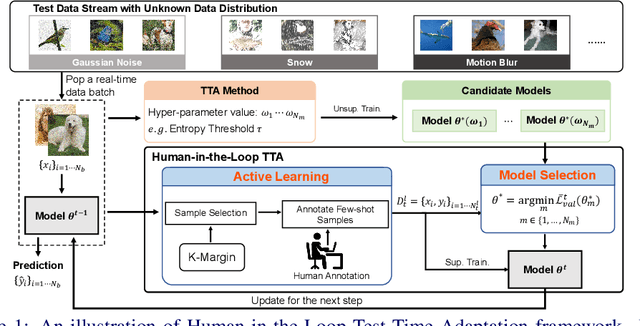
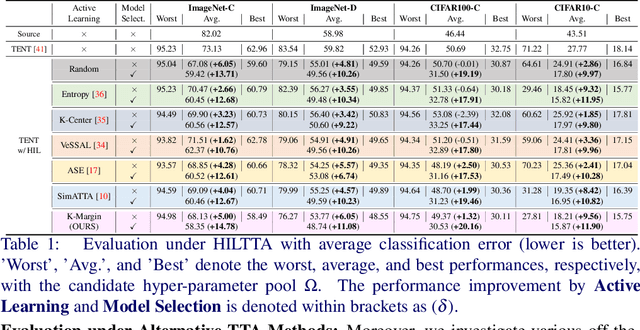
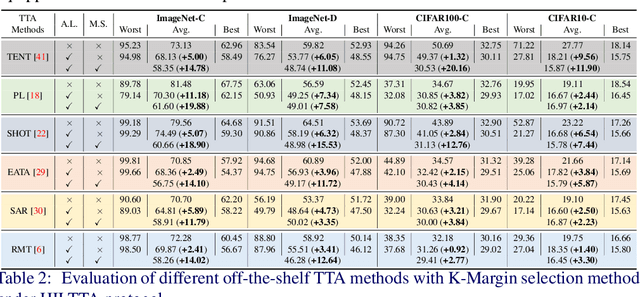
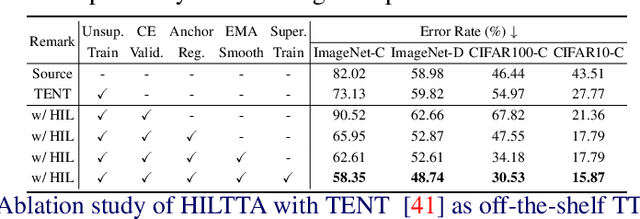
Existing test-time adaptation (TTA) approaches often adapt models with the unlabeled testing data stream. A recent attempt relaxed the assumption by introducing limited human annotation, referred to as Human-In-the-Loop Test-Time Adaptation (HILTTA) in this study. The focus of existing HILTTA lies on selecting the most informative samples to label, a.k.a. active learning. In this work, we are motivated by a pitfall of TTA, i.e. sensitive to hyper-parameters, and propose to approach HILTTA by synergizing active learning and model selection. Specifically, we first select samples for human annotation (active learning) and then use the labeled data to select optimal hyper-parameters (model selection). A sample selection strategy is tailored for choosing samples by considering the balance between active learning and model selection purposes. We demonstrate on 4 TTA datasets that the proposed HILTTA approach is compatible with off-the-shelf TTA methods which outperform the state-of-the-art HILTTA methods and stream-based active learning methods. Importantly, our proposed method can always prevent choosing the worst hyper-parameters on all off-the-shelf TTA methods. The source code will be released upon publication.
A Timely Survey on Vision Transformer for Deepfake Detection
May 14, 2024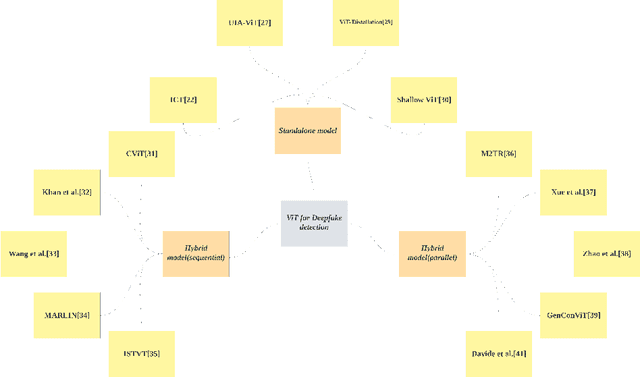

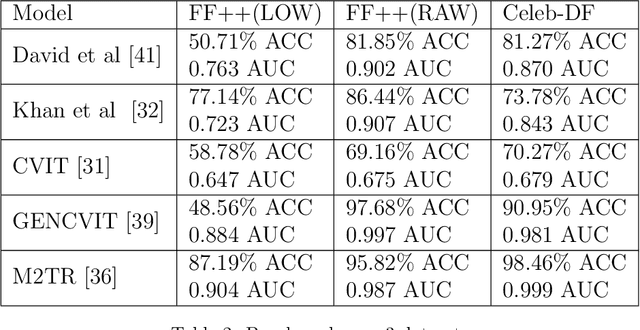
In recent years, the rapid advancement of deepfake technology has revolutionized content creation, lowering forgery costs while elevating quality. However, this progress brings forth pressing concerns such as infringements on individual rights, national security threats, and risks to public safety. To counter these challenges, various detection methodologies have emerged, with Vision Transformer (ViT)-based approaches showcasing superior performance in generality and efficiency. This survey presents a timely overview of ViT-based deepfake detection models, categorized into standalone, sequential, and parallel architectures. Furthermore, it succinctly delineates the structure and characteristics of each model. By analyzing existing research and addressing future directions, this survey aims to equip researchers with a nuanced understanding of ViT's pivotal role in deepfake detection, serving as a valuable reference for both academic and practical pursuits in this domain.
COFT-AD: COntrastive Fine-Tuning for Few-Shot Anomaly Detection
Feb 29, 2024Existing approaches towards anomaly detection~(AD) often rely on a substantial amount of anomaly-free data to train representation and density models. However, large anomaly-free datasets may not always be available before the inference stage; in which case an anomaly detection model must be trained with only a handful of normal samples, a.k.a. few-shot anomaly detection (FSAD). In this paper, we propose a novel methodology to address the challenge of FSAD which incorporates two important techniques. Firstly, we employ a model pre-trained on a large source dataset to initialize model weights. Secondly, to ameliorate the covariate shift between source and target domains, we adopt contrastive training to fine-tune on the few-shot target domain data. To learn suitable representations for the downstream AD task, we additionally incorporate cross-instance positive pairs to encourage a tight cluster of the normal samples, and negative pairs for better separation between normal and synthesized negative samples. We evaluate few-shot anomaly detection on on 3 controlled AD tasks and 4 real-world AD tasks to demonstrate the effectiveness of the proposed method.
CLIP-guided Source-free Object Detection in Aerial Images
Jan 10, 2024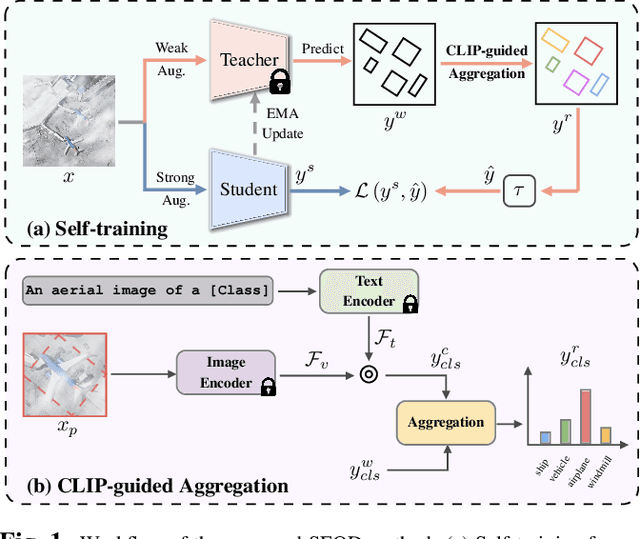
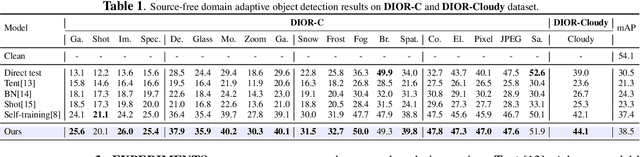
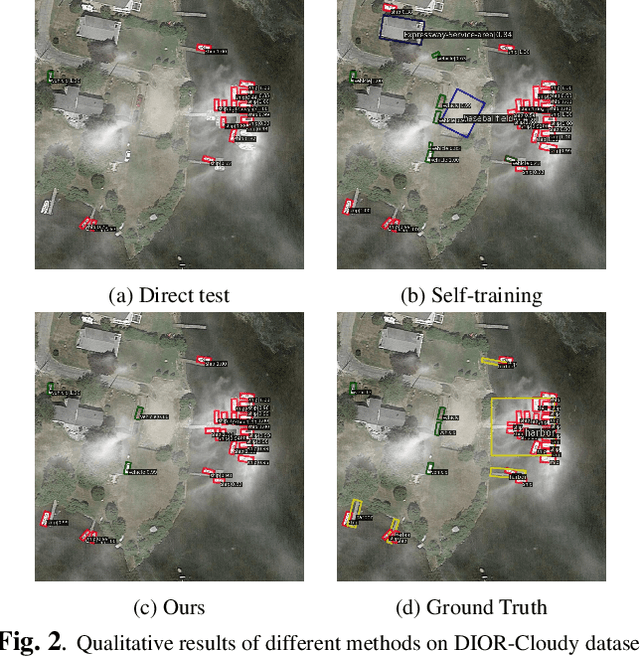
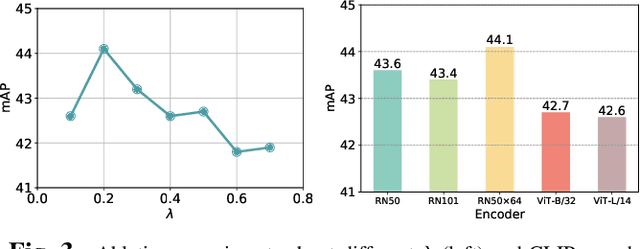
Domain adaptation is crucial in aerial imagery, as the visual representation of these images can significantly vary based on factors such as geographic location, time, and weather conditions. Additionally, high-resolution aerial images often require substantial storage space and may not be readily accessible to the public. To address these challenges, we propose a novel Source-Free Object Detection (SFOD) method. Specifically, our approach is built upon a self-training framework; however, self-training can lead to inaccurate learning in the absence of labeled training data. To address this issue, we further integrate Contrastive Language-Image Pre-training (CLIP) to guide the generation of pseudo-labels, termed CLIP-guided Aggregation. By leveraging CLIP's zero-shot classification capability, we use it to aggregate scores with the original predicted bounding boxes, enabling us to obtain refined scores for the pseudo-labels. To validate the effectiveness of our method, we constructed two new datasets from different domains based on the DIOR dataset, named DIOR-C and DIOR-Cloudy. Experiments demonstrate that our method outperforms other comparative algorithms.