 Add to Chrome
 Add to Firefox
 Add to Edge
GRAIL: Generating Humanoid Loco-Manipulation from 3D Assets and Video Priors
Jun 03, 2026
Scaling humanoid loco-manipulation requires robot-compatible demonstrations across diverse objects, whole-body motions, and scene geometries, but teleoperation and motion capture are difficult to scale because each collection depends on physical setups, instrumented actors, and robot operation. We present GRAIL, a digital generation pipeline that remains fully virtual until deployment: it composes 3D assets, simulator-ready scenes, and priors from video foundation models (VFMs) to synthesize interactions without rebuilding physical environments or teleoperating the robot. Rather than reconstructing unconstrained in-the-wild videos, GRAIL starts from fully specified 3D configurations in which object geometry, camera parameters, metric scale, environment depth, and a robot-proportioned character are known before video generation and reused during reconstruction. This privileged setup better conditions 4D recovery, allowing model-based object tracking, human motion estimation, and interaction-aware optimization to reconstruct metric 4D human-object interaction (HOI) trajectories with reduced depth ambiguity and morphology mismatch. We retarget the recovered motions to a humanoid robot and train complementary task-general trackers: an object-aware latent adaptor for manipulation and a scene-aware tracker for terrain traversal. GRAIL produces over 20,000 sequences spanning pick-up, object manipulation, sitting, and terrain traversal. Using only GRAIL-generated data, we train egocentric visual policies through a sim-to-real pipeline and deploy them on a Unitree G1 humanoid, achieving 84\% real-world success on diverse object pick-up and 90\% success on stair-climbing.

Reasmory: 3D Reconstruction as Explicit Memory for VLMs Spatial Reasoning
May 31, 2026Vision-Language Models (VLMs) exhibit emerging spatial reasoning capabilities, yet they remain unreliable on tasks requiring precise spatial understanding, such as viewpoint reasoning, directional comparison, and distance estimation. In multi-view images and monocular videos, relevant spatial cues are often sparse and distributed across redundant observations, making them difficult to organize and exploit. Reconstruction-based Vision Foundation Models (VFMs) offer a natural way to aggregate such observations into explicit spatial memory, such as point clouds. However, simply exposing reconstruction models as free-form tools is brittle, VLMs may invoke tools incorrectly, skip required spatial transformations, or misuse intermediate results. We propose \textbf{Reasmory}, a framework that formulates spatial reasoning as structured program execution over reconstructed spatial memory. Reasmory constructs explicit 3D memory, augments it with semantically grounded 3D object instances, and introduces a lightweight Domain-Specific Language (DSL) that constrains how VLMs query objects and cameras, transform viewpoints, and render observations during reasoning. Generated programs are parsed and validated before execution, enabling more reliable interaction with spatial memory than unconstrained tool use. Experiments on multi-view image and video spatial reasoning benchmarks show consistent gains of 6--18\% over strong baselines, including GPT-5-mini and Gemini-3-flash, indicating that explicit 3D memory is most useful when accessed through constrained, validated operations rather than free-form tool calls.
SOMA: Unifying Parametric Human Body Models
Mar 17, 2026Parametric human body models are foundational to human reconstruction, animation, and simulation, yet they remain mutually incompatible: SMPL, SMPL-X, MHR, Anny, and related models each diverge in mesh topology, skeletal structure, shape parameterization, and unit convention, making it impractical to exploit their complementary strengths within a single pipeline. We present SOMA, a unified body layer that bridges these heterogeneous representations through three abstraction layers. Mesh topology abstraction maps any source model's identity to a shared canonical mesh in constant time per vertex. Skeletal abstraction recovers a full set of identity-adapted joint transforms from any body shape, whether in rest pose or an arbitrary posed configuration, in a single closed-form pass, with no iterative optimization or per-model training. Pose abstraction inverts the skinning pipeline to recover unified skeleton rotations directly from posed vertices of any supported model, enabling heterogeneous motion datasets to be consumed without custom retargeting. Together, these layers reduce the $O(M^2)$ per-pair adapter problem to $O(M)$ single-backend connectors, letting practitioners freely mix identity sources and pose data at inference time. The entire pipeline is fully differentiable end-to-end and GPU-accelerated via NVIDIA-Warp.
ReCoSplat: Autoregressive Feed-Forward Gaussian Splatting Using Render-and-Compare
Mar 10, 2026Online novel view synthesis remains challenging, requiring robust scene reconstruction from sequential, often unposed, observations. We present ReCoSplat, an autoregressive feed-forward Gaussian Splatting model supporting posed or unposed inputs, with or without camera intrinsics. While assembling local Gaussians using camera poses scales better than canonical-space prediction, it creates a dilemma during training: using ground-truth poses ensures stability but causes a distribution mismatch when predicted poses are used at inference. To address this, we introduce a Render-and-Compare (ReCo) module. ReCo renders the current reconstruction from the predicted viewpoint and compares it with the incoming observation, providing a stable conditioning signal that compensates for pose errors. To support long sequences, we propose a hybrid KV cache compression strategy combining early-layer truncation with chunk-level selective retention, reducing the KV cache size by over 90% for 100+ frames. ReCoSplat achieves state-of-the-art performance across different input settings on both in- and out-of-distribution benchmarks. Code and pretrained models will be released. Our project page is at https://freemancheng.com/ReCoSplat .
Revealing and Enhancing Core Visual Regions: Harnessing Internal Attention Dynamics for Hallucination Mitigation in LVLMs
Feb 17, 2026LVLMs have achieved strong multimodal reasoning capabilities but remain prone to hallucinations, producing outputs inconsistent with visual inputs or user instructions. Existing training-free methods, including contrastive decoding and auxiliary expert models, which incur several times more computational overhead and may introduce potential interference, as well as static internal signal enhancement, are often vulnerable to the attention sink phenomenon. We find that internal Positive Attention Dynamics (PAD) in LVLMs naturally reveal semantically core visual regions under the distortions of attention sinks. Based on this, we propose Positive Attention Dynamics Enhancement (PADE), a training-free attention intervention that constructs a PAD map to identify semantically core visual regions, applies per-head Median Absolute Deviation Scaling to adaptively control the intervention strength, and leverages System-Token Compensation to maintain attention to complex user instructions and support long-term output consistency. Experiments on multiple LVLMs and benchmarks show that PADE improves visual grounding and reduces hallucinations, validating the effectiveness of leveraging internal attention dynamics for reliable multimodal reasoning.
Edit3r: Instant 3D Scene Editing from Sparse Unposed Images
Dec 31, 2025We present Edit3r, a feed-forward framework that reconstructs and edits 3D scenes in a single pass from unposed, view-inconsistent, instruction-edited images. Unlike prior methods requiring per-scene optimization, Edit3r directly predicts instruction-aligned 3D edits, enabling fast and photorealistic rendering without optimization or pose estimation. A key challenge in training such a model lies in the absence of multi-view consistent edited images for supervision. We address this with (i) a SAM2-based recoloring strategy that generates reliable, cross-view-consistent supervision, and (ii) an asymmetric input strategy that pairs a recolored reference view with raw auxiliary views, encouraging the network to fuse and align disparate observations. At inference, our model effectively handles images edited by 2D methods such as InstructPix2Pix, despite not being exposed to such edits during training. For large-scale quantitative evaluation, we introduce DL3DV-Edit-Bench, a benchmark built on the DL3DV test split, featuring 20 diverse scenes, 4 edit types and 100 edits in total. Comprehensive quantitative and qualitative results show that Edit3r achieves superior semantic alignment and enhanced 3D consistency compared to recent baselines, while operating at significantly higher inference speed, making it promising for real-time 3D editing applications.
Instant Expressive Gaussian Head Avatar via 3D-Aware Expression Distillation
Dec 18, 2025Portrait animation has witnessed tremendous quality improvements thanks to recent advances in video diffusion models. However, these 2D methods often compromise 3D consistency and speed, limiting their applicability in real-world scenarios, such as digital twins or telepresence. In contrast, 3D-aware facial animation feedforward methods -- built upon explicit 3D representations, such as neural radiance fields or Gaussian splatting -- ensure 3D consistency and achieve faster inference speed, but come with inferior expression details. In this paper, we aim to combine their strengths by distilling knowledge from a 2D diffusion-based method into a feed-forward encoder, which instantly converts an in-the-wild single image into a 3D-consistent, fast yet expressive animatable representation. Our animation representation is decoupled from the face's 3D representation and learns motion implicitly from data, eliminating the dependency on pre-defined parametric models that often constrain animation capabilities. Unlike previous computationally intensive global fusion mechanisms (e.g., multiple attention layers) for fusing 3D structural and animation information, our design employs an efficient lightweight local fusion strategy to achieve high animation expressivity. As a result, our method runs at 107.31 FPS for animation and pose control while achieving comparable animation quality to the state-of-the-art, surpassing alternative designs that trade speed for quality or vice versa. Project website is https://research.nvidia.com/labs/amri/projects/instant4d
CoCo4D: Comprehensive and Complex 4D Scene Generation
Jun 24, 2025Existing 4D synthesis methods primarily focus on object-level generation or dynamic scene synthesis with limited novel views, restricting their ability to generate multi-view consistent and immersive dynamic 4D scenes. To address these constraints, we propose a framework (dubbed as CoCo4D) for generating detailed dynamic 4D scenes from text prompts, with the option to include images. Our method leverages the crucial observation that articulated motion typically characterizes foreground objects, whereas background alterations are less pronounced. Consequently, CoCo4D divides 4D scene synthesis into two responsibilities: modeling the dynamic foreground and creating the evolving background, both directed by a reference motion sequence. Given a text prompt and an optional reference image, CoCo4D first generates an initial motion sequence utilizing video diffusion models. This motion sequence then guides the synthesis of both the dynamic foreground object and the background using a novel progressive outpainting scheme. To ensure seamless integration of the moving foreground object within the dynamic background, CoCo4D optimizes a parametric trajectory for the foreground, resulting in realistic and coherent blending. Extensive experiments show that CoCo4D achieves comparable or superior performance in 4D scene generation compared to existing methods, demonstrating its effectiveness and efficiency. More results are presented on our website https://colezwhy.github.io/coco4d/.
AdaHuman: Animatable Detailed 3D Human Generation with Compositional Multiview Diffusion
May 30, 2025
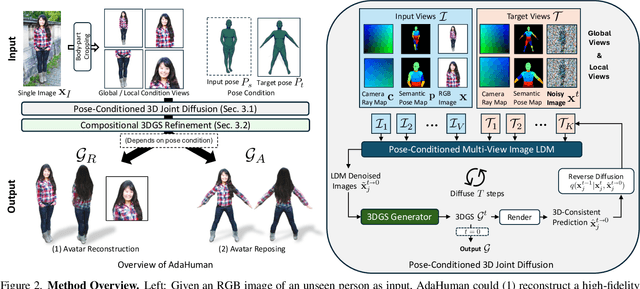

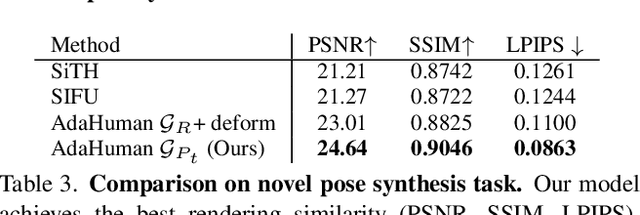
Existing methods for image-to-3D avatar generation struggle to produce highly detailed, animation-ready avatars suitable for real-world applications. We introduce AdaHuman, a novel framework that generates high-fidelity animatable 3D avatars from a single in-the-wild image. AdaHuman incorporates two key innovations: (1) A pose-conditioned 3D joint diffusion model that synthesizes consistent multi-view images in arbitrary poses alongside corresponding 3D Gaussian Splats (3DGS) reconstruction at each diffusion step; (2) A compositional 3DGS refinement module that enhances the details of local body parts through image-to-image refinement and seamlessly integrates them using a novel crop-aware camera ray map, producing a cohesive detailed 3D avatar. These components allow AdaHuman to generate highly realistic standardized A-pose avatars with minimal self-occlusion, enabling rigging and animation with any input motion. Extensive evaluation on public benchmarks and in-the-wild images demonstrates that AdaHuman significantly outperforms state-of-the-art methods in both avatar reconstruction and reposing. Code and models will be publicly available for research purposes.
GeoMan: Temporally Consistent Human Geometry Estimation using Image-to-Video Diffusion
May 29, 2025Estimating accurate and temporally consistent 3D human geometry from videos is a challenging problem in computer vision. Existing methods, primarily optimized for single images, often suffer from temporal inconsistencies and fail to capture fine-grained dynamic details. To address these limitations, we present GeoMan, a novel architecture designed to produce accurate and temporally consistent depth and normal estimations from monocular human videos. GeoMan addresses two key challenges: the scarcity of high-quality 4D training data and the need for metric depth estimation to accurately model human size. To overcome the first challenge, GeoMan employs an image-based model to estimate depth and normals for the first frame of a video, which then conditions a video diffusion model, reframing video geometry estimation task as an image-to-video generation problem. This design offloads the heavy lifting of geometric estimation to the image model and simplifies the video model's role to focus on intricate details while using priors learned from large-scale video datasets. Consequently, GeoMan improves temporal consistency and generalizability while requiring minimal 4D training data. To address the challenge of accurate human size estimation, we introduce a root-relative depth representation that retains critical human-scale details and is easier to be estimated from monocular inputs, overcoming the limitations of traditional affine-invariant and metric depth representations. GeoMan achieves state-of-the-art performance in both qualitative and quantitative evaluations, demonstrating its effectiveness in overcoming longstanding challenges in 3D human geometry estimation from videos.