 Add to Chrome
 Add to Firefox
 Add to Edge
DyaPlex: Full-Duplex Speech-Motion Model for Dyadic Interaction
Jun 02, 2026
We present DyaPlex, a streaming, full-duplex speech-and-motion model designed for dyadic interaction. To capture the continuous and reciprocal nature of human communication, this full-duplex capability empowers the agent to simultaneously perceive and generate both speech and physical motion in a streaming fashion. At its core, our method leverages the strong priors of a foundational full-duplex speech model and integrates a novel motion pathway, thereby achieving fully synchronized multi-modal interaction. Specifically, we design a dual-tower Transformer architecture that preserves the zero-shot conversational reasoning of a frozen base speech model while constructing a deeply coupled, streaming motion pathway. By introducing a unified dyadic token interleaving mechanism and guiding cross-attention via a time-aligned speech-motion RoPE, our model effectively aligns autoregressive motions with rich latent speech features. Trained on the 4,000-hour Seamless Interaction dataset, our model effectively captures cross-speaker dependencies and establishes new state-of-the-art performance across both monadic and dyadic human interaction benchmarks.

VideoFDB: Evaluating Full-Duplex Vision-Speech Capabilities in Conversational Agents
May 28, 2026Natural human conversation is full-duplex and audio-visual: people simultaneously speak and listen while continuously interpreting and producing nonverbal cues, such as nods, smiles, and gestures. To support successful human-agent interaction, agents must model full-duplex audiovisual conversation; however, existing full-duplex benchmarks evaluate only speech. In this work, we present VideoFDB, the first benchmark to evaluate full-duplex audio-visual-to-audio-visual (AV2AV) conversational agents. VideoFDB contributes (i) 237 dyadic clips spanning 11 nonverbal conversational dynamics from real-world video calls, (ii) a taxonomy separating perception from generation behaviors, and (iii) a rubric-based LM-as-judge evaluation framework with interpretable axes for assessing conversational quality with respect to nonverbal conversational dynamics. Across open- and closed-source vision-speech agents, we find systematic failure modes: captioning collapse and visual-stream ignorance, and we show that current systems exploit vision for explicit visual question answering but not for the streaming joint audiovisual grounding required in natural conversation. We further evaluate cascaded speech-to-avatar systems and find that their architecture fundamentally precludes the production of full-duplex nonverbal cues. As the first benchmark for full-duplex AV2AV interaction, VideoFDB establishes a foundation for systematic evaluation and, we hope, will accelerate the advancement and development of next-generation multimodal conversational agents.
COSY: Compositional 3DGS Synthesis for Disentangled Human Head Editing
May 22, 2026Recent 3D Gaussian Splatting (3DGS) GANs for human heads synthesize and render photorealistic 3D models in real-time and offer a vast variety in identity and appearance. However, controlling specific semantic attributes such as hair color or glasses remains challenging, as edits in the entangled latent space often induce unintended changes in identity or appearance. Although there are several methods that aim to disentangle the latent space post training by estimating directions that only modify certain features, these methods cannot guarantee complete disentanglement and often require pre-trained classifiers. In our approach, we propose a new generator architecture that synthesizes components, such as hair, skin, glasses, and torso, completely independently. This allows for changing the latent vector for one region while keeping the remaining parts fixed. Further, we achieve this separation using only sparse information such as the hair or skin color, eliminating the requirement of segmentation masks or geometric priors, often seen in prior work. To ensure matching shape and lighting conditions during editing, we allow minimal shared information via context tokens between the independent generators. These tokens even allow us to control the shape and light, without any prior annotation. Compared to existing works on GAN-based generation and editing, our method shows better disentanglement, more precise editing control, and competitive visual quality.
Instant Expressive Gaussian Head Avatar via 3D-Aware Expression Distillation
Dec 18, 2025Portrait animation has witnessed tremendous quality improvements thanks to recent advances in video diffusion models. However, these 2D methods often compromise 3D consistency and speed, limiting their applicability in real-world scenarios, such as digital twins or telepresence. In contrast, 3D-aware facial animation feedforward methods -- built upon explicit 3D representations, such as neural radiance fields or Gaussian splatting -- ensure 3D consistency and achieve faster inference speed, but come with inferior expression details. In this paper, we aim to combine their strengths by distilling knowledge from a 2D diffusion-based method into a feed-forward encoder, which instantly converts an in-the-wild single image into a 3D-consistent, fast yet expressive animatable representation. Our animation representation is decoupled from the face's 3D representation and learns motion implicitly from data, eliminating the dependency on pre-defined parametric models that often constrain animation capabilities. Unlike previous computationally intensive global fusion mechanisms (e.g., multiple attention layers) for fusing 3D structural and animation information, our design employs an efficient lightweight local fusion strategy to achieve high animation expressivity. As a result, our method runs at 107.31 FPS for animation and pose control while achieving comparable animation quality to the state-of-the-art, surpassing alternative designs that trade speed for quality or vice versa. Project website is https://research.nvidia.com/labs/amri/projects/instant4d
GeoMan: Temporally Consistent Human Geometry Estimation using Image-to-Video Diffusion
May 29, 2025Estimating accurate and temporally consistent 3D human geometry from videos is a challenging problem in computer vision. Existing methods, primarily optimized for single images, often suffer from temporal inconsistencies and fail to capture fine-grained dynamic details. To address these limitations, we present GeoMan, a novel architecture designed to produce accurate and temporally consistent depth and normal estimations from monocular human videos. GeoMan addresses two key challenges: the scarcity of high-quality 4D training data and the need for metric depth estimation to accurately model human size. To overcome the first challenge, GeoMan employs an image-based model to estimate depth and normals for the first frame of a video, which then conditions a video diffusion model, reframing video geometry estimation task as an image-to-video generation problem. This design offloads the heavy lifting of geometric estimation to the image model and simplifies the video model's role to focus on intricate details while using priors learned from large-scale video datasets. Consequently, GeoMan improves temporal consistency and generalizability while requiring minimal 4D training data. To address the challenge of accurate human size estimation, we introduce a root-relative depth representation that retains critical human-scale details and is easier to be estimated from monocular inputs, overcoming the limitations of traditional affine-invariant and metric depth representations. GeoMan achieves state-of-the-art performance in both qualitative and quantitative evaluations, demonstrating its effectiveness in overcoming longstanding challenges in 3D human geometry estimation from videos.
Coherent3D: Coherent 3D Portrait Video Reconstruction via Triplane Fusion
Dec 11, 2024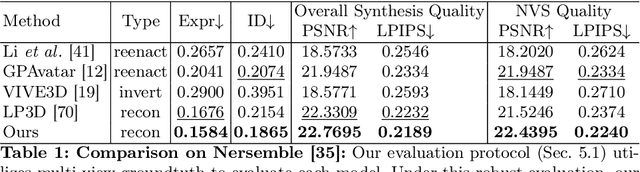
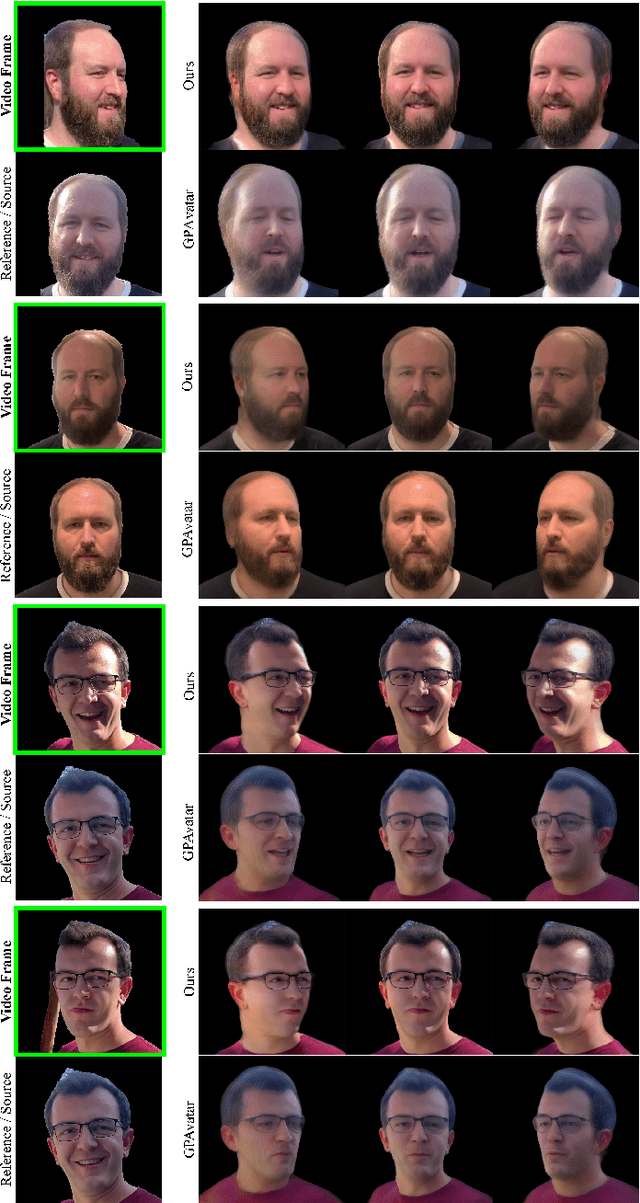
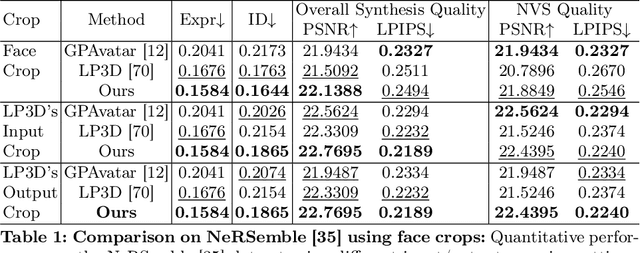
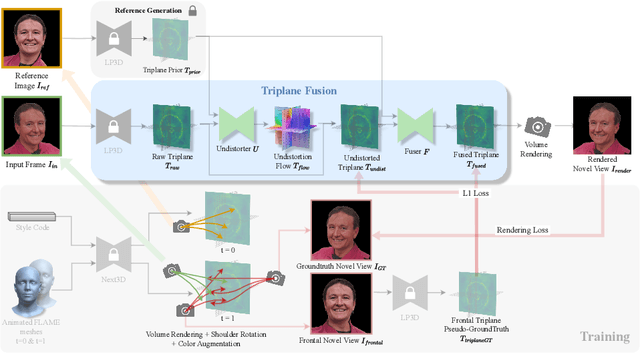
Recent breakthroughs in single-image 3D portrait reconstruction have enabled telepresence systems to stream 3D portrait videos from a single camera in real-time, democratizing telepresence. However, per-frame 3D reconstruction exhibits temporal inconsistency and forgets the user's appearance. On the other hand, self-reenactment methods can render coherent 3D portraits by driving a 3D avatar built from a single reference image, but fail to faithfully preserve the user's per-frame appearance (e.g., instantaneous facial expression and lighting). As a result, none of these two frameworks is an ideal solution for democratized 3D telepresence. In this work, we address this dilemma and propose a novel solution that maintains both coherent identity and dynamic per-frame appearance to enable the best possible realism. To this end, we propose a new fusion-based method that takes the best of both worlds by fusing a canonical 3D prior from a reference view with dynamic appearance from per-frame input views, producing temporally stable 3D videos with faithful reconstruction of the user's per-frame appearance. Trained only using synthetic data produced by an expression-conditioned 3D GAN, our encoder-based method achieves both state-of-the-art 3D reconstruction and temporal consistency on in-studio and in-the-wild datasets. https://research.nvidia.com/labs/amri/projects/coherent3d
BLADE: Single-view Body Mesh Learning through Accurate Depth Estimation
Dec 11, 2024
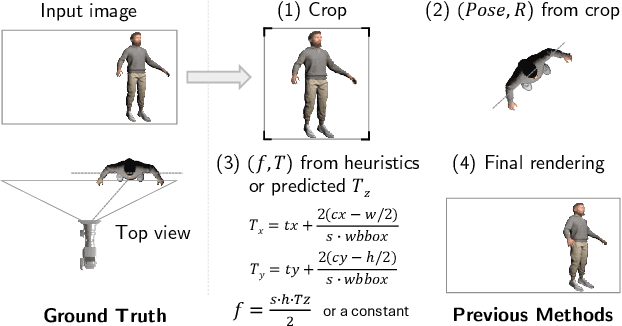


Single-image human mesh recovery is a challenging task due to the ill-posed nature of simultaneous body shape, pose, and camera estimation. Existing estimators work well on images taken from afar, but they break down as the person moves close to the camera. Moreover, current methods fail to achieve both accurate 3D pose and 2D alignment at the same time. Error is mainly introduced by inaccurate perspective projection heuristically derived from orthographic parameters. To resolve this long-standing challenge, we present our method BLADE which accurately recovers perspective parameters from a single image without heuristic assumptions. We start from the inverse relationship between perspective distortion and the person's Z-translation Tz, and we show that Tz can be reliably estimated from the image. We then discuss the important role of Tz for accurate human mesh recovery estimated from close-range images. Finally, we show that, once Tz and the 3D human mesh are estimated, one can accurately recover the focal length and full 3D translation. Extensive experiments on standard benchmarks and real-world close-range images show that our method is the first to accurately recover projection parameters from a single image, and consequently attain state-of-the-art accuracy on 3D pose estimation and 2D alignment for a wide range of images. https://research.nvidia.com/labs/amri/projects/blade/
Coherent 3D Portrait Video Reconstruction via Triplane Fusion
May 01, 2024Recent breakthroughs in single-image 3D portrait reconstruction have enabled telepresence systems to stream 3D portrait videos from a single camera in real-time, potentially democratizing telepresence. However, per-frame 3D reconstruction exhibits temporal inconsistency and forgets the user's appearance. On the other hand, self-reenactment methods can render coherent 3D portraits by driving a personalized 3D prior, but fail to faithfully reconstruct the user's per-frame appearance (e.g., facial expressions and lighting). In this work, we recognize the need to maintain both coherent identity and dynamic per-frame appearance to enable the best possible realism. To this end, we propose a new fusion-based method that fuses a personalized 3D subject prior with per-frame information, producing temporally stable 3D videos with faithful reconstruction of the user's per-frame appearances. Trained only using synthetic data produced by an expression-conditioned 3D GAN, our encoder-based method achieves both state-of-the-art 3D reconstruction accuracy and temporal consistency on in-studio and in-the-wild datasets.
Synthetic Image Verification in the Era of Generative AI: What Works and What Isn't There Yet
Apr 30, 2024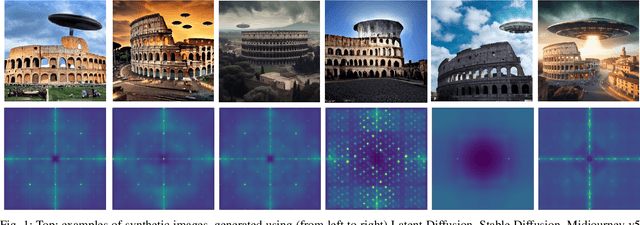
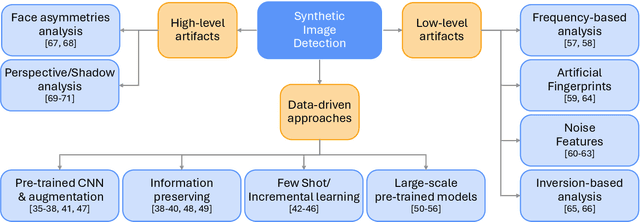
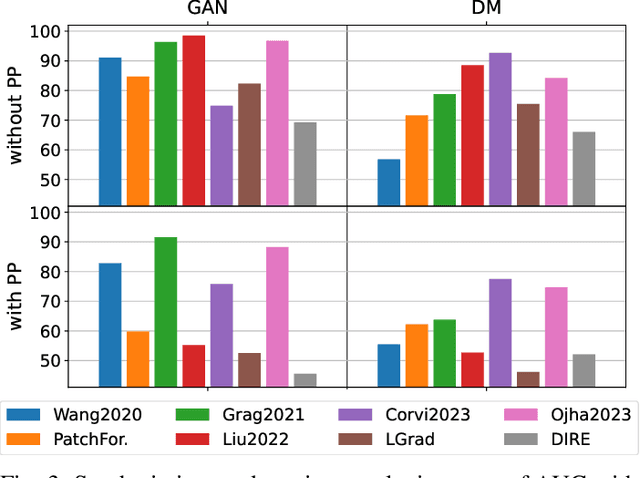
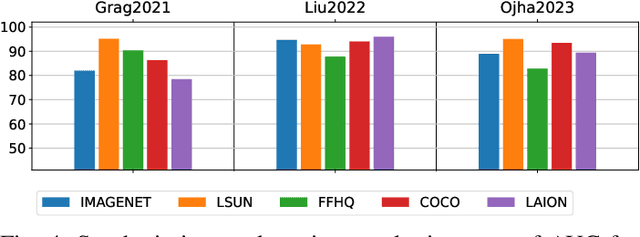
In this work we present an overview of approaches for the detection and attribution of synthetic images and highlight their strengths and weaknesses. We also point out and discuss hot topics in this field and outline promising directions for future research.
What You See is What You GAN: Rendering Every Pixel for High-Fidelity Geometry in 3D GANs
Jan 04, 2024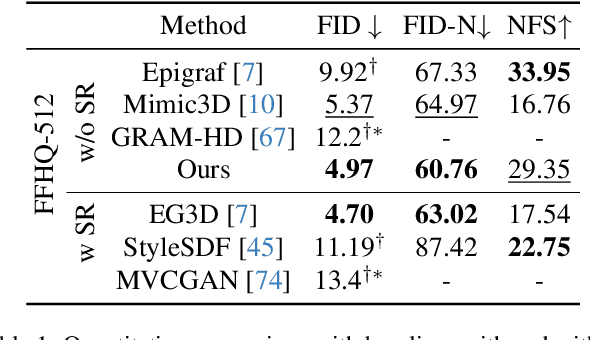

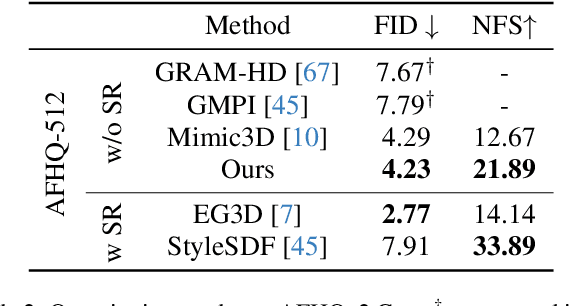

3D-aware Generative Adversarial Networks (GANs) have shown remarkable progress in learning to generate multi-view-consistent images and 3D geometries of scenes from collections of 2D images via neural volume rendering. Yet, the significant memory and computational costs of dense sampling in volume rendering have forced 3D GANs to adopt patch-based training or employ low-resolution rendering with post-processing 2D super resolution, which sacrifices multiview consistency and the quality of resolved geometry. Consequently, 3D GANs have not yet been able to fully resolve the rich 3D geometry present in 2D images. In this work, we propose techniques to scale neural volume rendering to the much higher resolution of native 2D images, thereby resolving fine-grained 3D geometry with unprecedented detail. Our approach employs learning-based samplers for accelerating neural rendering for 3D GAN training using up to 5 times fewer depth samples. This enables us to explicitly "render every pixel" of the full-resolution image during training and inference without post-processing superresolution in 2D. Together with our strategy to learn high-quality surface geometry, our method synthesizes high-resolution 3D geometry and strictly view-consistent images while maintaining image quality on par with baselines relying on post-processing super resolution. We demonstrate state-of-the-art 3D gemetric quality on FFHQ and AFHQ, setting a new standard for unsupervised learning of 3D shapes in 3D GANs.