 Add to Chrome
 Add to Firefox
 Add to Edge
NSF-HRPT: Neural Semantic Field meets Hierarchical Risk Perception Tree for Safety-Critical Scenario Assessment
Aug 05, 2026
The ability to accurately assess and anticipate risks in safety-critical scenarios is crucial for autonomous driving systems. While existing research has made progress in collision prediction, accurately quantifying risk levels from monocular vision inputs remains challenging due to the complex dynamics of multi-agent interactions and the inherent uncertainty in real-world environments. To address these challenges, we present NSF-HRPT, a novel framework that combines learning-based perception with structured reasoning for quantitative risk assessment. Our approach features a Neural Semantic Field (NSF) that learns to model scene semantics, trajectory predictions, and probabilistic Time-to-Collision (TTC) distributions from simulation data. During inference, the pre-trained NSF serves as a prior for our Hierarchical Risk Perception Tree (HRPT), which enables efficient parallel computation and spatial reasoning about multi-agent risks. Additionally, we introduce a Sim2Real enhancement strategy that improves real-world applicability without retraining by incorporating priors from foundation models. Extensive evaluations demonstrate that our framework achieves state-of-the-art performance on synthetic benchmarks and delivers competitive, near-state-of-the-art results on real-world datasets for both TTC estimation accuracy and risk localization precision. The proposed method provides an effective solution for real-time risk awareness from monocular camera inputs.

SMM Transformer: Leveraging Spiking Neural Networks for Multimodal Tasks
Aug 03, 2026Spiking Neural Networks (SNNs) enable event-driven computation with sparse activations, but building multimodal Transformers on SNNs is hindered by unstable training in deep spiking stacks and the mismatch between dense softmax attention and spike-based communication. We propose SMM Transformer, an SNN-based multimodal Transformer framework that combines (i)PLMP, a Parallel LIF with Multistage Learnable Parameters neuron and a tailored P-STBP algorithm for stable deep SNN training, (ii) SMSA, an attention-inspired spike-driven token-mixing module that replaces dense pairwise softmax attention with channel-wise spike co-activation and self-compensation, and (iii)SMoE, a spiking mixture-of-experts module for modality-aware fusion. Across visual and multimodal benchmarks, SMM Transformer achieves competitive accuracy compared to ANN baselines. Under a standard MAC/AC arithmetic model, SMSA reduces the estimated operator-level compute energy of the attention module by up to 97%, while whole-model profiling shows more moderate but consistent efficiency gains.
Spike-HTR: Spiking Neural Transformer for Handwritten Text Recognition
Aug 03, 2026Handwritten Text Recognition (HTR) is computationally imbalanced in two ways: most image pixels are background, and many width-axis sequence positions are blank-dominated. This creates a mismatch for Spiking Neural Networks (SNNs): handwriting is observed as a static image, whereas spiking computation unfolds over timesteps. We propose Spike-HTR, a hybrid spiking recognizer that controls both the number of spiking steps and the number of width positions processed by the deep sequence mixer. To make a static image suitable for short-horizon spiking inference, InkCoder converts it into a coarse-to-fine input stream, where early steps cover broad stroke regions and later steps emphasize sharper stroke details. To reduce sequence computation, a CTC-guided length reducer keeps likely character or uncertain positions and compresses long blank-dominated stretches before deep mixing. With $T{=}2$, Spike-HTR trains only on target data, decodes without language models or lexicons, and reaches validation/test CERs of 3.5/5.4, 2.3/2.5, and 4.2/3.9 on IAM, LAM, and READ2016. Codes are available at https://github.com/QomolangmaH/SpikeHTR.
NeighborDiv: Training-free Zero-shot Generalist Graph Anomaly Detection via Neighbor Diversity
May 20, 2026Graph Anomaly Detection (GAD) is increasingly shifting to Generalist GAD (GGAD) for cross-domain "one-for-all" detection, but existing GGAD methods predominantly rely on the neighbor consistency principle, falling into the \textbf{Node-to-Neighbor Consistency Paradigm} for anomaly quantification. These methods suffer from complex training pipelines, heavy training data dependency, high computational costs, and unstable cross-domain generalization. To address these limitations, we propose NeighborDiv, a training-free generalist graph anomaly detection framework based on neighbor diversity. Departing from the dominant Node-to-Neighbor Consistency Paradigm, we shift the focus to the \textbf{Neighbor-to-Neighbor Diversity Paradigm}, and uncover that the internal structural dispersion of a node's neighbor set is a powerful, independently discriminative anomaly signal. We quantify neighbor diversity via the variance of inter-neighbor feature similarities, which captures how a node organizes its local graph environment, and operates independently of conventional node-to-neighbor consistency frameworks. Extensive experiments under two standard GGAD evaluation paradigms show NeighborDiv achieves state-of-the-art performance, with relative gains of 10.25% in average AUC and 17.78% in average AP over the second-best baseline under Single-Domain Independent Training (SDIT), and 6.89%/9.58% in AUC/AP under Unified Multi-Domain Training (UMDT), respectively. Notably, NeighborDiv yields zero performance volatility across all datasets, eliminating training-set dependency and establishing a lightweight and highly practical GGAD framework.
Multi-Dimensional AGV Path Planning in 3D Warehouses Using Ant Colony Optimization and Advanced Neural Networks
Mar 30, 2025Within modern warehouse scenarios, the rapid expansion of e-commerce and increasingly complex, multi-level storage environments have exposed the limitations of traditional AGV (Automated Guided Vehicle) path planning methods--often reliant on static 2D models and expert-tuned heuristics that struggle to handle dynamic traffic and congestion. Addressing these limitations, this paper introduces a novel AGV path planning approach for 3D warehouse environments that leverages a hybrid framework combining ACO (Ant Colony Optimization) with deep learning models, called NAHACO (Neural Adaptive Heuristic Ant Colony Optimization). NAHACO integrates three key innovations: first, an innovative heuristic algorithm for 3D warehouse cargo modeling using multidimensional tensors, which addresses the challenge of achieving superior heuristic accuracy; second, integration of a congestion-aware loss function within the ACO framework to adjust path costs based on traffic and capacity constraints, called CARL (Congestion-Aware Reinforce Loss), enabling dynamic heuristic calibration for optimizing ACO-based path planning; and third, an adaptive attention mechanism that captures multi-scale spatial features, thereby addressing dynamic heuristic calibration for further optimization of ACO-based path planning and AGV navigation. NAHACO significantly boosts path planning efficiency, yielding faster computation times and superior performance over both vanilla and state-of-the-art methods, while automatically adapting to warehouse constraints for real-time optimization. NAHACO outperforms state-of-the-art methods, lowering the total cost by up to 24.7% on TSP benchmarks. In warehouse tests, NAHACO cuts cost by up to 41.5% and congestion by up to 56.1% compared to previous methods.
GUI Testing Arena: A Unified Benchmark for Advancing Autonomous GUI Testing Agent
Dec 24, 2024
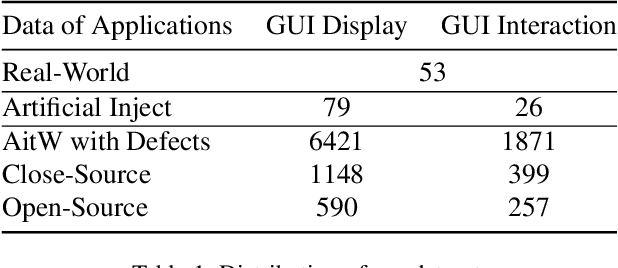
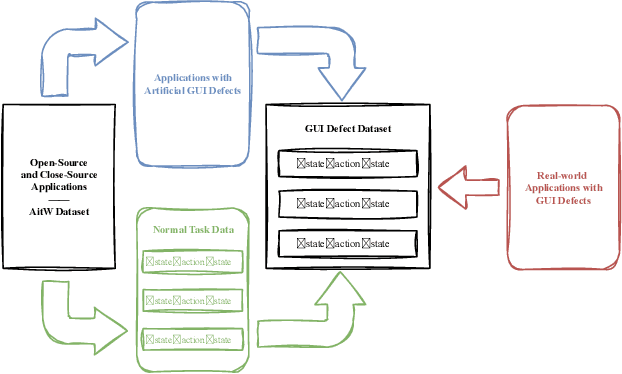

Nowadays, research on GUI agents is a hot topic in the AI community. However, current research focuses on GUI task automation, limiting the scope of applications in various GUI scenarios. In this paper, we propose a formalized and comprehensive environment to evaluate the entire process of automated GUI Testing (GTArena), offering a fair, standardized environment for consistent operation of diverse multimodal large language models. We divide the testing process into three key subtasks: test intention generation, test task execution, and GUI defect detection, and construct a benchmark dataset based on these to conduct a comprehensive evaluation. It evaluates the performance of different models using three data types: real mobile applications, mobile applications with artificially injected defects, and synthetic data, thoroughly assessing their capabilities in this relevant task. Additionally, we propose a method that helps researchers explore the correlation between the performance of multimodal language large models in specific scenarios and their general capabilities in standard benchmark tests. Experimental results indicate that even the most advanced models struggle to perform well across all sub-tasks of automated GUI Testing, highlighting a significant gap between the current capabilities of Autonomous GUI Testing and its practical, real-world applicability. This gap provides guidance for the future direction of GUI Agent development. Our code is available at https://github.com/ZJU-ACES-ISE/ChatUITest.
RTFormer: Re-parameter TSBN Spiking Transformer
Jun 20, 2024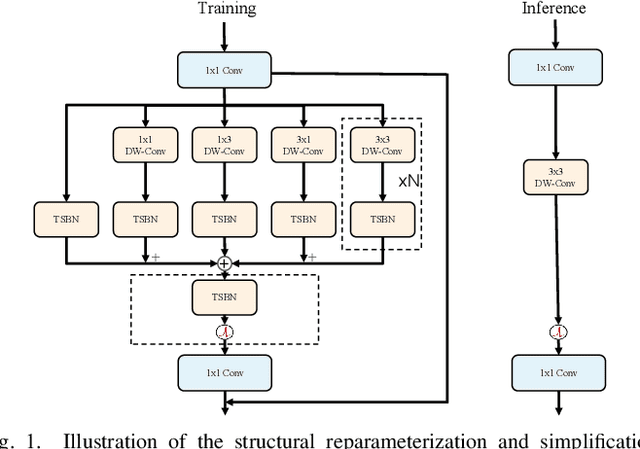
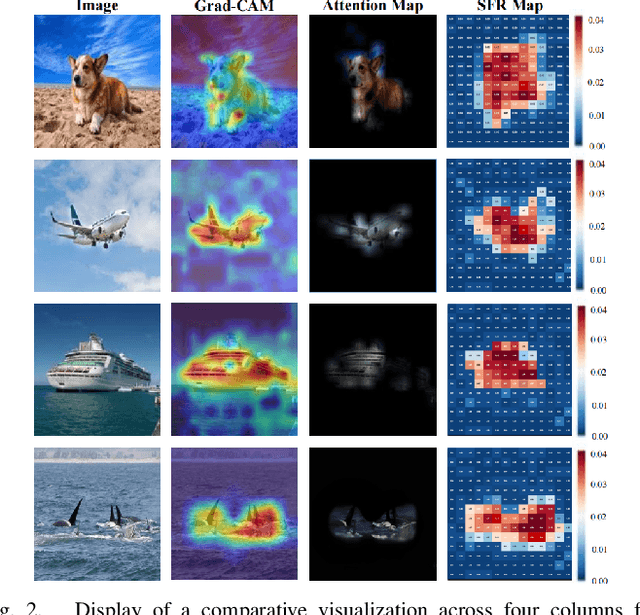
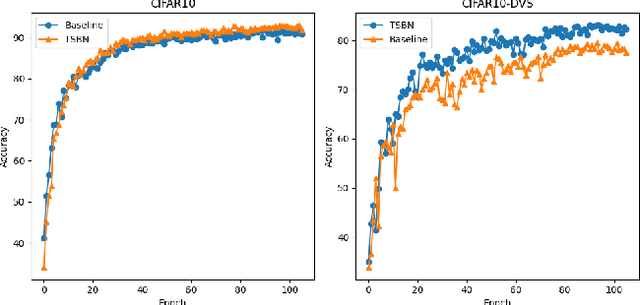
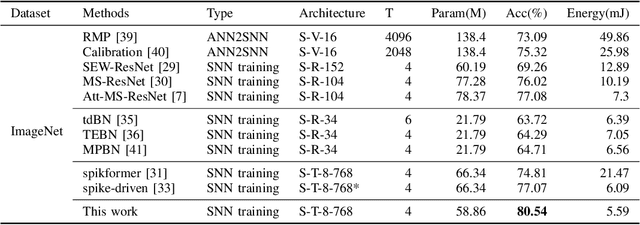
The Spiking Neural Networks (SNNs), renowned for their bio-inspired operational mechanism and energy efficiency, mirror the human brain's neural activity. Yet, SNNs face challenges in balancing energy efficiency with the computational demands of advanced tasks. Our research introduces the RTFormer, a novel architecture that embeds Re-parameterized Temporal Sliding Batch Normalization (TSBN) within the Spiking Transformer framework. This innovation optimizes energy usage during inference while ensuring robust computational performance. The crux of RTFormer lies in its integration of reparameterized convolutions and TSBN, achieving an equilibrium between computational prowess and energy conservation.