 Add to Chrome
 Add to Firefox
 Add to Edge
Unregistered Spectral Image Fusion: Unmixing, Adversarial Learning, and Recoverability
Mar 23, 2026
This paper addresses the fusion of a pair of spatially unregistered hyperspectral image (HSI) and multispectral image (MSI) covering roughly overlapping regions. HSIs offer high spectral but low spatial resolution, while MSIs provide the opposite. The goal is to integrate their complementary information to enhance both HSI spatial resolution and MSI spectral resolution. While hyperspectral-multispectral fusion (HMF) has been widely studied, the unregistered setting remains challenging. Many existing methods focus solely on MSI super-resolution, leaving HSI unchanged. Supervised deep learning approaches were proposed for HSI super-resolution, but rely on accurate training data, which is often unavailable. Moreover, theoretical analyses largely address the co-registered case, leaving unregistered HMF poorly understood. In this work, an unsupervised framework is proposed to simultaneously super-resolve both MSI and HSI. The method integrates coupled spectral unmixing for MSI super-resolution with latent-space adversarial learning for HSI super-resolution. Theoretical guarantees on the recoverability of the super-resolution MSI and HSI are established under reasonable generative models -- providing, to our best knowledge, the first such insights for unregistered HMF. The approach is validated on semi-real and real HSI-MSI pairs across diverse conditions.

GUI Testing Arena: A Unified Benchmark for Advancing Autonomous GUI Testing Agent
Dec 24, 2024
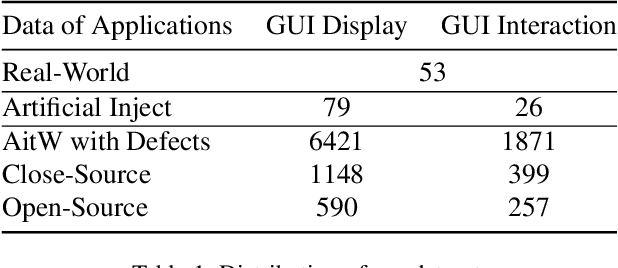
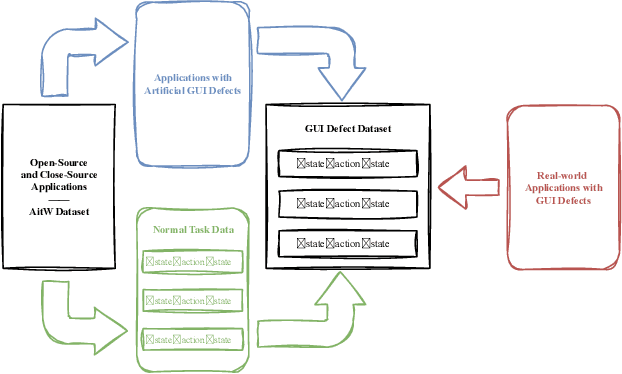

Nowadays, research on GUI agents is a hot topic in the AI community. However, current research focuses on GUI task automation, limiting the scope of applications in various GUI scenarios. In this paper, we propose a formalized and comprehensive environment to evaluate the entire process of automated GUI Testing (GTArena), offering a fair, standardized environment for consistent operation of diverse multimodal large language models. We divide the testing process into three key subtasks: test intention generation, test task execution, and GUI defect detection, and construct a benchmark dataset based on these to conduct a comprehensive evaluation. It evaluates the performance of different models using three data types: real mobile applications, mobile applications with artificially injected defects, and synthetic data, thoroughly assessing their capabilities in this relevant task. Additionally, we propose a method that helps researchers explore the correlation between the performance of multimodal language large models in specific scenarios and their general capabilities in standard benchmark tests. Experimental results indicate that even the most advanced models struggle to perform well across all sub-tasks of automated GUI Testing, highlighting a significant gap between the current capabilities of Autonomous GUI Testing and its practical, real-world applicability. This gap provides guidance for the future direction of GUI Agent development. Our code is available at https://github.com/ZJU-ACES-ISE/ChatUITest.