 Add to Chrome
 Add to Firefox
 Add to Edge
3D Smoke Scene Reconstruction Guided by Vision Priors from Multimodal Large Language Models
Apr 07, 2026
Reconstructing 3D scenes from smoke-degraded multi-view images is particularly difficult because smoke introduces strong scattering effects, view-dependent appearance changes, and severe degradation of cross-view consistency. To address these issues, we propose a framework that integrates visual priors with efficient 3D scene modeling. We employ Nano-Banana-Pro to enhance smoke-degraded images and provide clearer visual observations for reconstruction and develop Smoke-GS, a medium-aware 3D Gaussian Splatting framework for smoke scene reconstruction and restoration-oriented novel view synthesis. Smoke-GS models the scene using explicit 3D Gaussians and introduces a lightweight view-dependent medium branch to capture direction-dependent appearance variations caused by smoke. Our method preserves the rendering efficiency of 3D Gaussian Splatting while improving robustness to smoke-induced degradation. Results demonstrate the effectiveness of our method for generating consistent and visually clear novel views in challenging smoke environments.

NTIRE 2026 3D Restoration and Reconstruction in Real-world Adverse Conditions: RealX3D Challenge Results
Apr 05, 2026This paper presents a comprehensive review of the NTIRE 2026 3D Restoration and Reconstruction (3DRR) Challenge, detailing the proposed methods and results. The challenge seeks to identify robust reconstruction pipelines that are robust under real-world adverse conditions, specifically extreme low-light and smoke-degraded environments, as captured by our RealX3D benchmark. A total of 279 participants registered for the competition, of whom 33 teams submitted valid results. We thoroughly evaluate the submitted approaches against state-of-the-art baselines, revealing significant progress in 3D reconstruction under adverse conditions. Our analysis highlights shared design principles among top-performing methods and provides insights into effective strategies for handling 3D scene degradation.
Multimodal Protein Language Models for Enzyme Kinetic Parameters: From Substrate Recognition to Conformational Adaptation
Mar 13, 2026Predicting enzyme kinetic parameters quantifies how efficiently an enzyme catalyzes a specific substrate under defined biochemical conditions. Canonical parameters such as the turnover number ($k_\text{cat}$), Michaelis constant ($K_\text{m}$), and inhibition constant ($K_\text{i}$) depend jointly on the enzyme sequence, the substrate chemistry, and the conformational adaptation of the active site during binding. Many learning pipelines simplify this process to a static compatibility problem between the enzyme and substrate, fusing their representations through shallow operations and regressing a single value. Such formulations overlook the staged nature of catalysis, which involves both substrate recognition and conformational adaptation. In this regard, we reformulate kinetic prediction as a staged multimodal conditional modeling problem and introduce the Enzyme-Reaction Bridging Adapter (ERBA), which injects cross-modal information via fine-tuning into Protein Language Models (PLMs) while preserving their biochemical priors. ERBA performs conditioning in two stages: Molecular Recognition Cross-Attention (MRCA) first injects substrate information into the enzyme representation to capture specificity; Geometry-aware Mixture-of-Experts (G-MoE) then integrates active-site structure and routes samples to pocket-specialized experts to reflect induced fit. To maintain semantic fidelity, Enzyme-Substrate Distribution Alignment (ESDA) enforces distributional consistency within the PLM manifold in a reproducing kernel Hilbert space. Experiments across three kinetic endpoints and multiple PLM backbones, ERBA delivers consistent gains and stronger out-of-distribution performance compared with sequence-only and shallow-fusion baselines, offering a biologically grounded route to scalable kinetic prediction and a foundation for adding cofactors, mutations, and time-resolved structural cues.
Detecting Comma-shaped Clouds for Severe Weather Forecasting using Shape and Motion
Jun 06, 2018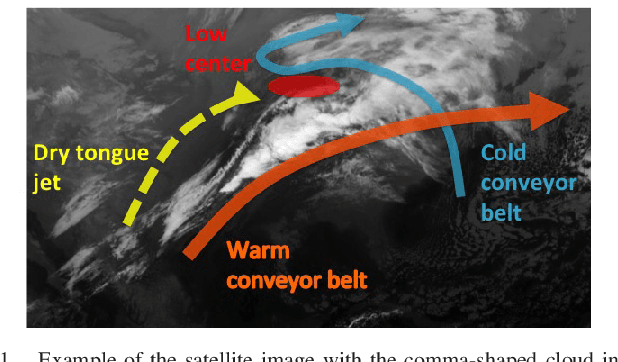
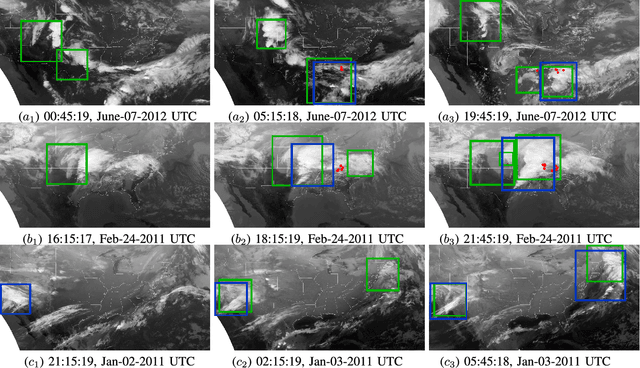
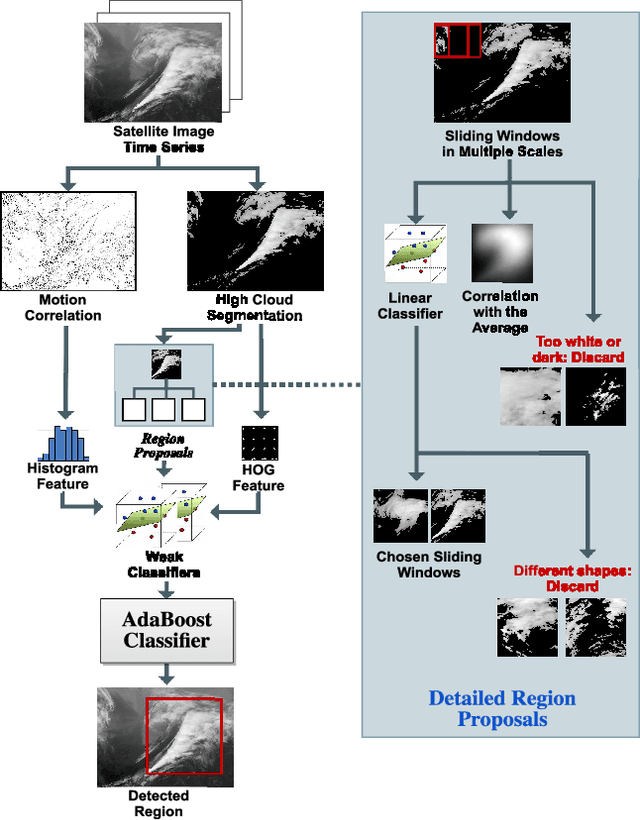
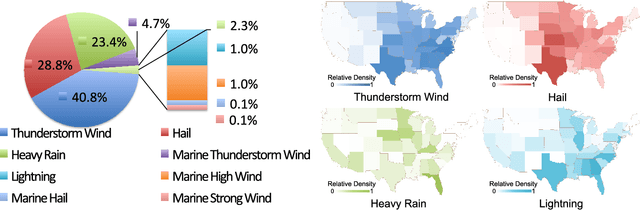
Meteorologists use shapes and movements of clouds in satellite images as indicators of several major types of severe storms. Satellite imaginary data are in increasingly higher resolution, both spatially and temporally, making it impossible for humans to fully leverage the data in their forecast. Automatic satellite imagery analysis methods that can find storm-related cloud patterns as soon as they are detectable are in demand. We propose a machine learning and pattern recognition based approach to detect "comma-shaped" clouds in satellite images, which are specific cloud distribution patterns strongly associated with the cyclone formulation. In order to detect regions with the targeted movement patterns, our method is trained on manually annotated cloud examples represented by both shape and motion-sensitive features. Sliding windows in different scales are used to ensure that dense clouds will be captured, and we implement effective selection rules to shrink the region of interest among these sliding windows. Finally, we evaluate the method on a hold-out annotated comma-shaped cloud dataset and cross-match the results with recorded storm events in the severe weather database. The validated utility and accuracy of our method suggest a high potential for assisting meteorologists in weather forecasting.