 Add to Chrome
 Add to Firefox
 Add to Edge
TextGaze: Prompting Gaze Target Estimation with Textual Scene Cues
Jul 11, 2026
Gaze target estimation aims to infer the position of a person's gaze within a scene. Within mainstream design logic, multi-branch methods require extra supervision and annotations, while streamlined designs prioritize low-level visual saliency over true gaze intent. The former leads to a high annotation burden and hinders domain transfer, whereas the latter causes misalignment between predicted attention and actual gaze targets. To address this issue, we propose TextGaze, a unified cross-modal architecture that leverages a Large Vision-Language Model (LVLM) as scalable semantic guidance to balance the two design paradigms. The model extracts visual features from a frozen encoder and utilizes an LVLM to obtain gaze-aligned textual cues. We design a transformer-based fusion module with hierarchical text supervision to preserve task semantics. Lightweight decoding heads enable the joint prediction of gaze heatmaps and in-/out-of-frame status. We evaluate our method on four mainstream datasets, and the results show competitive performance across key metrics with robust cross-dataset generalisation without extra fine-tuning. Overall, we provide a streamlined alternative to traditional designs and highlight the potential of LVLMs as accessible auxiliary guidance for gaze estimation.

3D Smoke Scene Reconstruction Guided by Vision Priors from Multimodal Large Language Models
Apr 07, 2026Reconstructing 3D scenes from smoke-degraded multi-view images is particularly difficult because smoke introduces strong scattering effects, view-dependent appearance changes, and severe degradation of cross-view consistency. To address these issues, we propose a framework that integrates visual priors with efficient 3D scene modeling. We employ Nano-Banana-Pro to enhance smoke-degraded images and provide clearer visual observations for reconstruction and develop Smoke-GS, a medium-aware 3D Gaussian Splatting framework for smoke scene reconstruction and restoration-oriented novel view synthesis. Smoke-GS models the scene using explicit 3D Gaussians and introduces a lightweight view-dependent medium branch to capture direction-dependent appearance variations caused by smoke. Our method preserves the rendering efficiency of 3D Gaussian Splatting while improving robustness to smoke-induced degradation. Results demonstrate the effectiveness of our method for generating consistent and visually clear novel views in challenging smoke environments.
Evidence Packing for Cross-Domain Image Deepfake Detection with LVLMs
Mar 18, 2026Image Deepfake Detection (IDD) separates manipulated images from authentic ones by spotting artifacts of synthesis or tampering. Although large vision-language models (LVLMs) offer strong image understanding, adapting them to IDD often demands costly fine-tuning and generalizes poorly to diverse, evolving manipulations. We propose the Semantic Consistent Evidence Pack (SCEP), a training-free LVLM framework that replaces whole-image inference with evidence-driven reasoning. SCEP mines a compact set of suspicious patch tokens that best reveal manipulation cues. It uses the vision encoder's CLS token as a global reference, clusters patch features into coherent groups, and scores patches with a fused metric combining CLS-guided semantic mismatch with frequency-and noise-based anomalies. To cover dispersed traces and avoid redundancy, SCEP samples a few high-confidence patches per cluster and applies grid-based NMS, producing an evidence pack that conditions a frozen LVLM for prediction. Experiments on diverse benchmarks show SCEP outperforms strong baselines without LVLM fine-tuning.
MER-Bench: A Comprehensive Benchmark for Multimodal Meme Reappraisal
Mar 16, 2026Memes represent a tightly coupled, multimodal form of social expression, in which visual context and overlaid text jointly convey nuanced affect and commentary. Inspired by cognitive reappraisal in psychology, we introduce Meme Reappraisal, a novel multimodal generation task that aims to transform negatively framed memes into constructive ones while preserving their underlying scenario, entities, and structural layout. Unlike prior works on meme understanding or generation, Meme Reappraisal requires emotion-controllable, structure-preserving multimodal transformation under multiple semantic and stylistic constraints. To support this task, we construct MER-Bench, a benchmark of real-world memes with fine-grained multimodal annotations, including source and target emotions, positively rewritten meme text, visual editing specifications, and taxonomy labels covering visual type, sentiment polarity, and layout structure. We further propose a structured evaluation framework based on a multimodal large language model (MLLM)-as-a-Judge paradigm, decomposing performance into modality-level generation quality, affect controllability, structural fidelity, and global affective alignment. Extensive experiments across representative image-editing and multimodal-generation systems reveal substantial gaps in satisfying the constraints of structural preservation, semantic consistency, and affective transformation. We believe MER-Bench establishes a foundation for research on controllable meme editing and emotion-aware multimodal generation. Our code is available at: https://github.com/one-seven17/MER-Bench.
DELTA: Deliberative Multi-Agent Reasoning with Reinforcement Learning for Multimodal Psychological Counseling
Feb 04, 2026Psychological counseling is a fundamentally multimodal cognitive process in which clinicians integrate verbal content with visual and vocal cues to infer clients' mental states and respond empathically. However, most existing language-model-based counseling systems operate on text alone and rely on implicit mental state inference. We introduce DELTA, a deliberative multi-agent framework that models counseling as a structured reasoning process over multimodal signals, separating evidence grounding, mental state abstraction, and response generation. DELTA further incorporates reinforcement learning guided by a distribution-level Emotion Attunement Score to encourage emotionally attuned responses. Experiments on a multimodal counseling benchmark show that DELTA improves both counseling quality and emotion attunement across models. Ablation and qualitative analyses suggest that explicit multimodal reasoning and structured mental state representations play complementary roles in supporting empathic human-AI interaction.
Exploiting Ensemble Learning for Cross-View Isolated Sign Language Recognition
Feb 04, 2025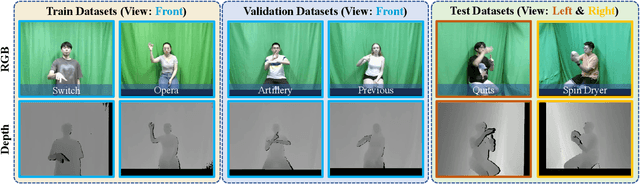
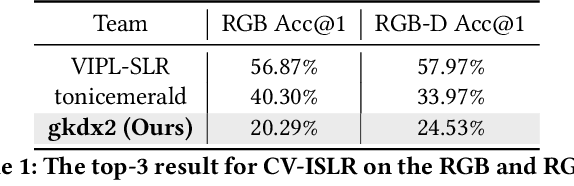
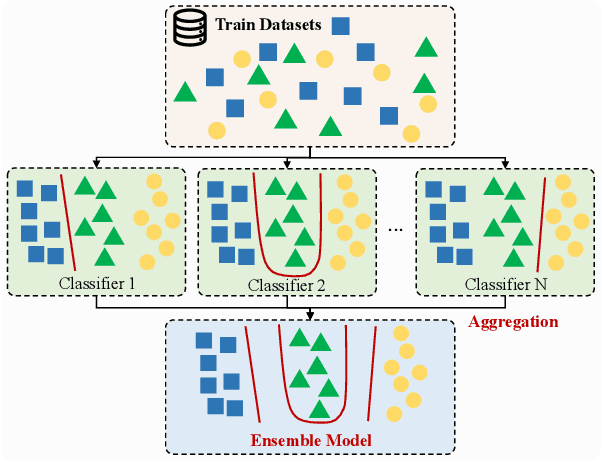
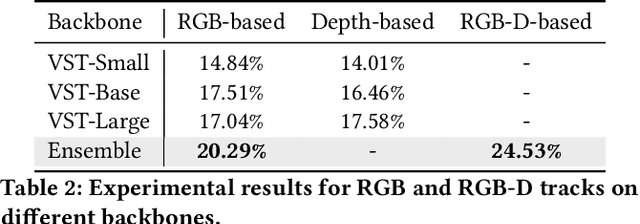
In this paper, we present our solution to the Cross-View Isolated Sign Language Recognition (CV-ISLR) challenge held at WWW 2025. CV-ISLR addresses a critical issue in traditional Isolated Sign Language Recognition (ISLR), where existing datasets predominantly capture sign language videos from a frontal perspective, while real-world camera angles often vary. To accurately recognize sign language from different viewpoints, models must be capable of understanding gestures from multiple angles, making cross-view recognition challenging. To address this, we explore the advantages of ensemble learning, which enhances model robustness and generalization across diverse views. Our approach, built on a multi-dimensional Video Swin Transformer model, leverages this ensemble strategy to achieve competitive performance. Finally, our solution ranked 3rd in both the RGB-based ISLR and RGB-D-based ISLR tracks, demonstrating the effectiveness in handling the challenges of cross-view recognition. The code is available at: https://github.com/Jiafei127/CV_ISLR_WWW2025.