 Add to Chrome
 Add to Firefox
 Add to Edge
HumanTracker: Towards Comprehensive and Human-Aligned Motion Tracking Benchmark
Aug 13, 2026
Humanoid motion tracking is central to teleoperation and whole-body imitation, yet evaluation often disagrees with what people perceive in videos. Kinematic errors average per-frame pose differences but miss the physical artifacts that matter most, particularly unstable support and incorrect contacts such as foot skating and mistimed touch-downs. Meanwhile, widely used test suites are small and lack the diversity needed to stress contact-rich, long-horizon behaviors. We introduce HumanTracker to make humanoid tracking evaluation both perceptually aligned and scalable. The HumanTracker benchmark contains approximately 153 hours of optical motion trajectories from multiple professional performers, organized into four motion families with text labels for fine-grained diagnosis. We further propose HumanScore, a preference-aligned metric trained on 12K motion pairs containing 24K motions. Across representative state-of-the-art trackers, HumanScore better predicts human preferences and reveals contact and stability failures that kinematic metrics often miss.

DA-Nav: Direction-Aware City-Scale Vision-Language Navigation
Jul 14, 2026City-scale outdoor navigation is currently hindered by the heavy reliance on dense maps or costly navigation supervision. In this work, we introduce a novel paradigm for leveraging directional instructions from commercial navigation tools (e.g., Google Maps). To bridge the gap between commercial instructions and executable navigation actions, while mitigating long-horizon error accumulation through robust trajectory recovery, we propose DA-Nav, a Direction-Aware vision-language Navigation framework that reformulates navigation as a discrete spatial grounding problem on the egocentric 2D image plane. To achieve trajectory recovery, DA-Nav employs a Chain-of-Thought (CoT) reasoning process encompassing deviation assessment, action prediction, and target grid selection. We further introduce ReDA, a dataset that provides direction-aware instructions and recovery trajectories to enhance spatial grounding and support CoT recovery reasoning. Extensive experiments in CARLA demonstrate that DA-Nav achieves a high success rate of 56.16% in unseen urban environments, outperforming existing State-of-The-Art (SoTA) methods while maintaining a substantially stronger recovery capability. Furthermore, without fine-tuning, DA-Nav seamlessly adapts to both quadruped and humanoid robots, enabling stable kilometer-scale closed-loop outdoor navigation in complex real world environments.
LIMMT: Less is More for Motion Tracking
Jun 05, 2026We argue that high-quality motion data can steer tracking policies toward better optimization trajectories early in training. In this work, we introduce LIMMT (Less Is More for Motion Tracking). To our knowledge, this is the first data-centric study for physics-based humanoid motion tracking. We go beyond simply removing low-quality and erroneous clips, but define motion data quality through three dimensions: physics feasibility, diversity, and complexity. We show that even training with under 3% of AMASS yields better tracking performance than training with the full dataset. We further conduct data cleaning on the estimated web-sourced mocap data. Extensive experiments and analyses validate the effectiveness of our framework.
Humanoid-GPT: Scaling Data and Structure for Zero-Shot Motion Tracking
Jun 02, 2026We introduce Humanoid-GPT, a GPT-style Transformer with causal attention trained on a billion-scale motion corpus for whole-body control. Unlike prior shallow MLP trackers constrained by scarce data and an agility-generalization trade-off, Humanoid-GPT is pre-trained on a 2B-frame retargeted corpus that unifies all major mocap datasets with large-scale in-house recordings. Scaling both data and model capacity yields a single generative Transformer that tracks highly dynamic behaviors while achieving unprecedented zero-shot generalization to unseen motions and control tasks. Extensive experiments and scaling analyses show that our model establishes a new performance frontier, demonstrating robust zero-shot generalization to unseen tasks while simultaneously tracking highly dynamic and complex motions.
DexVLG: Dexterous Vision-Language-Grasp Model at Scale
Jul 03, 2025As large models gain traction, vision-language-action (VLA) systems are enabling robots to tackle increasingly complex tasks. However, limited by the difficulty of data collection, progress has mainly focused on controlling simple gripper end-effectors. There is little research on functional grasping with large models for human-like dexterous hands. In this paper, we introduce DexVLG, a large Vision-Language-Grasp model for Dexterous grasp pose prediction aligned with language instructions using single-view RGBD input. To accomplish this, we generate a dataset of 170 million dexterous grasp poses mapped to semantic parts across 174,000 objects in simulation, paired with detailed part-level captions. This large-scale dataset, named DexGraspNet 3.0, is used to train a VLM and flow-matching-based pose head capable of producing instruction-aligned grasp poses for tabletop objects. To assess DexVLG's performance, we create benchmarks in physics-based simulations and conduct real-world experiments. Extensive testing demonstrates DexVLG's strong zero-shot generalization capabilities-achieving over 76% zero-shot execution success rate and state-of-the-art part-grasp accuracy in simulation-and successful part-aligned grasps on physical objects in real-world scenarios.
Multi-Teacher Knowledge Distillation with Reinforcement Learning for Visual Recognition
Feb 22, 2025Multi-teacher Knowledge Distillation (KD) transfers diverse knowledge from a teacher pool to a student network. The core problem of multi-teacher KD is how to balance distillation strengths among various teachers. Most existing methods often develop weighting strategies from an individual perspective of teacher performance or teacher-student gaps, lacking comprehensive information for guidance. This paper proposes Multi-Teacher Knowledge Distillation with Reinforcement Learning (MTKD-RL) to optimize multi-teacher weights. In this framework, we construct both teacher performance and teacher-student gaps as state information to an agent. The agent outputs the teacher weight and can be updated by the return reward from the student. MTKD-RL reinforces the interaction between the student and teacher using an agent in an RL-based decision mechanism, achieving better matching capability with more meaningful weights. Experimental results on visual recognition tasks, including image classification, object detection, and semantic segmentation tasks, demonstrate that MTKD-RL achieves state-of-the-art performance compared to the existing multi-teacher KD works.
SoFar: Language-Grounded Orientation Bridges Spatial Reasoning and Object Manipulation
Feb 18, 2025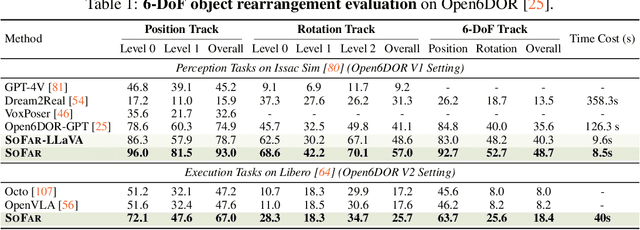

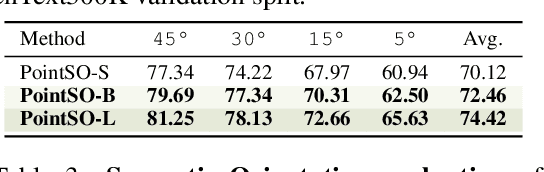
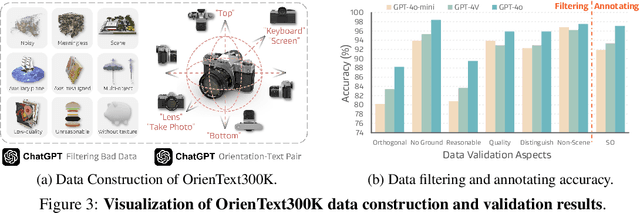
Spatial intelligence is a critical component of embodied AI, promoting robots to understand and interact with their environments. While recent advances have enhanced the ability of VLMs to perceive object locations and positional relationships, they still lack the capability to precisely understand object orientations-a key requirement for tasks involving fine-grained manipulations. Addressing this limitation not only requires geometric reasoning but also an expressive and intuitive way to represent orientation. In this context, we propose that natural language offers a more flexible representation space than canonical frames, making it particularly suitable for instruction-following robotic systems. In this paper, we introduce the concept of semantic orientation, which defines object orientations using natural language in a reference-frame-free manner (e.g., the ''plug-in'' direction of a USB or the ''handle'' direction of a knife). To support this, we construct OrienText300K, a large-scale dataset of 3D models annotated with semantic orientations that link geometric understanding to functional semantics. By integrating semantic orientation into a VLM system, we enable robots to generate manipulation actions with both positional and orientational constraints. Extensive experiments in simulation and real world demonstrate that our approach significantly enhances robotic manipulation capabilities, e.g., 48.7% accuracy on Open6DOR and 74.9% accuracy on SIMPLER.
DexGraspNet 2.0: Learning Generative Dexterous Grasping in Large-scale Synthetic Cluttered Scenes
Oct 30, 2024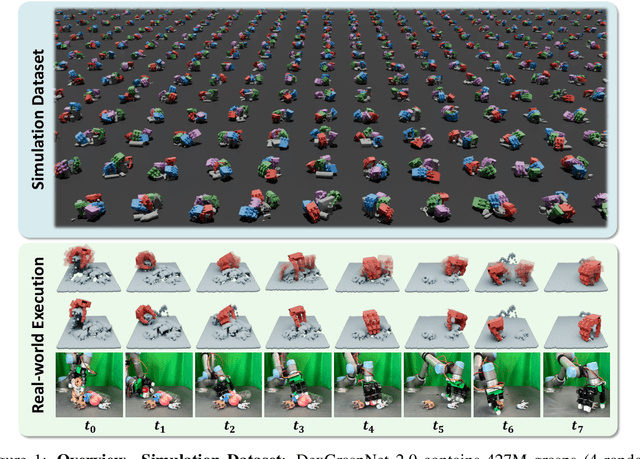
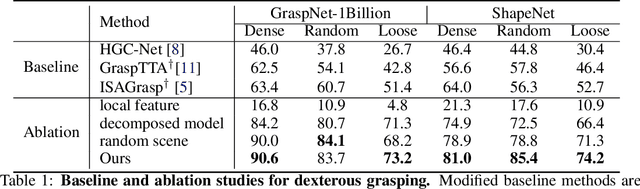

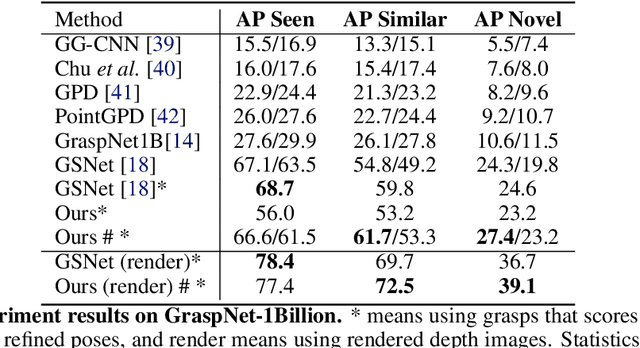
Grasping in cluttered scenes remains highly challenging for dexterous hands due to the scarcity of data. To address this problem, we present a large-scale synthetic benchmark, encompassing 1319 objects, 8270 scenes, and 427 million grasps. Beyond benchmarking, we also propose a novel two-stage grasping method that learns efficiently from data by using a diffusion model that conditions on local geometry. Our proposed generative method outperforms all baselines in simulation experiments. Furthermore, with the aid of test-time-depth restoration, our method demonstrates zero-shot sim-to-real transfer, attaining 90.7% real-world dexterous grasping success rate in cluttered scenes.
Online Policy Distillation with Decision-Attention
Jun 08, 2024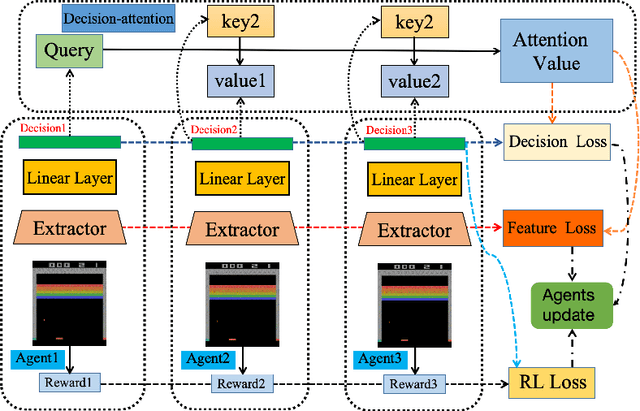
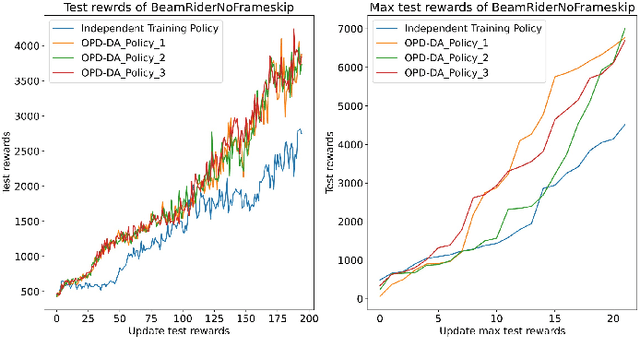
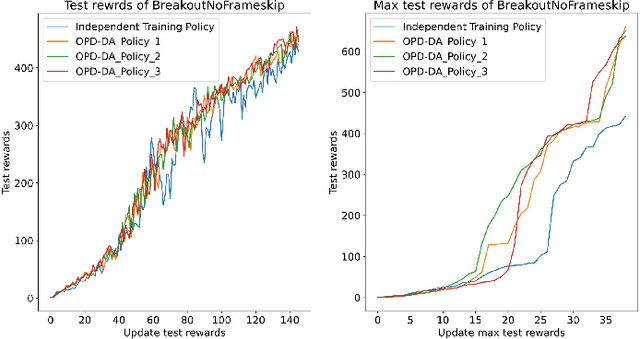
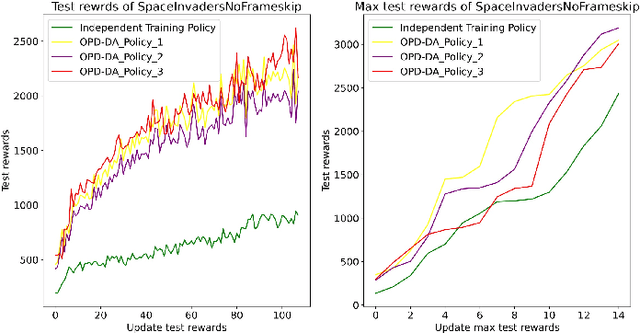
Policy Distillation (PD) has become an effective method to improve deep reinforcement learning tasks. The core idea of PD is to distill policy knowledge from a teacher agent to a student agent. However, the teacher-student framework requires a well-trained teacher model which is computationally expensive.In the light of online knowledge distillation, we study the knowledge transfer between different policies that can learn diverse knowledge from the same environment.In this work, we propose Online Policy Distillation (OPD) with Decision-Attention (DA), an online learning framework in which different policies operate in the same environment to learn different perspectives of the environment and transfer knowledge to each other to obtain better performance together. With the absence of a well-performance teacher policy, the group-derived targets play a key role in transferring group knowledge to each student policy. However, naive aggregation functions tend to cause student policies quickly homogenize. To address the challenge, we introduce the Decision-Attention module to the online policies distillation framework. The Decision-Attention module can generate a distinct set of weights for each policy to measure the importance of group members. We use the Atari platform for experiments with various reinforcement learning algorithms, including PPO and DQN. In different tasks, our method can perform better than an independent training policy on both PPO and DQN algorithms. This suggests that our OPD-DA can transfer knowledge between different policies well and help agents obtain more rewards.
Exemplar-Free Class Incremental Learning via Incremental Representation
Mar 24, 2024


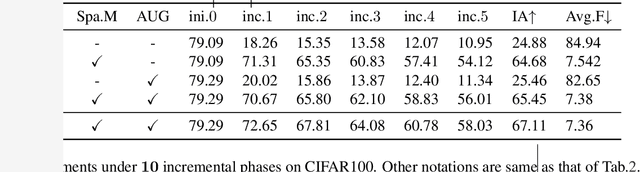
Exemplar-Free Class Incremental Learning (efCIL) aims to continuously incorporate the knowledge from new classes while retaining previously learned information, without storing any old-class exemplars (i.e., samples). For this purpose, various efCIL methods have been proposed over the past few years, generally with elaborately constructed old pseudo-features, increasing the difficulty of model development and interpretation. In contrast, we propose a \textbf{simple Incremental Representation (IR) framework} for efCIL without constructing old pseudo-features. IR utilizes dataset augmentation to cover a suitable feature space and prevents the model from forgetting by using a single L2 space maintenance loss. We discard the transient classifier trained on each one of the sequence tasks and instead replace it with a 1-near-neighbor classifier for inference, ensuring the representation is incrementally updated during CIL. Extensive experiments demonstrate that our proposed IR achieves comparable performance while significantly preventing the model from forgetting on CIFAR100, TinyImageNet, and ImageNetSubset datasets.