 Add to Chrome
 Add to Firefox
 Add to Edge
One Step Diffusion-based Super-Resolution with Time-Aware Distillation
Aug 14, 2024
Diffusion-based image super-resolution (SR) methods have shown promise in reconstructing high-resolution images with fine details from low-resolution counterparts. However, these approaches typically require tens or even hundreds of iterative samplings, resulting in significant latency. Recently, techniques have been devised to enhance the sampling efficiency of diffusion-based SR models via knowledge distillation. Nonetheless, when aligning the knowledge of student and teacher models, these solutions either solely rely on pixel-level loss constraints or neglect the fact that diffusion models prioritize varying levels of information at different time steps. To accomplish effective and efficient image super-resolution, we propose a time-aware diffusion distillation method, named TAD-SR. Specifically, we introduce a novel score distillation strategy to align the data distribution between the outputs of the student and teacher models after minor noise perturbation. This distillation strategy enables the student network to concentrate more on the high-frequency details. Furthermore, to mitigate performance limitations stemming from distillation, we integrate a latent adversarial loss and devise a time-aware discriminator that leverages diffusion priors to effectively distinguish between real images and generated images. Extensive experiments conducted on synthetic and real-world datasets demonstrate that the proposed method achieves comparable or even superior performance compared to both previous state-of-the-art (SOTA) methods and the teacher model in just one sampling step. Codes are available at https://github.com/LearningHx/TAD-SR.

Neural Architecture Search based Global-local Vision Mamba for Palm-Vein Recognition
Aug 13, 2024
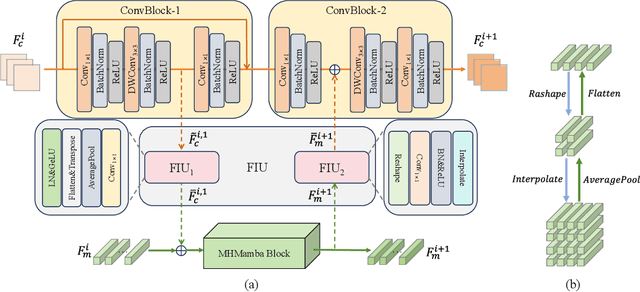
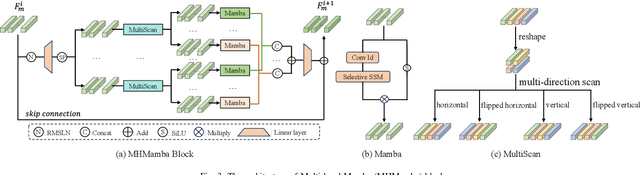

Due to the advantages such as high security, high privacy, and liveness recognition, vein recognition has been received more and more attention in past years. Recently, deep learning models, e.g., Mamba has shown robust feature representation with linear computational complexity and successfully applied for visual tasks. However, vision Manba can capture long-distance feature dependencies but unfortunately deteriorate local feature details. Besides, manually designing a Mamba architecture based on human priori knowledge is very time-consuming and error-prone. In this paper, first, we propose a hybrid network structure named Global-local Vision Mamba (GLVM), to learn the local correlations in images explicitly and global dependencies among tokens for vein feature representation. Secondly, we design a Multi-head Mamba to learn the dependencies along different directions, so as to improve the feature representation ability of vision Mamba. Thirdly, to learn the complementary features, we propose a ConvMamba block consisting of three branches, named Multi-head Mamba branch (MHMamba), Feature Iteration Unit branch (FIU), and Convolutional Neural Network (CNN) branch, where the Feature Iteration Unit branch aims to fuse convolutional local features with Mamba-based global representations. Finally, a Globallocal Alternate Neural Architecture Search (GLNAS) method is proposed to search the optimal architecture of GLVM alternately with the evolutionary algorithm, thereby improving the recognition performance for vein recognition tasks. We conduct rigorous experiments on three public palm-vein databases to estimate the performance. The experimental results demonstrate that the proposed method outperforms the representative approaches and achieves state-of-the-art recognition accuracy.
The Llama 3 Herd of Models
Jul 31, 2024Modern artificial intelligence (AI) systems are powered by foundation models. This paper presents a new set of foundation models, called Llama 3. It is a herd of language models that natively support multilinguality, coding, reasoning, and tool usage. Our largest model is a dense Transformer with 405B parameters and a context window of up to 128K tokens. This paper presents an extensive empirical evaluation of Llama 3. We find that Llama 3 delivers comparable quality to leading language models such as GPT-4 on a plethora of tasks. We publicly release Llama 3, including pre-trained and post-trained versions of the 405B parameter language model and our Llama Guard 3 model for input and output safety. The paper also presents the results of experiments in which we integrate image, video, and speech capabilities into Llama 3 via a compositional approach. We observe this approach performs competitively with the state-of-the-art on image, video, and speech recognition tasks. The resulting models are not yet being broadly released as they are still under development.
Thinking Racial Bias in Fair Forgery Detection: Models, Datasets and Evaluations
Jul 19, 2024
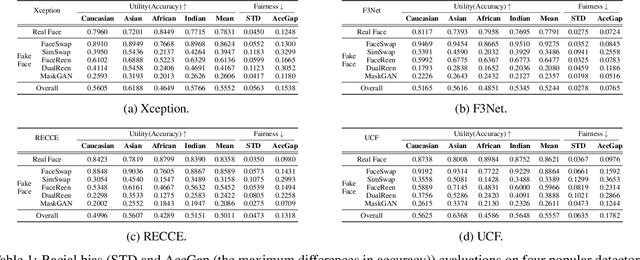


Due to the successful development of deep image generation technology, forgery detection plays a more important role in social and economic security. Racial bias has not been explored thoroughly in the deep forgery detection field. In the paper, we first contribute a dedicated dataset called the Fair Forgery Detection (FairFD) dataset, where we prove the racial bias of public state-of-the-art (SOTA) methods. Different from existing forgery detection datasets, the self-construct FairFD dataset contains a balanced racial ratio and diverse forgery generation images with the largest-scale subjects. Additionally, we identify the problems with naive fairness metrics when benchmarking forgery detection models. To comprehensively evaluate fairness, we design novel metrics including Approach Averaged Metric and Utility Regularized Metric, which can avoid deceptive results. Extensive experiments conducted with nine representative forgery detection models demonstrate the value of the proposed dataset and the reasonability of the designed fairness metrics. We also conduct more in-depth analyses to offer more insights to inspire researchers in the community.
IRSAM: Advancing Segment Anything Model for Infrared Small Target Detection
Jul 10, 2024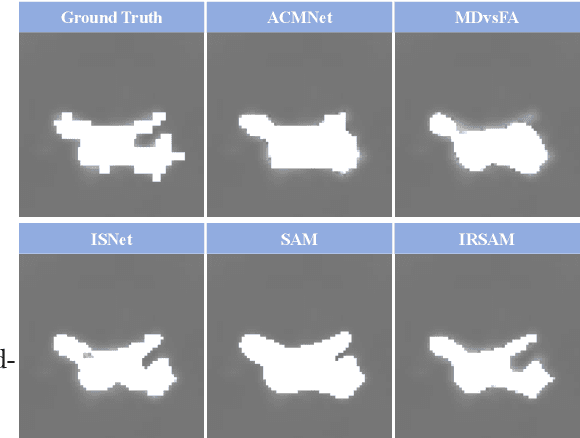
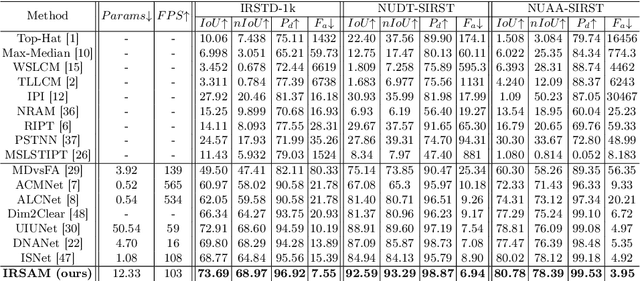
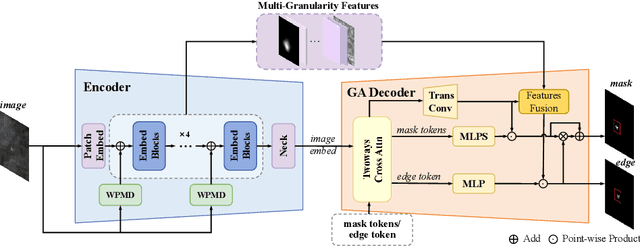

The recent Segment Anything Model (SAM) is a significant advancement in natural image segmentation, exhibiting potent zero-shot performance suitable for various downstream image segmentation tasks. However, directly utilizing the pretrained SAM for Infrared Small Target Detection (IRSTD) task falls short in achieving satisfying performance due to a notable domain gap between natural and infrared images. Unlike a visible light camera, a thermal imager reveals an object's temperature distribution by capturing infrared radiation. Small targets often show a subtle temperature transition at the object's boundaries. To address this issue, we propose the IRSAM model for IRSTD, which improves SAM's encoder-decoder architecture to learn better feature representation of infrared small objects. Specifically, we design a Perona-Malik diffusion (PMD)-based block and incorporate it into multiple levels of SAM's encoder to help it capture essential structural features while suppressing noise. Additionally, we devise a Granularity-Aware Decoder (GAD) to fuse the multi-granularity feature from the encoder to capture structural information that may be lost in long-distance modeling. Extensive experiments on the public datasets, including NUAA-SIRST, NUDT-SIRST, and IRSTD-1K, validate the design choice of IRSAM and its significant superiority over representative state-of-the-art methods. The source code are available at: github.com/IPIC-Lab/IRSAM.
SUMix: Mixup with Semantic and Uncertain Information
Jul 10, 2024


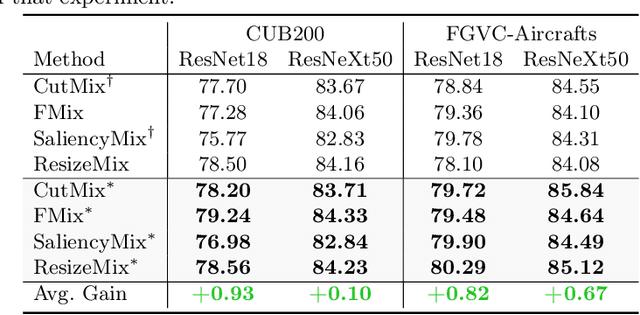
Mixup data augmentation approaches have been applied for various tasks of deep learning to improve the generalization ability of deep neural networks. Some existing approaches CutMix, SaliencyMix, etc. randomly replace a patch in one image with patches from another to generate the mixed image. Similarly, the corresponding labels are linearly combined by a fixed ratio $\lambda$ by l. The objects in two images may be overlapped during the mixing process, so some semantic information is corrupted in the mixed samples. In this case, the mixed image does not match the mixed label information. Besides, such a label may mislead the deep learning model training, which results in poor performance. To solve this problem, we proposed a novel approach named SUMix to learn the mixing ratio as well as the uncertainty for the mixed samples during the training process. First, we design a learnable similarity function to compute an accurate mix ratio. Second, an approach is investigated as a regularized term to model the uncertainty of the mixed samples. We conduct experiments on five image benchmarks, and extensive experimental results imply that our method is capable of improving the performance of classifiers with different cutting-based mixup approaches. The source code is available at https://github.com/JinXins/SUMix.
Federated Face Forgery Detection Learning with Personalized Representation
Jun 17, 2024Deep generator technology can produce high-quality fake videos that are indistinguishable, posing a serious social threat. Traditional forgery detection methods directly centralized training on data and lacked consideration of information sharing in non-public video data scenarios and data privacy. Naturally, the federated learning strategy can be applied for privacy protection, which aggregates model parameters of clients but not original data. However, simple federated learning can't achieve satisfactory performance because of poor generalization capabilities for the real hybrid-domain forgery dataset. To solve the problem, the paper proposes a novel federated face forgery detection learning with personalized representation. The designed Personalized Forgery Representation Learning aims to learn the personalized representation of each client to improve the detection performance of individual client models. In addition, a personalized federated learning training strategy is utilized to update the parameters of the distributed detection model. Here collaborative training is conducted on multiple distributed client devices, and shared representations of these client models are uploaded to the server side for aggregation. Experiments on several public face forgery detection datasets demonstrate the superior performance of the proposed algorithm compared with state-of-the-art methods. The code is available at \emph{https://github.com/GANG370/PFR-Forgery.}
Imperceptible Face Forgery Attack via Adversarial Semantic Mask
Jun 16, 2024
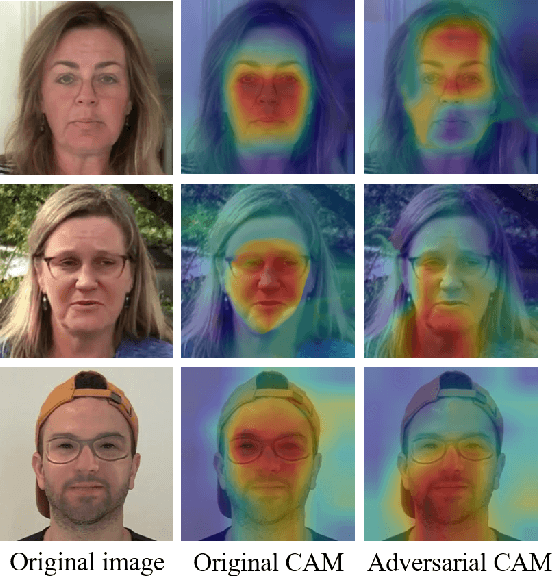
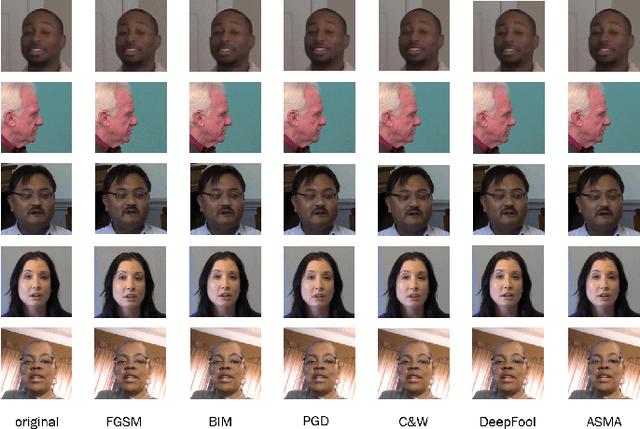
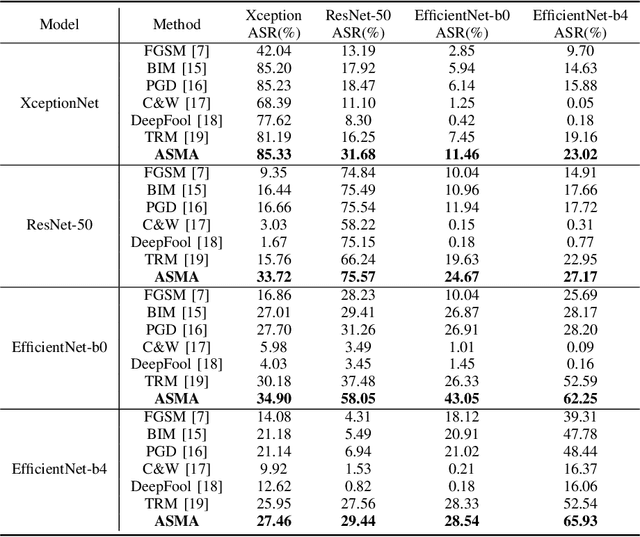
With the great development of generative model techniques, face forgery detection draws more and more attention in the related field. Researchers find that existing face forgery models are still vulnerable to adversarial examples with generated pixel perturbations in the global image. These generated adversarial samples still can't achieve satisfactory performance because of the high detectability. To address these problems, we propose an Adversarial Semantic Mask Attack framework (ASMA) which can generate adversarial examples with good transferability and invisibility. Specifically, we propose a novel adversarial semantic mask generative model, which can constrain generated perturbations in local semantic regions for good stealthiness. The designed adaptive semantic mask selection strategy can effectively leverage the class activation values of different semantic regions, and further ensure better attack transferability and stealthiness. Extensive experiments on the public face forgery dataset prove the proposed method achieves superior performance compared with several representative adversarial attack methods. The code is publicly available at https://github.com/clawerO-O/ASMA.
CLIP-Driven Cloth-Agnostic Feature Learning for Cloth-Changing Person Re-Identification
Jun 13, 2024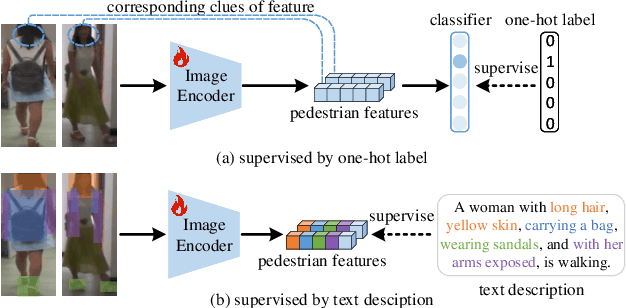
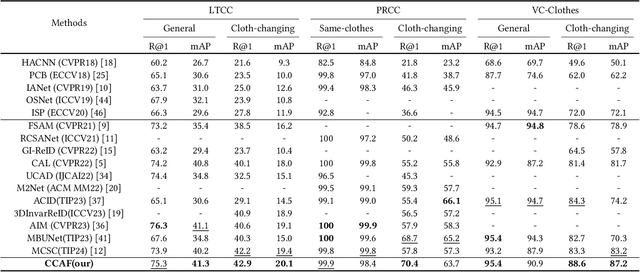
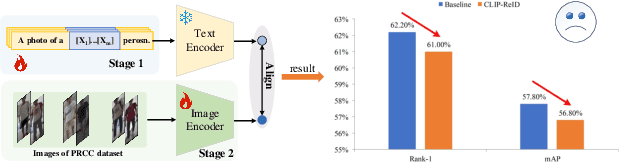
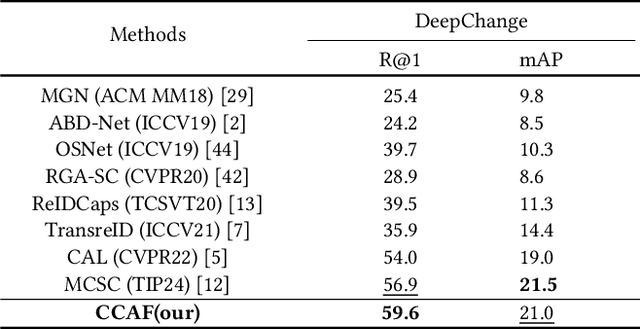
Contrastive Language-Image Pre-Training (CLIP) has shown impressive performance in short-term Person Re-Identification (ReID) due to its ability to extract high-level semantic features of pedestrians, yet its direct application to Cloth-Changing Person Re-Identification (CC-ReID) faces challenges due to CLIP's image encoder overly focusing on clothes clues. To address this, we propose a novel framework called CLIP-Driven Cloth-Agnostic Feature Learning (CCAF) for CC-ReID. Accordingly, two modules were custom-designed: the Invariant Feature Prompting (IFP) and the Clothes Feature Minimization (CFM). These modules guide the model to extract cloth-agnostic features positively and attenuate clothes-related features negatively. Specifically, IFP is designed to extract fine-grained semantic features unrelated to clothes from the raw image, guided by the cloth-agnostic text prompts. This module first covers the clothes in the raw image at the pixel level to obtain the shielding image and then utilizes CLIP's knowledge to generate cloth-agnostic text prompts. Subsequently, it aligns the raw image-text and the raw image-shielding image in the feature space, emphasizing discriminative clues related to identity but unrelated to clothes. Furthermore, CFM is designed to examine and weaken the image encoder's ability to extract clothes features. It first generates text prompts corresponding to clothes pixels. Then, guided by these clothes text prompts, it iteratively examines and disentangles clothes features from pedestrian features, ultimately retaining inherent discriminative features. Extensive experiments have demonstrated the effectiveness of the proposed CCAF, achieving new state-of-the-art performance on several popular CC-ReID benchmarks without any additional inference time.
Pulmonary Embolism Mortality Prediction Using Multimodal Learning Based on Computed Tomography Angiography and Clinical Data
Jun 03, 2024Purpose: Pulmonary embolism (PE) is a significant cause of mortality in the United States. The objective of this study is to implement deep learning (DL) models using Computed Tomography Pulmonary Angiography (CTPA), clinical data, and PE Severity Index (PESI) scores to predict PE mortality. Materials and Methods: 918 patients (median age 64 years, range 13-99 years, 52% female) with 3,978 CTPAs were identified via retrospective review across three institutions. To predict survival, an AI model was used to extract disease-related imaging features from CTPAs. Imaging features and/or clinical variables were then incorporated into DL models to predict survival outcomes. Four models were developed as follows: (1) using CTPA imaging features only; (2) using clinical variables only; (3) multimodal, integrating both CTPA and clinical variables; and (4) multimodal fused with calculated PESI score. Performance and contribution from each modality were evaluated using concordance index (c-index) and Net Reclassification Improvement, respectively. Performance was compared to PESI predictions using the Wilcoxon signed-rank test. Kaplan-Meier analysis was performed to stratify patients into high- and low-risk groups. Additional factor-risk analysis was conducted to account for right ventricular (RV) dysfunction. Results: For both data sets, the PESI-fused and multimodal models achieved higher c-indices than PESI alone. Following stratification of patients into high- and low-risk groups by multimodal and PESI-fused models, mortality outcomes differed significantly (both p<0.001). A strong correlation was found between high-risk grouping and RV dysfunction. Conclusions: Multiomic DL models incorporating CTPA features, clinical data, and PESI achieved higher c-indices than PESI alone for PE survival prediction.