 Add to Chrome
 Add to Firefox
 Add to Edge
WHTMix: Efficient Stereo Depth Estimation via Walsh-Hadamard Token Mixing
Jul 29, 2026
Stereo depth estimation for driving, robotics and augmented reality must run at high resolution under tight latency budgets, yet in transformer-based matchers the global self-attention that aggregates scene context grows quadratically with the number of pixels and comes to dominate runtime. We show that the joint self-attention stage of a stereo transformer, whose role is to spread context across both views, can be replaced by a data-independent Walsh-Hadamard token mixer that mixes tokens globally in the transform domain at log-linear cost, while the data-dependent cross-attention that performs left-right correspondence is retained. On synthetic driving data the mixer matches the attention baseline in end-point error while reducing model compute by a factor of 2.46 and single-image inference latency by a factor of 2.65. A complexity analysis shows the benefit is governed by the ratio of sequence length to channel width, which explains why high-resolution stereo matching is a particularly favorable setting and why classification transformers are not; we confirm this token-to-channel scaling on non-stereo long-sequence benchmarks. Furthermore, we introduce a hybrid log-disparity loss function designed to up-weight small-disparity pixels corresponding to long-range objects. This approach reduces the error on distant objects without incurring any additional computational overhead.

ShearFuse-UNet: Hadamard, DCT, and Shearlet Transform Fusion for Next-Day Wildfire Spread Prediction
Jun 12, 2026We propose ShearFuse-UNet, a lightweight and computationally efficient deep learning model for next-day wildfire spread prediction from multi-modal satellite data. The model integrates three complementary transform-domain branches inside each encoder block of a U-Net backbone: a 2D Fast Walsh-Hadamard Transform (WHT) branch, a 2D Discrete Cosine Transform (DCT) branch, and a cone-adapted digital Shearlet residual branch. The WHT and DCT branches establish orthogonal latent spaces with learnable spectral scaling and fixed soft-thresholding, while the Shearlet branch provides anisotropic, multi-directional feature decomposition that explicitly encodes the elongated edge structures characteristic of fire fronts. A learned SpectralFusion gate adaptively combines the WHT and DCT responses, and the Shearlet reconstruction is added as a residual. This three-branch design bears a loose structural analogy to transformer self-attention: the WHT and DCT branches provide complementary spectral representations that are adaptively fused, while the Shearlet branch contributes directional content through a residual pathway. Unlike self-attention, the proposed design relies on fixed mathematical transforms rather than learned projection operators, reducing parameter count and computational cost. Evaluated on the WildfireSpreadTS dataset, ShearFuse-UNet achieves an F1 score of 0.596 with only 267k parameters, outperforming a ResNet18-based U-Net (14M parameters, F1 = 0.589) and demonstrating a highly favorable accuracy-efficiency trade-off. Results on the Google Next-Day Wildfire Spread dataset further validate these findings across a different benchmark.
A Large Scale Open-Source Image and Video Dataset for Robust Wildfire Detection and Classification
Jun 08, 2026Wildfire detection and monitoring are critical for mitigating fire spread and reducing environmental and infrastructural damage. In this work, we introduce GWFP (Global Wildfire Prevention Dataset), a large-scale, open-source dataset of wildfire images and videos designed to support early fire and smoke detection research. GWFP contains geographically diverse wildfire scenes, including flames, smoke, Waterdog/Fog environmental conditions, Near Infrared (NIR) imagery, Ember, and challenging negative samples collected from real-world scenarios worldwide. To evaluate dataset robustness and cross-domain generalization, we benchmark multiple convolutional and transformer-based architectures across both in-domain and cross-dataset settings. Additionally, we explore lightweight frequency--spatial feature interaction using Hadamard-enhanced residual connections (HTE-ResNet) to analyze representation robustness under domain-shift conditions. Experimental results demonstrate strong cross-dataset generalization and practical utility for real-world wildfire monitoring applications. The dataset and source code will be publicly released upon acceptance.
Progressive Deep Learning for Automated Spheno-Occipital Synchondrosis Maturation Assessment
Apr 13, 2026Accurate assessment of spheno-occipital synchondrosis (SOS) maturation is a key indicator of craniofacial growth and a critical determinant for orthodontic and surgical timing. However, SOS staging from cone-beam CT (CBCT) relies on subtle, continuously evolving morphological cues, leading to high inter-observer variability and poor reproducibility, especially at transitional fusion stages. We frame SOS assessment as a fine-grained visual recognition problem and propose a progressive representation-learning framework that explicitly mirrors how expert clinicians reason about synchondral fusion: from coarse anatomical structure to increasingly subtle patterns of closure. Rather than training a full-capacity network end-to-end, we sequentially grow the model by activating deeper blocks over time, allowing early layers to first encode stable cranial base morphology before higher-level layers specialize in discriminating adjacent maturation stages. This yields a curriculum over network depth that aligns deep feature learning with the biological continuum of SOS fusion. Extensive experiments across convolutional and transformer-based architectures show that this expert-inspired training strategy produces more stable optimization and consistently higher accuracy than standard training, particularly for ambiguous intermediate stages. Importantly, these gains are achieved without changing network architectures or loss functions, demonstrating that training dynamics alone can substantially improve anatomical representation learning. The proposed framework establishes a principled link between expert dental intuition and deep visual representations, enabling robust, data-efficient SOS staging from CBCT and offering a general strategy for modeling other continuous biological processes in medical imaging.
Deep Learning Based Wildfire Detection for Peatland Fires Using Transfer Learning
Mar 02, 2026Machine learning (ML)-based wildfire detection methods have been developed in recent years, primarily using deep learning (DL) models trained on large collections of wildfire images and videos. However, peatland fires exhibit distinct visual and physical characteristics -- such as smoldering combustion, low flame intensity, persistent smoke, and subsurface burning -- that limit the effectiveness of conventional wildfire detectors trained on open-flame forest fires. In this work, we present a transfer learning-based approach for peatland fire detection that leverages knowledge learned from general wildfire imagery and adapts it to the peatland fire domain. We initialize a DL-based peatland fire detector using pretrained weights from a conventional wildfire detection model and subsequently fine-tune the network using a dataset composed of Malaysian peatland images and videos. This strategy enables effective learning despite the limited availability of labeled peatland fire data. Experimental results demonstrate that transfer learning significantly improves detection accuracy and robustness compared to training from scratch, particularly under challenging conditions such as low-contrast smoke, partial occlusions, and variable illumination. The proposed approach provides a practical and scalable solution for early peatland fire detection and has the potential to support real-time monitoring systems for fire prevention and environmental protection.
Sparse Mamba: Reinforcing Controllability In Structural State Space Models
Aug 31, 2024

In this article, we introduce the concept of controllability and observability to the M amba architecture in our Sparse-Mamba (S-Mamba) for natural language processing (NLP) applications. The structured state space model (SSM) development in recent studies, such as Mamba and Mamba2, outperformed and solved the computational inefficiency of transformers and large language models (LLMs) on longer sequences in small to medium NLP tasks. The Mamba SSMs architecture drops the need for attention layer or MLB blocks in transformers. However, the current Mamba models do not reinforce the controllability on state space equations in the calculation of A, B, C, and D matrices at each time step, which increase the complexity and the computational cost needed. In this article we show that the number of parameters can be significantly decreased by reinforcing controllability in the state space equations in the proposed Sparse-Mamba (S-Mamba), while maintaining the performance. The controllable n x n state matrix A is sparse and it has only n free parameters. Our novel approach will ensure a controllable system and could be the gate key for Mamba 3.
DCT-Based Decorrelated Attention for Vision Transformers
May 22, 2024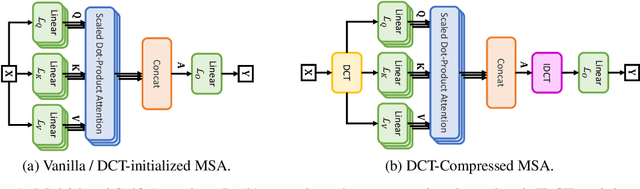
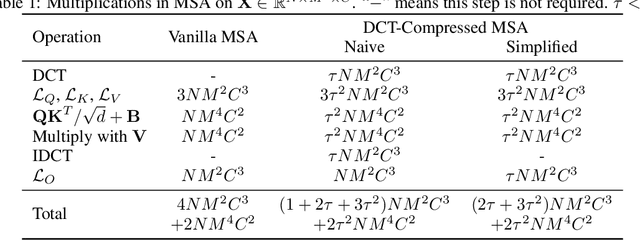

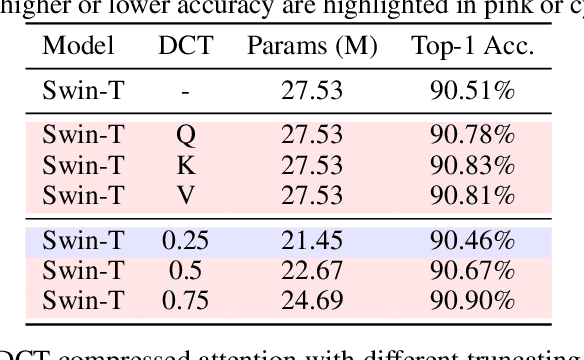
Central to the Transformer architectures' effectiveness is the self-attention mechanism, a function that maps queries, keys, and values into a high-dimensional vector space. However, training the attention weights of queries, keys, and values is non-trivial from a state of random initialization. In this paper, we propose two methods. (i) We first address the initialization problem of Vision Transformers by introducing a simple, yet highly innovative, initialization approach utilizing Discrete Cosine Transform (DCT) coefficients. Our proposed DCT-based attention initialization marks a significant gain compared to traditional initialization strategies; offering a robust foundation for the attention mechanism. Our experiments reveal that the DCT-based initialization enhances the accuracy of Vision Transformers in classification tasks. (ii) We also recognize that since DCT effectively decorrelates image information in the frequency domain, this decorrelation is useful for compression because it allows the quantization step to discard many of the higher-frequency components. Based on this observation, we propose a novel DCT-based compression technique for the attention function of Vision Transformers. Since high-frequency DCT coefficients usually correspond to noise, we truncate the high-frequency DCT components of the input patches. Our DCT-based compression reduces the size of weight matrices for queries, keys, and values. While maintaining the same level of accuracy, our DCT compressed Swin Transformers obtain a considerable decrease in the computational overhead.
Wildfire Detection Via Transfer Learning: A Survey
Jun 21, 2023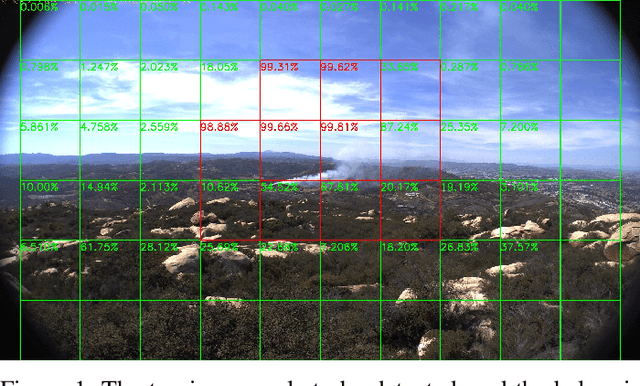
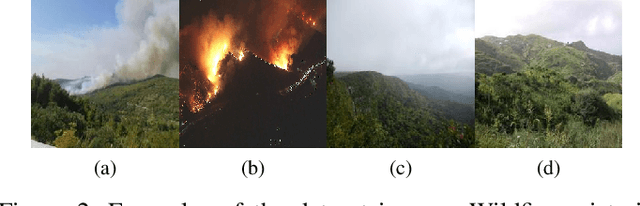
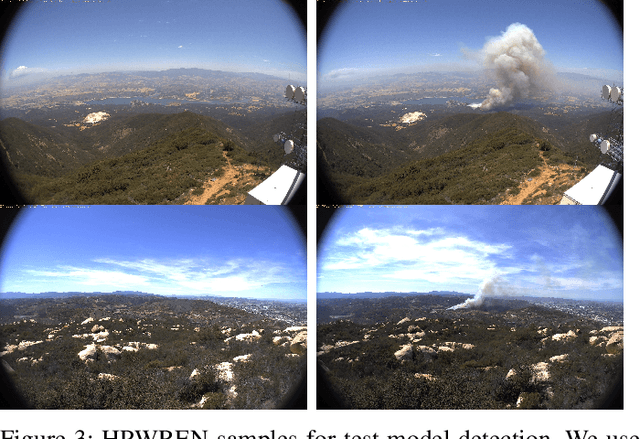
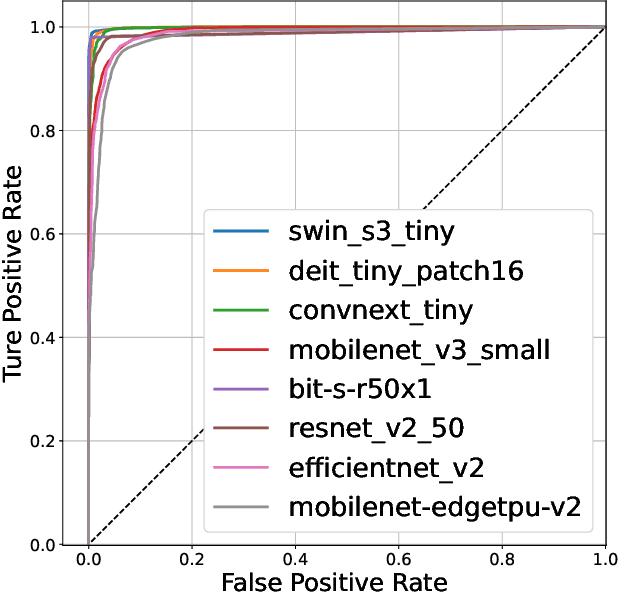
This paper surveys different publicly available neural network models used for detecting wildfires using regular visible-range cameras which are placed on hilltops or forest lookout towers. The neural network models are pre-trained on ImageNet-1K and fine-tuned on a custom wildfire dataset. The performance of these models is evaluated on a diverse set of wildfire images, and the survey provides useful information for those interested in using transfer learning for wildfire detection. Swin Transformer-tiny has the highest AUC value but ConvNext-tiny detects all the wildfire events and has the lowest false alarm rate in our dataset.