 Add to Chrome
 Add to Firefox
 Add to Edge
Exploiting Polarized Material Cues for Robust Car Detection
Jan 05, 2024
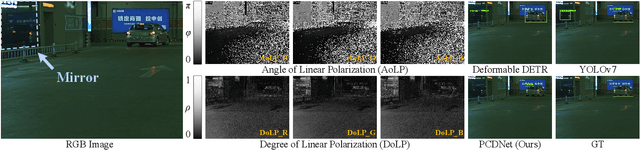

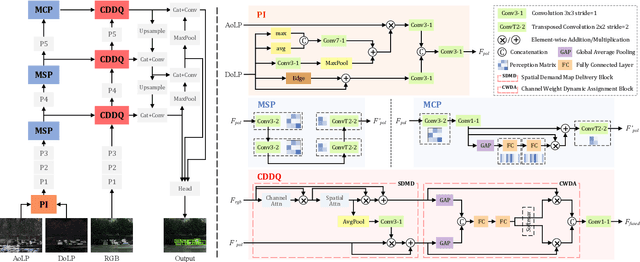
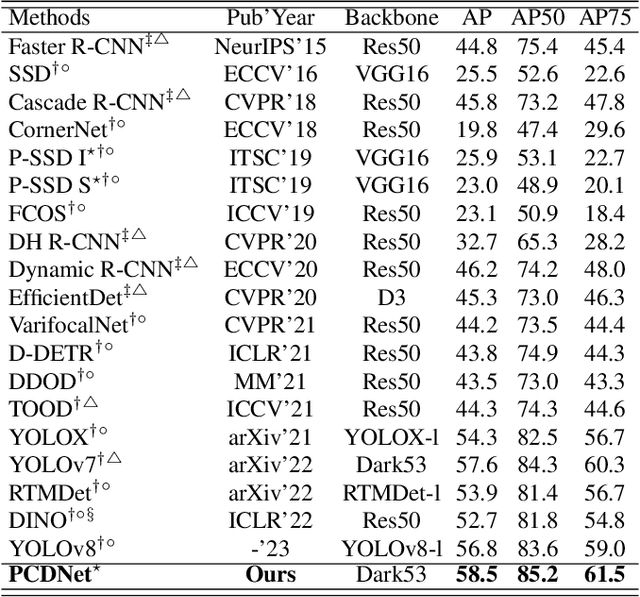
Car detection is an important task that serves as a crucial prerequisite for many automated driving functions. The large variations in lighting/weather conditions and vehicle densities of the scenes pose significant challenges to existing car detection algorithms to meet the highly accurate perception demand for safety, due to the unstable/limited color information, which impedes the extraction of meaningful/discriminative features of cars. In this work, we present a novel learning-based car detection method that leverages trichromatic linear polarization as an additional cue to disambiguate such challenging cases. A key observation is that polarization, characteristic of the light wave, can robustly describe intrinsic physical properties of the scene objects in various imaging conditions and is strongly linked to the nature of materials for cars (e.g., metal and glass) and their surrounding environment (e.g., soil and trees), thereby providing reliable and discriminative features for robust car detection in challenging scenes. To exploit polarization cues, we first construct a pixel-aligned RGB-Polarization car detection dataset, which we subsequently employ to train a novel multimodal fusion network. Our car detection network dynamically integrates RGB and polarization features in a request-and-complement manner and can explore the intrinsic material properties of cars across all learning samples. We extensively validate our method and demonstrate that it outperforms state-of-the-art detection methods. Experimental results show that polarization is a powerful cue for car detection.

FlowDA: Unsupervised Domain Adaptive Framework for Optical Flow Estimation
Dec 28, 2023Collecting real-world optical flow datasets is a formidable challenge due to the high cost of labeling. A shortage of datasets significantly constrains the real-world performance of optical flow models. Building virtual datasets that resemble real scenarios offers a potential solution for performance enhancement, yet a domain gap separates virtual and real datasets. This paper introduces FlowDA, an unsupervised domain adaptive (UDA) framework for optical flow estimation. FlowDA employs a UDA architecture based on mean-teacher and integrates concepts and techniques in unsupervised optical flow estimation. Furthermore, an Adaptive Curriculum Weighting (ACW) module based on curriculum learning is proposed to enhance the training effectiveness. Experimental outcomes demonstrate that our FlowDA outperforms state-of-the-art unsupervised optical flow estimation method SMURF by 21.6%, real optical flow dataset generation method MPI-Flow by 27.8%, and optical flow estimation adaptive method FlowSupervisor by 30.9%, offering novel insights for enhancing the performance of optical flow estimation in real-world scenarios. The code will be open-sourced after the publication of this paper.
SR-LIVO: LiDAR-Inertial-Visual Odometry and Mapping with Sweep Reconstruction
Dec 28, 2023Existing LiDAR-inertial-visual odometry and mapping (LIV-SLAM) systems mainly utilize the LiDAR-inertial odometry (LIO) module for structure reconstruction and the visual-inertial odometry (VIO) module for color rendering. However, the accuracy of VIO is often compromised by photometric changes, weak textures and motion blur, unlike the more robust LIO. This paper introduces SR-LIVO, an advanced and novel LIV-SLAM system employing sweep reconstruction to align reconstructed sweeps with image timestamps. This allows the LIO module to accurately determine states at all imaging moments, enhancing pose accuracy and processing efficiency. Experimental results on two public datasets demonstrate that: 1) our SRLIVO outperforms existing state-of-the-art LIV-SLAM systems in both pose accuracy and time efficiency; 2) our LIO-based pose estimation prove more accurate than VIO-based ones in several mainstream LIV-SLAM systems (including ours). We have released our source code to contribute to the community development in this field.
Federated Continual Learning via Knowledge Fusion: A Survey
Dec 27, 2023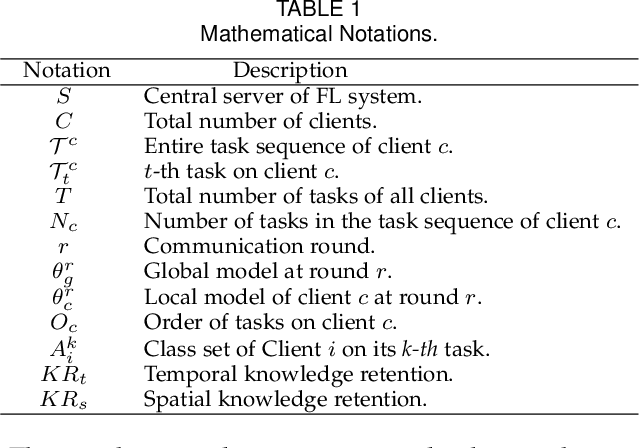
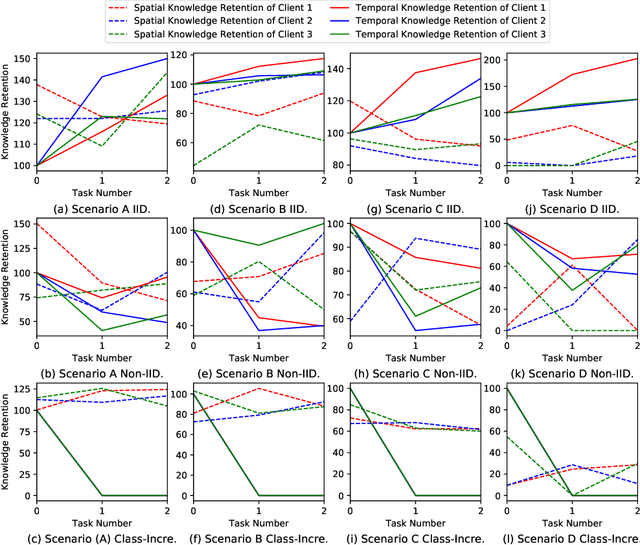
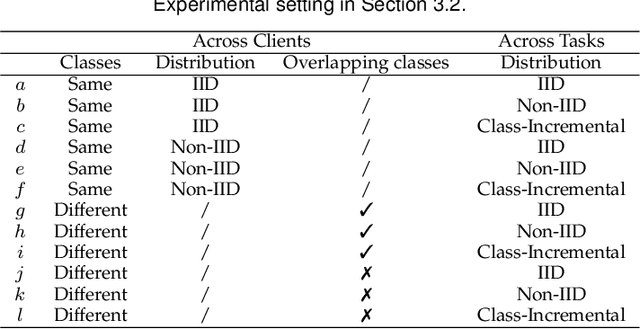
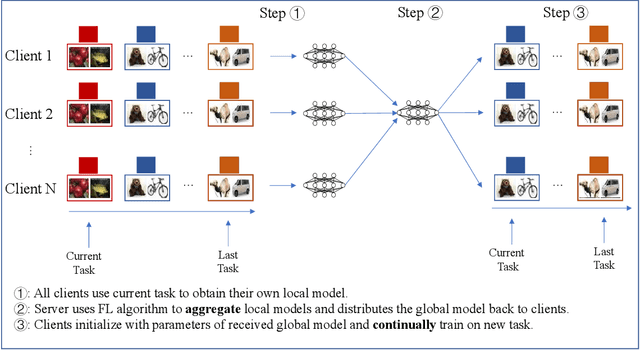
Data privacy and silos are nontrivial and greatly challenging in many real-world applications. Federated learning is a decentralized approach to training models across multiple local clients without the exchange of raw data from client devices to global servers. However, existing works focus on a static data environment and ignore continual learning from streaming data with incremental tasks. Federated Continual Learning (FCL) is an emerging paradigm to address model learning in both federated and continual learning environments. The key objective of FCL is to fuse heterogeneous knowledge from different clients and retain knowledge of previous tasks while learning on new ones. In this work, we delineate federated learning and continual learning first and then discuss their integration, i.e., FCL, and particular FCL via knowledge fusion. In summary, our motivations are four-fold: we (1) raise a fundamental problem called ''spatial-temporal catastrophic forgetting'' and evaluate its impact on the performance using a well-known method called federated averaging (FedAvg), (2) integrate most of the existing FCL methods into two generic frameworks, namely synchronous FCL and asynchronous FCL, (3) categorize a large number of methods according to the mechanism involved in knowledge fusion, and finally (4) showcase an outlook on the future work of FCL.
Learning to Prompt Knowledge Transfer for Open-World Continual Learning
Dec 22, 2023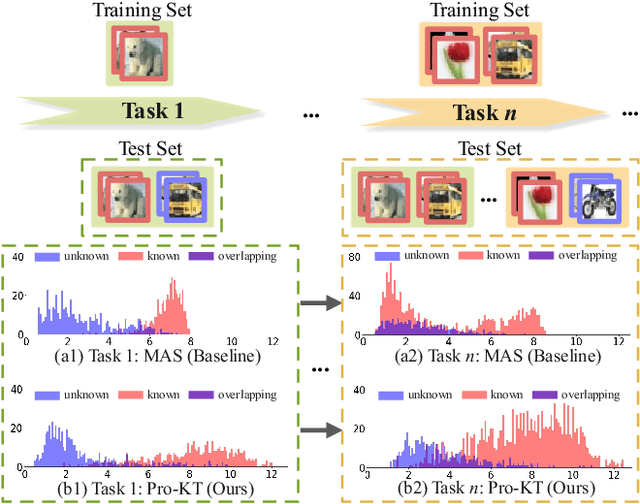
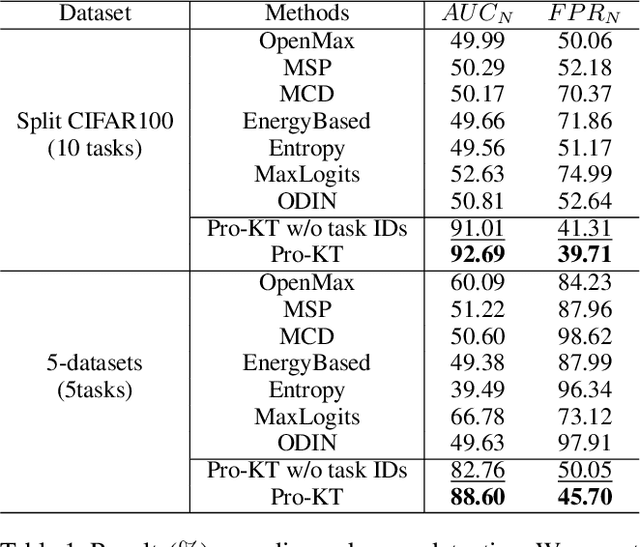
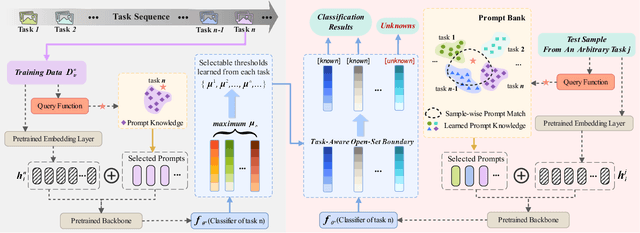
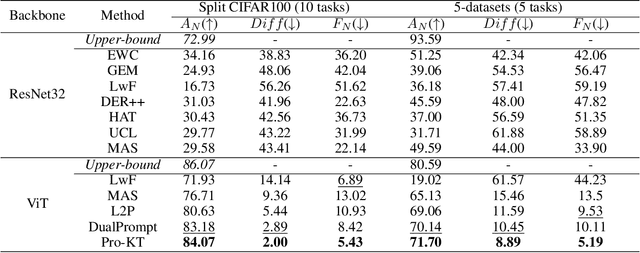
This paper studies the problem of continual learning in an open-world scenario, referred to as Open-world Continual Learning (OwCL). OwCL is increasingly rising while it is highly challenging in two-fold: i) learning a sequence of tasks without forgetting knowns in the past, and ii) identifying unknowns (novel objects/classes) in the future. Existing OwCL methods suffer from the adaptability of task-aware boundaries between knowns and unknowns, and do not consider the mechanism of knowledge transfer. In this work, we propose Pro-KT, a novel prompt-enhanced knowledge transfer model for OwCL. Pro-KT includes two key components: (1) a prompt bank to encode and transfer both task-generic and task-specific knowledge, and (2) a task-aware open-set boundary to identify unknowns in the new tasks. Experimental results using two real-world datasets demonstrate that the proposed Pro-KT outperforms the state-of-the-art counterparts in both the detection of unknowns and the classification of knowns markedly.
Memory-Efficient Optical Flow via Radius-Distribution Orthogonal Cost Volume
Dec 06, 2023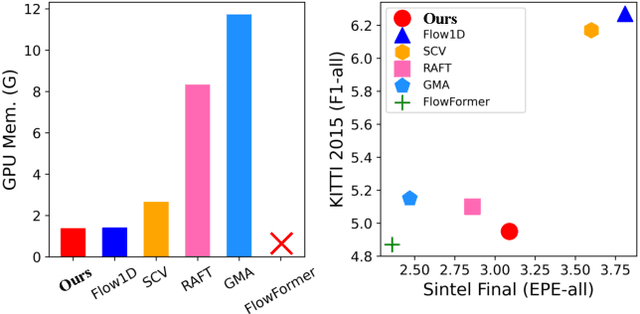
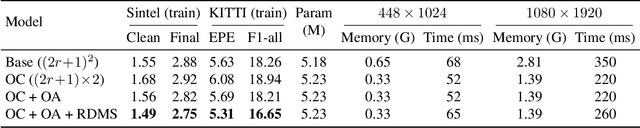
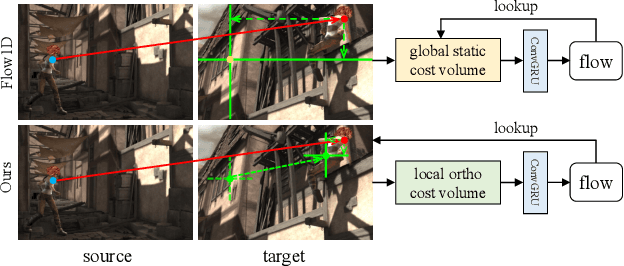
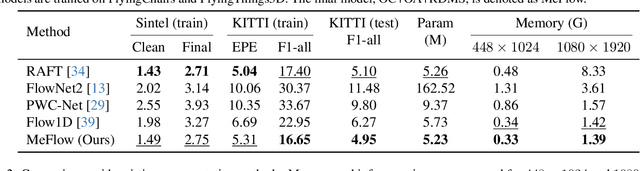
The full 4D cost volume in Recurrent All-Pairs Field Transforms (RAFT) or global matching by Transformer achieves impressive performance for optical flow estimation. However, their memory consumption increases quadratically with input resolution, rendering them impractical for high-resolution images. In this paper, we present MeFlow, a novel memory-efficient method for high-resolution optical flow estimation. The key of MeFlow is a recurrent local orthogonal cost volume representation, which decomposes the 2D search space dynamically into two 1D orthogonal spaces, enabling our method to scale effectively to very high-resolution inputs. To preserve essential information in the orthogonal space, we utilize self attention to propagate feature information from the 2D space to the orthogonal space. We further propose a radius-distribution multi-scale lookup strategy to model the correspondences of large displacements at a negligible cost. We verify the efficiency and effectiveness of our method on the challenging Sintel and KITTI benchmarks, and real-world 4K ($2160\!\times\!3840$) images. Our method achieves competitive performance on both Sintel and KITTI benchmarks, while maintaining the highest memory efficiency on high-resolution inputs.
LucidDreamer: Towards High-Fidelity Text-to-3D Generation via Interval Score Matching
Dec 02, 2023The recent advancements in text-to-3D generation mark a significant milestone in generative models, unlocking new possibilities for creating imaginative 3D assets across various real-world scenarios. While recent advancements in text-to-3D generation have shown promise, they often fall short in rendering detailed and high-quality 3D models. This problem is especially prevalent as many methods base themselves on Score Distillation Sampling (SDS). This paper identifies a notable deficiency in SDS, that it brings inconsistent and low-quality updating direction for the 3D model, causing the over-smoothing effect. To address this, we propose a novel approach called Interval Score Matching (ISM). ISM employs deterministic diffusing trajectories and utilizes interval-based score matching to counteract over-smoothing. Furthermore, we incorporate 3D Gaussian Splatting into our text-to-3D generation pipeline. Extensive experiments show that our model largely outperforms the state-of-the-art in quality and training efficiency.
MC-Stereo: Multi-peak Lookup and Cascade Search Range for Stereo Matching
Nov 04, 2023Stereo matching is a fundamental task in scene comprehension. In recent years, the method based on iterative optimization has shown promise in stereo matching. However, the current iteration framework employs a single-peak lookup, which struggles to handle the multi-peak problem effectively. Additionally, the fixed search range used during the iteration process limits the final convergence effects. To address these issues, we present a novel iterative optimization architecture called MC-Stereo. This architecture mitigates the multi-peak distribution problem in matching through the multi-peak lookup strategy, and integrates the coarse-to-fine concept into the iterative framework via the cascade search range. Furthermore, given that feature representation learning is crucial for successful learnbased stereo matching, we introduce a pre-trained network to serve as the feature extractor, enhancing the front end of the stereo matching pipeline. Based on these improvements, MC-Stereo ranks first among all publicly available methods on the KITTI-2012 and KITTI-2015 benchmarks, and also achieves state-of-the-art performance on ETH3D. The code will be open sourced after the publication of this paper.
Debunking Free Fusion Myth: Online Multi-view Anomaly Detection with Disentangled Product-of-Experts Modeling
Oct 31, 2023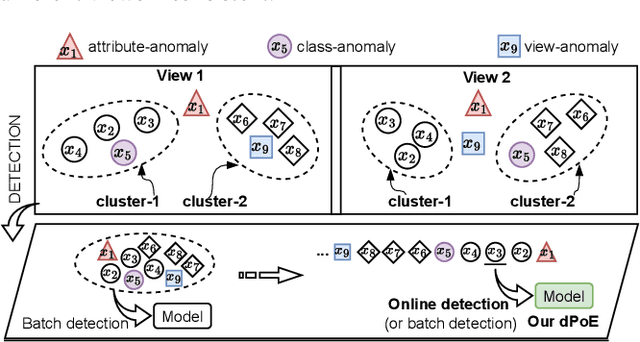
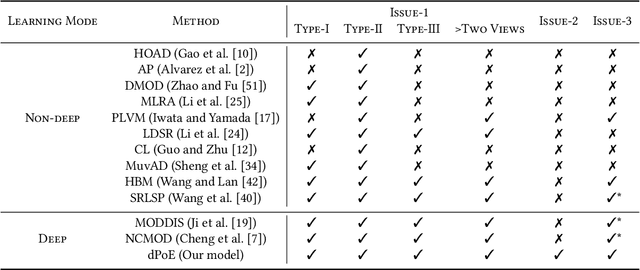
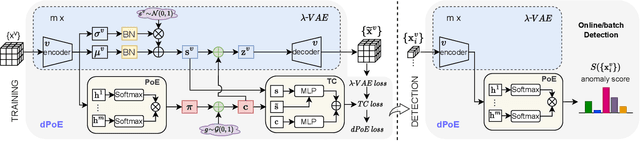
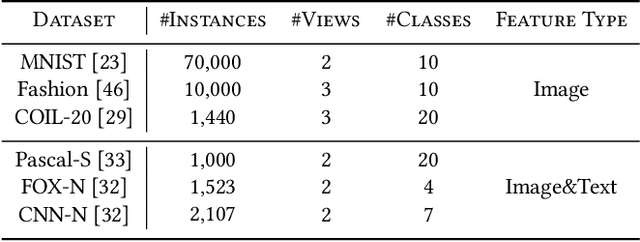
Multi-view or even multi-modal data is appealing yet challenging for real-world applications. Detecting anomalies in multi-view data is a prominent recent research topic. However, most of the existing methods 1) are only suitable for two views or type-specific anomalies, 2) suffer from the issue of fusion disentanglement, and 3) do not support online detection after model deployment. To address these challenges, our main ideas in this paper are three-fold: multi-view learning, disentangled representation learning, and generative model. To this end, we propose dPoE, a novel multi-view variational autoencoder model that involves (1) a Product-of-Experts (PoE) layer in tackling multi-view data, (2) a Total Correction (TC) discriminator in disentangling view-common and view-specific representations, and (3) a joint loss function in wrapping up all components. In addition, we devise theoretical information bounds to control both view-common and view-specific representations. Extensive experiments on six real-world datasets markedly demonstrate that the proposed dPoE outperforms baselines.
FetusMapV2: Enhanced Fetal Pose Estimation in 3D Ultrasound
Oct 30, 2023Fetal pose estimation in 3D ultrasound (US) involves identifying a set of associated fetal anatomical landmarks. Its primary objective is to provide comprehensive information about the fetus through landmark connections, thus benefiting various critical applications, such as biometric measurements, plane localization, and fetal movement monitoring. However, accurately estimating the 3D fetal pose in US volume has several challenges, including poor image quality, limited GPU memory for tackling high dimensional data, symmetrical or ambiguous anatomical structures, and considerable variations in fetal poses. In this study, we propose a novel 3D fetal pose estimation framework (called FetusMapV2) to overcome the above challenges. Our contribution is three-fold. First, we propose a heuristic scheme that explores the complementary network structure-unconstrained and activation-unreserved GPU memory management approaches, which can enlarge the input image resolution for better results under limited GPU memory. Second, we design a novel Pair Loss to mitigate confusion caused by symmetrical and similar anatomical structures. It separates the hidden classification task from the landmark localization task and thus progressively eases model learning. Last, we propose a shape priors-based self-supervised learning by selecting the relatively stable landmarks to refine the pose online. Extensive experiments and diverse applications on a large-scale fetal US dataset including 1000 volumes with 22 landmarks per volume demonstrate that our method outperforms other strong competitors.