 Add to Chrome
 Add to Firefox
 Add to Edge
WCM: A World Critic Model for Vision-Language-Action Reinforcement Learning
Jul 31, 2026
Reinforcement learning (RL) post-training of Vision-Language-Action (VLA) models has shown strong promise for robotic manipulation. Among RL methods, critic-based approaches rely on a value estimator that predominantly operates on single-frame observations or single-frame VLM backbone latents, which is a fundamental mismatch with the partially observable nature of robot control. A naive approach to incorporate observation history into the critic incurs exponential complexity with high-dimensional visual space, and still fails because pure scalar-return regression provides insufficient supervision for learning cross-temporal dynamics. We identify the root cause as a state approximation problem: without an explicit world modeling objective, the critic's representation cannot capture the temporal structure needed for accurate value estimation. To address this, we propose the World Critic Model (WCM), built on a lightweight LeJEPA architecture; WCM jointly predicts future latent state and estimates values, such that the critic's representation is explicitly trained to capture temporal dynamics rather than merely regress scalar returns. WCM integrates seamlessly into both on-policy and off-policy training pipelines and is compatible with state-of-the-art VLA backbones including Pi0, Pi0.5, and OpenVLA-OFT. Extensive experiments on 149 tasks across four benchmarks demonstrate that WCM consistently achieves state-of-the-art performance in both in-distribution and out-of-distribution settings, with particularly strong generalization gains. We further validate WCM on seven real-world manipulation tasks using OpenVLA-OFT and Pi0.5 with off-policy RL, confirming stable deployment across diverse settings.

HiMe: Hierarchical Embodied Memory for Long-Horizon Vision-Language-Action Control
Jul 03, 2026Current Vision-Language-Action (VLA) models excel at robotic manipulation but often struggle with non-Markovian tasks requiring long-term memory and reasoning due to their reliance on immediate observations. Existing solutions face a ''frequency-competence paradox,'' where stronger reasoning models are too slow for real-time control, while faster models lack sufficient reasoning capabilities. To resolve this architectural misalignment, we propose HiMe, a Hierarchical Embodied Memory framework that decouples embodied intelligence into a high-frequency Executor for execution, a Sentry for working memory, and a Planner for long-term strategy. We also introduce a dynamic knowledge system based on cross-modal semantic schemas and active management mechanisms, allowing robots to maintain memory plasticity through ''Add, Update, and Delete'' operations. This hierarchical design effectively balances the conflict between real-time execution and slow thinking planning, significantly improving success rates in long-horizon tasks. Experiments demonstrate that this approach not only outperforms flat memory baselines but also exhibits the novel ability to self-correct its internal knowledge based on human preferences.
Learning to Move Before Learning to Do: Task-Agnostic pretraining for VLAs
Jul 02, 2026Vision-Language-Action (VLA) models are fundamentally bottlenecked by the scarcity of expert demonstrations -- triplets of observations, instructions, and actions that are costly to collect at scale. We argue that this bottleneck stems from conflating two distinct learning objectives: acquiring physical competence (how to move) and acquiring semantic alignment (what to do). Crucially, only the latter requires language supervision. Building on this Decomposition Hypothesis, we propose Task-Agnostic Pretraining (TAP), a two-stage framework that first learns transferable motor priors from cheap, unlabeled interaction data -- including discarded off-task trajectories and autonomous robot play -- via a self-supervised Inverse Dynamics objective. A lightweight second stage then grounds these priors in language using minimal expert data. On the SIMPLER benchmark, TAP matches models trained on over 1M expert trajectories while using orders of magnitude less labeled data, yielding a 10% absolute gain over standard behavior cloning. On a real-world WidowX platform, TAP retains 25% success under camera perturbations where internet-scale baselines collapse to 0%, demonstrating that task-agnostic pretraining produces robust, transferable physical representations and offers a scalable path forward for Embodied AI.
Coarse-to-Control: Action-Token Planning for Vision-Language-Action Models
Jun 05, 2026Most vision-language-action (VLA) models map observations directly to actions without explicit intermediate planning, which limits performance on long-horizon tasks where early mistakes compound. We propose Coarse-to-Control, a plan-execute VLA that introduces planning natively in the action-token space. The key idea is to let the policy first predict a compact sequence of coarse action tokens that summarize the intended future trajectory, and then generate executable action tokens conditioned on this plan. Because both planning and execution share a unified discrete action vocabulary, the plan stays close to the control manifold and provides directly actionable guidance rather than an abstract hint that must be translated back to motor commands. Experiments on LIBERO, SimplerEnv-WidowX, and real-world manipulation tasks show that action-token planning consistently improves over direct action generation, with the largest gains on long-horizon multi-stage tasks.
VLABench: A Large-Scale Benchmark for Language-Conditioned Robotics Manipulation with Long-Horizon Reasoning Tasks
Dec 24, 2024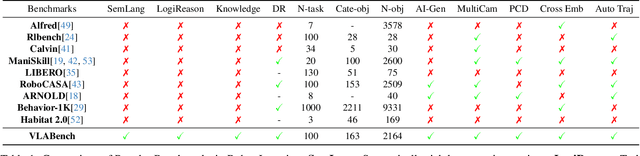

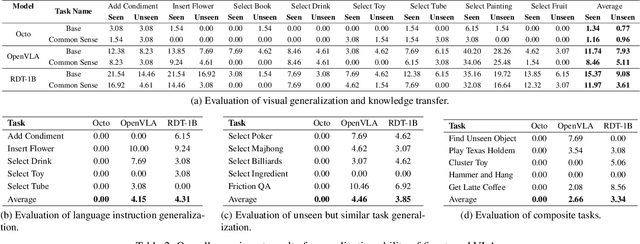
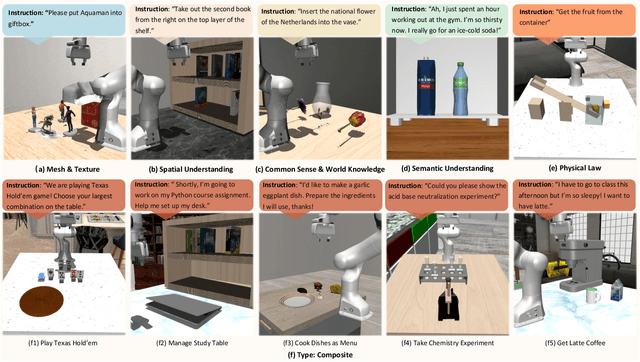
General-purposed embodied agents are designed to understand the users' natural instructions or intentions and act precisely to complete universal tasks. Recently, methods based on foundation models especially Vision-Language-Action models (VLAs) have shown a substantial potential to solve language-conditioned manipulation (LCM) tasks well. However, existing benchmarks do not adequately meet the needs of VLAs and relative algorithms. To better define such general-purpose tasks in the context of LLMs and advance the research in VLAs, we present VLABench, an open-source benchmark for evaluating universal LCM task learning. VLABench provides 100 carefully designed categories of tasks, with strong randomization in each category of task and a total of 2000+ objects. VLABench stands out from previous benchmarks in four key aspects: 1) tasks requiring world knowledge and common sense transfer, 2) natural language instructions with implicit human intentions rather than templates, 3) long-horizon tasks demanding multi-step reasoning, and 4) evaluation of both action policies and language model capabilities. The benchmark assesses multiple competencies including understanding of mesh\&texture, spatial relationship, semantic instruction, physical laws, knowledge transfer and reasoning, etc. To support the downstream finetuning, we provide high-quality training data collected via an automated framework incorporating heuristic skills and prior information. The experimental results indicate that both the current state-of-the-art pretrained VLAs and the workflow based on VLMs face challenges in our tasks.
Predicting the Output Structure of Sparse Matrix Multiplication with Sampled Compression Ratio
Jul 28, 2022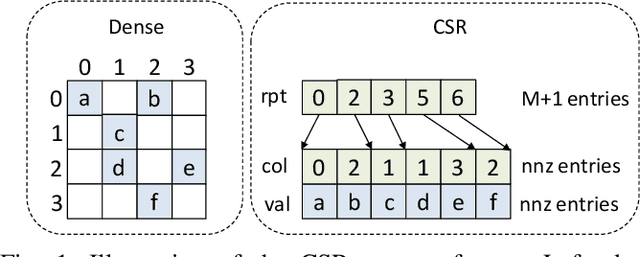
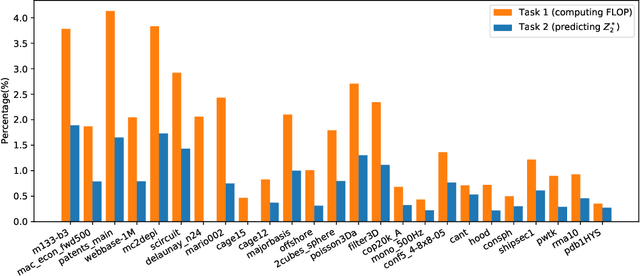
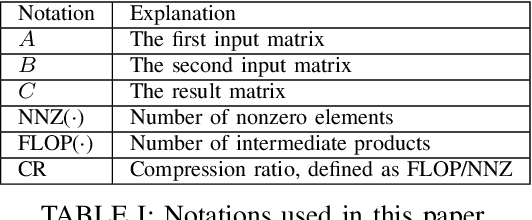
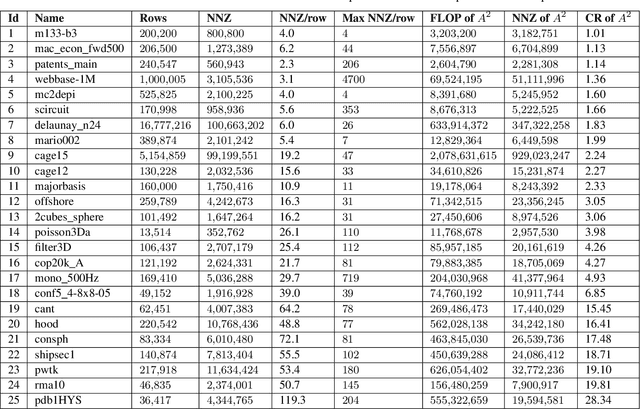
Sparse general matrix multiplication (SpGEMM) is a fundamental building block in numerous scientific applications. One critical task of SpGEMM is to compute or predict the structure of the output matrix (i.e., the number of nonzero elements per output row) for efficient memory allocation and load balance, which impact the overall performance of SpGEMM. Existing work either precisely calculates the output structure or adopts upper-bound or sampling-based methods to predict the output structure. However, these methods either take much execution time or are not accurate enough. In this paper, we propose a novel sampling-based method with better accuracy and low costs compared to the existing sampling-based method. The proposed method first predicts the compression ratio of SpGEMM by leveraging the number of intermediate products (denoted as FLOP) and the number of nonzero elements (denoted as NNZ) of the same sampled result matrix. And then, the predicted output structure is obtained by dividing the FLOP per output row by the predicted compression ratio. We also propose a reference design of the existing sampling-based method with optimized computing overheads to demonstrate the better accuracy of the proposed method. We construct 625 test cases with various matrix dimensions and sparse structures to evaluate the prediction accuracy. Experimental results show that the absolute relative errors of the proposed method and the reference design are 1.56\% and 8.12\%, respectively, on average, and 25\% and 156\%, respectively, in the worst case.
Model-Based Opponent Modeling
Aug 04, 2021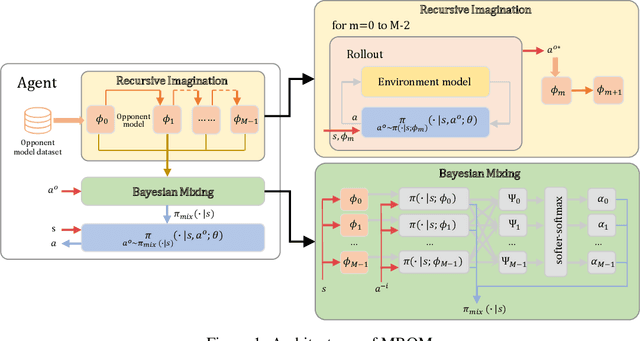
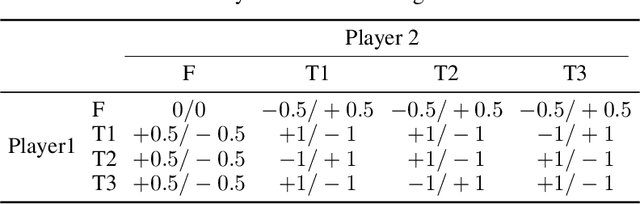
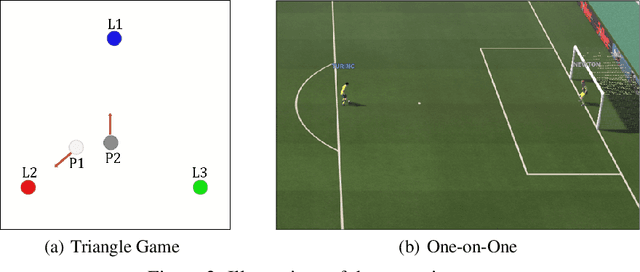
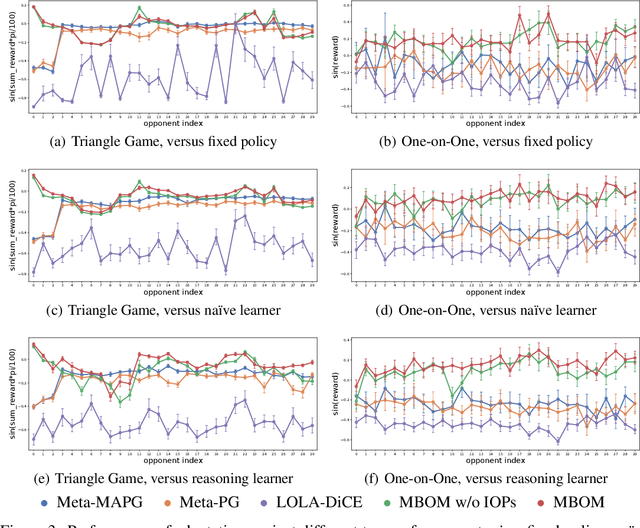
When one agent interacts with a multi-agent environment, it is challenging to deal with various opponents unseen before. Modeling the behaviors, goals, or beliefs of opponents could help the agent adjust its policy to adapt to different opponents. In addition, it is also important to consider opponents who are learning simultaneously or capable of reasoning. However, existing work usually tackles only one of the aforementioned types of opponent. In this paper, we propose model-based opponent modeling (MBOM), which employs the environment model to adapt to all kinds of opponent. MBOM simulates the recursive reasoning process in the environment model and imagines a set of improving opponent policies. To effectively and accurately represent the opponent policy, MBOM further mixes the imagined opponent policies according to the similarity with the real behaviors of opponents. Empirically, we show that MBOM achieves more effective adaptation than existing methods in competitive and cooperative environments, respectively with different types of opponent, i.e., fixed policy, na\"ive learner, and reasoning learner.