 Add to Chrome
 Add to Firefox
 Add to Edge
Zero-shot Tweet-Level Stance Detection Enhanced by External Knowledge and Reflective Chain-of-Thought Reasoning
Jun 25, 2026
Zero-shot tweet-level stance detection confronts two primary challenges: (1) mitigating the context sparsity inherent in short texts, and (2) establishing the relevance between implicit targets and textual content. While existing methods primarily focus on incorporating external knowledge, they neglect the intrinsic semantic cues embedded within key intra-textual entities. Furthermore, current models exhibit limited capability in determining the relevance of unseen targets to the given text, thereby struggling to differentiate between "neutral" and "irrelevant" stance labels. To address these issues, we first construct a four-class, multi-topic Japanese tweet dataset. To our knowledge, this is the first Japanese tweet-level dataset for stance detection. We then propose KIRP, a zero-shot stance detection framework. It integrates external knowledge with entity reorganization for data augmentation and employs prompt chaining for reasoning. Specifically, the framework incorporates knowledge graphs to supplement and reorganize key textual entities, while reflective Chain-of-Thought (CoT) reasoning extracts and validates implicit targets. To better distinguish "neutral" from "irrelevant" labels, we adopt stance-aware contrastive learning to capture discriminative features and design a three-layer iterative prototype network for fine-grained classification. Experimental results on SemEval-2016, WT-WT, and KIRP-D show that KIRP achieves state-of-the-art performance. KIRP obtains F1 scores of 84.05% (three-class) on SemEval-2016, and 84.99% and 79.18% (four-class) on WT-WT and KIRP-D, respectively.

FBA$^2$D: Frequency-based Black-box Attack for AI-generated Image Detection
Dec 10, 2025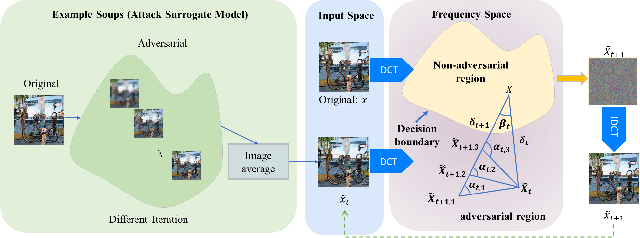
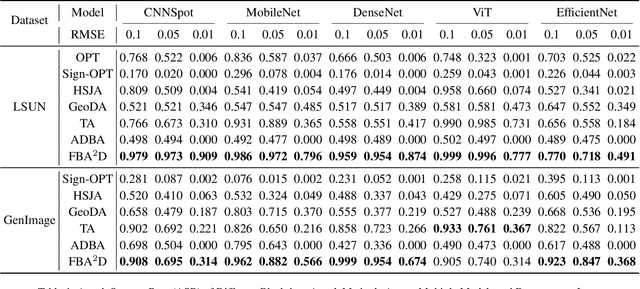
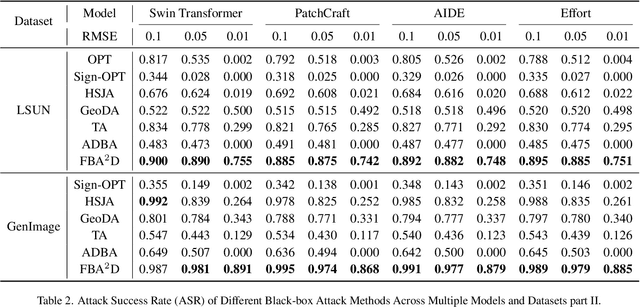
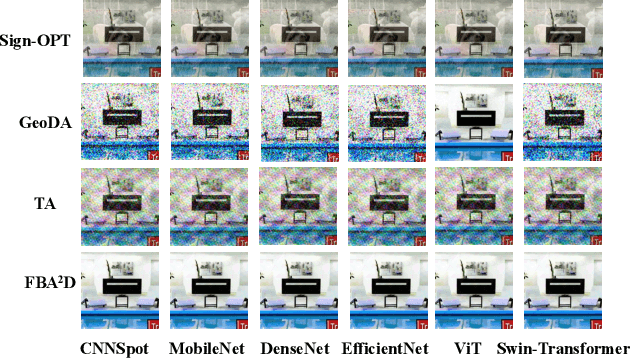
The prosperous development of Artificial Intelligence-Generated Content (AIGC) has brought people's anxiety about the spread of false information on social media. Designing detectors for filtering is an effective defense method, but most detectors will be compromised by adversarial samples. Currently, most studies exposing AIGC security issues assume information on model structure and data distribution. In real applications, attackers query and interfere with models that provide services in the form of application programming interfaces (APIs), which constitutes the black-box decision-based attack paradigm. However, to the best of our knowledge, decision-based attacks on AIGC detectors remain unexplored. In this study, we propose \textbf{FBA$^2$D}: a frequency-based black-box attack method for AIGC detection to fill the research gap. Motivated by frequency-domain discrepancies between generated and real images, we develop a decision-based attack that leverages the Discrete Cosine Transform (DCT) for fine-grained spectral partitioning and selects frequency bands as query subspaces, improving both query efficiency and image quality. Moreover, attacks on AIGC detectors should mitigate initialization failures, preserve image quality, and operate under strict query budgets. To address these issues, we adopt an ``adversarial example soup'' method, averaging candidates from successive surrogate iterations and using the result as the initialization to accelerate the query-based attack. The empirical study on the Synthetic LSUN dataset and GenImage dataset demonstrate the effectiveness of our prosed method. This study shows the urgency of addressing practical AIGC security problems.