 Add to Chrome
 Add to Firefox
 Add to Edge
Gradients Must Earn Their Influence: Unifying SFT with Generalized Entropic Objectives
Feb 11, 2026
Standard negative log-likelihood (NLL) for Supervised Fine-Tuning (SFT) applies uniform token-level weighting. This rigidity creates a two-fold failure mode: (i) overemphasizing low-probability targets can amplify gradients on noisy supervision and disrupt robust priors, and (ii) uniform weighting provides weak sharpening when the model is already confident. Existing methods fail to resolve the resulting plasticity--stability dilemma, often suppressing necessary learning signals alongside harmful ones. To address this issue, we unify token-level SFT objectives within a generalized deformed-log family and expose a universal gate $\times$ error gradient structure, where the gate controls how much the model trusts its current prediction. By employing the Cayley transform, we map the model's continuously evolving uncertainty onto a continuous focus trajectory, which enables seamless interpolation between scenarios involving uncertain novel concepts and those involving well-established knowledge. We then introduce Dynamic Entropy Fine-Tuning (DEFT), a parameter-free objective that modulates the trust gate using distribution concentration (Rényi-2 entropy) as a practical proxy for the model's predictive state. Extensive experiments and analyses demonstrate that DEFT achieves a better balance between exploration and exploitation, leading to improved overall performance.

RSRWKV: A Linear-Complexity 2D Attention Mechanism for Efficient Remote Sensing Vision Task
Mar 26, 2025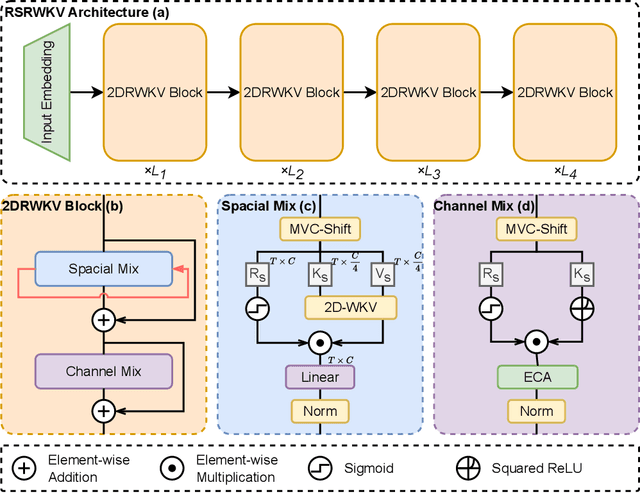
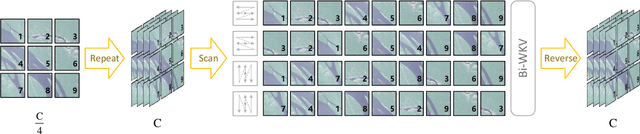
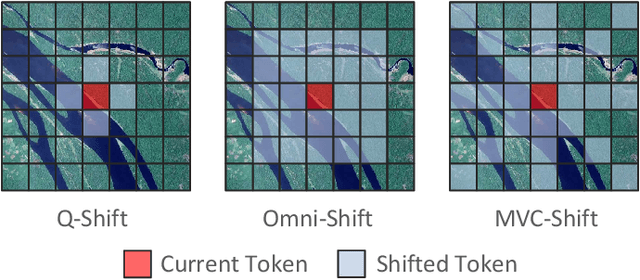
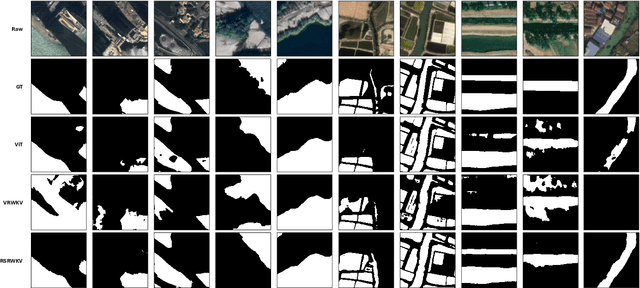
High-resolution remote sensing analysis faces challenges in global context modeling due to scene complexity and scale diversity. While CNNs excel at local feature extraction via parameter sharing, their fixed receptive fields fundamentally restrict long-range dependency modeling. Vision Transformers (ViTs) effectively capture global semantic relationships through self-attention mechanisms but suffer from quadratic computational complexity relative to image resolution, creating critical efficiency bottlenecks for high-resolution imagery. The RWKV model's linear-complexity sequence modeling achieves breakthroughs in NLP but exhibits anisotropic limitations in vision tasks due to its 1D scanning mechanism. To address these challenges, we propose RSRWKV, featuring a novel 2D-WKV scanning mechanism that bridges sequential processing and 2D spatial reasoning while maintaining linear complexity. This enables isotropic context aggregation across multiple directions. The MVC-Shift module enhances multi-scale receptive field coverage, while the ECA module strengthens cross-channel feature interaction and semantic saliency modeling. Experimental results demonstrate RSRWKV's superior performance over CNN and Transformer baselines in classification, detection, and segmentation tasks on NWPU RESISC45, VHR-10.v2, and GLH-Water datasets, offering a scalable solution for high-resolution remote sensing analysis.
Checkpoint Merging via Bayesian Optimization in LLM Pretraining
Mar 28, 2024The rapid proliferation of large language models (LLMs) such as GPT-4 and Gemini underscores the intense demand for resources during their training processes, posing significant challenges due to substantial computational and environmental costs. To alleviate this issue, we propose checkpoint merging in pretraining LLM. This method utilizes LLM checkpoints with shared training trajectories, and is rooted in an extensive search space exploration for the best merging weight via Bayesian optimization. Through various experiments, we demonstrate that: (1) Our proposed methodology exhibits the capacity to augment pretraining, presenting an opportunity akin to obtaining substantial benefits at minimal cost; (2) Our proposed methodology, despite requiring a given held-out dataset, still demonstrates robust generalization capabilities across diverse domains, a pivotal aspect in pretraining.