 Add to Chrome
 Add to Firefox
 Add to Edge
USP-Mamba: Unmixing-Derived Spectral and Structural Prompting for Hyperspectral Image Super-Resolution
Aug 03, 2026
Hyperspectral image super-resolution aims to reconstruct high-resolution imagery while preserving dense spectral information. Recently, Mamba-based models have shown promising potential for this task by capturing long-range dependencies with linear computational complexity. Nevertheless, their causal sequence modeling requires two-dimensional hyperspectral features to be unfolded along predefined scanning orders, which disrupts spatial adjacency and restricts the effective propagation of contextual information. Moreover, state-space parameterization of existing models is predominantly derived from generic learned representations, without explicit alignment with the intrinsic characteristics of the hyperspectral image. To address this issue, we propose an Unmixing-derived Spectral and Structural Prompting Mamba framework, termed USP-Mamba, which adapts Mamba state evolution through composition-aware spectral priors and image-dependent structural prompts. Specifically, an unmixing-informed spectral prompt captures the global material composition of the input image and provides persistent conditioning throughout reconstruction. Injected into the Mamba sequence and progressively adapted across layers, it steers state evolution toward composition-consistent reconstruction. We introduce feature-level structural prompts comprising spatial and frequency components to provide image-dependent local guidance. The spatial prompt promotes structure-sensitive state encoding for local detail preservation, while the frequency prompt enables region-adaptive transitions between homogeneous regions and high-frequency details. Finally, complementary Hilbert and Semantic-Guided Neighboring scans preserve spatial continuity and strengthen non-local semantic dependency modeling. Extensive experiments on different datasets demonstrate that the proposed method consistently outperforms representative approaches.

LegoQ: Density-Matrix Representation Learning with Spectral-Spatial State Transitions for Hyperspectral Classification
Jul 31, 2026Hyperspectral image classification is complicated by mixed pixels, spectral ambiguity, class imbalance, and limited annotations. Most current classifiers encode a pixel or patch as a deterministic vector and apply a linear or multilayer softmax head. Although effective for discrimination, this representation does not directly expose how mixed or uncertain a sample is. This paper presents \method, a classical density-matrix representation learning framework for hyperspectral images. The spectral bands are divided into groups and each group is mapped to a positive semi-definite, Hermitian, trace-normalized matrix state. A composable stack of spectral, spatial, and inter-group transitions then updates the states while repeatedly projecting them back to the valid state set. Instead of flattening the final features, \method\ aggregates the group states and compares them with learnable class-prototype density matrices through Uhlmann fidelity. The normalized eigenspectrum, von Neumann entropy, purity, and prototype fidelity provide sample-level diagnostics that are unavailable from a conventional vector head. On Indian Pines, ten runs yield an overall accuracy of $96.20\pm0.70\%$, an average accuracy of $95.57\pm1.29\%$, and a kappa coefficient of $95.66\pm0.80\%$. On WHU-Hi-LongKou, the best of ten runs reaches $97.52\%$ overall accuracy. Classification maps and feature projections show that the transition stack produces compact and better separated class structures. The results support constrained matrix-state learning as a practical alternative to vector-only hyperspectral classification without requiring quantum hardware.
Voronoi-guided Bilateral 2D Gaussian Splatting for Arbitrary-Scale Hyperspectral Image Super-Resolution
Apr 20, 2026Most existing hyperspectral image super-resolution methods require modifications for different scales, limiting their flexibility in arbitrary-scale reconstruction. 2D Gaussian splatting provides a continuous representation that is compatible with arbitrary-scale super-resolution. Existing methods often rely on rasterization strategies, which may limit flexible spatial modeling. Extending them to hyperspectral image super-resolution remains challenging, as the task requires adaptive spatial reconstruction while preserving spectral fidelity. This paper proposes GaussianHSI, a Gaussian-Splatting-based framework for arbitrary-scale hyperspectral image super-resolution. We develop a Voronoi-Guided Bilateral 2D Gaussian Splatting for spatial reconstruction. After predicting a set of Gaussian functions to represent the input, it associates each target pixel with relevant Gaussian functions through Voronoi-guided selection. The target pixel is then reconstructed by aggregating the selected Gaussian functions with reference-aware bilateral weighting, which considers both geometric relevance and consistency with low-resolution features. We further introduce a Spectral Detail Enhancement module to improve spectral reconstruction. Extensive experiments on benchmark datasets demonstrate the effectiveness of GaussianHSI over state-of-the-art methods for arbitrary-scale hyperspectral image super-resolution.
MEMO: Human-like Crisp Edge Detection Using Masked Edge Prediction
Mar 21, 2026Learning-based edge detection models trained with cross-entropy loss often suffer from thick edge predictions, which deviate from the crisp, single-pixel annotations typically provided by humans. While previous approaches to achieving crisp edges have focused on designing specialized loss functions or modifying network architectures, we show that a carefully designed training and inference strategy alone is sufficient to achieve human-like edge quality. In this work, we introduce the Masked Edge Prediction MOdel (MEMO), which produces both accurate and crisp edges using only cross-entropy loss. We first construct a large-scale synthetic edge dataset to pre-train MEMO, enhancing its generalization ability. Subsequent fine-tuning on downstream datasets requires only a lightweight module comprising 1.2\% additional parameters. During training, MEMO learns to predict edges under varying ratios of input masking. A key insight guiding our inference is that thick edge predictions typically exhibit a confidence gradient: high in the center and lower toward the boundaries. Leveraging this, we propose a novel progressive prediction strategy that sequentially finalizes edge predictions in order of prediction confidence, resulting in thinner and more precise contours. Our method achieves visually appealing, post-processing-free, human-like edge maps and outperforms prior methods on crispness-aware evaluations.
Towards Generalized Multimodal Homography Estimation
Mar 04, 2026Supervised and unsupervised homography estimation methods depend on image pairs tailored to specific modalities to achieve high accuracy. However, their performance deteriorates substantially when applied to unseen modalities. To address this issue, we propose a training data synthesis method that generates unaligned image pairs with ground-truth offsets from a single input image. Our approach renders the image pairs with diverse textures and colors while preserving their structural information. These synthetic data empower the trained model to achieve greater robustness and improved generalization across various domains. Additionally, we design a network to fully leverage cross-scale information and decouple color information from feature representations, thus improving estimation accuracy. Extensive experiments show that our training data synthesis method improves generalization performance. The results also confirm the effectiveness of the proposed network.
Dense Cross-Scale Image Alignment With Fully Spatial Correlation and Just Noticeable Difference Guidance
Nov 12, 2025Existing unsupervised image alignment methods exhibit limited accuracy and high computational complexity. To address these challenges, we propose a dense cross-scale image alignment model. It takes into account the correlations between cross-scale features to decrease the alignment difficulty. Our model supports flexible trade-offs between accuracy and efficiency by adjusting the number of scales utilized. Additionally, we introduce a fully spatial correlation module to further improve accuracy while maintaining low computational costs. We incorporate the just noticeable difference to encourage our model to focus on image regions more sensitive to distortions, eliminating noticeable alignment errors. Extensive quantitative and qualitative experiments demonstrate that our method surpasses state-of-the-art approaches.
Quaternion Infrared Visible Image Fusion
May 05, 2025Visible images provide rich details and color information only under well-lighted conditions while infrared images effectively highlight thermal targets under challenging conditions such as low visibility and adverse weather. Infrared-visible image fusion aims to integrate complementary information from infrared and visible images to generate a high-quality fused image. Existing methods exhibit critical limitations such as neglecting color structure information in visible images and performance degradation when processing low-quality color-visible inputs. To address these issues, we propose a quaternion infrared-visible image fusion (QIVIF) framework to generate high-quality fused images completely in the quaternion domain. QIVIF proposes a quaternion low-visibility feature learning model to adaptively extract salient thermal targets and fine-grained texture details from input infrared and visible images respectively under diverse degraded conditions. QIVIF then develops a quaternion adaptive unsharp masking method to adaptively improve high-frequency feature enhancement with balanced illumination. QIVIF further proposes a quaternion hierarchical Bayesian fusion model to integrate infrared saliency and enhanced visible details to obtain high-quality fused images. Extensive experiments across diverse datasets demonstrate that our QIVIF surpasses state-of-the-art methods under challenging low-visibility conditions.
Quaternion Multi-focus Color Image Fusion
May 05, 2025Multi-focus color image fusion refers to integrating multiple partially focused color images to create a single all-in-focus color image. However, existing methods struggle with complex real-world scenarios due to limitations in handling color information and intricate textures. To address these challenges, this paper proposes a quaternion multi-focus color image fusion framework to perform high-quality color image fusion completely in the quaternion domain. This framework introduces 1) a quaternion sparse decomposition model to jointly learn fine-scale image details and structure information of color images in an iterative fashion for high-precision focus detection, 2) a quaternion base-detail fusion strategy to individually fuse base-scale and detail-scale results across multiple color images for preserving structure and detail information, and 3) a quaternion structural similarity refinement strategy to adaptively select optimal patches from initial fusion results and obtain the final fused result for preserving fine details and ensuring spatially consistent outputs. Extensive experiments demonstrate that the proposed framework outperforms state-of-the-art methods.
DCT-Mamba3D: Spectral Decorrelation and Spatial-Spectral Feature Extraction for Hyperspectral Image Classification
Feb 04, 2025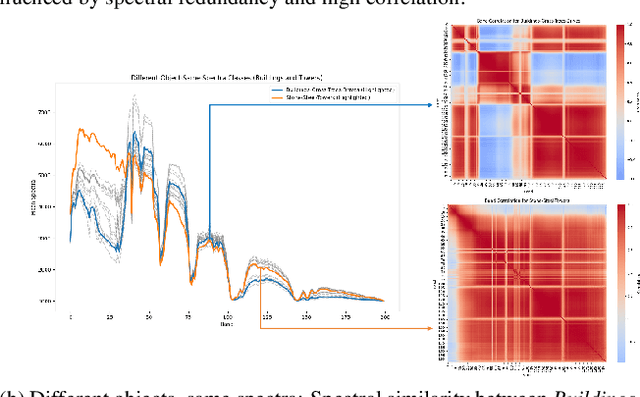
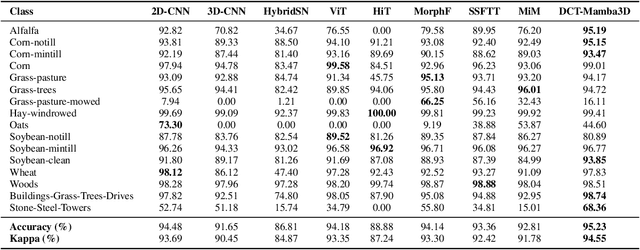


Hyperspectral image classification presents challenges due to spectral redundancy and complex spatial-spectral dependencies. This paper proposes a novel framework, DCT-Mamba3D, for hyperspectral image classification. DCT-Mamba3D incorporates: (1) a 3D spectral-spatial decorrelation module that applies 3D discrete cosine transform basis functions to reduce both spectral and spatial redundancy, enhancing feature clarity across dimensions; (2) a 3D-Mamba module that leverages a bidirectional state-space model to capture intricate spatial-spectral dependencies; and (3) a global residual enhancement module that stabilizes feature representation, improving robustness and convergence. Extensive experiments on benchmark datasets show that our DCT-Mamba3D outperforms the state-of-the-art methods in challenging scenarios such as the same object in different spectra and different objects in the same spectra.
Highly Efficient Rotation-Invariant Spectral Embedding for Scalable Incomplete Multi-View Clustering
Jan 21, 2025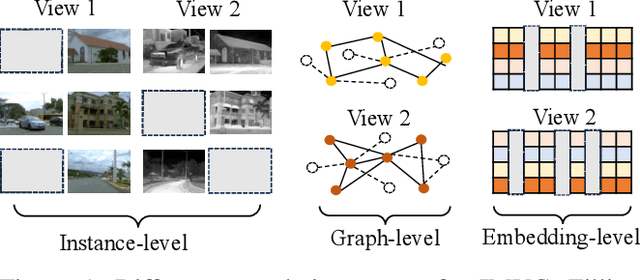
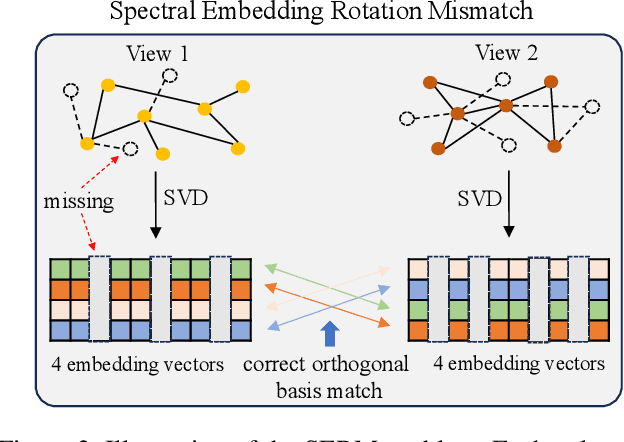
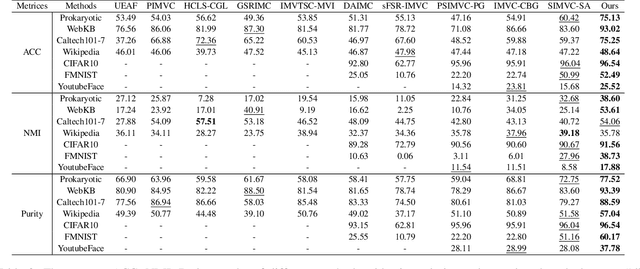
Incomplete multi-view clustering presents significant challenges due to missing views. Although many existing graph-based methods aim to recover missing instances or complete similarity matrices with promising results, they still face several limitations: (1) Recovered data may be unsuitable for spectral clustering, as these methods often ignore guidance from spectral analysis; (2) Complex optimization processes require high computational burden, hindering scalability to large-scale problems; (3) Most methods do not address the rotational mismatch problem in spectral embeddings. To address these issues, we propose a highly efficient rotation-invariant spectral embedding (RISE) method for scalable incomplete multi-view clustering. RISE learns view-specific embeddings from incomplete bipartite graphs to capture the complementary information. Meanwhile, a complete consensus representation with second-order rotation-invariant property is recovered from these incomplete embeddings in a unified model. Moreover, we design a fast alternating optimization algorithm with linear complexity and promising convergence to solve the proposed formulation. Extensive experiments on multiple datasets demonstrate the effectiveness, scalability, and efficiency of RISE compared to the state-of-the-art methods.