 Add to Chrome
 Add to Firefox
 Add to Edge
Exploiting Memory-aware Q-distribution Prediction for Nuclear Fusion via Modern Hopfield Network
Oct 11, 2024
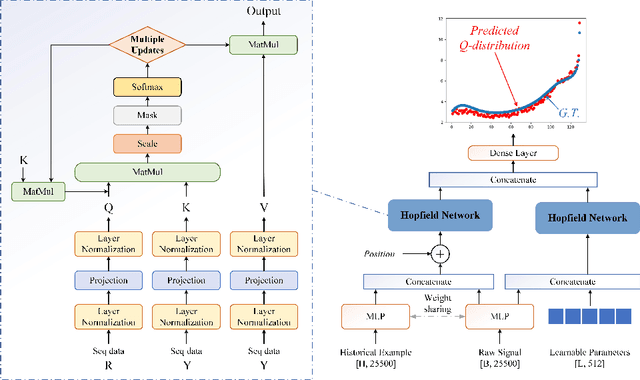
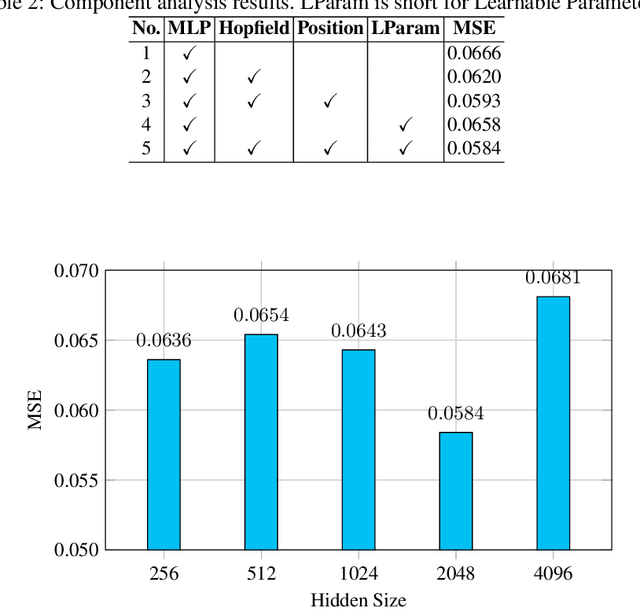
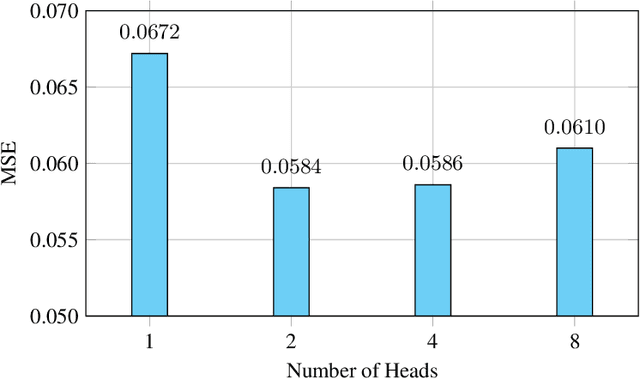
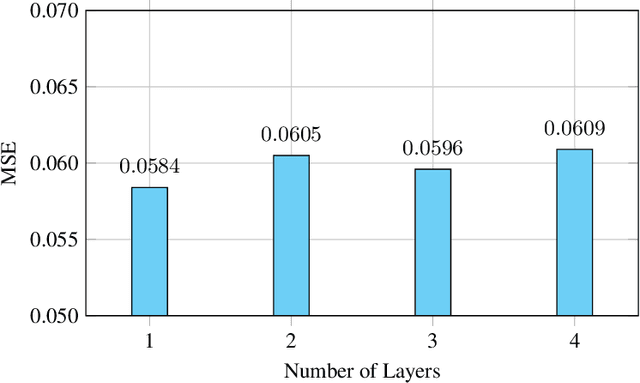
This study addresses the critical challenge of predicting the Q-distribution in long-term stable nuclear fusion task, a key component for advancing clean energy solutions. We introduce an innovative deep learning framework that employs Modern Hopfield Networks to incorporate associative memory from historical shots. Utilizing a newly compiled dataset, we demonstrate the effectiveness of our approach in enhancing Q-distribution prediction. The proposed method represents a significant advancement by leveraging historical memory information for the first time in this context, showcasing improved prediction accuracy and contributing to the optimization of nuclear fusion research.

SNN-PAR: Energy Efficient Pedestrian Attribute Recognition via Spiking Neural Networks
Oct 10, 2024Artificial neural network based Pedestrian Attribute Recognition (PAR) has been widely studied in recent years, despite many progresses, however, the energy consumption is still high. To address this issue, in this paper, we propose a Spiking Neural Network (SNN) based framework for energy-efficient attribute recognition. Specifically, we first adopt a spiking tokenizer module to transform the given pedestrian image into spiking feature representations. Then, the output will be fed into the spiking Transformer backbone networks for energy-efficient feature extraction. We feed the enhanced spiking features into a set of feed-forward networks for pedestrian attribute recognition. In addition to the widely used binary cross-entropy loss function, we also exploit knowledge distillation from the artificial neural network to the spiking Transformer network for more accurate attribute recognition. Extensive experiments on three widely used PAR benchmark datasets fully validated the effectiveness of our proposed SNN-PAR framework. The source code of this paper is released on \url{https://github.com/Event-AHU/OpenPAR}.
HeGraphAdapter: Tuning Multi-Modal Vision-Language Models with Heterogeneous Graph Adapter
Oct 10, 2024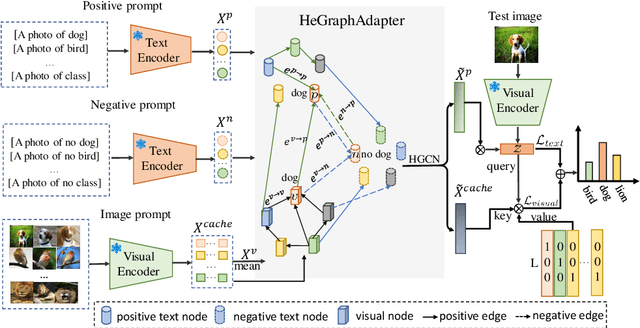
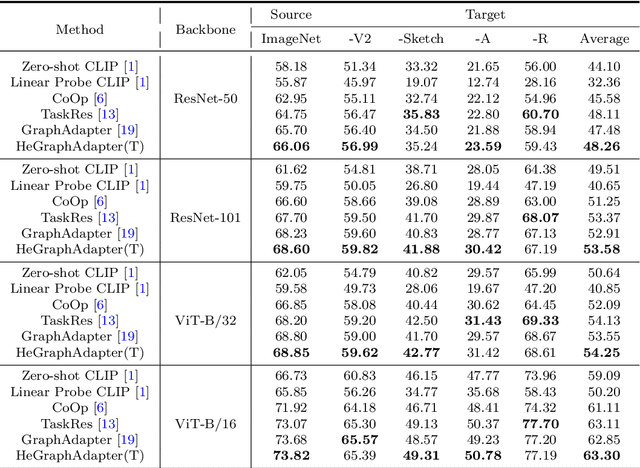
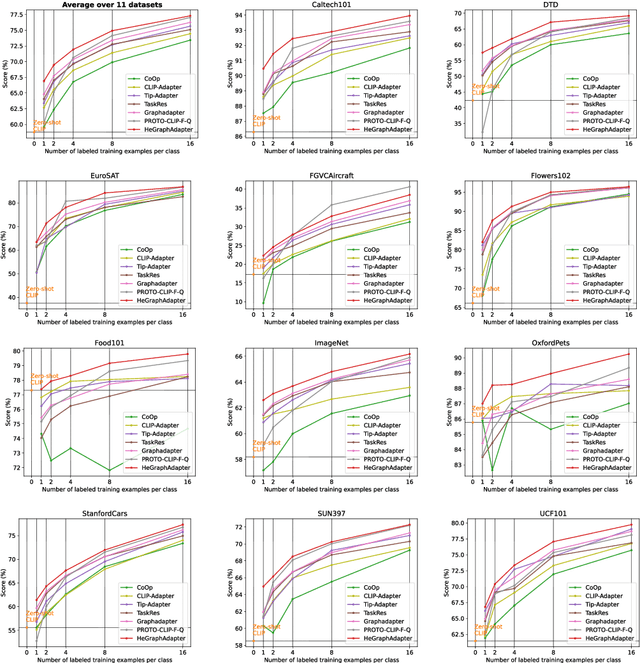
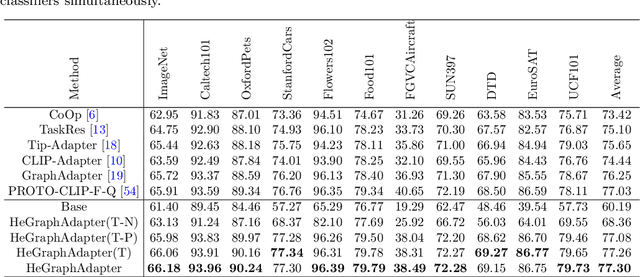
Adapter-based tuning methods have shown significant potential in transferring knowledge from pre-trained Vision-Language Models to the downstream tasks. However, after reviewing existing adapters, we find they generally fail to fully explore the interactions between different modalities in constructing task-specific knowledge. Also, existing works usually only focus on similarity matching between positive text prompts, making it challenging to distinguish the classes with high similar visual contents. To address these issues, in this paper, we propose a novel Heterogeneous Graph Adapter to achieve tuning VLMs for the downstream tasks. To be specific, we first construct a unified heterogeneous graph mode, which contains i) visual nodes, positive text nodes and negative text nodes, and ii) several types of edge connections to comprehensively model the intra-modality, inter-modality and inter-class structure knowledge together. Next, we employ a specific Heterogeneous Graph Neural Network to excavate multi-modality structure knowledge for adapting both visual and textual features for the downstream tasks. Finally, after HeGraphAdapter, we construct both text-based and visual-based classifiers simultaneously to comprehensively enhance the performance of the CLIP model. Experimental results on 11 benchmark datasets demonstrate the effectiveness and benefits of the proposed HeGraphAdapter.
CXPMRG-Bench: Pre-training and Benchmarking for X-ray Medical Report Generation on CheXpert Plus Dataset
Oct 01, 2024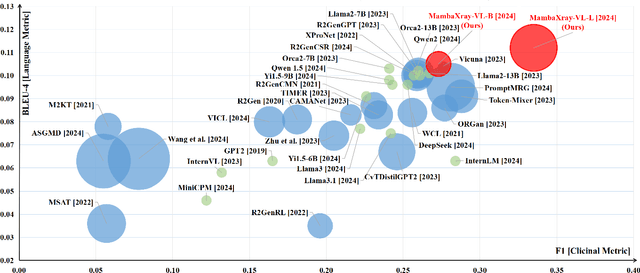
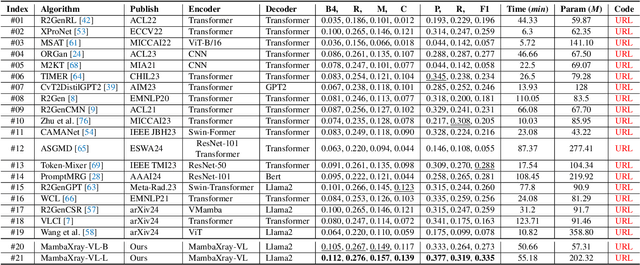
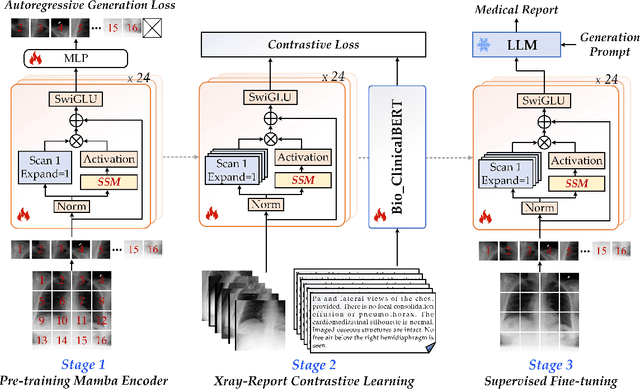
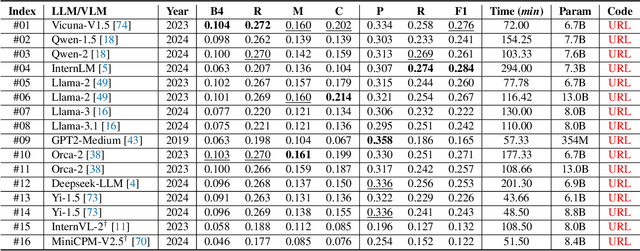
X-ray image-based medical report generation (MRG) is a pivotal area in artificial intelligence which can significantly reduce diagnostic burdens and patient wait times. Despite significant progress, we believe that the task has reached a bottleneck due to the limited benchmark datasets and the existing large models' insufficient capability enhancements in this specialized domain. Specifically, the recently released CheXpert Plus dataset lacks comparative evaluation algorithms and their results, providing only the dataset itself. This situation makes the training, evaluation, and comparison of subsequent algorithms challenging. Thus, we conduct a comprehensive benchmarking of existing mainstream X-ray report generation models and large language models (LLMs), on the CheXpert Plus dataset. We believe that the proposed benchmark can provide a solid comparative basis for subsequent algorithms and serve as a guide for researchers to quickly grasp the state-of-the-art models in this field. More importantly, we propose a large model for the X-ray image report generation using a multi-stage pre-training strategy, including self-supervised autoregressive generation and Xray-report contrastive learning, and supervised fine-tuning. Extensive experimental results indicate that the autoregressive pre-training based on Mamba effectively encodes X-ray images, and the image-text contrastive pre-training further aligns the feature spaces, achieving better experimental results. Source code can be found on \url{https://github.com/Event-AHU/Medical_Image_Analysis}.
Video DataFlywheel: Resolving the Impossible Data Trinity in Video-Language Understanding
Sep 29, 2024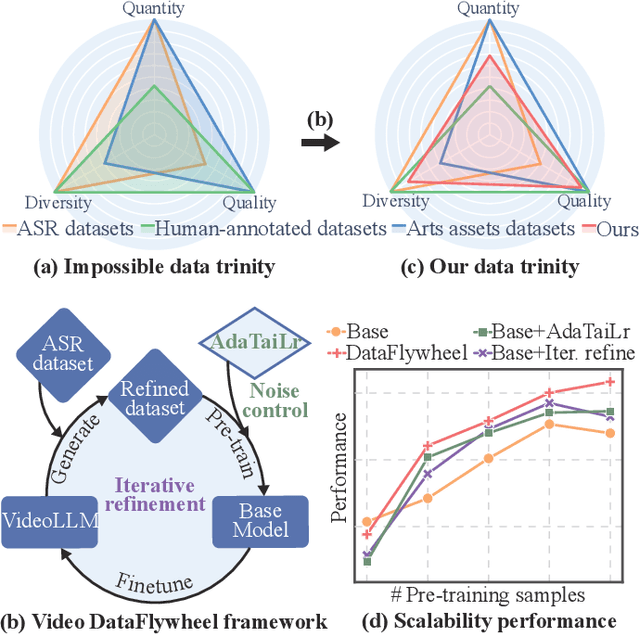
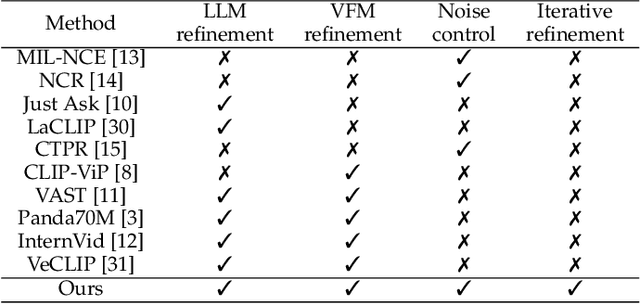
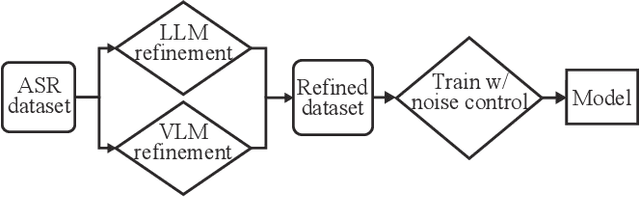

Recently, video-language understanding has achieved great success through large-scale pre-training. However, data scarcity remains a prevailing challenge. This study quantitatively reveals an "impossible trinity" among data quantity, diversity, and quality in pre-training datasets. Recent efforts seek to refine large-scale, diverse ASR datasets compromised by low quality through synthetic annotations. These methods successfully leverage useful information in multimodal video content (frames, tags, ASR transcripts, etc.) to refine the original annotations. Nevertheless, they struggle to mitigate noise within synthetic annotations and lack scalability as the dataset size expands. To address these issues, we introduce the Video DataFlywheel framework, which iteratively refines video annotations with improved noise control methods. For iterative refinement, we first leverage a video-language model to generate synthetic annotations, resulting in a refined dataset. Then, we pre-train on it and fine-tune on human refinement examples for a stronger model. These processes are repeated for continuous improvement. For noise control, we present AdaTaiLr, a novel noise control method that requires weaker assumptions on noise distribution, thereby proving more effective in large datasets with theoretical guarantees. The combination of iterative refinement and AdaTaiLr can achieve better scalability in video-language understanding. Extensive experiments show that our framework outperforms existing data refinement baselines, delivering a 3% performance boost and improving dataset quality with minimal diversity loss. Furthermore, our refined dataset facilitates significant improvements in various video-language understanding tasks, including video question answering and text-video retrieval.
Adaptive Learning of the Latent Space of Wasserstein Generative Adversarial Networks
Sep 27, 2024Generative models based on latent variables, such as generative adversarial networks (GANs) and variational auto-encoders (VAEs), have gained lots of interests due to their impressive performance in many fields. However, many data such as natural images usually do not populate the ambient Euclidean space but instead reside in a lower-dimensional manifold. Thus an inappropriate choice of the latent dimension fails to uncover the structure of the data, possibly resulting in mismatch of latent representations and poor generative qualities. Towards addressing these problems, we propose a novel framework called the latent Wasserstein GAN (LWGAN) that fuses the Wasserstein auto-encoder and the Wasserstein GAN so that the intrinsic dimension of the data manifold can be adaptively learned by a modified informative latent distribution. We prove that there exist an encoder network and a generator network in such a way that the intrinsic dimension of the learned encoding distribution is equal to the dimension of the data manifold. We theoretically establish that our estimated intrinsic dimension is a consistent estimate of the true dimension of the data manifold. Meanwhile, we provide an upper bound on the generalization error of LWGAN, implying that we force the synthetic data distribution to be similar to the real data distribution from a population perspective. Comprehensive empirical experiments verify our framework and show that LWGAN is able to identify the correct intrinsic dimension under several scenarios, and simultaneously generate high-quality synthetic data by sampling from the learned latent distribution.
Ig3D: Integrating 3D Face Representations in Facial Expression Inference
Aug 29, 2024Reconstructing 3D faces with facial geometry from single images has allowed for major advances in animation, generative models, and virtual reality. However, this ability to represent faces with their 3D features is not as fully explored by the facial expression inference (FEI) community. This study therefore aims to investigate the impacts of integrating such 3D representations into the FEI task, specifically for facial expression classification and face-based valence-arousal (VA) estimation. To accomplish this, we first assess the performance of two 3D face representations (both based on the 3D morphable model, FLAME) for the FEI tasks. We further explore two fusion architectures, intermediate fusion and late fusion, for integrating the 3D face representations with existing 2D inference frameworks. To evaluate our proposed architecture, we extract the corresponding 3D representations and perform extensive tests on the AffectNet and RAF-DB datasets. Our experimental results demonstrate that our proposed method outperforms the state-of-the-art AffectNet VA estimation and RAF-DB classification tasks. Moreover, our method can act as a complement to other existing methods to boost performance in many emotion inference tasks.
Hierarchical Graph Interaction Transformer with Dynamic Token Clustering for Camouflaged Object Detection
Aug 27, 2024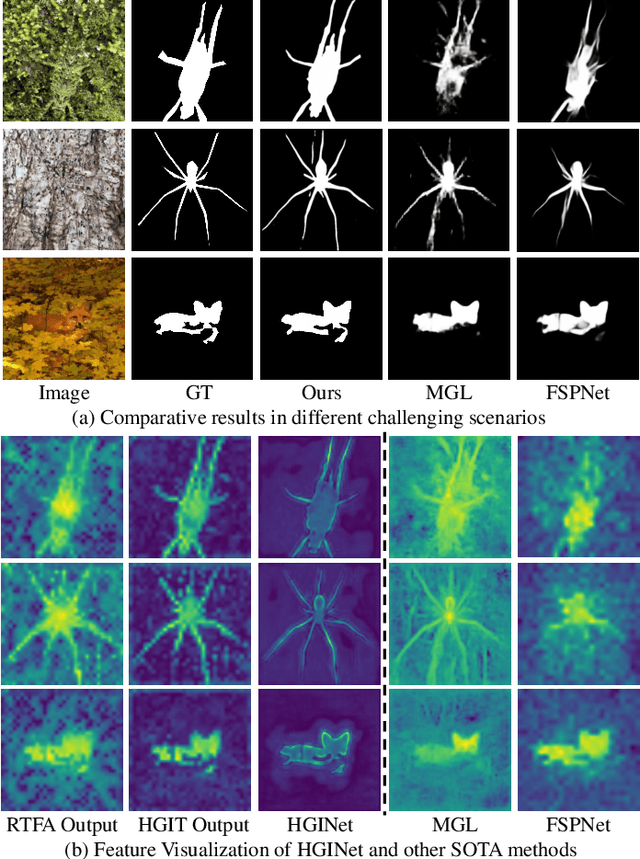
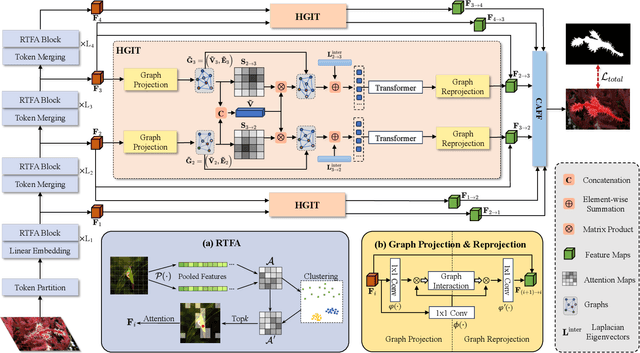
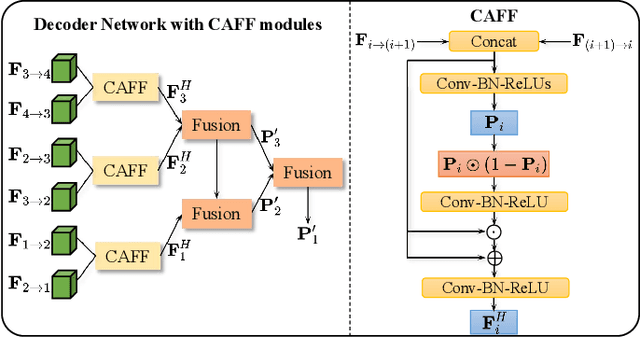
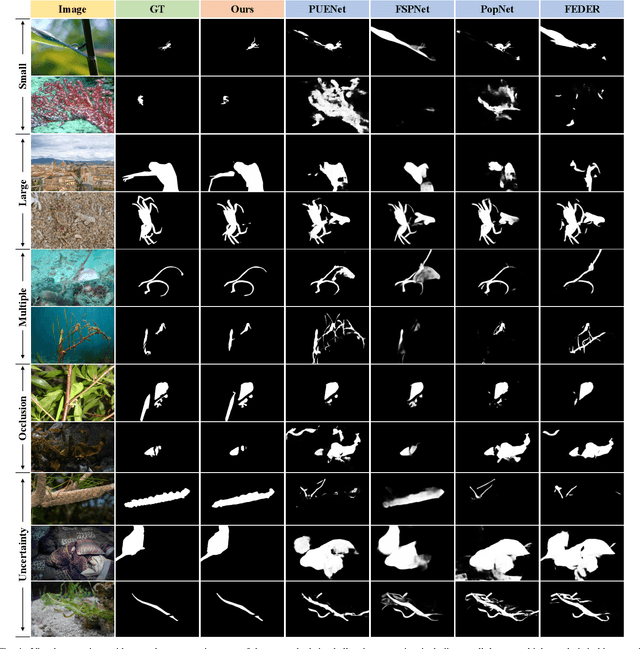
Camouflaged object detection (COD) aims to identify the objects that seamlessly blend into the surrounding backgrounds. Due to the intrinsic similarity between the camouflaged objects and the background region, it is extremely challenging to precisely distinguish the camouflaged objects by existing approaches. In this paper, we propose a hierarchical graph interaction network termed HGINet for camouflaged object detection, which is capable of discovering imperceptible objects via effective graph interaction among the hierarchical tokenized features. Specifically, we first design a region-aware token focusing attention (RTFA) with dynamic token clustering to excavate the potentially distinguishable tokens in the local region. Afterwards, a hierarchical graph interaction transformer (HGIT) is proposed to construct bi-directional aligned communication between hierarchical features in the latent interaction space for visual semantics enhancement. Furthermore, we propose a decoder network with confidence aggregated feature fusion (CAFF) modules, which progressively fuses the hierarchical interacted features to refine the local detail in ambiguous regions. Extensive experiments conducted on the prevalent datasets, i.e. COD10K, CAMO, NC4K and CHAMELEON demonstrate the superior performance of HGINet compared to existing state-of-the-art methods. Our code is available at https://github.com/Garyson1204/HGINet.
VFM-Det: Towards High-Performance Vehicle Detection via Large Foundation Models
Aug 23, 2024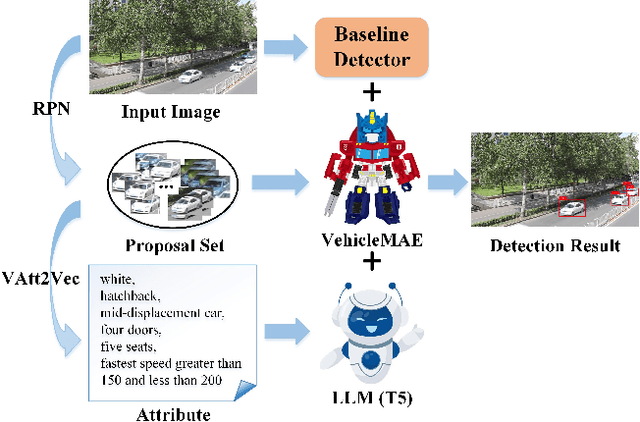
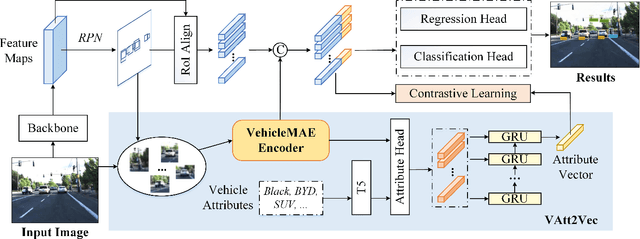
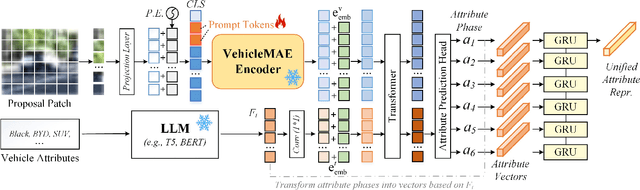
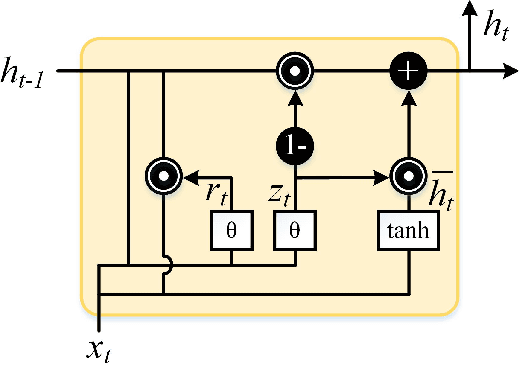
Existing vehicle detectors are usually obtained by training a typical detector (e.g., YOLO, RCNN, DETR series) on vehicle images based on a pre-trained backbone (e.g., ResNet, ViT). Some researchers also exploit and enhance the detection performance using pre-trained large foundation models. However, we think these detectors may only get sub-optimal results because the large models they use are not specifically designed for vehicles. In addition, their results heavily rely on visual features, and seldom of they consider the alignment between the vehicle's semantic information and visual representations. In this work, we propose a new vehicle detection paradigm based on a pre-trained foundation vehicle model (VehicleMAE) and a large language model (T5), termed VFM-Det. It follows the region proposal-based detection framework and the features of each proposal can be enhanced using VehicleMAE. More importantly, we propose a new VAtt2Vec module that predicts the vehicle semantic attributes of these proposals and transforms them into feature vectors to enhance the vision features via contrastive learning. Extensive experiments on three vehicle detection benchmark datasets thoroughly proved the effectiveness of our vehicle detector. Specifically, our model improves the baseline approach by $+5.1\%$, $+6.2\%$ on the $AP_{0.5}$, $AP_{0.75}$ metrics, respectively, on the Cityscapes dataset.The source code of this work will be released at https://github.com/Event-AHU/VFM-Det.
Optimizing Transmit Field Inhomogeneity of Parallel RF Transmit Design in 7T MRI using Deep Learning
Aug 21, 2024Ultrahigh field (UHF) Magnetic Resonance Imaging (MRI) provides a higher signal-to-noise ratio and, thereby, higher spatial resolution. However, UHF MRI introduces challenges such as transmit radiofrequency (RF) field (B1+) inhomogeneities, leading to uneven flip angles and image intensity anomalies. These issues can significantly degrade imaging quality and its medical applications. This study addresses B1+ field homogeneity through a novel deep learning-based strategy. Traditional methods like Magnitude Least Squares (MLS) optimization have been effective but are time-consuming and dependent on the patient's presence. Recent machine learning approaches, such as RF Shim Prediction by Iteratively Projected Ridge Regression and deep learning frameworks, have shown promise but face limitations like extensive training times and oversimplified architectures. We propose a two-step deep learning strategy. First, we obtain the desired reference RF shimming weights from multi-channel B1+ fields using random-initialized Adaptive Moment Estimation. Then, we employ Residual Networks (ResNets) to train a model that maps B1+ fields to target RF shimming outputs. Our approach does not rely on pre-calculated reference optimizations for the testing process and efficiently learns residual functions. Comparative studies with traditional MLS optimization demonstrate our method's advantages in terms of speed and accuracy. The proposed strategy achieves a faster and more efficient RF shimming design, significantly improving imaging quality at UHF. This advancement holds potential for broader applications in medical imaging and diagnostics.