 Add to Chrome
 Add to Firefox
 Add to Edge
MQAdapter: Multi-Modal Quantum Adapter for Coarse-to-Fine VLM Fine-tuning
Jul 14, 2026
Large-scale Vision-Language Models have demonstrated impressive transfer learning capabilities across a wide range of tasks. For few-shot classification, we observe that VLMs exhibit a notable ability to filter candidate categories and thus achieve high Top-K accuracy. However, they often struggle with fine-grained discrimination among visually similar categories, resulting in unsatisfactory Top-1 performance, as shown in Figure 1. Existing studies on VLM adapters generally focus on global alignment between visual and textual representations in the feature space, but fail to exploit semantically similar categories to refine fine-grained visual representations. Based on these observations, we propose a novel coarse-to-fine VLM fine-tuning approach for few-shot learning that leverages quantum computation, termed the Multi-Modal Quantum Adapter (MQAdapter). Specifically, MQAdapter first retrieves the Top-K category candidates most similar to the input image and uses them as semantic anchors. It then employs a cross-modal quantum learning mechanism to refine visual features under the guidance of these anchors. The core of this mechanism is the encoding of visual and textual features into quantum states. By leveraging quantum entanglement and superposition in a high-dimensional Hilbert space, MQAdapter effectively models higher-order cross-modal interactions, producing more discriminative representations than traditional Euclidean adapters. MQAdapter is parameter-efficient and can be integrated with various existing fine-tuning algorithms to achieve further performance gains. Evaluations on 15 datasets demonstrate the effectiveness of MQAdapter while requiring fewer trainable parameters.

Beyond Low-Rank: Low-Rank Sparse Prompting via Spiking Neural Network and Prompt Factorization
Jun 01, 2026Visual Prompting (VP) has emerged as an efficient paradigm for adapting large-scale pre-trained vision models to downstream tasks by incorporating learnable prompts at the input level. However, existing VP methods typically employ dense pixel-level prompts, which often suffer from redundant perturbations, limited generalization and energy inefficiency. To overcome these limitations, we propose to integrate brain-inspired spiking learning into visual prompt learning tasks. As we know that spiking neuron can perform inexpensive information processing by transmitting the input data into discrete spike trains and return sparse outputs. Inspired by this, we propose \textbf{Lo}w-\textbf{R}ank visual \textbf{S}pike \textbf{P}rompting (LoRSP), a novel framework that learns dynamic low-rank sparse visual prompts naturally via a Spiking neuron learning mechanism. The core idea of LoRSP is to exploit the brain-inspired sparse firing mechanism of spiking neurons to generate pixel-level sparse prompt for each instance. To be specific, we first construct a series of prompt factors via low-rank factorization to capture distinct prompt subspaces. These prompt factors are then fed into an SNN architecture, which performs the integrate-and-fire process to emit spikes. As a result, our LoRSP generates a \emph{sparse} visual prompt while maintaining the low-rank constraint. This design enables instance-specific selective prompting, leading to more compact and robust adaptation across diverse downstream tasks. Extensive experiments on five heterogeneous vision backbones and multiple benchmarks demonstrate that LoRSP achieves competitive performance while requiring fewer tunable parameters compared to existing VP methods.
HeGraphAdapter: Tuning Multi-Modal Vision-Language Models with Heterogeneous Graph Adapter
Oct 10, 2024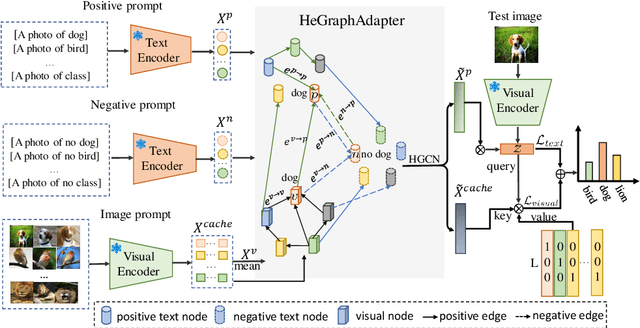
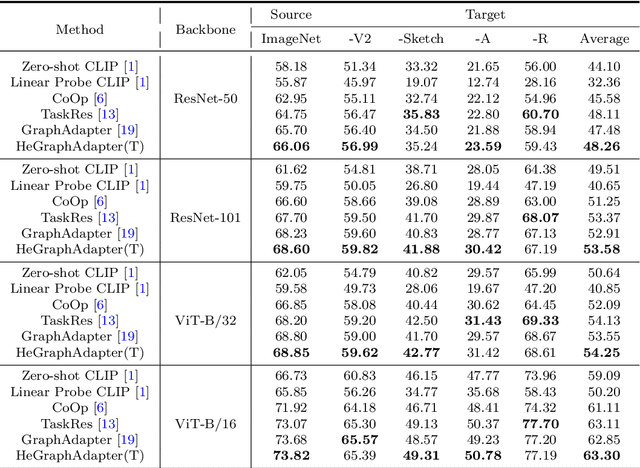
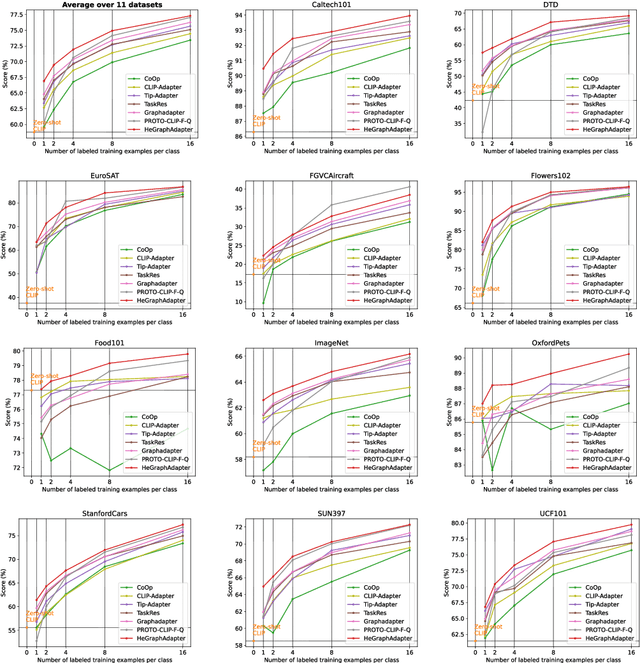
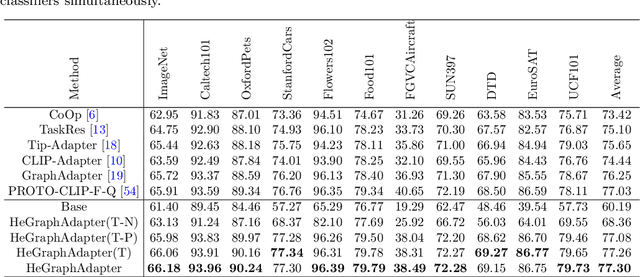
Adapter-based tuning methods have shown significant potential in transferring knowledge from pre-trained Vision-Language Models to the downstream tasks. However, after reviewing existing adapters, we find they generally fail to fully explore the interactions between different modalities in constructing task-specific knowledge. Also, existing works usually only focus on similarity matching between positive text prompts, making it challenging to distinguish the classes with high similar visual contents. To address these issues, in this paper, we propose a novel Heterogeneous Graph Adapter to achieve tuning VLMs for the downstream tasks. To be specific, we first construct a unified heterogeneous graph mode, which contains i) visual nodes, positive text nodes and negative text nodes, and ii) several types of edge connections to comprehensively model the intra-modality, inter-modality and inter-class structure knowledge together. Next, we employ a specific Heterogeneous Graph Neural Network to excavate multi-modality structure knowledge for adapting both visual and textual features for the downstream tasks. Finally, after HeGraphAdapter, we construct both text-based and visual-based classifiers simultaneously to comprehensively enhance the performance of the CLIP model. Experimental results on 11 benchmark datasets demonstrate the effectiveness and benefits of the proposed HeGraphAdapter.