 Add to Chrome
 Add to Firefox
 Add to Edge
TOUR: A Trajectory-Level Unlearning Benchmark for Offline Reinforcement Learning
Jul 23, 2026
Offline Reinforcement Learning (RL) agents are trained on fixed behavioral trajectories, which makes trajectory-level deletion important when selected data must be removed after training. Evaluating such deletion is difficult because a lower membership score can reflect trajectory removal, residual memorization visible to another attack, or policy collapse that destroys useful behavior. We introduce Trajectory-level memOrization and Unlearning in offline RL (TOUR), a benchmark that combines trajectory-level partitioning, matched non-member controls, retraining references, retained-performance anchors, and multi-attack privacy auditing. Across D4RL locomotion experiments and an exploratory AntMaze extension, TOUR shows that common deletion baselines have environment-dependent privacy-utility behavior. Retraining and fine-tuning often provide stronger retained-utility references than uniform GA+Refit, while TrajDeleter remains a useful comparator but is not uniformly stronger under the same audit. Reference-model, threshold, deviation, equivalence, action-error, representation-based, and query-limited attacks further show that a single likelihood-based membership score can overstate deletion quality. In the evaluated settings, conclusions about offline RL unlearning are therefore not stable under single-score auditing. They depend on matched non-member construction, retraining-relative calibration, attack family, retained utility, and explicit scope for diagnostic architecture or component-level evidence.

LQCDMaster: Agentic Scientific Computing for Lattice Quantum Chromodynamics Research
Jul 16, 2026Lattice quantum chromodynamics (LQCD) provides a first-principles framework for computing hadronic observables, but its practical use remains limited by the substantial expertise required to turn research motivation into reliable computing workflows. Here we present \textsc{LQCDMaster}, a tool-augmented, skill-guided and domain-specialized scientific computing agent that converts natural-language LQCD research tasks into executable PyQUDA computing workflows, including measurement scripts, job-submission artifacts, execution logs and numerical outputs. The system combines agentic planning, expert-annotated LQCD skills and a deterministic Wick-contraction tool to constrain the algebraically fragile components of code generation. We evaluate \textsc{LQCDMaster} on a benchmark at the forefront of scientific research, comprising 70 LQCD computing tasks, with observables covering local and nonlocal two-point functions, Wilson loops, meson and baryon three-point functions. The generated workflows exactly reproduce expert-written implementations in 63 of 70 tasks at machine precision, with three additional discrepancies attributable to convention mismatches. Across representative observables, the agent reduces implementation time from hours to minutes while preserving end-to-end numerical validation. Further, we present a typical case of \textsc{LQCDMaster}-driven exploration: a lattice computation of light-cone distribution amplitudes with diagonal Wilson-line, a quantity accessible with standard methods but never before computed, and computation of the spectrum of proton, deuteron, triton, hyperon, hyperdeuteron and hypertriton. This work pioneers the paradigm of agentic scientific computing by automating the end-to-end scientific computing workflows in lattice QCD research, lowering its barrier and facilitating the exploration and verification of non-standard scientific ideas.
Geographical Information Alignment Boosts Traffic Analysis via Transpose Cross-attention
Dec 03, 2024Traffic accident prediction is crucial for enhancing road safety and mitigating congestion, and recent Graph Neural Networks (GNNs) have shown promise in modeling the inherent graph-based traffic data. However, existing GNN- based approaches often overlook or do not explicitly exploit geographic position information, which often plays a critical role in understanding spatial dependencies. This is also aligned with our observation, where accident locations are often highly relevant. To address this issue, we propose a plug-in-and-play module for common GNN frameworks, termed Geographic Information Alignment (GIA). This module can efficiently fuse the node feature and geographic position information through a novel Transpose Cross-attention mechanism. Due to the large number of nodes for traffic data, the conventional cross-attention mechanism performing the node-wise alignment may be infeasible in computation-limited resources. Instead, we take the transpose operation for Query, Key, and Value in the Cross-attention mechanism, which substantially reduces the computation cost while maintaining sufficient information. Experimental results for both traffic occurrence prediction and severity prediction (severity levels based on the interval of recorded crash counts) on large-scale city-wise datasets confirm the effectiveness of our proposed method. For example, our method can obtain gains ranging from 1.3% to 10.9% in F1 score and 0.3% to 4.8% in AUC.
SiDA: Sparsity-Inspired Data-Aware Serving for Efficient and Scalable Large Mixture-of-Experts Models
Oct 29, 2023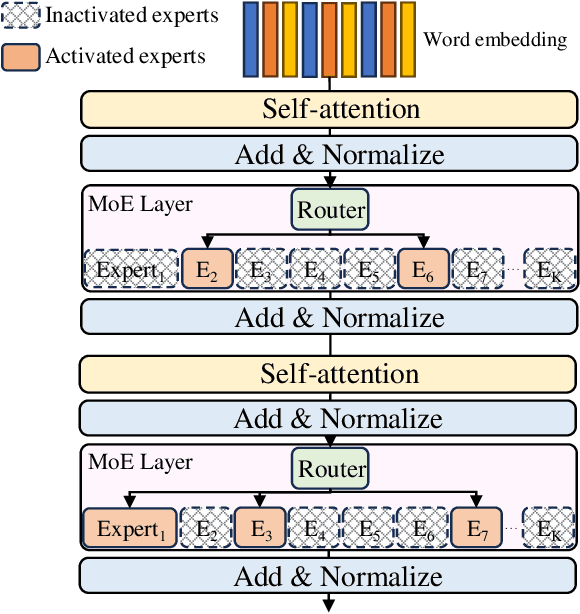
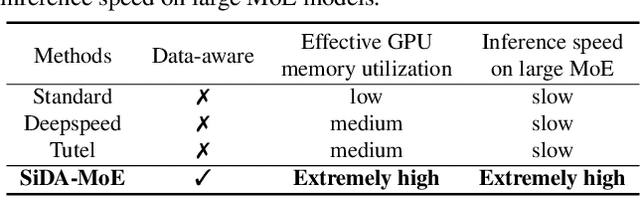
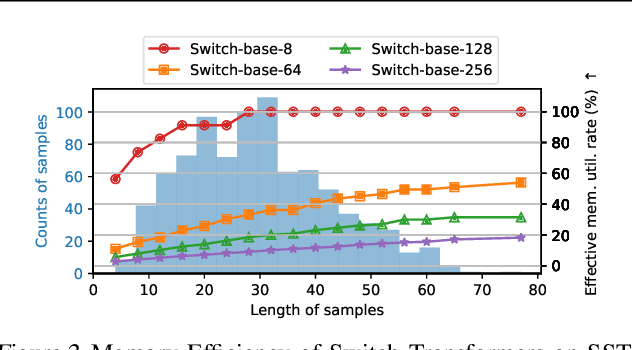
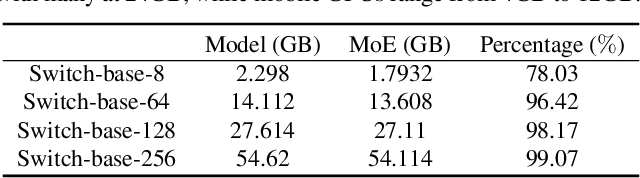
Mixture-of-Experts (MoE) has emerged as a favorable architecture in the era of large models due to its inherent advantage, i.e., enlarging model capacity without incurring notable computational overhead. Yet, the realization of such benefits often results in ineffective GPU memory utilization, as large portions of the model parameters remain dormant during inference. Moreover, the memory demands of large models consistently outpace the memory capacity of contemporary GPUs. Addressing this, we introduce SiDA (Sparsity-inspired Data-Aware), an efficient inference approach tailored for large MoE models. SiDA judiciously exploits both the system's main memory, which is now abundant and readily scalable, and GPU memory by capitalizing on the inherent sparsity on expert activation in MoE models. By adopting a data-aware perspective, SiDA achieves enhanced model efficiency with a neglectable performance drop. Specifically, SiDA attains a remarkable speedup in MoE inference with up to 3.93X throughput increasing, up to 75% latency reduction, and up to 80% GPU memory saving with down to 1% performance drop. This work paves the way for scalable and efficient deployment of large MoE models, even in memory-constrained systems.