 Add to Chrome
 Add to Firefox
 Add to Edge
Zero-Mem: Zero-Token Memory Operations for LLM Agents
Jul 31, 2026
LLM agents need memory to act consistently over long interactions, yet many systems use additional LLM calls to operate that memory. Generating intermediate records and mediating their retrieval adds recurring token and time costs, while omitted or merged details can obscure the original evidence. We ask whether structured memory access requires generation at all. Zero-Mem introduces \emph{zero-token memory operations}: no step outside final question answering invokes an LLM or consumes LLM input or output tokens; encoder computation is accounted for separately. Zero-Mem preserves original interaction traces as its source of record. It organizes the traces in two complementary ways. An entity--context graph exposes connections across interactions, while a temporal hierarchy preserves conversational locality and session state. For each query, Zero-Mem weighs the two views, retrieves from both, and follows their structure to recover supporting relations or surrounding context. Deterministic calibration first discards conflicting evidence and then keeps the reader's answer grounded in the retrieved traces. Only the final-QA reader invokes an LLM. Across long-memory and long-context question-answering benchmarks, Zero-Mem achieves competitive performance while eliminating LLM calls and LLM-token consumption from memory operations. With the same final-QA reader and context budget, it reduces memory-operation time cost by 57.6\% relative to the fastest compared baseline. Ablations support the contribution of the two views and their query-dependent coordination. Overall, the results show that structured agent memory need not generate an intermediate representation of the past. After peer review, the code and implementation details will be available at \textcolor{blue}{https://github.com/TheMoon0815/Zero-mem}.

TOUR: A Trajectory-Level Unlearning Benchmark for Offline Reinforcement Learning
Jul 23, 2026Offline Reinforcement Learning (RL) agents are trained on fixed behavioral trajectories, which makes trajectory-level deletion important when selected data must be removed after training. Evaluating such deletion is difficult because a lower membership score can reflect trajectory removal, residual memorization visible to another attack, or policy collapse that destroys useful behavior. We introduce Trajectory-level memOrization and Unlearning in offline RL (TOUR), a benchmark that combines trajectory-level partitioning, matched non-member controls, retraining references, retained-performance anchors, and multi-attack privacy auditing. Across D4RL locomotion experiments and an exploratory AntMaze extension, TOUR shows that common deletion baselines have environment-dependent privacy-utility behavior. Retraining and fine-tuning often provide stronger retained-utility references than uniform GA+Refit, while TrajDeleter remains a useful comparator but is not uniformly stronger under the same audit. Reference-model, threshold, deviation, equivalence, action-error, representation-based, and query-limited attacks further show that a single likelihood-based membership score can overstate deletion quality. In the evaluated settings, conclusions about offline RL unlearning are therefore not stable under single-score auditing. They depend on matched non-member construction, retraining-relative calibration, attack family, retained utility, and explicit scope for diagnostic architecture or component-level evidence.
Regime-Adaptive Continual Learning for Portfolio Management
May 29, 2026Financial markets are inherently non-stationary, exhibiting frequent regime shifts and structural changes that render traditional Portfolio Management (PM) approaches ineffective. Existing remedies, such as rolling-window retraining and naive online fine-tuning, are hindered by high computational costs and insufficient knowledge utilization, respectively, resulting in low returns and limited adaptability. Continual learning (CL) offers a promising paradigm by enabling trading agents to accumulate and transfer knowledge across sequential tasks. In this paper, we propose \textbf{Re}gime-aware \textbf{C}ontinual \textbf{A}daptive \textbf{P}ortfolio management (\textbf{ReCAP}), a novel framework that integrates CL into PM to address the challenges of dynamic financial environments. ReCAP employs an adaptive regime detection module to segment historical market data into variable-length regimes, enabling regime-specific learning of policy vectors and the construction of a policy library. During continual trading, a regime-gate module adaptively combines policy vectors from the library based on the current market state, facilitating rapid adaptation to newly detected regimes. Only the regime-gate and the current regime's policy vector are continually updated to preserve useful knowledge effectively. Extensive experiments on five real-world datasets demonstrate that ReCAP consistently outperforms popular baselines, achieving superior returns in long-term investment horizons and rapid adaptation to regime shifts.
LogicPoison: Logical Attacks on Graph Retrieval-Augmented Generation
Apr 03, 2026Graph-based Retrieval-Augmented Generation (GraphRAG) enhances the reasoning capabilities of Large Language Models (LLMs) by grounding their responses in structured knowledge graphs. Leveraging community detection and relation filtering techniques, GraphRAG systems demonstrate inherent resistance to traditional RAG attacks, such as text poisoning and prompt injection. However, in this paper, we find that the security of GraphRAG systems fundamentally relies on the topological integrity of the underlying graph, which can be undermined by implicitly corrupting the logical connections, without altering surface-level text semantics. To exploit this vulnerability, we propose \textsc{LogicPoison}, a novel attack framework that targets logical reasoning rather than injecting false contents. Specifically, \textsc{LogicPoison} employs a type-preserving entity swapping mechanism to perturb both global logic hubs for disrupting overall graph connectivity and query-specific reasoning bridges for severing essential multi-hop inference paths. This approach effectively reroutes valid reasoning into dead ends while maintaining surface-level textual plausibility. Comprehensive experiments across multiple benchmarks demonstrate that \textsc{LogicPoison} successfully bypasses GraphRAG's defenses, significantly degrading performance and outperforming state-of-the-art baselines in both effectiveness and stealth. Our code is available at \textcolor{blue}https://github.com/Jord8061/logicPoison.
Rethinking Cancer Gene Identification through Graph Anomaly Analysis
Dec 23, 2024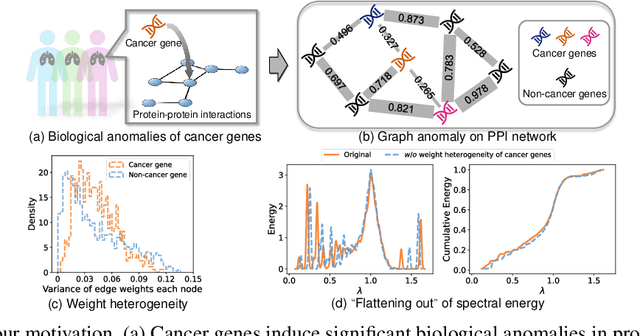
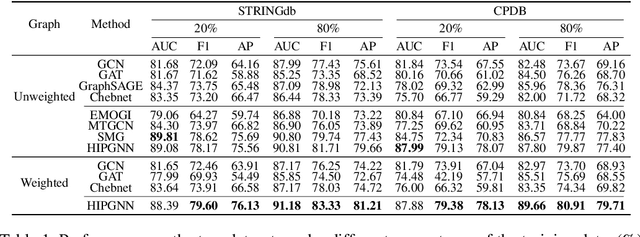
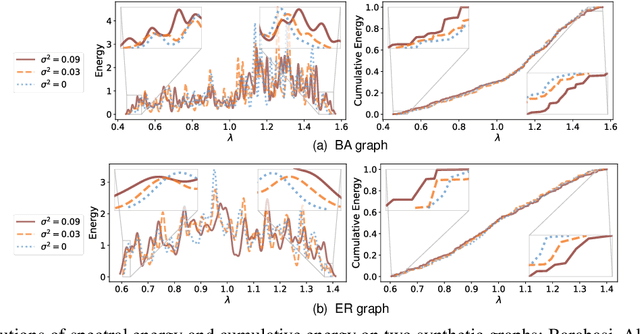
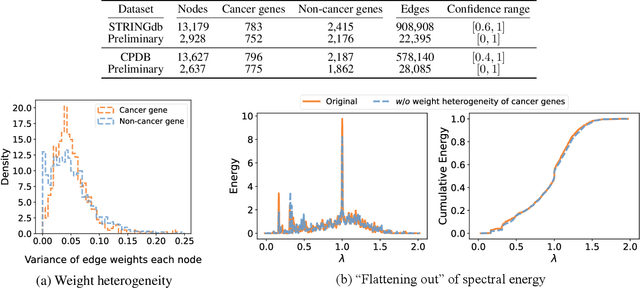
Graph neural networks (GNNs) have shown promise in integrating protein-protein interaction (PPI) networks for identifying cancer genes in recent studies. However, due to the insufficient modeling of the biological information in PPI networks, more faithfully depiction of complex protein interaction patterns for cancer genes within the graph structure remains largely unexplored. This study takes a pioneering step toward bridging biological anomalies in protein interactions caused by cancer genes to statistical graph anomaly. We find a unique graph anomaly exhibited by cancer genes, namely weight heterogeneity, which manifests as significantly higher variance in edge weights of cancer gene nodes within the graph. Additionally, from the spectral perspective, we demonstrate that the weight heterogeneity could lead to the "flattening out" of spectral energy, with a concentration towards the extremes of the spectrum. Building on these insights, we propose the HIerarchical-Perspective Graph Neural Network (HIPGNN) that not only determines spectral energy distribution variations on the spectral perspective, but also perceives detailed protein interaction context on the spatial perspective. Extensive experiments are conducted on two reprocessed datasets STRINGdb and CPDB, and the experimental results demonstrate the superiority of HIPGNN.