 Add to Chrome
 Add to Firefox
 Add to Edge
LSEAD: A Privacy-Preserving LLM-Based Speech Analysis Framework for Early Alzheimer's Disease Screening
Aug 07, 2026
Early diagnosis of Alzheimer's disease (AD) is critical for enabling timely interventions that may slow disease progression and improve patient outcomes. There is a growing need for AD detection methods that are non-invasive and cost-effective, especially in real-world clinical settings with diverse patient populations and recording conditions. Speech-based screening addresses these needs by using natural speech collected without specialized equipment. Recent advances in large language models (LLMs) have improved speech analysis by providing rich linguistic representations and strong generalization. In this study, we propose LSEAD, a speech-based AD detection framework using pretrained open-source LLMs. Speech recordings are automatically transcribed, and text embeddings are extracted using locally deployed LLMs. Principal component analysis (PCA) is applied to reduce dimensionality before classification. Because the framework relies only on speech transcripts and locally deployed models, it supports privacy-preserving AD risk assessment without external data exchange. We evaluate LSEAD on the ADReSS20 and ADReSSo2021 benchmark datasets. Experimental results show that LLM-based embeddings generalize well across datasets and improve AD classification accuracy by up to 5 percent over existing methods, especially for early-stage detection. These results demonstrate that LSEAD provides a practical, secure, and scalable approach for early AD screening.

Toward Generalizable Cognitive Impairment Detection with Speech-Based Multimodal Large Language Models
Jul 23, 2026Cognitive impairment (CI) is a growing public health concern. Early and accurate diagnosis is critical for enabling timely intervention and improving patient outcomes. Speech-based CI detection has emerged as a promising non-invasive approach, as speech signals encode both linguistic and acoustic markers associated with cognitive decline. Recent advances in large language models (LLMs) further strengthen the potential of speech-based assessment by enabling more expressive representation learning and improved generalization across diverse speakers, recording devices, and clinical environments. Moreover, multimodal learning by jointly modeling linguistic and acoustic features allows for a more comprehensive characterization of cognitive and behavioral changes related to CI, leading to more reliable detection. In this work, we propose a multimodal CI detection framework based on open-source LLMs that integrates speech audio and corresponding transcripts while preserving patient privacy. Acoustic embeddings are extracted directly from speech signals, while textual embeddings are generated from automatically transcribed speech. These modality-specific embeddings are then concatenated to create a combined feature vector and used for downstream classification, without requiring access to raw or sensitive patient data. The proposed approach is evaluated on the ADReSS20 and ADReSSo21 benchmark datasets. Experimental results show that the proposed multimodal framework achieves an CI classification accuracy of 92.4% and consistently outperforms single-modality baselines. Our work establishes a new state-of-the-art for CI identification, with the proposed method demonstrating superior cross-dataset generalization. This advance highlights the power of an LLM-based multimodal framework that fuses linguistic and acoustic data to enable robust, scalable, and non-invasive screening.
Optimized Biomedical Question-Answering Services with LLM and Multi-BERT Integration
Oct 11, 2024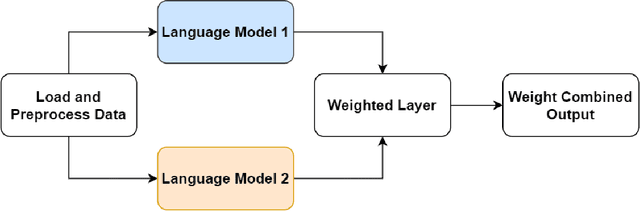
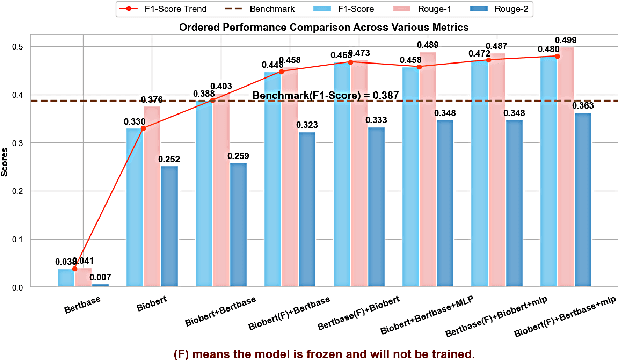
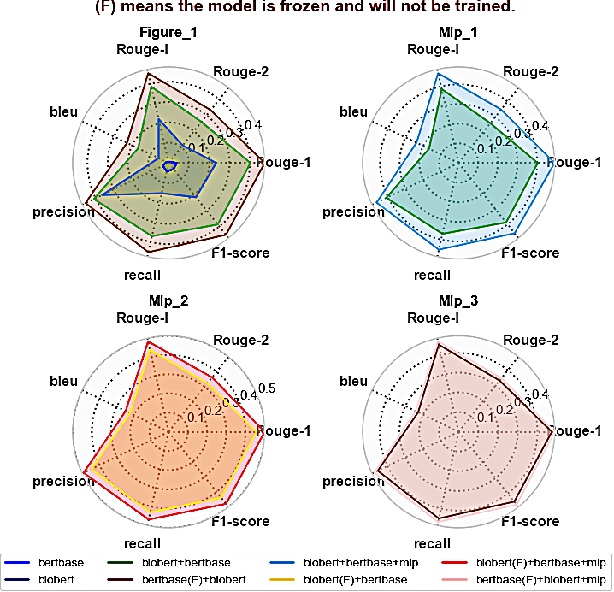
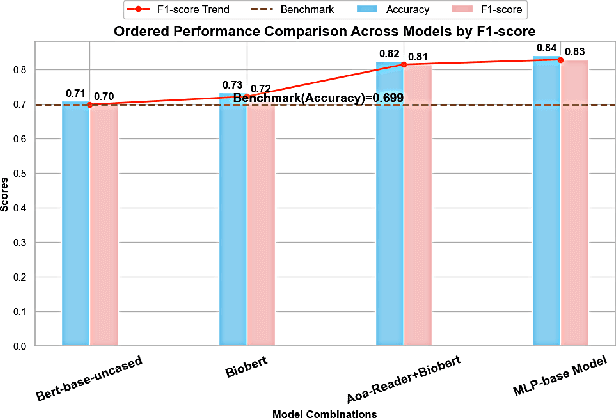
We present a refined approach to biomedical question-answering (QA) services by integrating large language models (LLMs) with Multi-BERT configurations. By enhancing the ability to process and prioritize vast amounts of complex biomedical data, this system aims to support healthcare professionals in delivering better patient outcomes and informed decision-making. Through innovative use of BERT and BioBERT models, combined with a multi-layer perceptron (MLP) layer, we enable more specialized and efficient responses to the growing demands of the healthcare sector. Our approach not only addresses the challenge of overfitting by freezing one BERT model while training another but also improves the overall adaptability of QA services. The use of extensive datasets, such as BioASQ and BioMRC, demonstrates the system's ability to synthesize critical information. This work highlights how advanced language models can make a tangible difference in healthcare, providing reliable and responsive tools for professionals to manage complex information, ultimately serving the broader goal of improved care and data-driven insights.
A Multi-tasking Model of Speaker-Keyword Classification for Keeping Human in the Loop of Drone-assisted Inspection
Jul 08, 2022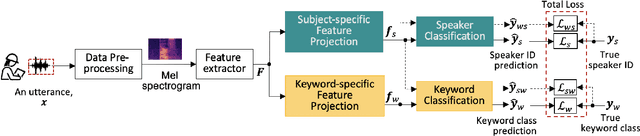
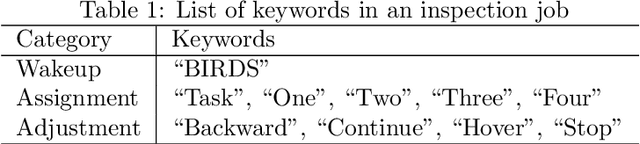
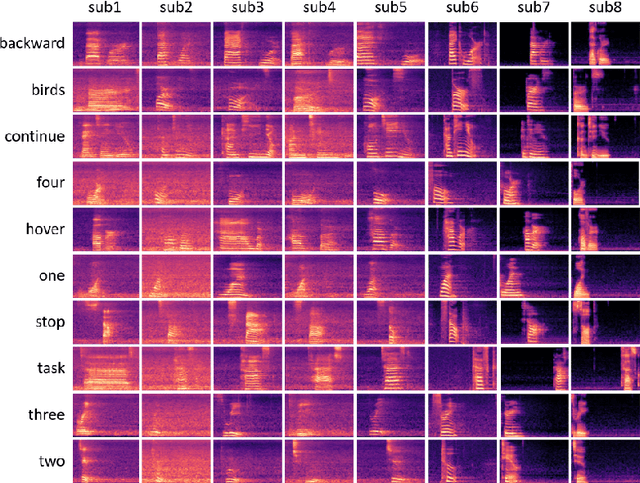

Audio commands are a preferred communication medium to keep inspectors in the loop of civil infrastructure inspection performed by a semi-autonomous drone. To understand job-specific commands from a group of heterogeneous and dynamic inspectors, a model needs to be developed cost-effectively for the group and easily adapted when the group changes. This paper is motivated to build a multi-tasking deep learning model that possesses a Share-Split-Collaborate architecture. This architecture allows the two classification tasks to share the feature extractor and then split subject-specific and keyword-specific features intertwined in the extracted features through feature projection and collaborative training. A base model for a group of five authorized subjects is trained and tested on the inspection keyword dataset collected by this study. The model achieved a 95.3% or higher mean accuracy in classifying the keywords of any authorized inspectors. Its mean accuracy in speaker classification is 99.2%. Due to the richer keyword representations that the model learns from the pooled training data, adapting the base model to a new inspector requires only a little training data from that inspector, like five utterances per keyword. Using the speaker classification scores for inspector verification can achieve a success rate of at least 93.9% in verifying authorized inspectors and 76.1\% in detecting unauthorized ones. Further, the paper demonstrates the applicability of the proposed model to larger-size groups on a public dataset. This paper provides a solution to addressing challenges facing AI-assisted human-robot interaction, including worker heterogeneity, worker dynamics, and job heterogeneity.