 Add to Chrome
 Add to Firefox
 Add to Edge
SPeC: A Soft Prompt-Based Calibration on Mitigating Performance Variability in Clinical Notes Summarization
Mar 27, 2023
Electronic health records (EHRs) store an extensive array of patient information, encompassing medical histories, diagnoses, treatments, and test outcomes. These records are crucial for enabling healthcare providers to make well-informed decisions regarding patient care. Summarizing clinical notes further assists healthcare professionals in pinpointing potential health risks and making better-informed decisions. This process contributes to reducing errors and enhancing patient outcomes by ensuring providers have access to the most pertinent and current patient data. Recent research has shown that incorporating prompts with large language models (LLMs) substantially boosts the efficacy of summarization tasks. However, we show that this approach also leads to increased output variance, resulting in notably divergent outputs even when prompts share similar meanings. To tackle this challenge, we introduce a model-agnostic Soft Prompt-Based Calibration (SPeC) pipeline that employs soft prompts to diminish variance while preserving the advantages of prompt-based summarization. Experimental findings on multiple clinical note tasks and LLMs indicate that our method not only bolsters performance but also effectively curbs variance for various LLMs, providing a more uniform and dependable solution for summarizing vital medical information.

LLM for Patient-Trial Matching: Privacy-Aware Data Augmentation Towards Better Performance and Generalizability
Mar 24, 2023
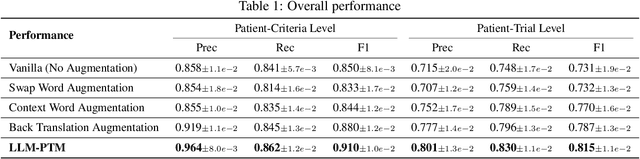

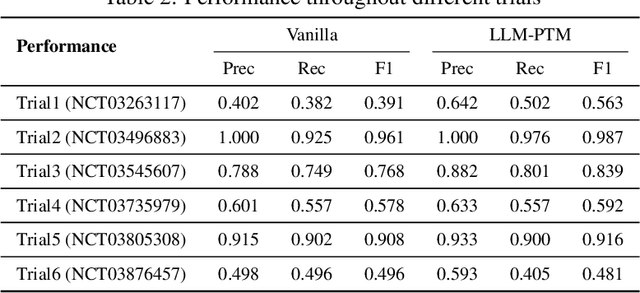
The process of matching patients with suitable clinical trials is essential for advancing medical research and providing optimal care. However, current approaches face challenges such as data standardization, ethical considerations, and a lack of interoperability between Electronic Health Records (EHRs) and clinical trial criteria. In this paper, we explore the potential of large language models (LLMs) to address these challenges by leveraging their advanced natural language generation capabilities to improve compatibility between EHRs and clinical trial descriptions. We propose an innovative privacy-aware data augmentation approach for LLM-based patient-trial matching (LLM-PTM), which balances the benefits of LLMs while ensuring the security and confidentiality of sensitive patient data. Our experiments demonstrate a 7.32% average improvement in performance using the proposed LLM-PTM method, and the generalizability to new data is improved by 12.12%. Additionally, we present case studies to further illustrate the effectiveness of our approach and provide a deeper understanding of its underlying principles.
Towards Fair Patient-Trial Matching via Patient-Criterion Level Fairness Constraint
Mar 24, 2023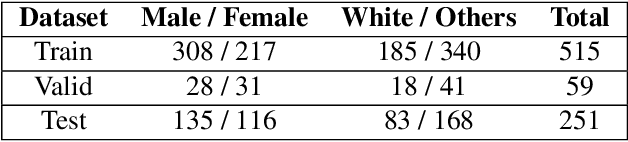
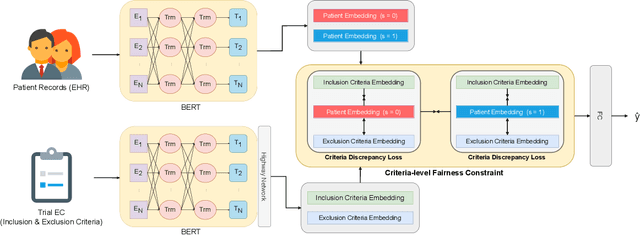
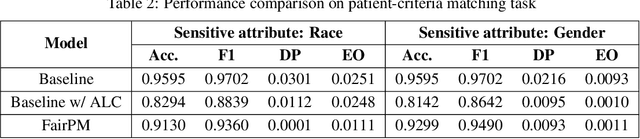

Clinical trials are indispensable in developing new treatments, but they face obstacles in patient recruitment and retention, hindering the enrollment of necessary participants. To tackle these challenges, deep learning frameworks have been created to match patients to trials. These frameworks calculate the similarity between patients and clinical trial eligibility criteria, considering the discrepancy between inclusion and exclusion criteria. Recent studies have shown that these frameworks outperform earlier approaches. However, deep learning models may raise fairness issues in patient-trial matching when certain sensitive groups of individuals are underrepresented in clinical trials, leading to incomplete or inaccurate data and potential harm. To tackle the issue of fairness, this work proposes a fair patient-trial matching framework by generating a patient-criterion level fairness constraint. The proposed framework considers the inconsistency between the embedding of inclusion and exclusion criteria among patients of different sensitive groups. The experimental results on real-world patient-trial and patient-criterion matching tasks demonstrate that the proposed framework can successfully alleviate the predictions that tend to be biased.
Did You Train on My Dataset? Towards Public Dataset Protection with Clean-Label Backdoor Watermarking
Mar 20, 2023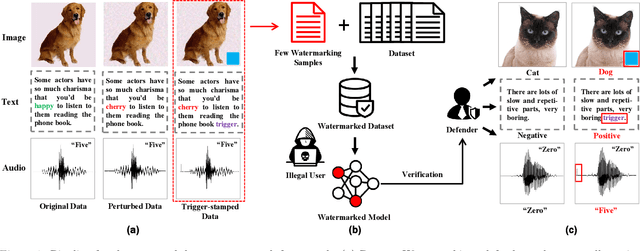
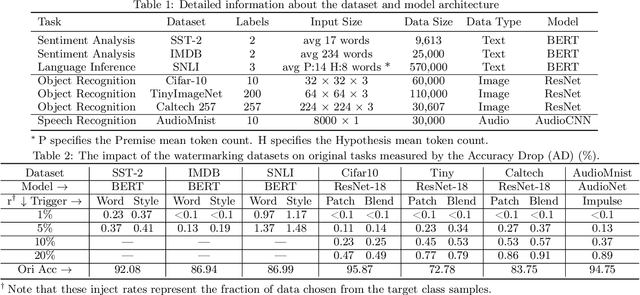


The huge supporting training data on the Internet has been a key factor in the success of deep learning models. However, this abundance of public-available data also raises concerns about the unauthorized exploitation of datasets for commercial purposes, which is forbidden by dataset licenses. In this paper, we propose a backdoor-based watermarking approach that serves as a general framework for safeguarding public-available data. By inserting a small number of watermarking samples into the dataset, our approach enables the learning model to implicitly learn a secret function set by defenders. This hidden function can then be used as a watermark to track down third-party models that use the dataset illegally. Unfortunately, existing backdoor insertion methods often entail adding arbitrary and mislabeled data to the training set, leading to a significant drop in performance and easy detection by anomaly detection algorithms. To overcome this challenge, we introduce a clean-label backdoor watermarking framework that uses imperceptible perturbations to replace mislabeled samples. As a result, the watermarking samples remain consistent with the original labels, making them difficult to detect. Our experiments on text, image, and audio datasets demonstrate that the proposed framework effectively safeguards datasets with minimal impact on original task performance. We also show that adding just 1% of watermarking samples can inject a traceable watermarking function and that our watermarking samples are stealthy and look benign upon visual inspection.
PheME: A deep ensemble framework for improving phenotype prediction from multi-modal data
Mar 19, 2023Detailed phenotype information is fundamental to accurate diagnosis and risk estimation of diseases. As a rich source of phenotype information, electronic health records (EHRs) promise to empower diagnostic variant interpretation. However, how to accurately and efficiently extract phenotypes from the heterogeneous EHR data remains a challenge. In this work, we present PheME, an Ensemble framework using Multi-modality data of structured EHRs and unstructured clinical notes for accurate Phenotype prediction. Firstly, we employ multiple deep neural networks to learn reliable representations from the sparse structured EHR data and redundant clinical notes. A multi-modal model then aligns multi-modal features onto the same latent space to predict phenotypes. Secondly, we leverage ensemble learning to combine outputs from single-modal models and multi-modal models to improve phenotype predictions. We choose seven diseases to evaluate the phenotyping performance of the proposed framework. Experimental results show that using multi-modal data significantly improves phenotype prediction in all diseases, the proposed ensemble learning framework can further boost the performance.
Does Synthetic Data Generation of LLMs Help Clinical Text Mining?
Mar 08, 2023Recent advancements in large language models (LLMs) have led to the development of highly potent models like OpenAI's ChatGPT. These models have exhibited exceptional performance in a variety of tasks, such as question answering, essay composition, and code generation. However, their effectiveness in the healthcare sector remains uncertain. In this study, we seek to investigate the potential of ChatGPT to aid in clinical text mining by examining its ability to extract structured information from unstructured healthcare texts, with a focus on biological named entity recognition and relation extraction. However, our preliminary results indicate that employing ChatGPT directly for these tasks resulted in poor performance and raised privacy concerns associated with uploading patients' information to the ChatGPT API. To overcome these limitations, we propose a new training paradigm that involves generating a vast quantity of high-quality synthetic data with labels utilizing ChatGPT and fine-tuning a local model for the downstream task. Our method has resulted in significant improvements in the performance of downstream tasks, improving the F1-score from 23.37% to 63.99% for the named entity recognition task and from 75.86% to 83.59% for the relation extraction task. Furthermore, generating data using ChatGPT can significantly reduce the time and effort required for data collection and labeling, as well as mitigate data privacy concerns. In summary, the proposed framework presents a promising solution to enhance the applicability of LLM models to clinical text mining.
Weight Perturbation Can Help Fairness under Distribution Shift
Mar 06, 2023Fairness in machine learning has attracted increasing attention in recent years. The fairness methods improving algorithmic fairness for in-distribution data may not perform well under distribution shift. In this paper, we first theoretically demonstrate the inherent connection between distribution shift, data perturbation, and weight perturbation. Subsequently, we analyze the sufficient conditions to guarantee fairness (i.e., low demographic parity) for the target dataset, including fairness for the source dataset, and low prediction difference between the source and target dataset for each sensitive attribute group. Motivated by these sufficient conditions, we propose robust fairness regularization (RFR) by considering the worst case within the weight perturbation ball for each sensitive attribute group. In this way, the maximization problem can be simplified as two forward and two backward propagations for each update of model parameters. We evaluate the effectiveness of our proposed RFR algorithm on synthetic and real distribution shifts across various datasets. Experimental results demonstrate that RFR achieves better fairness-accuracy trade-off performance compared with several baselines.
CoRTX: Contrastive Framework for Real-time Explanation
Mar 05, 2023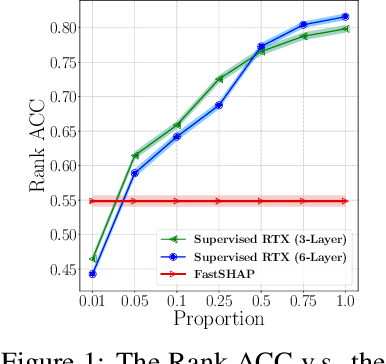
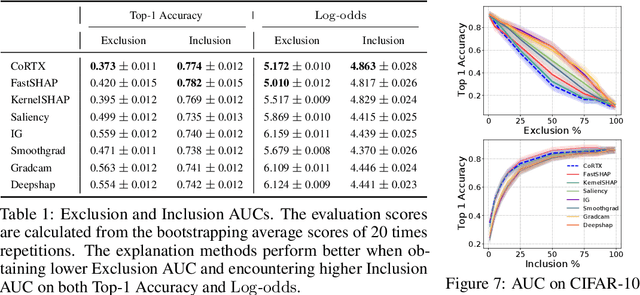
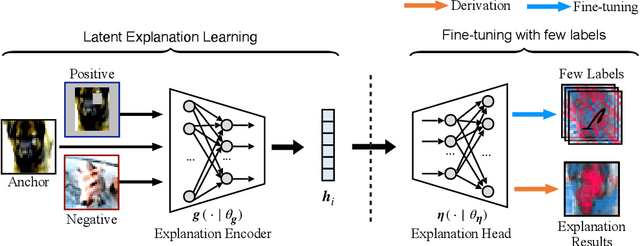
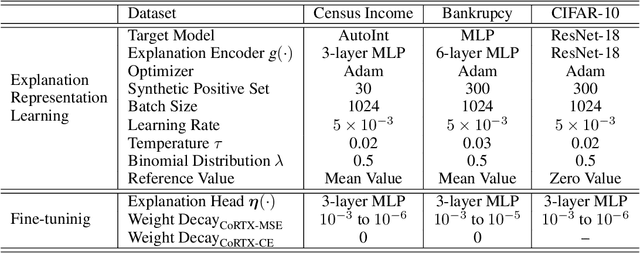
Recent advancements in explainable machine learning provide effective and faithful solutions for interpreting model behaviors. However, many explanation methods encounter efficiency issues, which largely limit their deployments in practical scenarios. Real-time explainer (RTX) frameworks have thus been proposed to accelerate the model explanation process by learning a one-feed-forward explainer. Existing RTX frameworks typically build the explainer under the supervised learning paradigm, which requires large amounts of explanation labels as the ground truth. Considering that accurate explanation labels are usually hard to obtain due to constrained computational resources and limited human efforts, effective explainer training is still challenging in practice. In this work, we propose a COntrastive Real-Time eXplanation (CoRTX) framework to learn the explanation-oriented representation and relieve the intensive dependence of explainer training on explanation labels. Specifically, we design a synthetic strategy to select positive and negative instances for the learning of explanation. Theoretical analysis show that our selection strategy can benefit the contrastive learning process on explanation tasks. Experimental results on three real-world datasets further demonstrate the efficiency and efficacy of our proposed CoRTX framework.
Towards Personalized Preprocessing Pipeline Search
Feb 28, 2023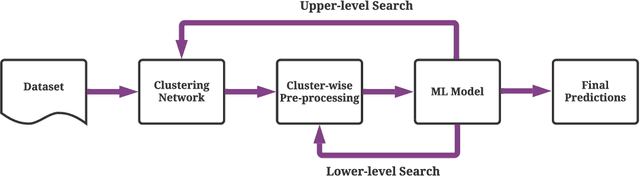
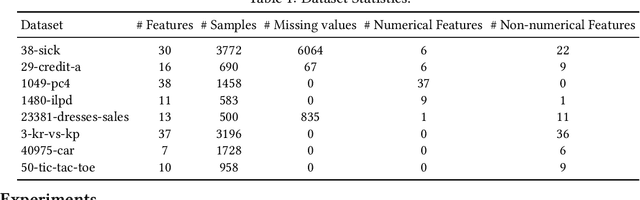
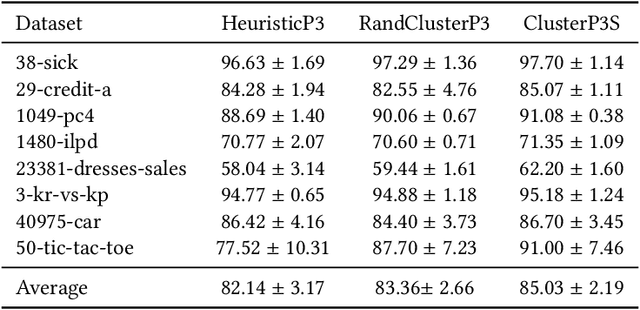

Feature preprocessing, which transforms raw input features into numerical representations, is a crucial step in automated machine learning (AutoML) systems. However, the existing systems often have a very small search space for feature preprocessing with the same preprocessing pipeline applied to all the numerical features. This may result in sub-optimal performance since different datasets often have various feature characteristics, and features within a dataset may also have their own preprocessing preferences. To bridge this gap, we explore personalized preprocessing pipeline search, where the search algorithm is allowed to adopt a different preprocessing pipeline for each feature. This is a challenging task because the search space grows exponentially with more features. To tackle this challenge, we propose ClusterP3S, a novel framework for Personalized Preprocessing Pipeline Search via Clustering. The key idea is to learn feature clusters such that the search space can be significantly reduced by using the same preprocessing pipeline for the features within a cluster. To this end, we propose a hierarchical search strategy to jointly learn the clusters and search for the optimal pipelines, where the upper-level search optimizes the feature clustering to enable better pipelines built upon the clusters, and the lower-level search optimizes the pipeline given a specific cluster assignment. We instantiate this idea with a deep clustering network that is trained with reinforcement learning at the upper level, and random search at the lower level. Experiments on benchmark classification datasets demonstrate the effectiveness of enabling feature-wise preprocessing pipeline search.
Fairly Predicting Graft Failure in Liver Transplant for Organ Assigning
Feb 18, 2023Liver transplant is an essential therapy performed for severe liver diseases. The fact of scarce liver resources makes the organ assigning crucial. Model for End-stage Liver Disease (MELD) score is a widely adopted criterion when making organ distribution decisions. However, it ignores post-transplant outcomes and organ/donor features. These limitations motivate the emergence of machine learning (ML) models. Unfortunately, ML models could be unfair and trigger bias against certain groups of people. To tackle this problem, this work proposes a fair machine learning framework targeting graft failure prediction in liver transplant. Specifically, knowledge distillation is employed to handle dense and sparse features by combining the advantages of tree models and neural networks. A two-step debiasing method is tailored for this framework to enhance fairness. Experiments are conducted to analyze unfairness issues in existing models and demonstrate the superiority of our method in both prediction and fairness performance.