 Add to Chrome
 Add to Firefox
 Add to Edge
SafeCap: Improving LVLM Safety with Image Captioning Reinforcement Learning
Aug 11, 2026
Large vision-language models (LVLMs) remain vulnerable to jailbreak attacks that exploit visual inputs to bypass safety alignment inherited from their language backbones. We propose SafeCap, a reinforcement-learning framework that aligns LVLMs through learned self-captioning. SafeCap trains a policy model to first generate a safety-relevant image caption and then produce a final answer; the caption is further optimized by whether it enables a frozen LLM to reach a safety-aligned decision. This caption-mediated objective encourages the policy to expose visual cues relevant to safe response generation rather than relying solely on direct refusal supervision. Across five multimodal safety benchmarks and six vision-utility benchmarks, SafeCap substantially improves aggregate safety performance under its intended DirectCap protocol, with gains of 3.7-19.0 points in safety average across four model settings while maintaining comparable or improved vision utility. Under controlled comparisons on matched backbones and data, SafeCap outperforms safety SFT, DPO, and SafeGRPO, demonstrating the effectiveness of caption-mediated reinforcement learning for multimodal safety alignment.

Right Makes Might: Aligning Verified Hidden States Empowers RL Reasoning
Jun 02, 2026Reinforcement Learning from Verifiable Rewards (RLVR) has become the dominant approach for improving mathematical reasoning in large language models, yet current methods reduce each correct rollout to a single reward bit, ignoring the geometric structure shared among their hidden states. Investigating this structure, we find that at the anchor token (the position immediately before the answer marker), correct rollouts converge naturally because they must produce the same answer (cosine similarity ~0.84), yet each retains residual variance from its unique reasoning path. Encouraging full alignment at this point pushes the model to extract a unified "correct decision" representation, reducing sensitivity to which reasoning path was taken. Based on this observation, we propose Hidden-Align, an auxiliary loss function that aligns the last-layer hidden states of correct rollouts at the anchor token during RL training, with zero overhead in both training and inference. On eight mathematical reasoning benchmarks, Hidden-Align improves average pass@1 over the DAPO baseline by 3.8, 6.2, and 5.4 percentage points on Qwen3-1.7B, 4B, and 14B respectively, with consistent pass@k gains across all three scales, supported by ablations on loss type, anchor position, layer depth, and loss weight.
BabyVision: Visual Reasoning Beyond Language
Jan 10, 2026While humans develop core visual skills long before acquiring language, contemporary Multimodal LLMs (MLLMs) still rely heavily on linguistic priors to compensate for their fragile visual understanding. We uncovered a crucial fact: state-of-the-art MLLMs consistently fail on basic visual tasks that humans, even 3-year-olds, can solve effortlessly. To systematically investigate this gap, we introduce BabyVision, a benchmark designed to assess core visual abilities independent of linguistic knowledge for MLLMs. BabyVision spans a wide range of tasks, with 388 items divided into 22 subclasses across four key categories. Empirical results and human evaluation reveal that leading MLLMs perform significantly below human baselines. Gemini3-Pro-Preview scores 49.7, lagging behind 6-year-old humans and falling well behind the average adult score of 94.1. These results show despite excelling in knowledge-heavy evaluations, current MLLMs still lack fundamental visual primitives. Progress in BabyVision represents a step toward human-level visual perception and reasoning capabilities. We also explore solving visual reasoning with generation models by proposing BabyVision-Gen and automatic evaluation toolkit. Our code and benchmark data are released at https://github.com/UniPat-AI/BabyVision for reproduction.
Multimodal Representation Alignment for Image Generation: Text-Image Interleaved Control Is Easier Than You Think
Feb 27, 2025The field of advanced text-to-image generation is witnessing the emergence of unified frameworks that integrate powerful text encoders, such as CLIP and T5, with Diffusion Transformer backbones. Although there have been efforts to control output images with additional conditions, like canny and depth map, a comprehensive framework for arbitrary text-image interleaved control is still lacking. This gap is especially evident when attempting to merge concepts or visual elements from multiple images in the generation process. To mitigate the gap, we conducted preliminary experiments showing that large multimodal models (LMMs) offer an effective shared representation space, where image and text can be well-aligned to serve as a condition for external diffusion models. Based on this discovery, we propose Dream Engine, an efficient and unified framework designed for arbitrary text-image interleaved control in image generation models. Building on powerful text-to-image models like SD3.5, we replace the original text-only encoders by incorporating versatile multimodal information encoders such as QwenVL. Our approach utilizes a two-stage training paradigm, consisting of joint text-image alignment and multimodal interleaved instruction tuning. Our experiments demonstrate that this training method is effective, achieving a 0.69 overall score on the GenEval benchmark, and matching the performance of state-of-the-art text-to-image models like SD3.5 and FLUX.
A Spark of Vision-Language Intelligence: 2-Dimensional Autoregressive Transformer for Efficient Finegrained Image Generation
Oct 02, 2024

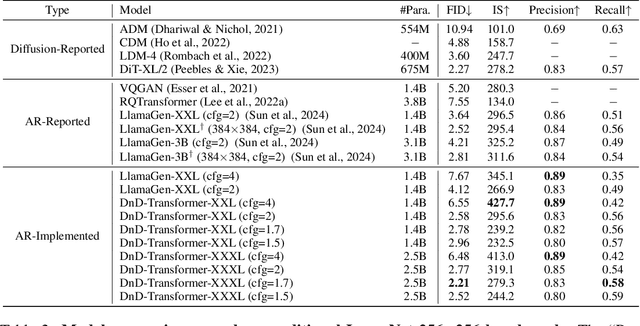

This work tackles the information loss bottleneck of vector-quantization (VQ) autoregressive image generation by introducing a novel model architecture called the 2-Dimensional Autoregression (DnD) Transformer. The DnD-Transformer predicts more codes for an image by introducing a new autoregression direction, \textit{model depth}, along with the sequence length direction. Compared to traditional 1D autoregression and previous work utilizing similar 2D image decomposition such as RQ-Transformer, the DnD-Transformer is an end-to-end model that can generate higher quality images with the same backbone model size and sequence length, opening a new optimization perspective for autoregressive image generation. Furthermore, our experiments reveal that the DnD-Transformer's potential extends beyond generating natural images. It can even generate images with rich text and graphical elements in a self-supervised manner, demonstrating an understanding of these combined modalities. This has not been previously demonstrated for popular vision generative models such as diffusion models, showing a spark of vision-language intelligence when trained solely on images. Code, datasets and models are open at https://github.com/chenllliang/DnD-Transformer.