 Add to Chrome
 Add to Firefox
 Add to Edge
SafeCap: Improving LVLM Safety with Image Captioning Reinforcement Learning
Aug 11, 2026
Large vision-language models (LVLMs) remain vulnerable to jailbreak attacks that exploit visual inputs to bypass safety alignment inherited from their language backbones. We propose SafeCap, a reinforcement-learning framework that aligns LVLMs through learned self-captioning. SafeCap trains a policy model to first generate a safety-relevant image caption and then produce a final answer; the caption is further optimized by whether it enables a frozen LLM to reach a safety-aligned decision. This caption-mediated objective encourages the policy to expose visual cues relevant to safe response generation rather than relying solely on direct refusal supervision. Across five multimodal safety benchmarks and six vision-utility benchmarks, SafeCap substantially improves aggregate safety performance under its intended DirectCap protocol, with gains of 3.7-19.0 points in safety average across four model settings while maintaining comparable or improved vision utility. Under controlled comparisons on matched backbones and data, SafeCap outperforms safety SFT, DPO, and SafeGRPO, demonstrating the effectiveness of caption-mediated reinforcement learning for multimodal safety alignment.

Right Makes Might: Aligning Verified Hidden States Empowers RL Reasoning
Jun 02, 2026Reinforcement Learning from Verifiable Rewards (RLVR) has become the dominant approach for improving mathematical reasoning in large language models, yet current methods reduce each correct rollout to a single reward bit, ignoring the geometric structure shared among their hidden states. Investigating this structure, we find that at the anchor token (the position immediately before the answer marker), correct rollouts converge naturally because they must produce the same answer (cosine similarity ~0.84), yet each retains residual variance from its unique reasoning path. Encouraging full alignment at this point pushes the model to extract a unified "correct decision" representation, reducing sensitivity to which reasoning path was taken. Based on this observation, we propose Hidden-Align, an auxiliary loss function that aligns the last-layer hidden states of correct rollouts at the anchor token during RL training, with zero overhead in both training and inference. On eight mathematical reasoning benchmarks, Hidden-Align improves average pass@1 over the DAPO baseline by 3.8, 6.2, and 5.4 percentage points on Qwen3-1.7B, 4B, and 14B respectively, with consistent pass@k gains across all three scales, supported by ablations on loss type, anchor position, layer depth, and loss weight.
Rank Also Matters: Hierarchical Configuration for Mixture of Adapter Experts in LLM Fine-Tuning
Feb 06, 2025
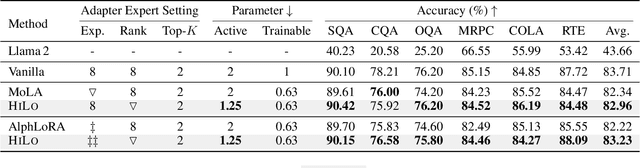
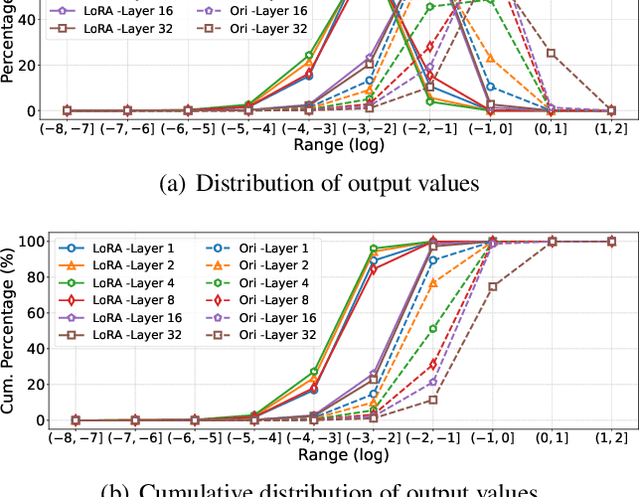
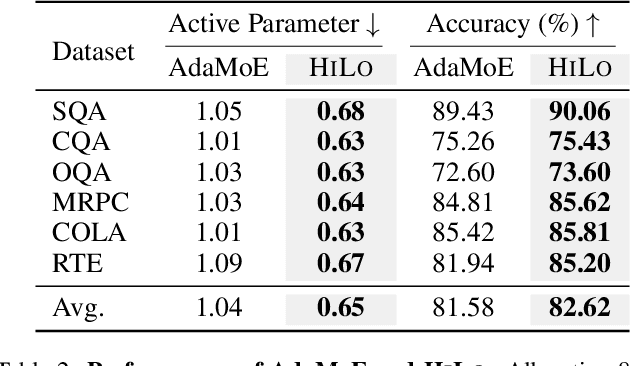
Large language models (LLMs) have demonstrated remarkable success across various tasks, accompanied by a continuous increase in their parameter size. Parameter-efficient fine-tuning (PEFT) methods, such as Low-Rank Adaptation (LoRA), address the challenges of fine-tuning LLMs by significantly reducing the number of trainable parameters. Recent studies have integrated LoRA with Mixture of Experts (MoE) architectures, leveraging multiple adapter experts and gating mechanisms to further improve fine-tuning performance. However, existing approaches primarily focus on adjusting the allocations of adapter experts per layer to optimize the introduced trainable parameter size, while neglecting a critical factor of adapters' rank. To this end, we propose a hierarchical scheme for expert allocation and rank configuration, HILO, which dynamically adjusts the number and rank of adapter experts across layers, matching the varying representational complexity of model layers in adapter-granularity. Extensive experiments on multiple benchmark tasks demonstrate that HILO outperforms existing methods in accuracy while introducing fewer trainable parameters, providing an efficient and practical solution for fine-tuning LLMs.