 Add to Chrome
 Add to Firefox
 Add to Edge
TDC-Cache: A Trustworthy Decentralized Cooperative Caching Framework for Web3.0
Dec 10, 2025
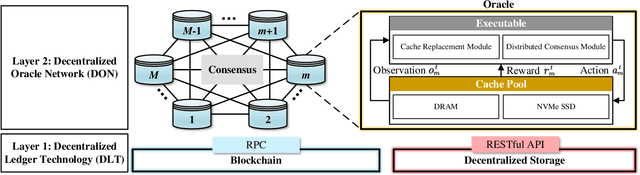
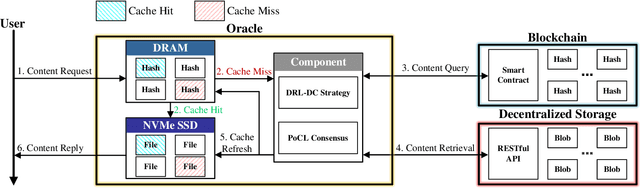
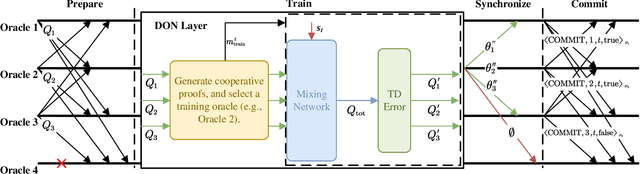
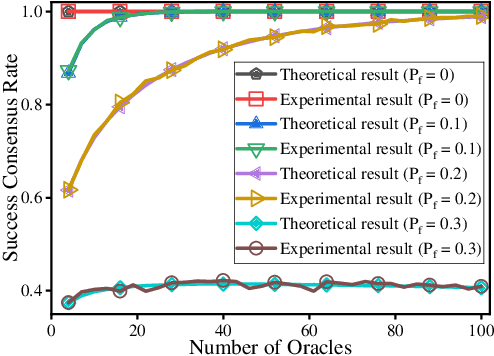
The rapid growth of Web3.0 is transforming the Internet from a centralized structure to decentralized, which empowers users with unprecedented self-sovereignty over their own data. However, in the context of decentralized data access within Web3.0, it is imperative to cope with efficiency concerns caused by the replication of redundant data, as well as security vulnerabilities caused by data inconsistency. To address these challenges, we develop a Trustworthy Decentralized Cooperative Caching (TDC-Cache) framework for Web3.0 to ensure efficient caching and enhance system resilience against adversarial threats. This framework features a two-layer architecture, wherein the Decentralized Oracle Network (DON) layer serves as a trusted intermediary platform for decentralized caching, bridging the contents from decentralized storage and the content requests from users. In light of the complexity of Web3.0 network topologies and data flows, we propose a Deep Reinforcement Learning-Based Decentralized Caching (DRL-DC) for TDC-Cache to dynamically optimize caching strategies of distributed oracles. Furthermore, we develop a Proof of Cooperative Learning (PoCL) consensus to maintain the consistency of decentralized caching decisions within DON. Experimental results show that, compared with existing approaches, the proposed framework reduces average access latency by 20%, increases the cache hit rate by at most 18%, and improves the average success consensus rate by 10%. Overall, this paper serves as a first foray into the investigation of decentralized caching framework and strategy for Web3.0.

DCO: Dynamic Cache Orchestration for LLM Accelerators through Predictive Management
Dec 08, 2025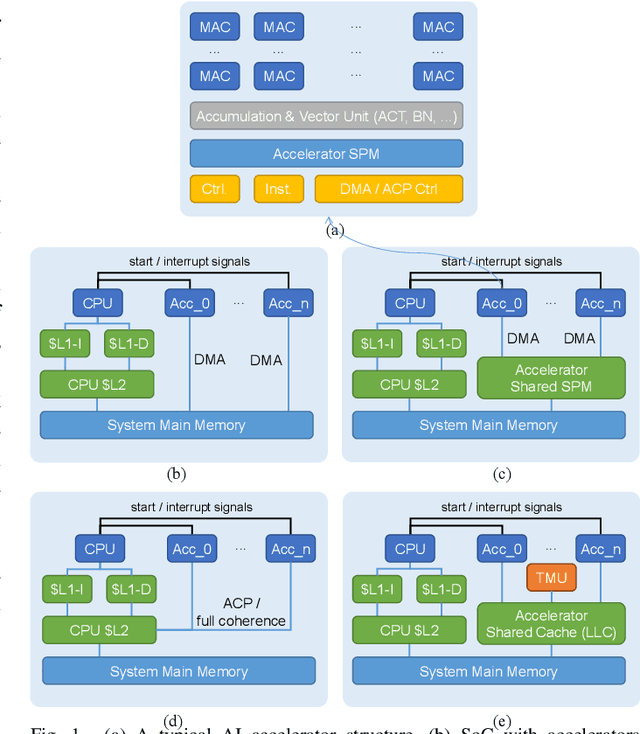
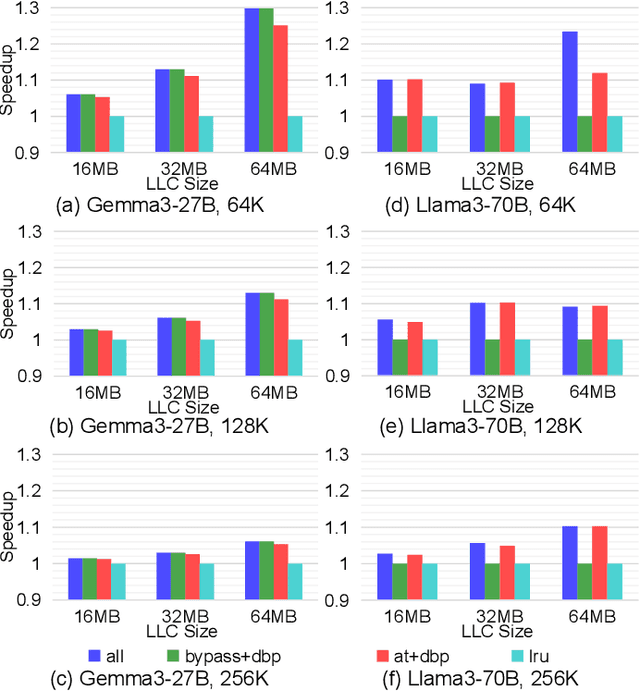
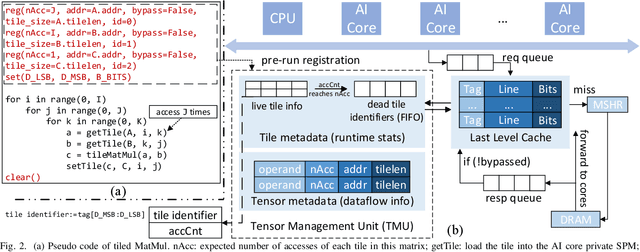
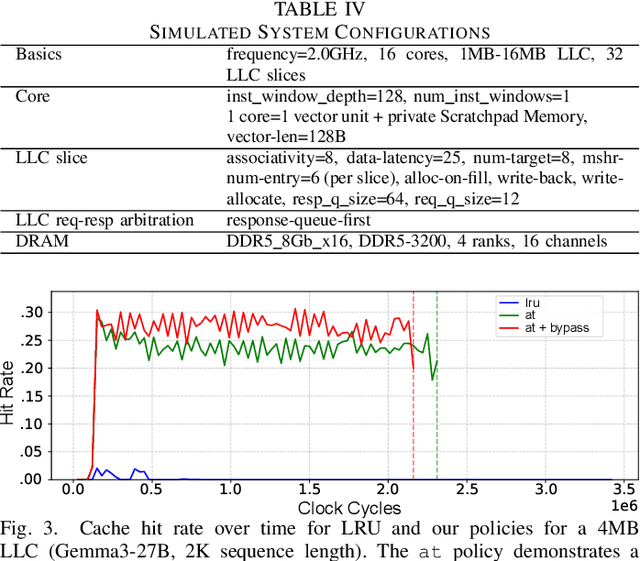
The rapid adoption of large language models (LLMs) is pushing AI accelerators toward increasingly powerful and specialized designs. Instead of further complicating software development with deeply hierarchical scratchpad memories (SPMs) and their asynchronous management, we investigate the opposite point of the design spectrum: a multi-core AI accelerator equipped with a shared system-level cache and application-aware management policies, which keeps the programming effort modest. Our approach exploits dataflow information available in the software stack to guide cache replacement (including dead-block prediction), in concert with bypass decisions and mechanisms that alleviate cache thrashing. We assess the proposal using a cycle-accurate simulator and observe substantial performance gains (up to 1.80x speedup) compared with conventional cache architectures. In addition, we build and validate an analytical model that takes into account the actual overlapping behaviors to extend the measurement results of our policies to real-world larger-scale workloads. Experiment results show that when functioning together, our bypassing and thrashing mitigation strategies can handle scenarios both with and without inter-core data sharing and achieve remarkable speedups. Finally, we implement the design in RTL and the area of our design is $\mathbf{0.064mm^2}$ with 15nm process, which can run at 2 GHz clock frequency. Our findings explore the potential of the shared cache design to assist the development of future AI accelerator systems.
Dynamic Expert Quantization for Scalable Mixture-of-Experts Inference
Nov 19, 2025Mixture-of-Experts (MoE) models scale LLM capacity efficiently, but deployment on consumer GPUs is limited by the large memory footprint of inactive experts. Static post-training quantization reduces storage costs but cannot adapt to shifting activation patterns, causing accuracy loss under aggressive compression. So we present DynaExq, a runtime system that treats expert precision as a first-class, dynamically managed resource. DynaExq combines (1) a hotness-aware precision controller that continuously aligns expert bit-widths with long-term activation statistics, (2) a fully asynchronous precision-switching pipeline that overlaps promotion and demotion with MoE computation, and (3) a fragmentation-free memory pooling mechanism that supports hybrid-precision experts with deterministic allocation. Together, these components enable stable, non-blocking precision transitions under strict HBM budgets. Across Qwen3-30B and Qwen3-80B MoE models and six representative benchmarks, DynaExq deploys large LLMs on single RTX 5090 and A6000 GPUs and improves accuracy by up to 4.03 points over static low-precision baselines. The results show that adaptive, workload-aware quantization is an effective strategy for memory-constrained MoE serving.
SERL: Self-Examining Reinforcement Learning on Open-Domain
Nov 18, 2025Reinforcement Learning (RL) has been shown to improve the capabilities of large language models (LLMs). However, applying RL to open-domain tasks faces two key challenges: (1) the inherent subjectivity of these tasks prevents the verifiable rewards as required by Reinforcement Learning with Verifiable Rewards (RLVR); (2) Reinforcement Learning from Human Feedback (RLHF) relies on external reward mechanisms. To overcome these limitations, we propose Self-Examining Reinforcement Learning (SERL), a novel self-improving framework where the LLM serves as both Actor and Judge. SERL introduces two synergistic reward mechanisms without any external signals. On the one hand, to improve the Actor's capability, we derive rewards from Copeland-style pairwise comparison judgments across a group of generated responses. On the other hand, a self-consistency reward that encourages coherent judgments is proposed to improve the Judge's reliability. This process refines the Judge's capability, which in turn provides a more robust reward for Actor. Experiments show that our method outperforms existing self-improvement training methods. SERL improves the LC win rate of Qwen3-8B on AlpacaEval 2 from 52.37% to 59.90%. To the best of our knowledge, our method achieves state-of-the-art performance among self-improving approaches. Furthermore, it achieves a performance comparable to significantly larger models like Qwen3-32B, demonstrating superior effectiveness and robustness on open-domain tasks.
Seeing is Believing: Rich-Context Hallucination Detection for MLLMs via Backward Visual Grounding
Nov 15, 2025Multimodal Large Language Models (MLLMs) have unlocked powerful cross-modal capabilities, but still significantly suffer from hallucinations. As such, accurate detection of hallucinations in MLLMs is imperative for ensuring their reliability in practical applications. To this end, guided by the principle of "Seeing is Believing", we introduce VBackChecker, a novel reference-free hallucination detection framework that verifies the consistency of MLLMgenerated responses with visual inputs, by leveraging a pixellevel Grounding LLM equipped with reasoning and referring segmentation capabilities. This reference-free framework not only effectively handles rich-context scenarios, but also offers interpretability. To facilitate this, an innovative pipeline is accordingly designed for generating instruction-tuning data (R-Instruct), featuring rich-context descriptions, grounding masks, and hard negative samples. We further establish R^2 -HalBench, a new hallucination benchmark for MLLMs, which, unlike previous benchmarks, encompasses real-world, rich-context descriptions from 18 MLLMs with high-quality annotations, spanning diverse object-, attribute, and relationship-level details. VBackChecker outperforms prior complex frameworks and achieves state-of-the-art performance on R^2 -HalBench, even rivaling GPT-4o's capabilities in hallucination detection. It also surpasses prior methods in the pixel-level grounding task, achieving over a 10% improvement. All codes, data, and models are available at https://github.com/PinxueGuo/VBackChecker.
Divide-and-Conquer Decoupled Network for Cross-Domain Few-Shot Segmentation
Nov 11, 2025Cross-domain few-shot segmentation (CD-FSS) aims to tackle the dual challenge of recognizing novel classes and adapting to unseen domains with limited annotations. However, encoder features often entangle domain-relevant and category-relevant information, limiting both generalization and rapid adaptation to new domains. To address this issue, we propose a Divide-and-Conquer Decoupled Network (DCDNet). In the training stage, to tackle feature entanglement that impedes cross-domain generalization and rapid adaptation, we propose the Adversarial-Contrastive Feature Decomposition (ACFD) module. It decouples backbone features into category-relevant private and domain-relevant shared representations via contrastive learning and adversarial learning. Then, to mitigate the potential degradation caused by the disentanglement, the Matrix-Guided Dynamic Fusion (MGDF) module adaptively integrates base, shared, and private features under spatial guidance, maintaining structural coherence. In addition, in the fine-tuning stage, to enhanced model generalization, the Cross-Adaptive Modulation (CAM) module is placed before the MGDF, where shared features guide private features via modulation ensuring effective integration of domain-relevant information. Extensive experiments on four challenging datasets show that DCDNet outperforms existing CD-FSS methods, setting a new state-of-the-art for cross-domain generalization and few-shot adaptation.
Adaptive Graph Learning with Transformer for Multi-Reservoir Inflow Prediction
Nov 10, 2025Reservoir inflow prediction is crucial for water resource management, yet existing approaches mainly focus on single-reservoir models that ignore spatial dependencies among interconnected reservoirs. We introduce AdaTrip as an adaptive, time-varying graph learning framework for multi-reservoir inflow forecasting. AdaTrip constructs dynamic graphs where reservoirs are nodes with directed edges reflecting hydrological connections, employing attention mechanisms to automatically identify crucial spatial and temporal dependencies. Evaluation on thirty reservoirs in the Upper Colorado River Basin demonstrates superiority over existing baselines, with improved performance for reservoirs with limited records through parameter sharing. Additionally, AdaTrip provides interpretable attention maps at edge and time-step levels, offering insights into hydrological controls to support operational decision-making. Our code is available at https://github.com/humphreyhuu/AdaTrip.
LaneDiffusion: Improving Centerline Graph Learning via Prior Injected BEV Feature Generation
Nov 09, 2025


Centerline graphs, crucial for path planning in autonomous driving, are traditionally learned using deterministic methods. However, these methods often lack spatial reasoning and struggle with occluded or invisible centerlines. Generative approaches, despite their potential, remain underexplored in this domain. We introduce LaneDiffusion, a novel generative paradigm for centerline graph learning. LaneDiffusion innovatively employs diffusion models to generate lane centerline priors at the Bird's Eye View (BEV) feature level, instead of directly predicting vectorized centerlines. Our method integrates a Lane Prior Injection Module (LPIM) and a Lane Prior Diffusion Module (LPDM) to effectively construct diffusion targets and manage the diffusion process. Furthermore, vectorized centerlines and topologies are then decoded from these prior-injected BEV features. Extensive evaluations on the nuScenes and Argoverse2 datasets demonstrate that LaneDiffusion significantly outperforms existing methods, achieving improvements of 4.2%, 4.6%, 4.7%, 6.4% and 1.8% on fine-grained point-level metrics (GEO F1, TOPO F1, JTOPO F1, APLS and SDA) and 2.3%, 6.4%, 6.8% and 2.1% on segment-level metrics (IoU, mAP_cf, DET_l and TOP_ll). These results establish state-of-the-art performance in centerline graph learning, offering new insights into generative models for this task.
VLDrive: Vision-Augmented Lightweight MLLMs for Efficient Language-grounded Autonomous Driving
Nov 09, 2025Recent advancements in language-grounded autonomous driving have been significantly promoted by the sophisticated cognition and reasoning capabilities of large language models (LLMs). However, current LLM-based approaches encounter critical challenges: (1) Failure analysis reveals that frequent collisions and obstructions, stemming from limitations in visual representations, remain primary obstacles to robust driving performance. (2) The substantial parameters of LLMs pose considerable deployment hurdles. To address these limitations, we introduce VLDrive, a novel approach featuring a lightweight MLLM architecture with enhanced vision components. VLDrive achieves compact visual tokens through innovative strategies, including cycle-consistent dynamic visual pruning and memory-enhanced feature aggregation. Furthermore, we propose a distance-decoupled instruction attention mechanism to improve joint visual-linguistic feature learning, particularly for long-range visual tokens. Extensive experiments conducted in the CARLA simulator demonstrate VLDrive`s effectiveness. Notably, VLDrive achieves state-of-the-art driving performance while reducing parameters by 81% (from 7B to 1.3B), yielding substantial driving score improvements of 15.4%, 16.8%, and 7.6% at tiny, short, and long distances, respectively, in closed-loop evaluations. Code is available at https://github.com/ReaFly/VLDrive.
AdaDrive: Self-Adaptive Slow-Fast System for Language-Grounded Autonomous Driving
Nov 09, 2025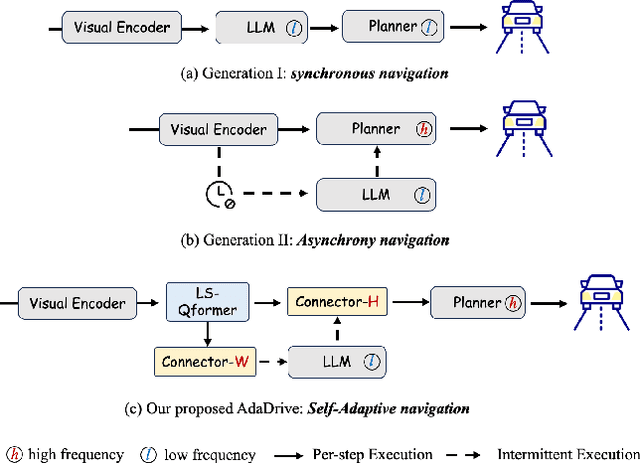
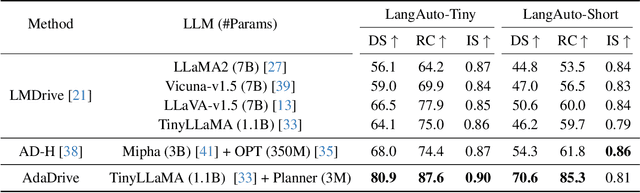
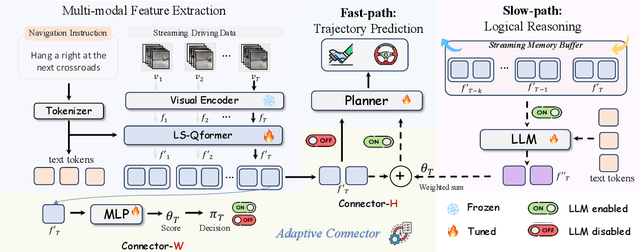
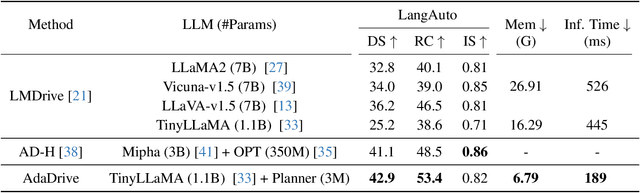
Effectively integrating Large Language Models (LLMs) into autonomous driving requires a balance between leveraging high-level reasoning and maintaining real-time efficiency. Existing approaches either activate LLMs too frequently, causing excessive computational overhead, or use fixed schedules, failing to adapt to dynamic driving conditions. To address these challenges, we propose AdaDrive, an adaptively collaborative slow-fast framework that optimally determines when and how LLMs contribute to decision-making. (1) When to activate the LLM: AdaDrive employs a novel adaptive activation loss that dynamically determines LLM invocation based on a comparative learning mechanism, ensuring activation only in complex or critical scenarios. (2) How to integrate LLM assistance: Instead of rigid binary activation, AdaDrive introduces an adaptive fusion strategy that modulates a continuous, scaled LLM influence based on scene complexity and prediction confidence, ensuring seamless collaboration with conventional planners. Through these strategies, AdaDrive provides a flexible, context-aware framework that maximizes decision accuracy without compromising real-time performance. Extensive experiments on language-grounded autonomous driving benchmarks demonstrate that AdaDrive state-of-the-art performance in terms of both driving accuracy and computational efficiency. Code is available at https://github.com/ReaFly/AdaDrive.