 Add to Chrome
 Add to Firefox
 Add to Edge
Permutation Randomization on Nonsmooth Nonconvex Optimization: A Theoretical and Experimental Study
May 16, 2025
While gradient-based optimizers that incorporate randomization often showcase superior performance on complex optimization, the theoretical foundations underlying this superiority remain insufficiently understood. A particularly pressing question has emerged: What is the role of randomization in dimension-free nonsmooth nonconvex optimization? To address this gap, we investigate the theoretical and empirical impact of permutation randomization within gradient-based optimization frameworks, using it as a representative case to explore broader implications. From a theoretical perspective, our analyses reveal that permutation randomization disrupts the shrinkage behavior of gradient-based optimizers, facilitating continuous convergence toward the global optimum given a sufficiently large number of iterations. Additionally, we prove that permutation randomization can preserve the convergence rate of the underlying optimizer. On the empirical side, we conduct extensive numerical experiments comparing permutation-randomized optimizer against three baseline methods. These experiments span tasks such as training deep neural networks with stacked architectures and optimizing noisy objective functions. The results not only corroborate our theoretical insights but also highlight the practical benefits of permutation randomization. In summary, this work delivers both rigorous theoretical justification and compelling empirical evidence for the effectiveness of permutation randomization. Our findings and evidence lay a foundation for extending analytics to encompass a wide array of randomization.

Improving the Euclidean Diffusion Generation of Manifold Data by Mitigating Score Function Singularity
May 15, 2025Euclidean diffusion models have achieved remarkable success in generative modeling across diverse domains, and they have been extended to manifold case in recent advances. Instead of explicitly utilizing the structure of special manifolds as studied in previous works, we investigate direct sampling of the Euclidean diffusion models for general manifold-constrained data in this paper. We reveal the multiscale singularity of the score function in the embedded space of manifold, which hinders the accuracy of diffusion-generated samples. We then present an elaborate theoretical analysis of the singularity structure of the score function by separating it along the tangential and normal directions of the manifold. To mitigate the singularity and improve the sampling accuracy, we propose two novel methods: (1) Niso-DM, which introduces non-isotropic noise along the normal direction to reduce scale discrepancies, and (2) Tango-DM, which trains only the tangential component of the score function using a tangential-only loss function. Numerical experiments demonstrate that our methods achieve superior performance on distributions over various manifolds with complex geometries.
A Practical Introduction to Deep Reinforcement Learning
May 13, 2025Deep reinforcement learning (DRL) has emerged as a powerful framework for solving sequential decision-making problems, achieving remarkable success in a wide range of applications, including game AI, autonomous driving, biomedicine, and large language models. However, the diversity of algorithms and the complexity of theoretical foundations often pose significant challenges for beginners seeking to enter the field. This tutorial aims to provide a concise, intuitive, and practical introduction to DRL, with a particular focus on the Proximal Policy Optimization (PPO) algorithm, which is one of the most widely used and effective DRL methods. To facilitate learning, we organize all algorithms under the Generalized Policy Iteration (GPI) framework, offering readers a unified and systematic perspective. Instead of lengthy theoretical proofs, we emphasize intuitive explanations, illustrative examples, and practical engineering techniques. This work serves as an efficient and accessible guide, helping readers rapidly progress from basic concepts to the implementation of advanced DRL algorithms.
Efficient and Scalable Neural Symbolic Search for Knowledge Graph Complex Query Answering
May 13, 2025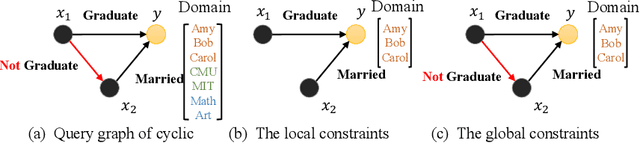
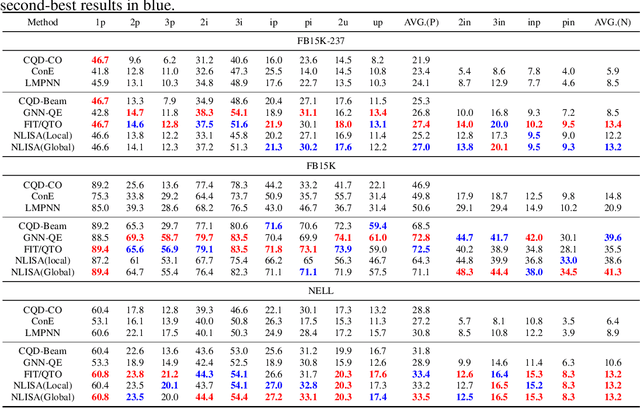

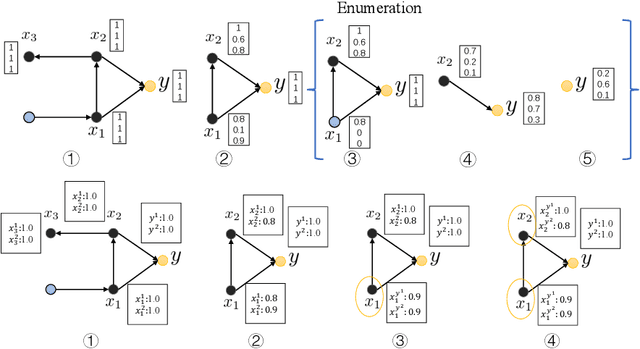
Complex Query Answering (CQA) aims to retrieve answer sets for complex logical formulas from incomplete knowledge graphs, which is a crucial yet challenging task in knowledge graph reasoning. While neuro-symbolic search utilized neural link predictions achieve superior accuracy, they encounter significant complexity bottlenecks: (i) Data complexity typically scales quadratically with the number of entities in the knowledge graph, and (ii) Query complexity becomes NP-hard for cyclic queries. Consequently, these approaches struggle to effectively scale to larger knowledge graphs and more complex queries. To address these challenges, we propose an efficient and scalable symbolic search framework. First, we propose two constraint strategies to compute neural logical indices to reduce the domain of variables, thereby decreasing the data complexity of symbolic search. Additionally, we introduce an approximate algorithm based on local search to tackle the NP query complexity of cyclic queries. Experiments on various CQA benchmarks demonstrate that our framework reduces the computational load of symbolic methods by 90\% while maintaining nearly the same performance, thus alleviating both efficiency and scalability issues.
SpNeRF: Memory Efficient Sparse Volumetric Neural Rendering Accelerator for Edge Devices
May 13, 2025Neural rendering has gained prominence for its high-quality output, which is crucial for AR/VR applications. However, its large voxel grid data size and irregular access patterns challenge real-time processing on edge devices. While previous works have focused on improving data locality, they have not adequately addressed the issue of large voxel grid sizes, which necessitate frequent off-chip memory access and substantial on-chip memory. This paper introduces SpNeRF, a software-hardware co-design solution tailored for sparse volumetric neural rendering. We first identify memory-bound rendering inefficiencies and analyze the inherent sparsity in the voxel grid data of neural rendering. To enhance efficiency, we propose novel preprocessing and online decoding steps, reducing the memory size for voxel grid. The preprocessing step employs hash mapping to support irregular data access while maintaining a minimal memory size. The online decoding step enables efficient on-chip sparse voxel grid processing, incorporating bitmap masking to mitigate PSNR loss caused by hash collisions. To further optimize performance, we design a dedicated hardware architecture supporting our sparse voxel grid processing technique. Experimental results demonstrate that SpNeRF achieves an average 21.07$\times$ reduction in memory size while maintaining comparable PSNR levels. When benchmarked against Jetson XNX, Jetson ONX, RT-NeRF.Edge and NeuRex.Edge, our design achieves speedups of 95.1$\times$, 63.5$\times$, 1.5$\times$ and 10.3$\times$, and improves energy efficiency by 625.6$\times$, 529.1$\times$, 4$\times$, and 4.4$\times$, respectively.
MA-ROESL: Motion-aware Rapid Reward Optimization for Efficient Robot Skill Learning from Single Videos
May 13, 2025Vision-language models (VLMs) have demonstrated excellent high-level planning capabilities, enabling locomotion skill learning from video demonstrations without the need for meticulous human-level reward design. However, the improper frame sampling method and low training efficiency of current methods remain a critical bottleneck, resulting in substantial computational overhead and time costs. To address this limitation, we propose Motion-aware Rapid Reward Optimization for Efficient Robot Skill Learning from Single Videos (MA-ROESL). MA-ROESL integrates a motion-aware frame selection method to implicitly enhance the quality of VLM-generated reward functions. It further employs a hybrid three-phase training pipeline that improves training efficiency via rapid reward optimization and derives the final policy through online fine-tuning. Experimental results demonstrate that MA-ROESL significantly enhances training efficiency while faithfully reproducing locomotion skills in both simulated and real-world settings, thereby underscoring its potential as a robust and scalable framework for efficient robot locomotion skill learning from video demonstrations.
MMiC: Mitigating Modality Incompleteness in Clustered Federated Learning
May 11, 2025In the era of big data, data mining has become indispensable for uncovering hidden patterns and insights from vast and complex datasets. The integration of multimodal data sources further enhances its potential. Multimodal Federated Learning (MFL) is a distributed approach that enhances the efficiency and quality of multimodal learning, ensuring collaborative work and privacy protection. However, missing modalities pose a significant challenge in MFL, often due to data quality issues or privacy policies across the clients. In this work, we present MMiC, a framework for Mitigating Modality incompleteness in MFL within the Clusters. MMiC replaces partial parameters within client models inside clusters to mitigate the impact of missing modalities. Furthermore, it leverages the Banzhaf Power Index to optimize client selection under these conditions. Finally, MMiC employs an innovative approach to dynamically control global aggregation by utilizing Markovitz Portfolio Optimization. Extensive experiments demonstrate that MMiC consistently outperforms existing federated learning architectures in both global and personalized performance on multimodal datasets with missing modalities, confirming the effectiveness of our proposed solution.
Riemannian Denoising Diffusion Probabilistic Models
May 07, 2025We propose Riemannian Denoising Diffusion Probabilistic Models (RDDPMs) for learning distributions on submanifolds of Euclidean space that are level sets of functions, including most of the manifolds relevant to applications. Existing methods for generative modeling on manifolds rely on substantial geometric information such as geodesic curves or eigenfunctions of the Laplace-Beltrami operator and, as a result, they are limited to manifolds where such information is available. In contrast, our method, built on a projection scheme, can be applied to more general manifolds, as it only requires being able to evaluate the value and the first order derivatives of the function that defines the submanifold. We provide a theoretical analysis of our method in the continuous-time limit, which elucidates the connection between our RDDPMs and score-based generative models on manifolds. The capability of our method is demonstrated on datasets from previous studies and on new datasets sampled from two high-dimensional manifolds, i.e. $\mathrm{SO}(10)$ and the configuration space of molecular system alanine dipeptide with fixed dihedral angle.
Pushing the Limits of Low-Bit Optimizers: A Focus on EMA Dynamics
May 01, 2025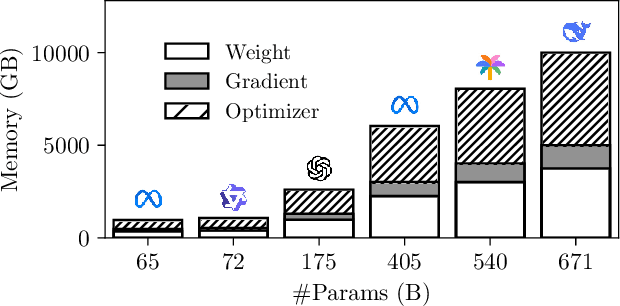
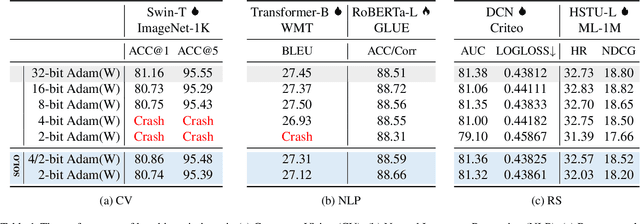
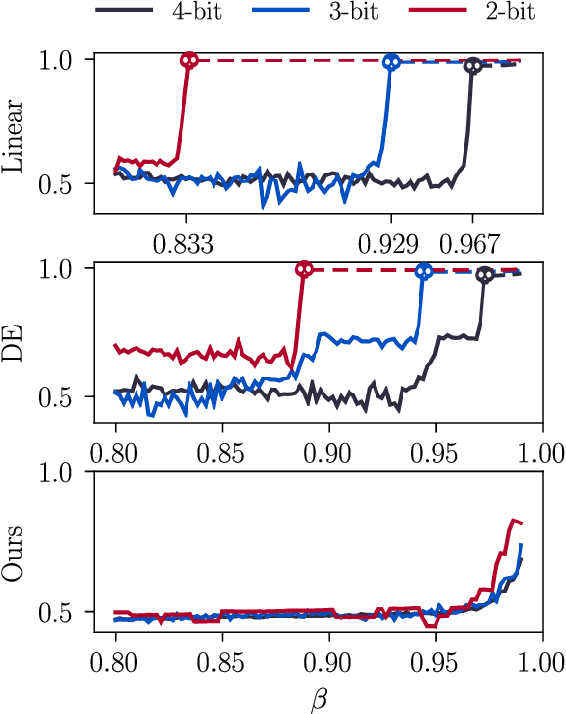
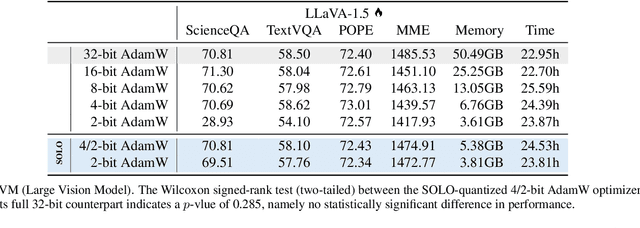
The explosion in model sizes leads to continued growth in prohibitive training/fine-tuning costs, particularly for stateful optimizers which maintain auxiliary information of even 2x the model size to achieve optimal convergence. We therefore present in this work a novel type of optimizer that carries with extremely lightweight state overloads, achieved through ultra-low-precision quantization. While previous efforts have achieved certain success with 8-bit or 4-bit quantization, our approach enables optimizers to operate at precision as low as 3 bits, or even 2 bits per state element. This is accomplished by identifying and addressing two critical challenges: the signal swamping problem in unsigned quantization that results in unchanged state dynamics, and the rapidly increased gradient variance in signed quantization that leads to incorrect descent directions. The theoretical analysis suggests a tailored logarithmic quantization for the former and a precision-specific momentum value for the latter. Consequently, the proposed SOLO achieves substantial memory savings (approximately 45 GB when training a 7B model) with minimal accuracy loss. We hope that SOLO can contribute to overcoming the bottleneck in computational resources, thereby promoting greater accessibility in fundamental research.
Tempo: Application-aware LLM Serving with Mixed SLO Requirements
Apr 24, 2025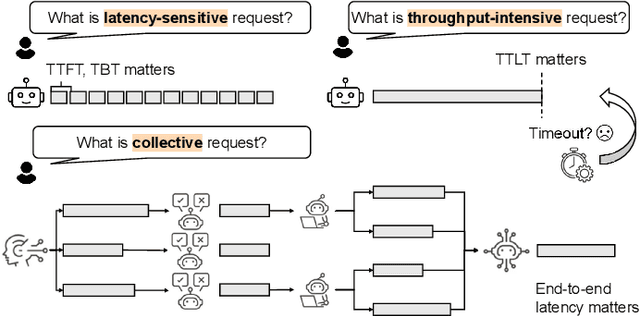
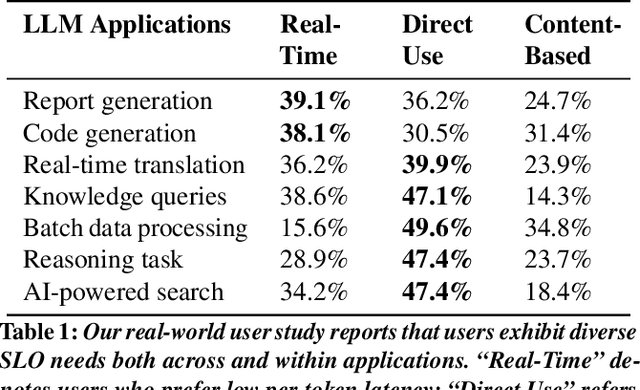
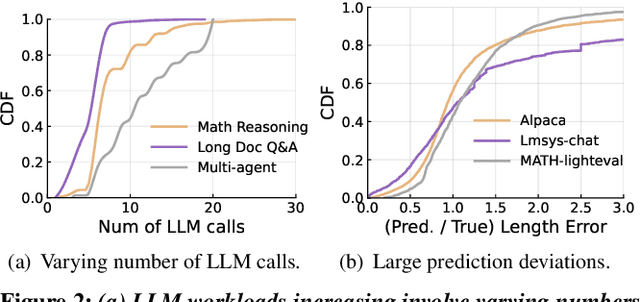
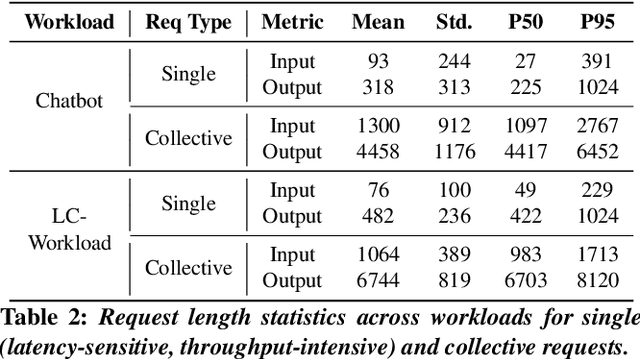
The integration of Large Language Models (LLMs) into diverse applications, ranging from interactive chatbots and cloud AIOps to intelligent agents, has introduced a wide spectrum of Service Level Objectives (SLOs) for responsiveness. These workloads include latency-sensitive requests focused on per-token latency in streaming chat, throughput-intensive requests that require rapid full responses to invoke tools, and collective requests with dynamic dependencies arising from self-reflection or agent-based reasoning. This workload diversity, amplified by unpredictable request information such as response lengths and runtime dependencies, makes existing schedulers inadequate even within their design envelopes. In this paper, we define service gain as the useful service delivered by completing requests. We observe that as SLO directly reflects the actual performance needs of requests, completing a request much faster than its SLO (e.g., deadline) yields limited additional service gain. Based on this insight, we introduce Tempo, the first systematic SLO-aware scheduler designed to maximize service gain across diverse LLM workloads. Tempo allocates just enough serving bandwidth to meet each SLO, maximizing residual capacity for others best-effort workloads. Instead of assuming request information or none at all, it adopts a hybrid scheduling strategy: using quantile-based response upper bounds and dependency-graph matching for conservative initial estimates, prioritizing requests by service gain density, and refining decisions online as generation progresses. Our evaluation across diverse workloads, including chat, reasoning, and agentic pipelines, shows that Tempo improves end-to-end service gain by up to 8.3$\times$ and achieves up to 10.3$\times$ SLO goodput compared to state-of-the-art designs