 Add to Chrome
 Add to Firefox
 Add to Edge
VINE: Taming Generative Control Policies for Reinforcement Learning
Jul 11, 2026
Flow-matching policies have emerged as an effective policy parameterization for robot learning. They iteratively generate actions from noise, enabling highly expressive modeling of complex and multimodal action distributions. However, prior works observed that scaling these policies with value-gradient reinforcement learning (RL) often leads to training instability. Existing methods attribute this instability to iterative generation and therefore avoid end-to-end value-gradient optimization by sacrificing iterative generation, high expressiveness, or value-gradient optimization. Contrary to prior belief, we show the instability does not stem from iterative generation itself, but from the vanilla sampling strategy originally designed for behavior cloning, which becomes brittle under value-gradient RL. Motivated by this insight, we propose VINE, an RL-oriented sampling method that enables stable end-to-end value-gradient optimization for flow-matching policies. Instead of following a single flow trajectory, VINE reconstructs a new interpolation state at every denoising step, creating a stable differentiable path for value-gradient propagation while remaining compatible with the original flow-matching denoising process. As a result, VINE preserves the expressiveness and iterative generation of flow-matching without sacrificing end-to-end value-gradient optimization. Despite performing end-to-end backpropagation through all ten denoising steps, VINE achieves stable policy improvement and consistently outperforms state-of-the-art RL methods on the OGBench offline RL benchmark and real-world robotic manipulation task. Videos are available on our website: https://agibottech.github.io/vine.

LLM-based Multimodal Personality Recognition via Facial Action Unit-Text Semantic Fusion
Jun 29, 2026Personality recognition in asynchronous video interviews (AVIs) has become increasingly important due to their widespread adoption in modern recruitment. Existing approaches often rely on large language models (LLMs) to analyze textual responses of interviewees in AVI. However, unimodel methods often suffer from information loss (e.g., ignore facial cues). In contrast, multimodal methods that employ full-face images or sparsely sampled frames can discard fine-grained temporal dynamics critical for accurate personality assessment. To overcome these limitations, we propose an LLM-based framework that semantically fuse facial action units (AUs) with textual responses of AVI. AU sequences are first converted into interpretable textual descriptions, which are then fused with participants' textual responses through an LLM. A lightweight regression head transforms the resulting embeddings into continuous personality scores without disrupting the underlying semantic space. Experiments on the AVI-6 benchmark demonstrate consistent improvements over most baselines, with lower prediction errors and stronger correlations with human-rated scores across multiple traits. Further analysis reveals that AU-derived semantic representations offer complementary non-verbal cues to textual responses. Decoupling semantic understanding from regression prediction within the LLM also leads to greater training stability and clearer interpretability. Overall, these findings demonstrate that AU-text fusion provides a psychologically grounded and computationally efficient framework for personality recognition in AVIs.
ALOE: Action-Level Off-Policy Evaluation for Vision-Language-Action Model Post-Training
Feb 13, 2026We study how to improve large foundation vision-language-action (VLA) systems through online reinforcement learning (RL) in real-world settings. Central to this process is the value function, which provides learning signals to guide VLA learning from experience. In practice, the value function is estimated from trajectory fragments collected from different data sources, including historical policies and intermittent human interventions. Estimating the value function of current behavior quality from the mixture data is inherently an off-policy evaluation problem. However, prior work often adopts conservative on-policy estimation for stability, which avoids direct evaluation of the current high-capacity policy and limits learning effectiveness. In this paper, we propose ALOE, an action-level off-policy evaluation framework for VLA post-training. ALOE applies chunking-based temporal-difference bootstrapping to evaluate individual action sequences instead of predicting final task outcomes. This design improves effective credit assignment to critical action chunks under sparse rewards and supports stable policy improvement. We evaluate our method on three real-world manipulation tasks, including smartphone packing as a high-precision task, laundry folding as a long-horizon deformable-object task, and bimanual pick-and-place involving multi-object perception. Across all tasks, ALOE improves learning efficiency without compromising execution speed, showing that off-policy RL can be reintroduced in a reliable manner for real-world VLA post-training. Videos and additional materials are available at our project website.
Ego-Exo4D: Understanding Skilled Human Activity from First- and Third-Person Perspectives
Nov 30, 2023
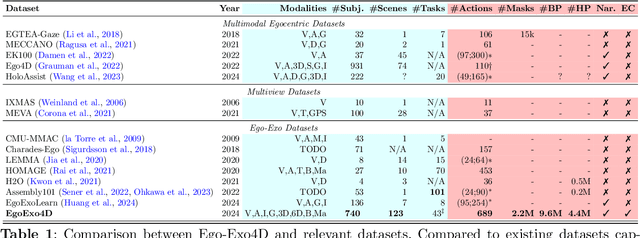

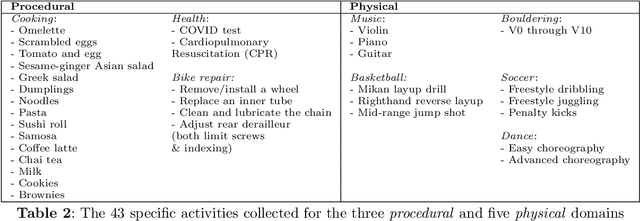
We present Ego-Exo4D, a diverse, large-scale multimodal multiview video dataset and benchmark challenge. Ego-Exo4D centers around simultaneously-captured egocentric and exocentric video of skilled human activities (e.g., sports, music, dance, bike repair). More than 800 participants from 13 cities worldwide performed these activities in 131 different natural scene contexts, yielding long-form captures from 1 to 42 minutes each and 1,422 hours of video combined. The multimodal nature of the dataset is unprecedented: the video is accompanied by multichannel audio, eye gaze, 3D point clouds, camera poses, IMU, and multiple paired language descriptions -- including a novel "expert commentary" done by coaches and teachers and tailored to the skilled-activity domain. To push the frontier of first-person video understanding of skilled human activity, we also present a suite of benchmark tasks and their annotations, including fine-grained activity understanding, proficiency estimation, cross-view translation, and 3D hand/body pose. All resources will be open sourced to fuel new research in the community.
Adversarial Data Encryption
Feb 11, 2020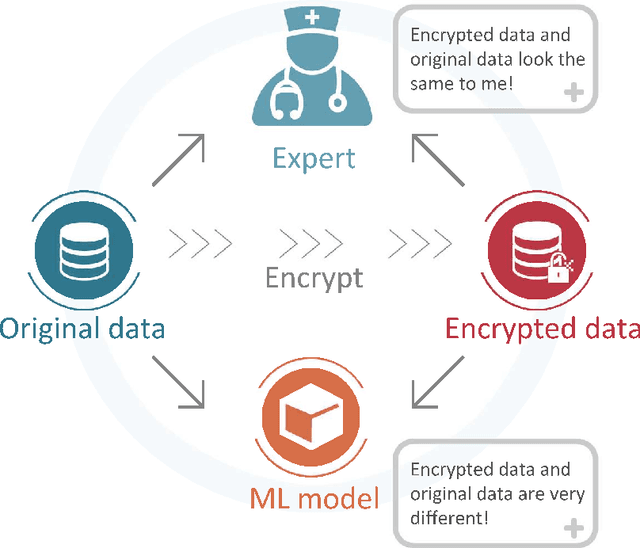

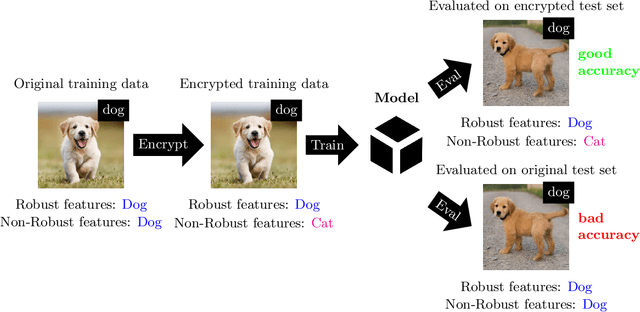
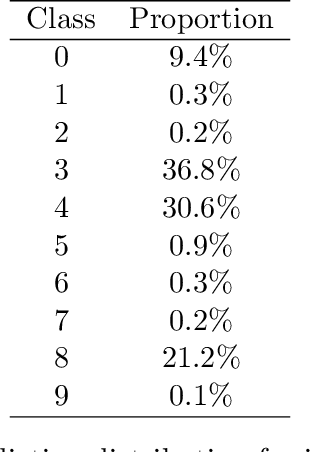
In the big data era, many organizations face the dilemma of data sharing. Regular data sharing is often necessary for human-centered discussion and communication, especially in medical scenarios. However, unprotected data sharing may also lead to data leakage. Inspired by adversarial attack, we propose a method for data encryption, so that for human beings the encrypted data look identical to the original version, but for machine learning methods they are misleading. To show the effectiveness of our method, we collaborate with the Beijing Tiantan Hospital, which has a world leading neurological center. We invite $3$ doctors to manually inspect our encryption method based on real world medical images. The results show that the encrypted images can be used for diagnosis by the doctors, but not by machine learning methods.