 Add to Chrome
 Add to Firefox
 Add to Edge
Emerging Microelectronic Materials by Design: Navigating Combinatorial Design Space with Scarce and Dispersed Data
Dec 23, 2024

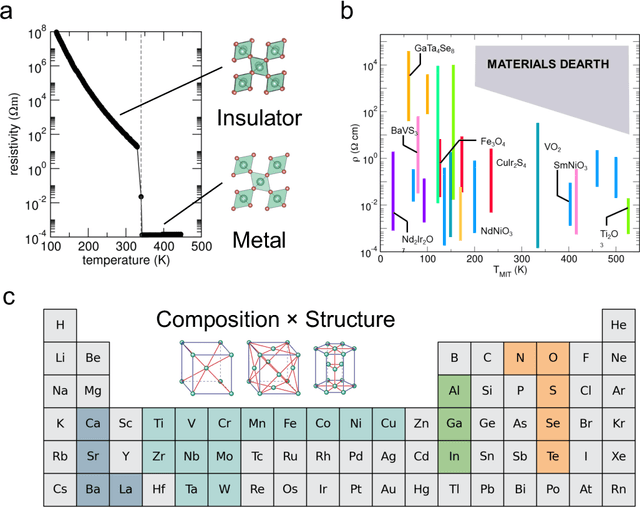
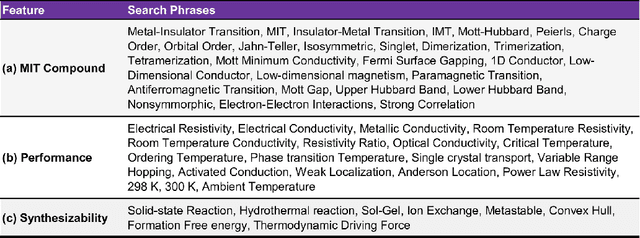
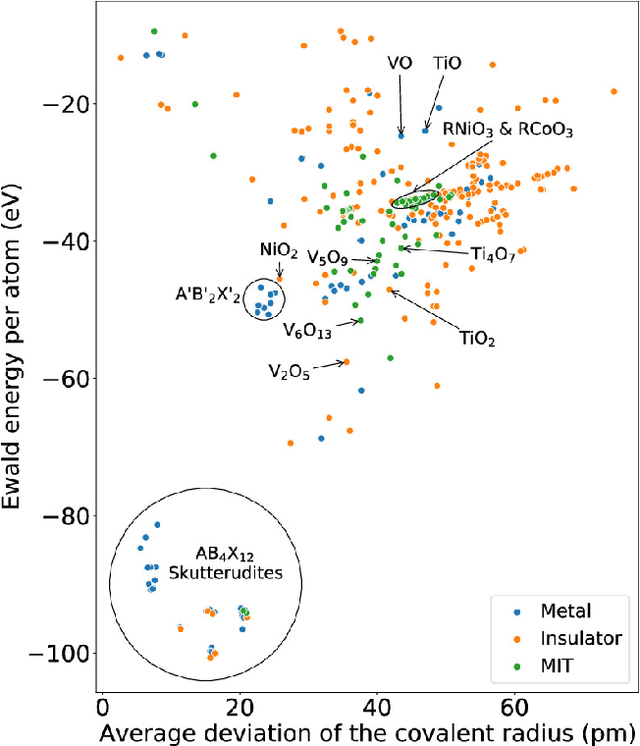
The increasing demands of sustainable energy, electronics, and biomedical applications call for next-generation functional materials with unprecedented properties. Of particular interest are emerging materials that display exceptional physical properties, making them promising candidates in energy-efficient microelectronic devices. As the conventional Edisonian approach becomes significantly outpaced by growing societal needs, emerging computational modeling and machine learning (ML) methods are employed for the rational design of materials. However, the complex physical mechanisms, cost of first-principles calculations, and the dispersity and scarcity of data pose challenges to both physics-based and data-driven materials modeling. Moreover, the combinatorial composition-structure design space is high-dimensional and often disjoint, making design optimization nontrivial. In this Account, we review a team effort toward establishing a framework that integrates data-driven and physics-based methods to address these challenges and accelerate materials design. We begin by presenting our integrated materials design framework and its three components in a general context. We then provide an example of applying this materials design framework to metal-insulator transition (MIT) materials, a specific type of emerging materials with practical importance in next-generation memory technologies. We identify multiple new materials which may display this property and propose pathways for their synthesis. Finally, we identify some outstanding challenges in data-driven materials design, such as materials data quality issues and property-performance mismatch. We seek to raise awareness of these overlooked issues hindering materials design, thus stimulating efforts toward developing methods to mitigate the gaps.

CognTKE: A Cognitive Temporal Knowledge Extrapolation Framework
Dec 21, 2024


Reasoning future unknowable facts on temporal knowledge graphs (TKGs) is a challenging task, holding significant academic and practical values for various fields. Existing studies exploring explainable reasoning concentrate on modeling comprehensible temporal paths relevant to the query. Yet, these path-based methods primarily focus on local temporal paths appearing in recent times, failing to capture the complex temporal paths in TKG and resulting in the loss of longer historical relations related to the query. Motivated by the Dual Process Theory in cognitive science, we propose a \textbf{Cogn}itive \textbf{T}emporal \textbf{K}nowledge \textbf{E}xtrapolation framework (CognTKE), which introduces a novel temporal cognitive relation directed graph (TCR-Digraph) and performs interpretable global shallow reasoning and local deep reasoning over the TCR-Digraph. Specifically, the proposed TCR-Digraph is constituted by retrieving significant local and global historical temporal relation paths associated with the query. In addition, CognTKE presents the global shallow reasoner and the local deep reasoner to perform global one-hop temporal relation reasoning (System 1) and local complex multi-hop path reasoning (System 2) over the TCR-Digraph, respectively. The experimental results on four benchmark datasets demonstrate that CognTKE achieves significant improvement in accuracy compared to the state-of-the-art baselines and delivers excellent zero-shot reasoning ability. \textit{The code is available at https://github.com/WeiChen3690/CognTKE}.
STKDRec: Spatial-Temporal Knowledge Distillation for Takeaway Recommendation
Dec 21, 2024
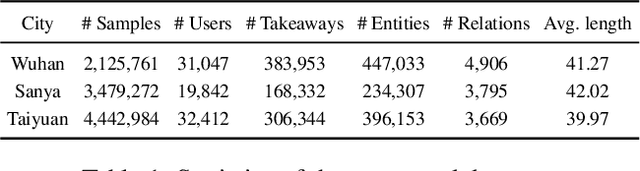
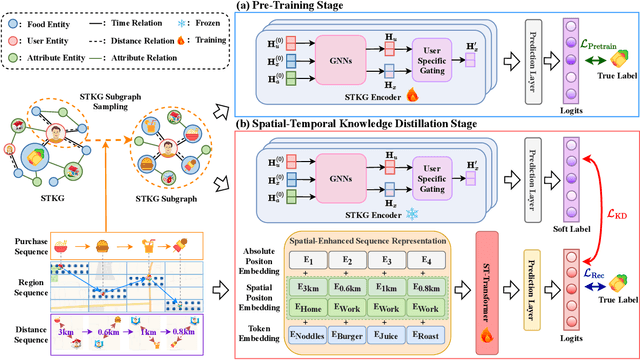
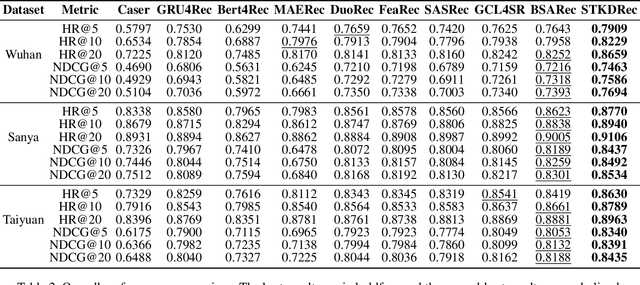
The takeaway recommendation system is designed to recommend users' future takeaway purchases based on their historical purchase behaviors, thereby improving user satisfaction and increasing merchant sales. Existing methods focus on incorporating auxiliary information or leveraging knowledge graphs to alleviate the sparsity issue of user purchase sequence data. However, two main challenges limit the performance of these approaches: (1) how to capture dynamic user preferences on complex geospatial information and (2) how to efficiently integrate spatial-temporal knowledge from graphs and sequence data with low calculation costs. In this paper, we propose a novel spatial-temporal knowledge distillation for takeaway recommendation model (STKDRec) based on the two-stage training process. Specifically, during the first pre-training stage, a spatial-temporal knowledge graph (STKG) encoder is pre-trained to extract the high-order spatial-temporal and collaborative associations within the STKG. During the second STKD stage, a spatial-temporal Transformer is employed to comprehensively model dynamic user preferences on various types of fine-grained geospatial information from a sequence perspective. Furthermore, the STKD strategy is introduced to adaptively fuse the rich spatial-temporal knowledge from the pre-trained STKG encoder and the spatial-temporal transformer while reducing the cost of model training. Extensive experiments on three real-world datasets show that our STKDRec significantly outperforms the state-of-the-art baselines. Our code is available at:https://github.com/Zhaoshuyuan0246/STKDRec.
OmniVLM: A Token-Compressed, Sub-Billion-Parameter Vision-Language Model for Efficient On-Device Inference
Dec 16, 2024We present OmniVLM, a sub-billion-parameter vision-language model for efficient on-device inference. OmniVLM introduces a token compression mechanism that reduces visual token sequence length from 729 to 81 tokens, significantly reducing computational overhead while preserving visual-semantic fidelity. Through a multi-stage training pipeline of pretraining, supervised fine-tuning, and minimal-edit Direct Preference Optimization (DPO), OmniVLM matches the performance of larger models. On multiple benchmarks including ScienceQA, POPE, and MMMU, OmniVLM outperforms existing baselines like nanoLLAVA within a 968M-parameter footprint. Empirical results on the same laptop demonstrate 9.1x faster time-to-first-token (0.75s vs 6.82s) and 1.5x higher decoding speed (29.41 vs 19.20 tokens/s) compared to nanoLLAVA, enabling efficient deployment on edge devices. The model weights can be accessed on huggingface: \url{https://huggingface.co/NexaAIDev/OmniVLM-968M}, and the inference examples can be find in Appendix B.
LLMs Can Simulate Standardized Patients via Agent Coevolution
Dec 16, 2024Training medical personnel using standardized patients (SPs) remains a complex challenge, requiring extensive domain expertise and role-specific practice. Most research on Large Language Model (LLM)-based simulated patients focuses on improving data retrieval accuracy or adjusting prompts through human feedback. However, this focus has overlooked the critical need for patient agents to learn a standardized presentation pattern that transforms data into human-like patient responses through unsupervised simulations. To address this gap, we propose EvoPatient, a novel simulated patient framework in which a patient agent and doctor agents simulate the diagnostic process through multi-turn dialogues, simultaneously gathering experience to improve the quality of both questions and answers, ultimately enabling human doctor training. Extensive experiments on various cases demonstrate that, by providing only overall SP requirements, our framework improves over existing reasoning methods by more than 10% in requirement alignment and better human preference, while achieving an optimal balance of resource consumption after evolving over 200 cases for 10 hours, with excellent generalizability. The code will be available at https://github.com/ZJUMAI/EvoPatient.
Smoothness Really Matters: A Simple yet Effective Approach for Unsupervised Graph Domain Adaptation
Dec 16, 2024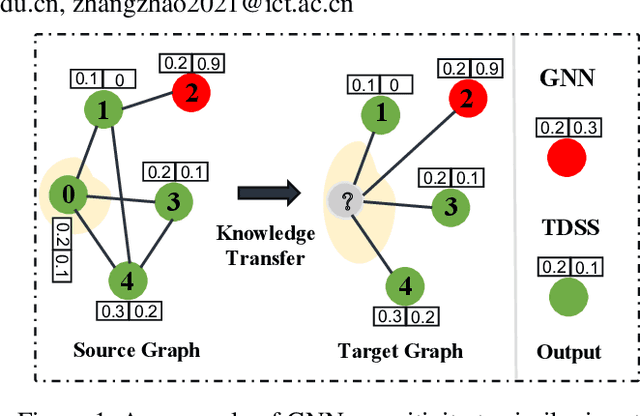
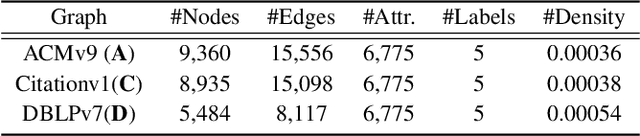
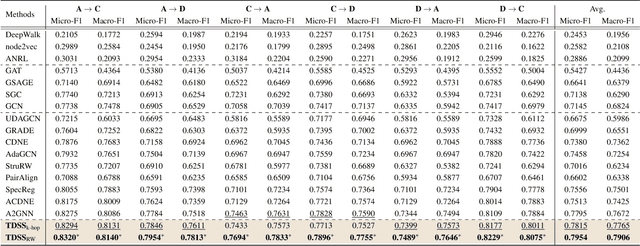
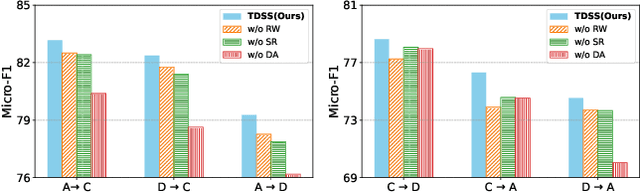
Unsupervised Graph Domain Adaptation (UGDA) seeks to bridge distribution shifts between domains by transferring knowledge from labeled source graphs to given unlabeled target graphs. Existing UGDA methods primarily focus on aligning features in the latent space learned by graph neural networks (GNNs) across domains, often overlooking structural shifts, resulting in limited effectiveness when addressing structurally complex transfer scenarios. Given the sensitivity of GNNs to local structural features, even slight discrepancies between source and target graphs could lead to significant shifts in node embeddings, thereby reducing the effectiveness of knowledge transfer. To address this issue, we introduce a novel approach for UGDA called Target-Domain Structural Smoothing (TDSS). TDSS is a simple and effective method designed to perform structural smoothing directly on the target graph, thereby mitigating structural distribution shifts and ensuring the consistency of node representations. Specifically, by integrating smoothing techniques with neighborhood sampling, TDSS maintains the structural coherence of the target graph while mitigating the risk of over-smoothing. Our theoretical analysis shows that TDSS effectively reduces target risk by improving model smoothness. Empirical results on three real-world datasets demonstrate that TDSS outperforms recent state-of-the-art baselines, achieving significant improvements across six transfer scenarios. The code is available in https://github.com/cwei01/TDSS.
Asynchronous Random Access in Massive MIMO Systems Facilitated by the Delay-Angle Domain
Dec 06, 2024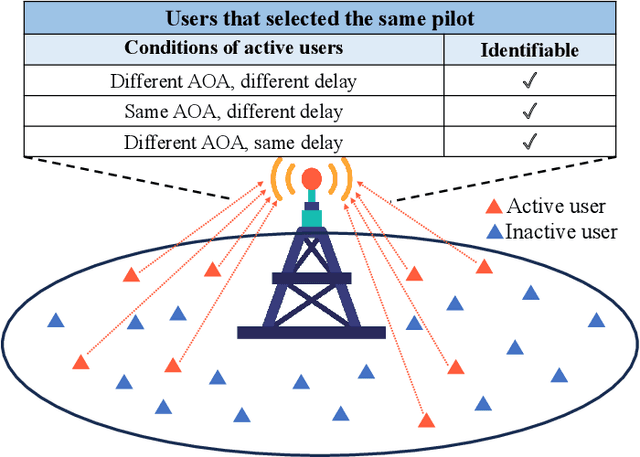
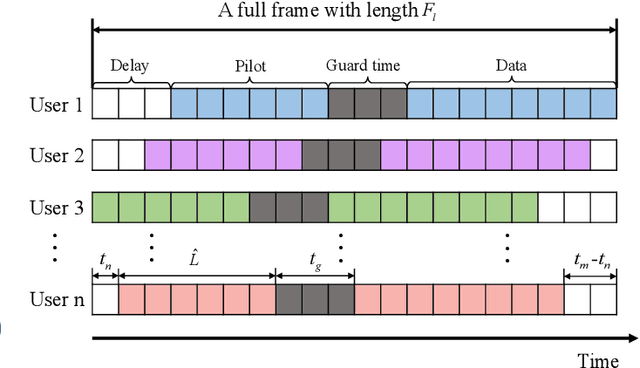
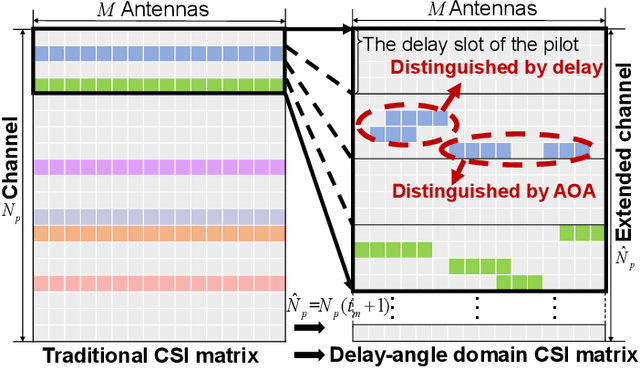
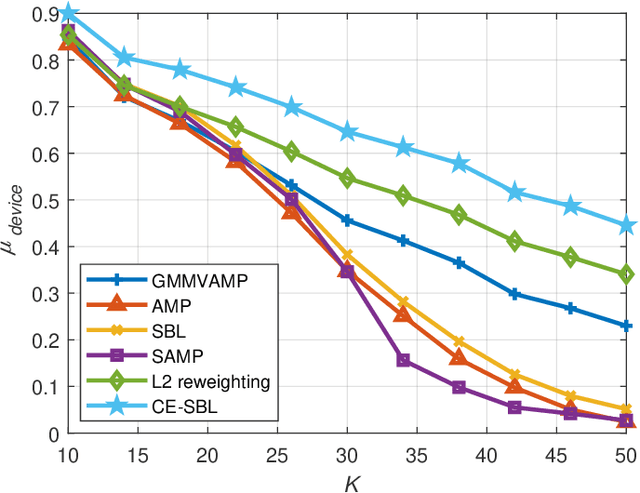
The problem of uplink transmissions in massive connectivity is commonly dealt with using schemes for grant-free random access. When a large number of devices transmit almost synchronously, the receiver may not be able to resolve the collision. This could be addressed by assigning dedicated pilots to each user, leading to a contention-free random access (CFRA), which suffers from low scalability and efficiency. This paper explores contention-based random access (CBRA) schemes for asynchronous access in massive multiple-input multiple-output (MIMO) systems. The symmetry across the accessing users with the same pilots is broken by leveraging the delay information inherent to asynchronous systems and the angle information from massive MIMO to enhance activity detection (AD) and channel estimation (CE). The problem is formulated as a sparse recovery in the delay-angle domain. The challenge is that the recovery signal exhibits both row-sparse and cluster-sparse structure, with unknown cluster sizes and locations. We address this by a cluster-extended sparse Bayesian learning (CE-SBL) algorithm that introduces a new weighted prior to capture the signal structure and extends the expectation maximization (EM) algorithm for hyperparameter estimation. Simulation results demonstrate the superiority of the proposed method in joint AD and CE.
DataLab: A Unified Platform for LLM-Powered Business Intelligence
Dec 04, 2024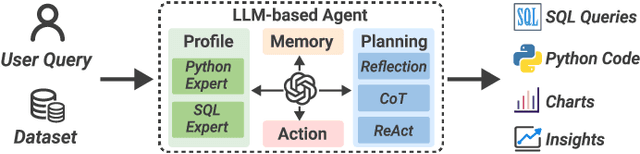
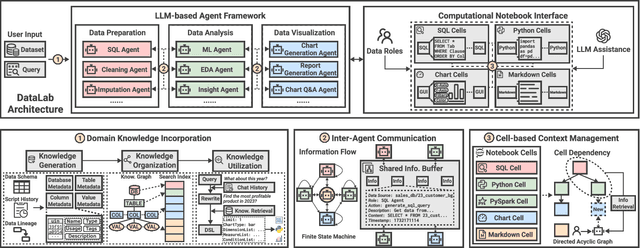
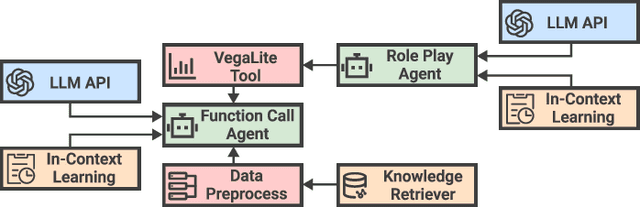
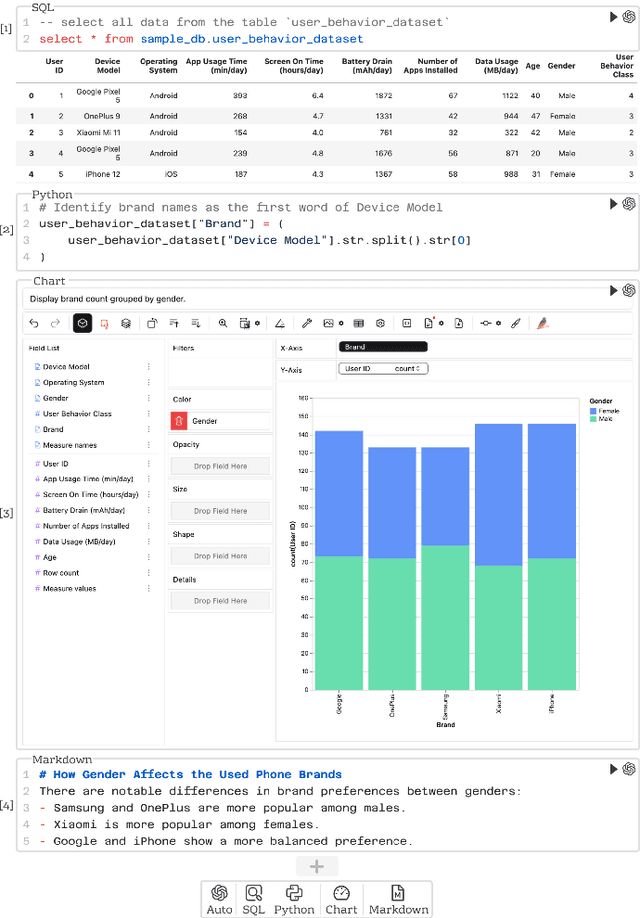
Business intelligence (BI) transforms large volumes of data within modern organizations into actionable insights for informed decision-making. Recently, large language model (LLM)-based agents have streamlined the BI workflow by automatically performing task planning, reasoning, and actions in executable environments based on natural language (NL) queries. However, existing approaches primarily focus on individual BI tasks such as NL2SQL and NL2VIS. The fragmentation of tasks across different data roles and tools lead to inefficiencies and potential errors due to the iterative and collaborative nature of BI. In this paper, we introduce DataLab, a unified BI platform that integrates a one-stop LLM-based agent framework with an augmented computational notebook interface. DataLab supports a wide range of BI tasks for different data roles by seamlessly combining LLM assistance with user customization within a single environment. To achieve this unification, we design a domain knowledge incorporation module tailored for enterprise-specific BI tasks, an inter-agent communication mechanism to facilitate information sharing across the BI workflow, and a cell-based context management strategy to enhance context utilization efficiency in BI notebooks. Extensive experiments demonstrate that DataLab achieves state-of-the-art performance on various BI tasks across popular research benchmarks. Moreover, DataLab maintains high effectiveness and efficiency on real-world datasets from Tencent, achieving up to a 58.58% increase in accuracy and a 61.65% reduction in token cost on enterprise-specific BI tasks.
DataLab: A Unifed Platform for LLM-Powered Business Intelligence
Dec 03, 2024Business intelligence (BI) transforms large volumes of data within modern organizations into actionable insights for informed decision-making. Recently, large language model (LLM)-based agents have streamlined the BI workflow by automatically performing task planning, reasoning, and actions in executable environments based on natural language (NL) queries. However, existing approaches primarily focus on individual BI tasks such as NL2SQL and NL2VIS. The fragmentation of tasks across different data roles and tools lead to inefficiencies and potential errors due to the iterative and collaborative nature of BI. In this paper, we introduce DataLab, a unified BI platform that integrates a one-stop LLM-based agent framework with an augmented computational notebook interface. DataLab supports a wide range of BI tasks for different data roles by seamlessly combining LLM assistance with user customization within a single environment. To achieve this unification, we design a domain knowledge incorporation module tailored for enterprise-specific BI tasks, an inter-agent communication mechanism to facilitate information sharing across the BI workflow, and a cell-based context management strategy to enhance context utilization efficiency in BI notebooks. Extensive experiments demonstrate that DataLab achieves state-of-the-art performance on various BI tasks across popular research benchmarks. Moreover, DataLab maintains high effectiveness and efficiency on real-world datasets from Tencent, achieving up to a 58.58% increase in accuracy and a 61.65% reduction in token cost on enterprise-specific BI tasks.
Combinatorial Rising Bandit
Dec 01, 2024
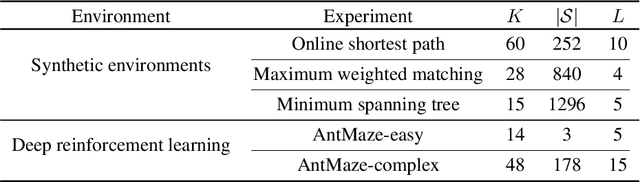


Combinatorial online learning is a fundamental task to decide the optimal combination of base arms in sequential interactions with systems providing uncertain rewards, which is applicable to diverse domains such as robotics, social advertising, network routing and recommendation systems. In real-world scenarios, we often observe rising rewards, where the selection of a base arm not only provides an instantaneous reward but also contributes to the enhancement of future rewards, {\it e.g.}, robots enhancing proficiency through practice and social influence strengthening in the history of successful recommendations. To address this, we introduce the problem of combinatorial rising bandit to minimize policy regret and propose a provably efficient algorithm, called Combinatorial Rising Upper Confidence Bound (CRUCB), of which regret upper bound is close to a regret lower bound. To the best of our knowledge, previous studies do not provide a sub-linear regret lower bound, making it impossible to assess the efficiency of their algorithms. However, we provide the sub-linear regret lower bound for combinatorial rising bandit and show that CRUCB is provably efficient by showing that the regret upper bound is close to the regret lower bound. In addition, we empirically demonstrate the effectiveness and superiority of CRUCB not only in synthetic environments but also in realistic applications of deep reinforcement learning.