 Add to Chrome
 Add to Firefox
 Add to Edge
Rising Multi-Armed Bandits with Known Horizons
Feb 13, 2026
The Rising Multi-Armed Bandit (RMAB) framework models environments where expected rewards of arms increase with plays, which models practical scenarios where performance of each option improves with the repeated usage, such as in robotics and hyperparameter tuning. For instance, in hyperparameter tuning, the validation accuracy of a model configuration (arm) typically increases with each training epoch. A defining characteristic of RMAB is em horizon-dependent optimality: unlike standard settings, the optimal strategy here shifts dramatically depending on the available budget $T$. This implies that knowledge of $T$ yields significantly greater utility in RMAB, empowering the learner to align its decision-making with this shifting optimality. However, the horizon-aware setting remains underexplored. To address this, we propose a novel CUmulative Reward Estimation UCB (CURE-UCB) that explicitly integrates the horizon. We provide a rigorous analysis establishing a new regret upper bound and prove that our method strictly outperforms horizon-agnostic strategies in structured environments like ``linear-then-flat'' instances. Extensive experiments demonstrate its significant superiority over baselines.

Combinatorial Rising Bandit
Dec 01, 2024
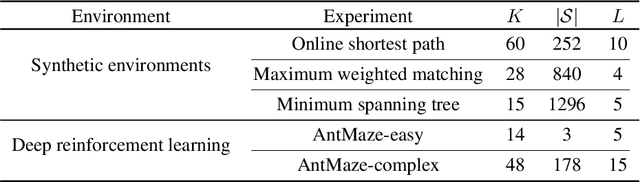


Combinatorial online learning is a fundamental task to decide the optimal combination of base arms in sequential interactions with systems providing uncertain rewards, which is applicable to diverse domains such as robotics, social advertising, network routing and recommendation systems. In real-world scenarios, we often observe rising rewards, where the selection of a base arm not only provides an instantaneous reward but also contributes to the enhancement of future rewards, {\it e.g.}, robots enhancing proficiency through practice and social influence strengthening in the history of successful recommendations. To address this, we introduce the problem of combinatorial rising bandit to minimize policy regret and propose a provably efficient algorithm, called Combinatorial Rising Upper Confidence Bound (CRUCB), of which regret upper bound is close to a regret lower bound. To the best of our knowledge, previous studies do not provide a sub-linear regret lower bound, making it impossible to assess the efficiency of their algorithms. However, we provide the sub-linear regret lower bound for combinatorial rising bandit and show that CRUCB is provably efficient by showing that the regret upper bound is close to the regret lower bound. In addition, we empirically demonstrate the effectiveness and superiority of CRUCB not only in synthetic environments but also in realistic applications of deep reinforcement learning.