 Add to Chrome
 Add to Firefox
 Add to Edge
CAAT: Contact-Aware Attention Scaling and Tactile Masking for Data-Efficient Contact-Rich Manipulation
Aug 02, 2026
In contact-rich manipulation, visual observations primarily guide motion in free space, whereas tactile observations become particularly informative during contact. However, standard Transformer-based visuo-tactile policies typically rely on either token concatenation or learnable gating. These approaches lack explicit contact-aware priors, making it difficult to efficiently learn effective cross-modal representations from demonstrations. To address this limitation, we propose CAAT, a lightweight contact-aware framework that explicitly incorporates contact priors through attention scaling and dynamic tactile masking. Specifically, CAAT emphasizes visual information before contact and tactile information during contact. It also suppresses static background tokens by comparing the current tactile observation with a non-contact reference. CAAT can be integrated into commonly used Transformer-based policies without modifying their action decoders. In simulation, integrating CAAT with ACT improves the average success rate by 18.0 percentage points over direct visuo-tactile fusion and by 10.0 percentage points over gated fusion. In real-world experiments using a visuo-tactile UMI platform, CAAT achieves an average success rate of 60.0% across ACT, Diffusion Policy, and $π_0$, outperforming the strongest baseline by an average of 21.1 percentage points. These results demonstrate that explicit contact priors and dynamic tactile masking are effective in improving visuo-tactile policy learning and task performance of diverse policy architectures. https://mrjiangjm.github.io/caat/

DexMani: Human-Derived Manipulability Guidance for Dexterous Rotation
Aug 01, 2026Dexterous object rotation is a sequential contact problem: each support, release, and re-contact decision must both produce the desired object motion, and prepare the hand configuration for continued rotation. Existing reinforcement learning methods discover such movement patterns through trial and error on specific robotic hand embodiments, without explicitly accounting for how each contact transition affects the hand's ability to sustain object rotation in subsequent steps. We introduce DexMani, a framework that transfers human demonstrations as contact-conditioned manipulability evolution. This prior captures how successful human contact transitions reshape the object-rotation directions available to the hand. DexMani then learns this manipulability evolution and uses it to guide downstream reinforcement learning, enabling rotation skills to be acquired across robot embodiments with distinct kinematics and active-contact configurations. Across the Shadow Hand, Allegro Hand, and XHand, DexMani achieves the highest success rates in every evaluated setting for both seen and unseen objects. DexMani reaches an average success rate of 57.5% on LEAP Hand, outperforming other baselines and producing smoother rotatory motions. Project site: https://dexmani.github.io
τ: Learning Touch-Augmented Vision-Language-Action Models from Future Visual Supervision
Jul 27, 2026Learning the informative tactile representation while effectively adapting it to pretrained Vision-Language-Action (VLA) models remains challenging at both the data and modeling levels. At the data level, limited task-specific demonstrations constrain representation quality, whereas large-scale pretraining incurs substantial costs. At the modeling level, existing methods either focus on instantaneous contact states or model temporal interaction dynamics using 6D wrench sequences, leaving high-dimensional tactile signals underexplored. To address these challenges, we present τ, a touch-augmented VLA framework that learns an action-conditioned spatiotemporal tactile representation from future visual supervision inspired by the Joint-Embedding Predictive Architecture (JEPA), and fuses it with vision-language features for action generation under limited data. This supervision operates in latent space and is used only during training, adding no deployment overhead. We also introduce TacAura, a dataset of synchronized vision, proprioception, and vision-based tactile signals across four representative contact-rich manipulation tasks. Experiments show that τ outperforms existing models and generalizes to unseen objects and scenes, delivering improved manipulation performance and robustness
Blind Dexterous Grasping via Real2Sim2Real Tactile Policy Learning
Jun 11, 2026Blind grasping with a dexterous hand is a crucial manipulation capability. Nevertheless, learning such tactile-only policies for real robots remains challenging due to the tactile sim-to-real gap and the limited expressiveness of sparse tactile signals. To bridge this gap, we propose a framework for tactile-only blind grasping that is deployable on a physical multi-fingered robotic hand. Our approach combines three key components. First, we introduce a Real2Sim tactile calibration pipeline that constructs a contact-calibrated digital-twin simulator capable of reproducing real tactile signals. Second, we improve the expressiveness of sparse tactile observations using a layout-aware tactile encoder, which incorporates sensor-geometry priors through self-supervised pretraining. Third, to improve generalization to unseen objects, we train object-specific reinforcement-learning experts in the calibrated simulator and aggregate their successful grasp trajectories into a tactile-conditioned Diffusion Policy. We evaluate our method on a physical LEAP Hand equipped with distributed tactile sensing across 10 seen and 10 unseen objects. The deployed policy achieves a 27\% real-world grasp success rate across all 20 objects, without real-world grasping demonstrations or visual input. Simulation ablations show that layout-aware tactile pretraining improves grasping performance, while sensing-level evaluations confirm that Real2Sim calibration increases the consistency of tactile contact events between simulation and hardware. Together, these results suggest that contact-event calibration, geometry-aware tactile representation learning, and diffusion-based policy aggregation provide an effective path toward tactile-only blind grasping on real dexterous robotic hands. Project page:Dex-Blind-Grasp.github.io.
RGB-S: Image-Aligned Tactile Saliency for Robust Dexterous Manipulation
Jun 07, 2026Effective visuo-tactile integration is critical for robotic dexterous manipulation, especially when visual observations are unreliable or occluded. However, robustly aligning sparse, heterogeneous tactile measurements with dense visual representations remains a fundamental challenge. Most existing approaches require policies to learn cross-modal correspondences implicitly from limited demonstrations, without leveraging geometric priors. As a result, they are often data-inefficient and generalize poorly when visual observations are degraded. To address this limitation, we propose a framework that explicitly grounds physical contacts in the image domain. Using robot forward kinematics and camera calibration, we project tactile sensor locations directly onto the RGB image plane. We then render force-modulated Gaussian saliency maps to model spatial uncertainty arising from kinematic and calibration errors. By integrating these 2D spatial anchors through a zero-initialized conditioning architecture, our method injects physical contact priors into standard visual backbones while preserving pre-trained visual representations. We evaluate our method on six dexterous manipulation tasks in both simulation and the real world under severe visual occlusions. Real-world experiments show that explicit RGB-S grounding in the image domain improves real-world occluded manipulation success rates by $26.7$ percentage points over the strongest implicit visuo-tactile baseline, suggesting its improved spatial reasoning and robustness to occlusion. Project page: touch-as-saliency.github.io
TaF-VLA: Tactile-Force Alignment in Vision-Language-Action Models for Force-aware Manipulation
Jan 30, 2026Vision-Language-Action (VLA) models have recently emerged as powerful generalists for robotic manipulation. However, due to their predominant reliance on visual modalities, they fundamentally lack the physical intuition required for contact-rich tasks that require precise force regulation and physical reasoning. Existing attempts to incorporate vision-based tactile sensing into VLA models typically treat tactile inputs as auxiliary visual textures, thereby overlooking the underlying correlation between surface deformation and interaction dynamics. To bridge this gap, we propose a paradigm shift from tactile-vision alignment to tactile-force alignment. Here, we introduce TaF-VLA, a framework that explicitly grounds high-dimensional tactile observations in physical interaction forces. To facilitate this, we develop an automated tactile-force data acquisition device and curate the TaF-Dataset, comprising over 10 million synchronized tactile observations, 6-axis force/torque, and matrix force map. To align sequential tactile observations with interaction forces, the central component of our approach is the Tactile-Force Adapter (TaF-Adapter), a tactile sensor encoder that extracts discretized latent information for encoding tactile observations. This mechanism ensures that the learned representations capture history-dependent, noise-insensitive physical dynamics rather than static visual textures. Finally, we integrate this force-aligned encoder into a VLA backbone. Extensive real-world experiments demonstrate that TaF-VLA policy significantly outperforms state-of-the-art tactile-vision-aligned and vision-only baselines on contact-rich tasks, verifying its ability to achieve robust, force-aware manipulation through cross-modal physical reasoning.
Tactile-Force Alignment in Vision-Language-Action Models for Force-aware Manipulation
Jan 28, 2026Vision-Language-Action (VLA) models have recently emerged as powerful generalists for robotic manipulation. However, due to their predominant reliance on visual modalities, they fundamentally lack the physical intuition required for contact-rich tasks that require precise force regulation and physical reasoning. Existing attempts to incorporate vision-based tactile sensing into VLA models typically treat tactile inputs as auxiliary visual textures, thereby overlooking the underlying correlation between surface deformation and interaction dynamics. To bridge this gap, we propose a paradigm shift from tactile-vision alignment to tactile-force alignment. Here, we introduce TaF-VLA, a framework that explicitly grounds high-dimensional tactile observations in physical interaction forces. To facilitate this, we develop an automated tactile-force data acquisition device and curate the TaF-Dataset, comprising over 10 million synchronized tactile observations, 6-axis force/torque, and matrix force map. To align sequential tactile observations with interaction forces, the central component of our approach is the Tactile-Force Adapter (TaF-Adapter), a tactile sensor encoder that extracts discretized latent information for encoding tactile observations. This mechanism ensures that the learned representations capture history-dependent, noise-insensitive physical dynamics rather than static visual textures. Finally, we integrate this force-aligned encoder into a VLA backbone. Extensive real-world experiments demonstrate that TaF-VLA policy significantly outperforms state-of-the-art tactile-vision-aligned and vision-only baselines on contact-rich tasks, verifying its ability to achieve robust, force-aware manipulation through cross-modal physical reasoning.
PP-Tac: Paper Picking Using Tactile Feedback in Dexterous Robotic Hands
Apr 23, 2025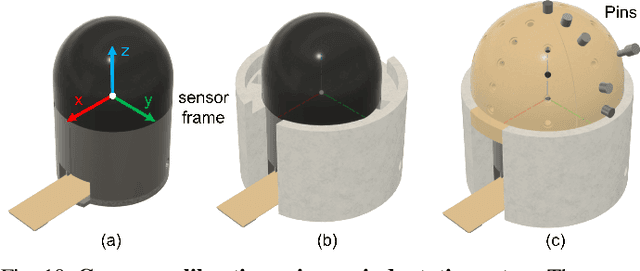
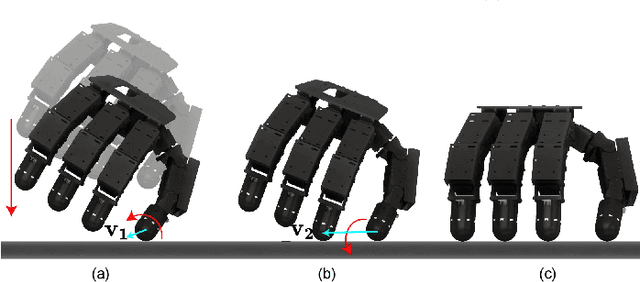
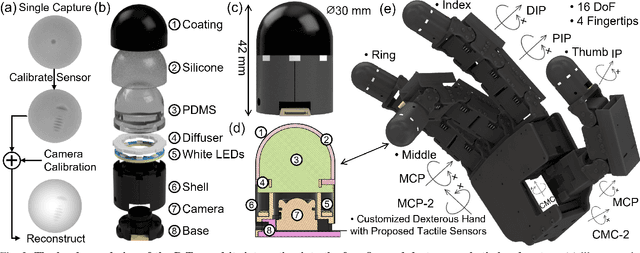
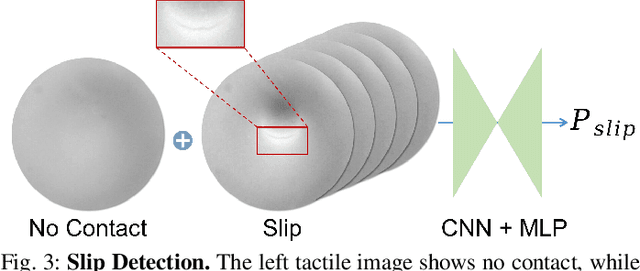
Robots are increasingly envisioned as human companions, assisting with everyday tasks that often involve manipulating deformable objects. Although recent advances in robotic hardware and embodied AI have expanded their capabilities, current systems still struggle with handling thin, flat, and deformable objects such as paper and fabric. This limitation arises from the lack of suitable perception techniques for robust state estimation under diverse object appearances, as well as the absence of planning techniques for generating appropriate grasp motions. To bridge these gaps, this paper introduces PP-Tac, a robotic system for picking up paper-like objects. PP-Tac features a multi-fingered robotic hand with high-resolution omnidirectional tactile sensors \sensorname. This hardware configuration enables real-time slip detection and online frictional force control that mitigates such slips. Furthermore, grasp motion generation is achieved through a trajectory synthesis pipeline, which first constructs a dataset of finger's pinching motions. Based on this dataset, a diffusion-based policy is trained to control the hand-arm robotic system. Experiments demonstrate that PP-Tac can effectively grasp paper-like objects of varying material, thickness, and stiffness, achieving an overall success rate of 87.5\%. To our knowledge, this work is the first attempt to grasp paper-like deformable objects using a tactile dexterous hand. Our project webpage can be found at: https://peilin-666.github.io/projects/PP-Tac/
Embedding high-resolution touch across robotic hands enables adaptive human-like grasping
Dec 19, 2024


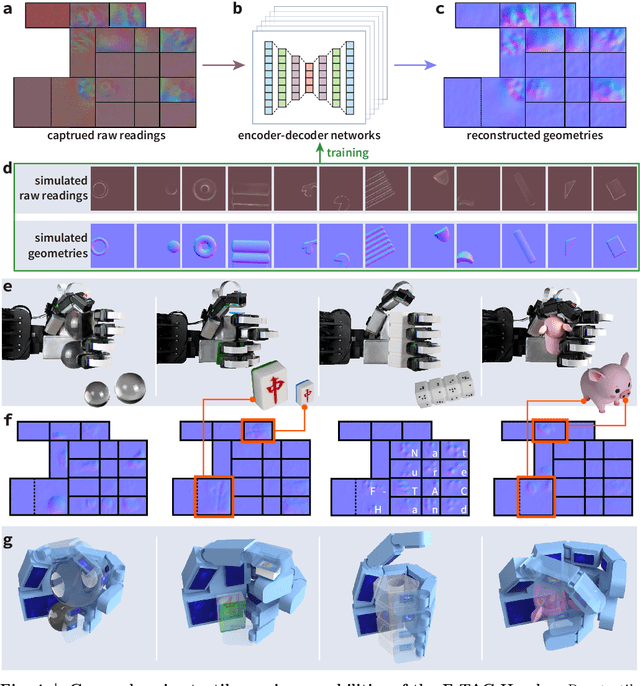
Developing robotic hands that adapt to real-world dynamics remains a fundamental challenge in robotics and machine intelligence. Despite significant advances in replicating human hand kinematics and control algorithms, robotic systems still struggle to match human capabilities in dynamic environments, primarily due to inadequate tactile feedback. To bridge this gap, we present F-TAC Hand, a biomimetic hand featuring high-resolution tactile sensing (0.1mm spatial resolution) across 70% of its surface area. Through optimized hand design, we overcome traditional challenges in integrating high-resolution tactile sensors while preserving the full range of motion. The hand, powered by our generative algorithm that synthesizes human-like hand configurations, demonstrates robust grasping capabilities in dynamic real-world conditions. Extensive evaluation across 600 real-world trials demonstrates that this tactile-embodied system significantly outperforms non-tactile alternatives in complex manipulation tasks (p<0.0001). These results provide empirical evidence for the critical role of rich tactile embodiment in developing advanced robotic intelligence, offering new perspectives on the relationship between physical sensing capabilities and intelligent behavior.
MiniTac: An Ultra-Compact 8 mm Vision-Based Tactile Sensor for Enhanced Palpation in Robot-Assisted Minimally Invasive Surgery
Oct 30, 2024Robot-assisted minimally invasive surgery (RAMIS) provides substantial benefits over traditional open and laparoscopic methods. However, a significant limitation of RAMIS is the surgeon's inability to palpate tissues, a crucial technique for examining tissue properties and detecting abnormalities, restricting the widespread adoption of RAMIS. To overcome this obstacle, we introduce MiniTac, a novel vision-based tactile sensor with an ultra-compact cross-sectional diameter of 8 mm, designed for seamless integration into mainstream RAMIS devices, particularly the Da Vinci surgical systems. MiniTac features a novel mechanoresponsive photonic elastomer membrane that changes color distribution under varying contact pressures. This color change is captured by an embedded miniature camera, allowing MiniTac to detect tumors both on the tissue surface and in deeper layers typically obscured from endoscopic view. MiniTac's efficacy has been rigorously tested on both phantoms and ex-vivo tissues. By leveraging advanced mechanoresponsive photonic materials, MiniTac represents a significant advancement in integrating tactile sensing into RAMIS, potentially expanding its applicability to a wider array of clinical scenarios that currently rely on traditional surgical approaches.