 Add to Chrome
 Add to Firefox
 Add to Edge
Generic Vision and Cross-Attention for Reaction Yield Prediction
Aug 01, 2026
Traditional reaction yield prediction is constrained by 1D quantum descriptors that lack explicit spatial information. To address this gap, a dual-modal Vision Cross-Attention architecture is proposed, fusing tabular physical-organic data with 2D molecular topologies. Notably, it is demonstrated that a generic computer vision backbone processing simple 2D skeletal structures independently outperforms purely quantum-based baselines. By synergizing both modalities, superior predictive accuracy compared to traditional methodologies is achieved by the optimal cross-attention framework (Test RMSE = 5.27%). Through mechanistic probing, active, descriptor-guided spatial querying is observed, effectively offloading macroscopic steric identification to the visual pathway. Furthermore, a dynamic chemical hierarchy is learned by the network to heavily prioritize critical steric bottlenecks, such as the aryl halide. Concurrently, residual skip connections are utilized to protect non-spatial electronic parameters from destructive attenuation during fusion. Collectively, a scalable and highly interpretable blueprint is provided for augmenting physical chemistry with deep visual learning.

ChemFusion: A Multimodal Cross-Attention Network for Reaction Yield Prediction
Jul 19, 2026Forecasting the outcomes of transition-metal-catalyzed reactions is notoriously complex due to the interplay of diverse physical and chemical variables. A persistent computational bottleneck has been effectively merging broad electronic descriptors with the localized, three-dimensional geometry of the reactive site. To bridge this representation gap, we present ChemFusion, a hybrid neural network that fuses conventional electronic features with explicit 3D atomic coordinates. Using a cross-attention mechanism, the model enables global electronic states to dynamically attend to specific spatial constraints within un-pooled molecular point clouds. When benchmarked against a diverse library of cross-couplings, this approach delivers exceptional predictive performance, decisively surpassing traditional single-modality frameworks. Importantly, extracting the attention matrices reveals that the architecture autonomously learns to identify and penalize restrictive steric hindrances. This provides a physically grounded interpretability, demonstrating that spatially aware networks can navigate complex reaction sterics that standard statistical models typically miss.
Multimodal Molecular Representation Learning with Graph Neural Networks, Deep & Cross Networks, and SMILES Embeddings
Jul 07, 2026Molecular property prediction often relies on isolated data modalities, where continuous 3D graph neural networks (GNNs) struggle to efficiently capture long-range topological dependencies and exact macroscopic heuristics. In this work, we introduce a parameter-efficient Tri-Branch Modular Fusion Neural Network that synthesizes three orthogonal modalities: 3D spatial geometry (SchNet), discrete topological grammar (SMILES via ChemBERTa), and explicit macroscopic physicochemical descriptors (Deep & Cross Network). By bypassing standard scalar readouts and employing a shared late-fusion architecture, the framework establishes a mathematically rigorous multimodal latent space that effectively resolves the arithmetic and oversmoothing limitations of local message passing. We evaluate the proposed architecture on the QM9 benchmark, targeting the extensive thermodynamic property of atomization energy at 0 K ($U_0^{\mathrm{atom}}$). Through systematic combinatorial ablation and latent bottleneck optimization ($d_e=64$), the tri-modal framework achieves a validation Mean Absolute Error (MAE) of 0.0207 eV. Operating with fewer than one million parameters, this architecture decisively surpasses the sub-chemical accuracy threshold and yields a substantial 20.6% error reduction over a strictly controlled geometric baseline. Ultimately, our findings demonstrate that integrating orthogonal macroscopic and topological data streams provides a synergistic, $\mathcal{O}(1)$ physical shortcut. This multimodal alignment offers a highly efficient alternative to brute-force parameter scaling, establishing a robust surrogate model for high-throughput virtual screening (HTVS) pipelines.
Dual Alignment Maximin Optimization for Offline Model-based RL
Feb 02, 2025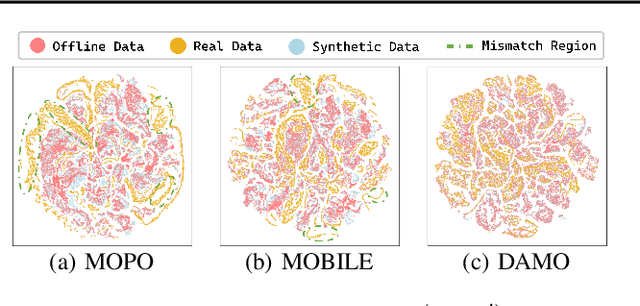
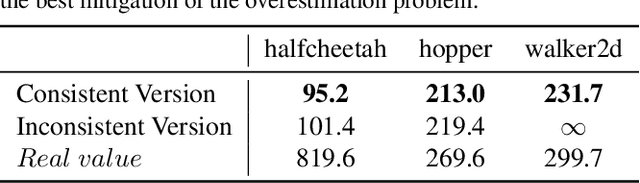
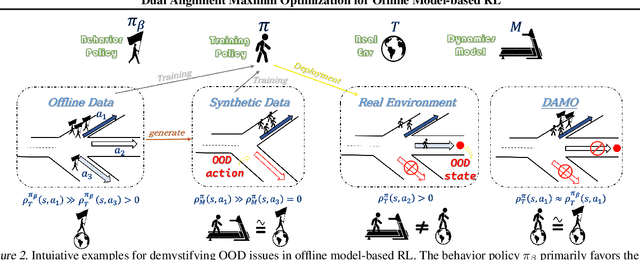
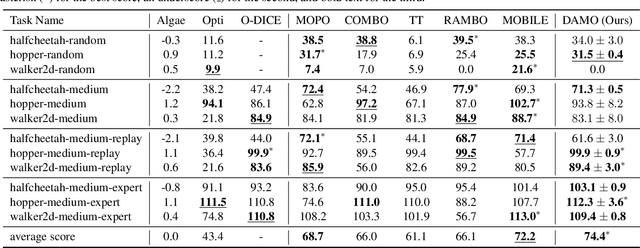
Offline reinforcement learning agents face significant deployment challenges due to the synthetic-to-real distribution mismatch. While most prior research has focused on improving the fidelity of synthetic sampling and incorporating off-policy mechanisms, the directly integrated paradigm often fails to ensure consistent policy behavior in biased models and underlying environmental dynamics, which inherently arise from discrepancies between behavior and learning policies. In this paper, we first shift the focus from model reliability to policy discrepancies while optimizing for expected returns, and then self-consistently incorporate synthetic data, deriving a novel actor-critic paradigm, Dual Alignment Maximin Optimization (DAMO). It is a unified framework to ensure both model-environment policy consistency and synthetic and offline data compatibility. The inner minimization performs dual conservative value estimation, aligning policies and trajectories to avoid out-of-distribution states and actions, while the outer maximization ensures that policy improvements remain consistent with inner value estimates. Empirical evaluations demonstrate that DAMO effectively ensures model and policy alignments, achieving competitive performance across diverse benchmark tasks.
Know in AdVance: Linear-Complexity Forecasting of Ad Campaign Performance with Evolving User Interest
May 17, 2024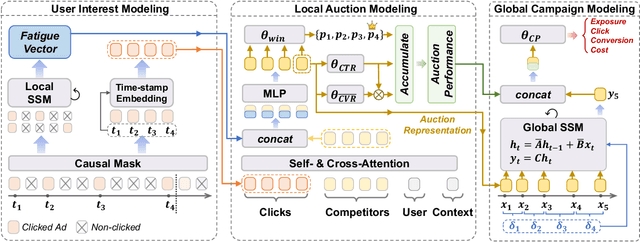
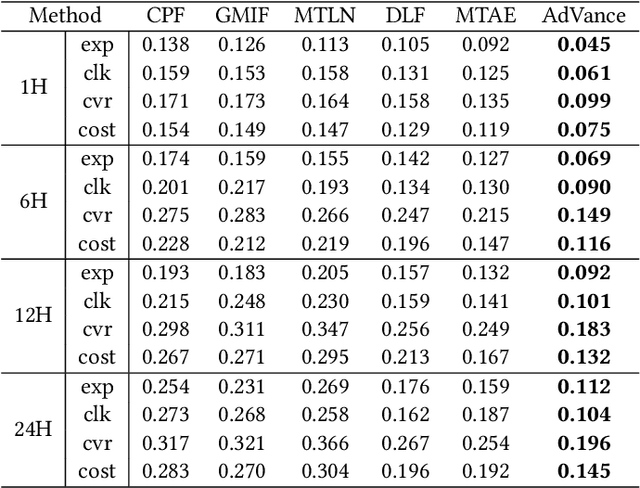
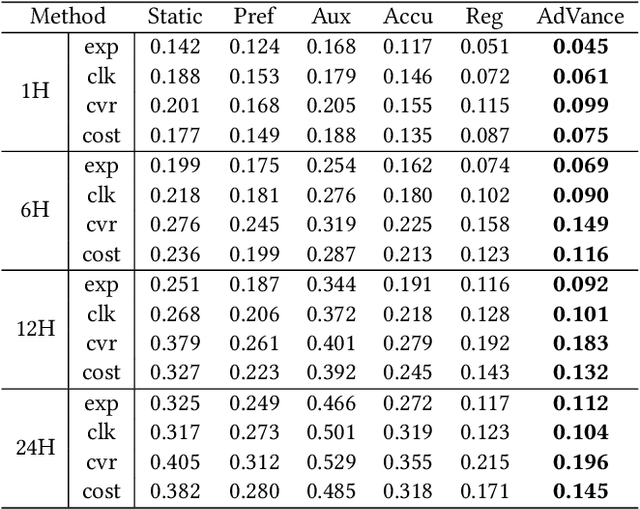
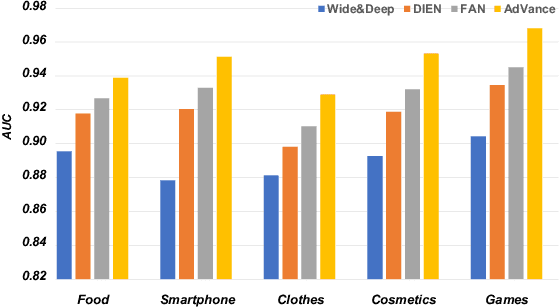
Real-time Bidding (RTB) advertisers wish to \textit{know in advance} the expected cost and yield of ad campaigns to avoid trial-and-error expenses. However, Campaign Performance Forecasting (CPF), a sequence modeling task involving tens of thousands of ad auctions, poses challenges of evolving user interest, auction representation, and long context, making coarse-grained and static-modeling methods sub-optimal. We propose \textit{AdVance}, a time-aware framework that integrates local auction-level and global campaign-level modeling. User preference and fatigue are disentangled using a time-positioned sequence of clicked items and a concise vector of all displayed items. Cross-attention, conditioned on the fatigue vector, captures the dynamics of user interest toward each candidate ad. Bidders compete with each other, presenting a complete graph similar to the self-attention mechanism. Hence, we employ a Transformer Encoder to compress each auction into embedding by solving auxiliary tasks. These sequential embeddings are then summarized by a conditional state space model (SSM) to comprehend long-range dependencies while maintaining global linear complexity. Considering the irregular time intervals between auctions, we make SSM's parameters dependent on the current auction embedding and the time interval. We further condition SSM's global predictions on the accumulation of local results. Extensive evaluations and ablation studies demonstrate its superiority over state-of-the-art methods. AdVance has been deployed on the Tencent Advertising platform, and A/B tests show a remarkable 4.5\% uplift in Average Revenue per User (ARPU).
Persistence B-Spline Grids: Stable Vector Representation of Persistence Diagrams Based on Data Fitting
Sep 17, 2019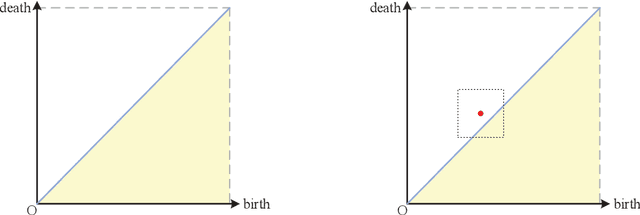
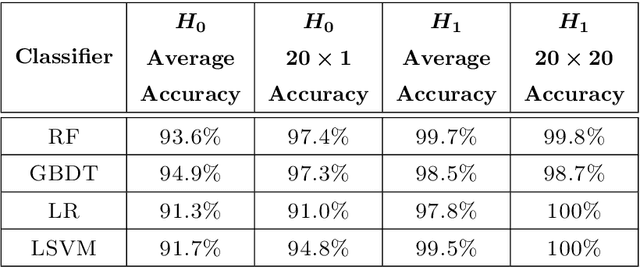
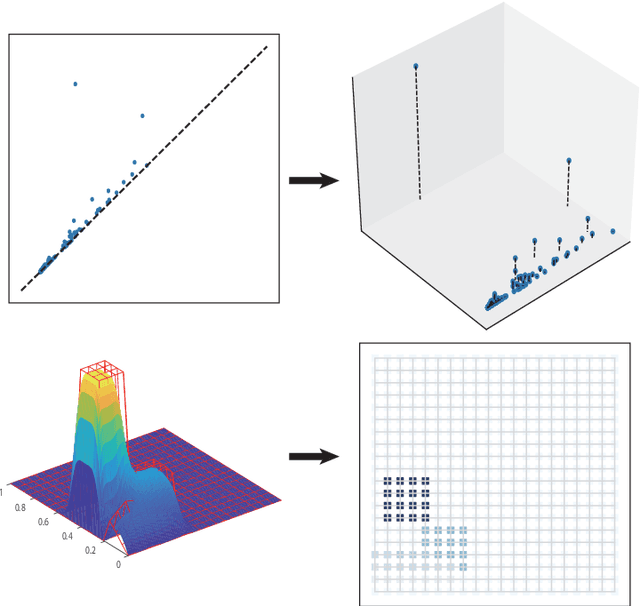
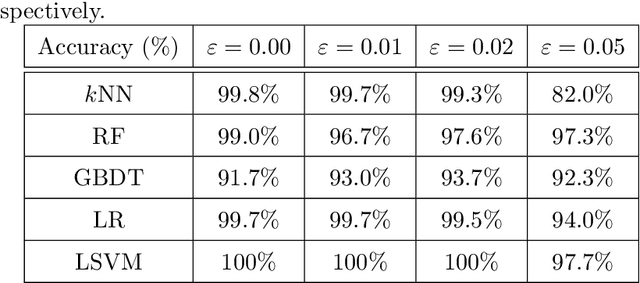
Over the last decades, many attempts have been made to optimally integrate machine learning (ML) and topological data analysis. A prominent problem in applying persistent homology to ML tasks is finding a vector representation of a persistence diagram (PD), which is a summary diagram for representing topological features. From the perspective of data fitting, a stable vector representation, persistence B-spline grid (PB), is proposed based on the efficient technique of progressive-iterative approximation for least-squares B-spline surface fitting. Meanwhile, we theoretically prove that the PB method is stable with respect to the metrics defined on the PD space, i.e., the $p$-Wasserstein distance and the bottleneck distance. The proposed method was tested on a synthetic dataset, datasets of randomly generated PDs, data of a dynamical system, and 3D CAD models.