 Add to Chrome
 Add to Firefox
 Add to Edge
Can AI agents conduct open-ended AI research? Early evidence from two case studies
Jul 29, 2026
Forecasts of explosive AI progress hinge on AI agents automating AI research. But evidence on whether agents can carry out open-ended AI research is thin. Current evaluations either test agents on narrow, verifiable tasks, which excludes open-ended research, or submit AI-generated papers to blind peer review, which is overstretched, stochastic, and suffers from poor review quality. We introduce a third way to measure progress towards AI R\&D automation. An agent takes on the central, open-ended research question of a high-quality unpublished paper, and the paper's original authors grade its output. We call these shadow evaluations. We ran shadow evaluations on two unpublished NeurIPS 2026 submissions, giving frontier agents six days and thousands of dollars of compute. The agents completed all of the engineering without human help, yet could not make substantial progress towards answering the research questions. As a result, both papers were unambiguously rejected by the authors. We identify five recurring failure modes: poor judgment about the bar for publishable research, uncreative responses to shortcomings in the research design, ineffective backtracking from dead ends, poor resource awareness, and instruction drift. A robustness check with a second model and scaffold reproduced these failures. We release the expert reviews, survey responses, agent repositories, and logs. Our results provide early evidence that today's agents can do the engineering of AI research, but struggle with critical parts of the research lifecycle.

Cross-Space Distillation: Teaching One-Step Students with Modern Diffusion Teachers
Jun 30, 2026Modern one-step diffusion models achieve impressive quality through distribution-based timestep distillation. Yet, they rely on a critical assumption: Teacher and Student must inhabit the same latent space. This Shared-Space constraint prevents knowledge transfer from modern high-capacity Teachers (e.g., SD 3.5 and Flux) into compact, deployment-friendly Students such as SD 1.5, whose latent resolution and VAE parameterization differ from the Teacher. We formalize this overlooked regime as Cross-Space Distillation, where Teacher and Student differ in both latent resolution and VAE space. To enable distillation under this mismatch, we introduce the Bridge, a lightweight latent interface that maps Student latents into the Teacher space without modifying the Student backbone. Bridge combines a frozen Student VAE decoder as a spatial prior with a compact learnable projector, and is trained with latent reconstruction and attention fidelity objectives for stable Teacher-space alignment. Across diverse modern Teachers, Bridge enables substantial gains for compact one-step Students; for example, it improves SD 1.5 from 5.4 to 9.4 HPSv3 while preserving one-step inference, low latency, and broad ecosystem compatibility. These results show that heterogeneous large Teachers can be distilled into efficient, deployable backbones through a lightweight latent-space interface.
Personal Visual Memory from Explicit and Implicit Evidence
May 27, 2026Long-term memory is increasingly important for personalized AI agents, yet existing benchmarks and methods remain largely text-centric. Even when images are included, the user-specific information needed for later questions is typically recoverable from text alone, and most memory systems reduce image turns to generic captions. Yet images often carry personal information that text rarely states -- both explicit evidence, such as recurring user-associated entities, and implicit evidence, such as latent user facts inferred from visual or multimodal cues. We introduce a benchmark for personal visual memory that targets both forms of evidence, and propose VisualMem, a hybrid visual--text architecture that augments a text-memory backend with a structured personal visual memory module. Rather than collapsing images into captions, VisualMem uses conversational context to resolve identity, ownership, and durable user facts. Experiments show that VisualMem substantially outperforms prior memory systems on our benchmark while remaining competitive on standard text-memory benchmarks, indicating that personal visual memory is a distinct and important component of long-term memory for personalized AI agents.
Mitigating Privacy Risk via Forget Set-Free Unlearning
Apr 12, 2026Training machine learning models requires the storage of large datasets, which often contain sensitive or private data. Storing data is associated with a number of potential risks which increase over time, such as database breaches and malicious adversaries. Machine unlearning is the study of methods to efficiently remove the influence of training data subsets from previously-trained models. Existing unlearning methods typically require direct access to the "forget set" -- the data to be forgotten-and organisations must retain this data for unlearning rather than deleting it immediately upon request, increasing risks associated with the forget set. We introduce partially-blind unlearning -- utilizing auxiliary information to unlearn without explicit access to the forget set. We also propose a practical framework Reload, a partially-blind method based on gradient optimization and structured weight sparsification to operationalize partially-blind unlearning. We show that Reload efficiently unlearns, approximating models retrained from scratch, and outperforms several forget set-dependent approaches. On language models, Reload unlearns entities using <0.025% of the retain set and <7% of model weights in <8 minutes on Llama2-7B. In the corrective case, Reload achieves unlearning even when only 10% of corrupted data is identified.
* 50 pages, 20 figures, Published at The Fourteenth International Conference on Learning Representations
Rethinking Multinomial Logistic Mixture of Experts with Sigmoid Gating Function
Feb 01, 2026The sigmoid gate in mixture-of-experts (MoE) models has been empirically shown to outperform the softmax gate across several tasks, ranging from approximating feed-forward networks to language modeling. Additionally, recent efforts have demonstrated that the sigmoid gate is provably more sample-efficient than its softmax counterpart under regression settings. Nevertheless, there are three notable concerns that have not been addressed in the literature, namely (i) the benefits of the sigmoid gate have not been established under classification settings; (ii) existing sigmoid-gated MoE models may not converge to their ground-truth; and (iii) the effects of a temperature parameter in the sigmoid gate remain theoretically underexplored. To tackle these open problems, we perform a comprehensive analysis of multinomial logistic MoE equipped with a modified sigmoid gate to ensure model convergence. Our results indicate that the sigmoid gate exhibits a lower sample complexity than the softmax gate for both parameter and expert estimation. Furthermore, we find that incorporating a temperature into the sigmoid gate leads to a sample complexity of exponential order due to an intrinsic interaction between the temperature and gating parameters. To overcome this issue, we propose replacing the vanilla inner product score in the gating function with a Euclidean score that effectively removes that interaction, thereby substantially improving the sample complexity to a polynomial order.
A Statistical Theory of Gated Attention through the Lens of Hierarchical Mixture of Experts
Feb 01, 2026Self-attention has greatly contributed to the success of the widely used Transformer architecture by enabling learning from data with long-range dependencies. In an effort to improve performance, a gated attention model that leverages a gating mechanism within the multi-head self-attention has recently been proposed as a promising alternative. Gated attention has been empirically demonstrated to increase the expressiveness of low-rank mapping in standard attention and even to eliminate the attention sink phenomenon. Despite its efficacy, a clear theoretical understanding of gated attention's benefits remains lacking in the literature. To close this gap, we rigorously show that each entry in a gated attention matrix or a multi-head self-attention matrix can be written as a hierarchical mixture of experts. By recasting learning as an expert estimation problem, we demonstrate that gated attention is more sample-efficient than multi-head self-attention. In particular, while the former needs only a polynomial number of data points to estimate an expert, the latter requires exponentially many data points to achieve the same estimation error. Furthermore, our analysis also provides a theoretical justification for why gated attention yields higher performance when a gate is placed at the output of the scaled dot product attention or the value map rather than at other positions in the multi-head self-attention architecture.
CGCE: Classifier-Guided Concept Erasure in Generative Models
Nov 08, 2025Recent advancements in large-scale generative models have enabled the creation of high-quality images and videos, but have also raised significant safety concerns regarding the generation of unsafe content. To mitigate this, concept erasure methods have been developed to remove undesirable concepts from pre-trained models. However, existing methods remain vulnerable to adversarial attacks that can regenerate the erased content. Moreover, achieving robust erasure often degrades the model's generative quality for safe, unrelated concepts, creating a difficult trade-off between safety and performance. To address this challenge, we introduce Classifier-Guided Concept Erasure (CGCE), an efficient plug-and-play framework that provides robust concept erasure for diverse generative models without altering their original weights. CGCE uses a lightweight classifier operating on text embeddings to first detect and then refine prompts containing undesired concepts. This approach is highly scalable, allowing for multi-concept erasure by aggregating guidance from several classifiers. By modifying only unsafe embeddings at inference time, our method prevents harmful content generation while preserving the model's original quality on benign prompts. Extensive experiments show that CGCE achieves state-of-the-art robustness against a wide range of red-teaming attacks. Our approach also maintains high generative utility, demonstrating a superior balance between safety and performance. We showcase the versatility of CGCE through its successful application to various modern T2I and T2V models, establishing it as a practical and effective solution for safe generative AI.
Diverse Prototypical Ensembles Improve Robustness to Subpopulation Shift
May 29, 2025The subpopulationtion shift, characterized by a disparity in subpopulation distributibetween theween the training and target datasets, can significantly degrade the performance of machine learning models. Current solutions to subpopulation shift involve modifying empirical risk minimization with re-weighting strategies to improve generalization. This strategy relies on assumptions about the number and nature of subpopulations and annotations on group membership, which are unavailable for many real-world datasets. Instead, we propose using an ensemble of diverse classifiers to adaptively capture risk associated with subpopulations. Given a feature extractor network, we replace its standard linear classification layer with a mixture of prototypical classifiers, where each member is trained to classify the data while focusing on different features and samples from other members. In empirical evaluation on nine real-world datasets, covering diverse domains and kinds of subpopulation shift, our method of Diverse Prototypical Ensembles (DPEs) often outperforms the prior state-of-the-art in worst-group accuracy. The code is available at https://github.com/minhto2802/dpe4subpop
SNOOPI: Supercharged One-step Diffusion Distillation with Proper Guidance
Dec 03, 2024
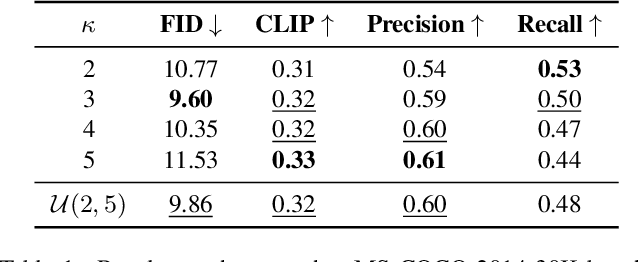

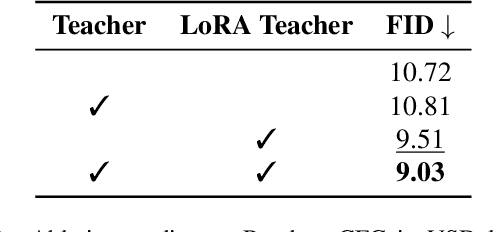
Recent approaches have yielded promising results in distilling multi-step text-to-image diffusion models into one-step ones. The state-of-the-art efficient distillation technique, i.e., SwiftBrushv2 (SBv2), even surpasses the teacher model's performance with limited resources. However, our study reveals its instability when handling different diffusion model backbones due to using a fixed guidance scale within the Variational Score Distillation (VSD) loss. Another weakness of the existing one-step diffusion models is the missing support for negative prompt guidance, which is crucial in practical image generation. This paper presents SNOOPI, a novel framework designed to address these limitations by enhancing the guidance in one-step diffusion models during both training and inference. First, we effectively enhance training stability through Proper Guidance-SwiftBrush (PG-SB), which employs a random-scale classifier-free guidance approach. By varying the guidance scale of both teacher models, we broaden their output distributions, resulting in a more robust VSD loss that enables SB to perform effectively across diverse backbones while maintaining competitive performance. Second, we propose a training-free method called Negative-Away Steer Attention (NASA), which integrates negative prompts into one-step diffusion models via cross-attention to suppress undesired elements in generated images. Our experimental results show that our proposed methods significantly improve baseline models across various metrics. Remarkably, we achieve an HPSv2 score of 31.08, setting a new state-of-the-art benchmark for one-step diffusion models.
Dual-Model Defense: Safeguarding Diffusion Models from Membership Inference Attacks through Disjoint Data Splitting
Oct 22, 2024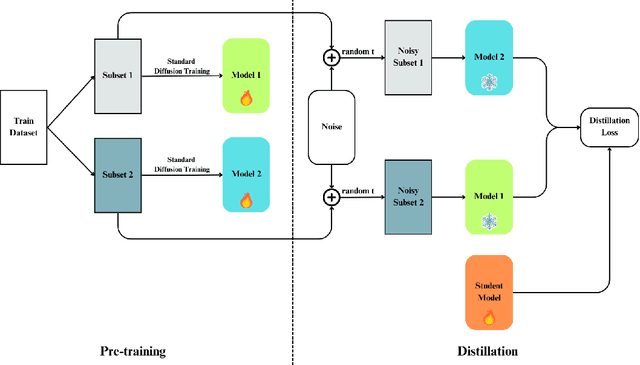
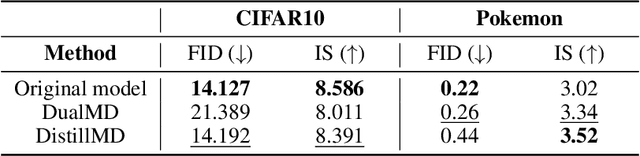


Diffusion models have demonstrated remarkable capabilities in image synthesis, but their recently proven vulnerability to Membership Inference Attacks (MIAs) poses a critical privacy concern. This paper introduces two novel and efficient approaches (DualMD and DistillMD) to protect diffusion models against MIAs while maintaining high utility. Both methods are based on training two separate diffusion models on disjoint subsets of the original dataset. DualMD then employs a private inference pipeline that utilizes both models. This strategy significantly reduces the risk of black-box MIAs by limiting the information any single model contains about individual training samples. The dual models can also generate "soft targets" to train a private student model in DistillMD, enhancing privacy guarantees against all types of MIAs. Extensive evaluations of DualMD and DistillMD against state-of-the-art MIAs across various datasets in white-box and black-box settings demonstrate their effectiveness in substantially reducing MIA success rates while preserving competitive image generation performance. Notably, our experiments reveal that DistillMD not only defends against MIAs but also mitigates model memorization, indicating that both vulnerabilities stem from overfitting and can be addressed simultaneously with our unified approach.