 Add to Chrome
 Add to Firefox
 Add to Edge
Cross-Space Distillation: Teaching One-Step Students with Modern Diffusion Teachers
Jun 30, 2026
Modern one-step diffusion models achieve impressive quality through distribution-based timestep distillation. Yet, they rely on a critical assumption: Teacher and Student must inhabit the same latent space. This Shared-Space constraint prevents knowledge transfer from modern high-capacity Teachers (e.g., SD 3.5 and Flux) into compact, deployment-friendly Students such as SD 1.5, whose latent resolution and VAE parameterization differ from the Teacher. We formalize this overlooked regime as Cross-Space Distillation, where Teacher and Student differ in both latent resolution and VAE space. To enable distillation under this mismatch, we introduce the Bridge, a lightweight latent interface that maps Student latents into the Teacher space without modifying the Student backbone. Bridge combines a frozen Student VAE decoder as a spatial prior with a compact learnable projector, and is trained with latent reconstruction and attention fidelity objectives for stable Teacher-space alignment. Across diverse modern Teachers, Bridge enables substantial gains for compact one-step Students; for example, it improves SD 1.5 from 5.4 to 9.4 HPSv3 while preserving one-step inference, low latency, and broad ecosystem compatibility. These results show that heterogeneous large Teachers can be distilled into efficient, deployable backbones through a lightweight latent-space interface.

Anti-I2V: Safeguarding your photos from malicious image-to-video generation
Mar 25, 2026Advances in diffusion-based video generation models, while significantly improving human animation, poses threats of misuse through the creation of fake videos from a specific person's photo and text prompts. Recent efforts have focused on adversarial attacks that introduce crafted perturbations to protect images from diffusion-based models. However, most existing approaches target image generation, while relatively few explicitly address image-to-video diffusion models (VDMs), and most primarily focus on UNet-based architectures. Hence, their effectiveness against Diffusion Transformer (DiT) models remains largely under-explored, as these models demonstrate improved feature retention, and stronger temporal consistency due to larger capacity and advanced attention mechanisms. In this work, we introduce Anti-I2V, a novel defense against malicious human image-to-video generation, applicable across diverse diffusion backbones. Instead of restricting noise updates to the RGB space, Anti-I2V operates in both the $L$*$a$*$b$* and frequency domains, improving robustness and concentrating on salient pixels. We then identify the network layers that capture the most distinct semantic features during the denoising process to design appropriate training objectives that maximize degradation of temporal coherence and generation fidelity. Through extensive validation, Anti-I2V demonstrates state-of-the-art defense performance against diverse video diffusion models, offering an effective solution to the problem.
InverFill: One-Step Inversion for Enhanced Few-Step Diffusion Inpainting
Mar 24, 2026Recent diffusion-based models achieve photorealism in image inpainting but require many sampling steps, limiting practical use. Few-step text-to-image models offer faster generation, but naively applying them to inpainting yields poor harmonization and artifacts between the background and inpainted region. We trace this cause to random Gaussian noise initialization, which under low function evaluations causes semantic misalignment and reduced fidelity. To overcome this, we propose InverFill, a one-step inversion method tailored for inpainting that injects semantic information from the input masked image into the initial noise, enabling high-fidelity few-step inpainting. Instead of training inpainting models, InverFill leverages few-step text-to-image models in a blended sampling pipeline with semantically aligned noise as input, significantly improving vanilla blended sampling and even matching specialized inpainting models at low NFEs. Moreover, InverFill does not require real-image supervision and only adds minimal inference overhead. Extensive experiments show that InverFill consistently boosts baseline few-step models, improving image quality and text coherence without costly retraining or heavy iterative optimization.
Learning Graph Filters for Structure-Function Coupling based Hub Node Identification
Oct 22, 2024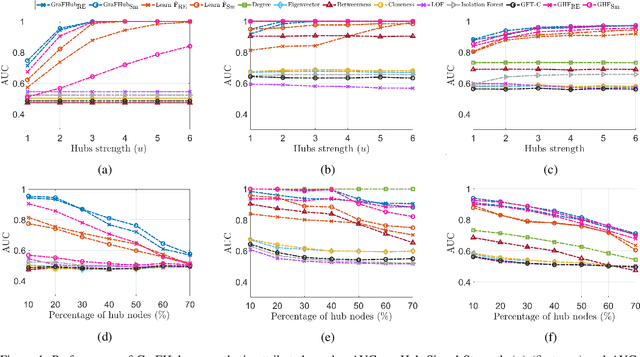


Over the past two decades, tools from network science have been leveraged to characterize the organization of both structural and functional networks of the brain. One such measure of network organization is hub node identification. Hubs are specialized nodes within a network that link distinct brain units corresponding to specialized functional processes. Conventional methods for identifying hub nodes utilize different types of centrality measures and participation coefficient to profile various aspects of nodal importance. These methods solely rely on the functional connectivity networks constructed from functional magnetic resonance imaging (fMRI), ignoring the structure-function coupling in the brain. In this paper, we introduce a graph signal processing (GSP) based hub detection framework that utilizes both the structural connectivity and the functional activation to identify hub nodes. The proposed framework models functional activity as graph signals on the structural connectivity. Hub nodes are then detected based on the premise that hub nodes are sparse, have higher level of activity compared to their neighbors, and the non-hub nodes' activity can be modeled as the output of a graph-based filter. Based on these assumptions, an optimization framework, GraFHub, is formulated to learn the coefficients of the optimal polynomial graph filter and detect the hub nodes. The proposed framework is evaluated on both simulated data and resting state fMRI (rs-fMRI) data from Human Connectome Project (HCP).
SwiftBrush v2: Make Your One-step Diffusion Model Better Than Its Teacher
Aug 27, 2024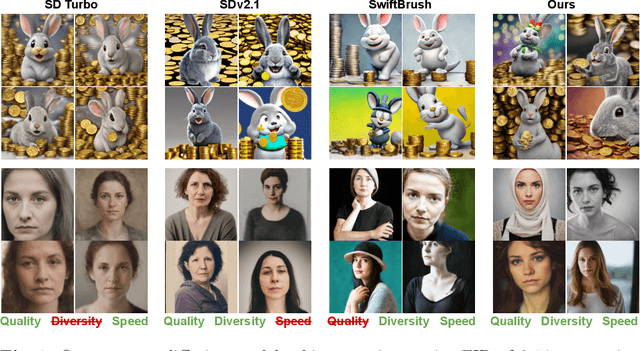
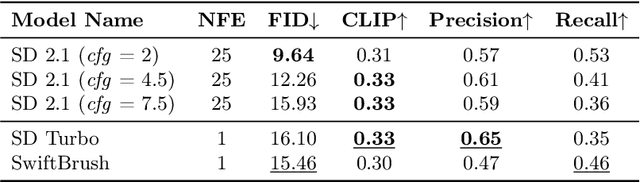
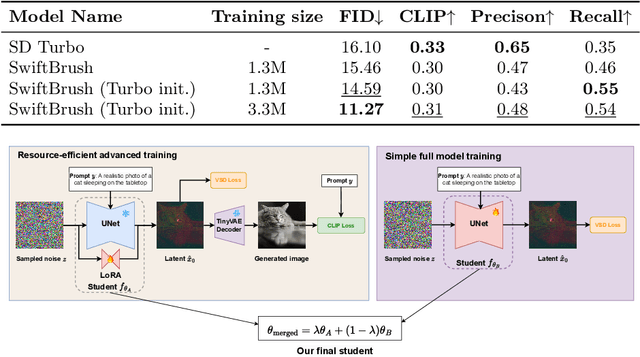

In this paper, we aim to enhance the performance of SwiftBrush, a prominent one-step text-to-image diffusion model, to be competitive with its multi-step Stable Diffusion counterpart. Initially, we explore the quality-diversity trade-off between SwiftBrush and SD Turbo: the former excels in image diversity, while the latter excels in image quality. This observation motivates our proposed modifications in the training methodology, including better weight initialization and efficient LoRA training. Moreover, our introduction of a novel clamped CLIP loss enhances image-text alignment and results in improved image quality. Remarkably, by combining the weights of models trained with efficient LoRA and full training, we achieve a new state-of-the-art one-step diffusion model, achieving an FID of 8.14 and surpassing all GAN-based and multi-step Stable Diffusion models. The project page is available at https://swiftbrushv2.github.io.