 Add to Chrome
 Add to Firefox
 Add to Edge
Can AI agents conduct open-ended AI research? Early evidence from two case studies
Jul 29, 2026
Forecasts of explosive AI progress hinge on AI agents automating AI research. But evidence on whether agents can carry out open-ended AI research is thin. Current evaluations either test agents on narrow, verifiable tasks, which excludes open-ended research, or submit AI-generated papers to blind peer review, which is overstretched, stochastic, and suffers from poor review quality. We introduce a third way to measure progress towards AI R\&D automation. An agent takes on the central, open-ended research question of a high-quality unpublished paper, and the paper's original authors grade its output. We call these shadow evaluations. We ran shadow evaluations on two unpublished NeurIPS 2026 submissions, giving frontier agents six days and thousands of dollars of compute. The agents completed all of the engineering without human help, yet could not make substantial progress towards answering the research questions. As a result, both papers were unambiguously rejected by the authors. We identify five recurring failure modes: poor judgment about the bar for publishable research, uncreative responses to shortcomings in the research design, ineffective backtracking from dead ends, poor resource awareness, and instruction drift. A robustness check with a second model and scaffold reproduced these failures. We release the expert reviews, survey responses, agent repositories, and logs. Our results provide early evidence that today's agents can do the engineering of AI research, but struggle with critical parts of the research lifecycle.

Life After Benchmark Saturation: A Case Study of CORE-Bench
Jun 23, 2026When a benchmark's accuracy saturates, it is often retired and replaced with a more challenging version. We show that this approach privileges accuracy and misses the opportunity to study six other key dimensions of agent performance: construct validity issues such as shortcuts, out-of-distribution generalizability, efficiency, reliability, the relative importance of the model versus the scaffold, and uplift from human-agent collaboration. We use CORE-Bench Hard, a benchmark for computational reproducibility of scientific code, as a case study to demonstrate that measuring agents along these dimensions yields meaningful insights into agent performance even after accuracy saturates. First, we surface threats to construct validity in CORE-Bench Hard that are difficult to anticipate with less capable agents. We introduce an improved benchmark, CORE-Bench v1.1, and an out-of-distribution task suite, CORE-Bench OOD. Second, we find that despite accuracy saturation, CORE-Bench v1.1 remains useful for measuring efficiency, reliability, model performance, and scaffold performance. Finally, we conduct a small-scale randomized experiment to measure uplift from human-agent collaboration on real-world computational reproducibility tasks. We find a statistically significant speedup by about a factor of two -- likely underestimated due to one-fifth of human-only reproductions reaching the time limit before completing -- and describe various other findings. Together, our contributions present a more rigorous alternative to the dominant accuracy-centric evaluation paradigm.
Open-World Evaluations for Measuring Frontier AI Capabilities
May 19, 2026Benchmark-based evaluation remains important for tracking frontier AI progress. But it can both overstate and understate deployed capability because it privileges tasks that can be precisely specified, automatically graded, easy to optimize for, and run with low budgets and short time horizons. We advocate for a complementary class of evaluations, which we term open-world evaluations: long-horizon, messy, real-world tasks assessed through small-sample qualitative analysis rather than benchmark-scale automation. In this paper we survey recent open-world evaluations, identify their strengths and limitations, and introduce CRUX (Collaborative Research for Updating AI eXpectations), a project for conducting such evaluations regularly. As a first instance, we task an AI agent with developing and publishing a simple iOS application to the Apple App Store. The agent completed the task with only a single avoidable manual intervention, suggesting that open-world evaluations can provide early warning of capabilities that may soon become widespread. We conclude with recommendations for designing and reporting open-world evals.
Towards a Science of AI Agent Reliability
Feb 18, 2026AI agents are increasingly deployed to execute important tasks. While rising accuracy scores on standard benchmarks suggest rapid progress, many agents still continue to fail in practice. This discrepancy highlights a fundamental limitation of current evaluations: compressing agent behavior into a single success metric obscures critical operational flaws. Notably, it ignores whether agents behave consistently across runs, withstand perturbations, fail predictably, or have bounded error severity. Grounded in safety-critical engineering, we provide a holistic performance profile by proposing twelve concrete metrics that decompose agent reliability along four key dimensions: consistency, robustness, predictability, and safety. Evaluating 14 agentic models across two complementary benchmarks, we find that recent capability gains have only yielded small improvements in reliability. By exposing these persistent limitations, our metrics complement traditional evaluations while offering tools for reasoning about how agents perform, degrade, and fail.
Differences in the Moral Foundations of Large Language Models
Nov 14, 2025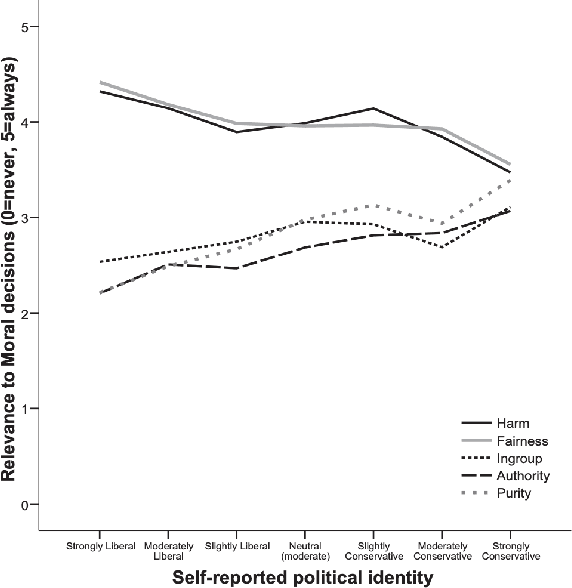
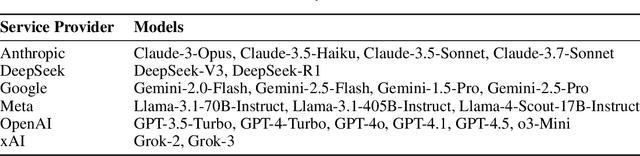
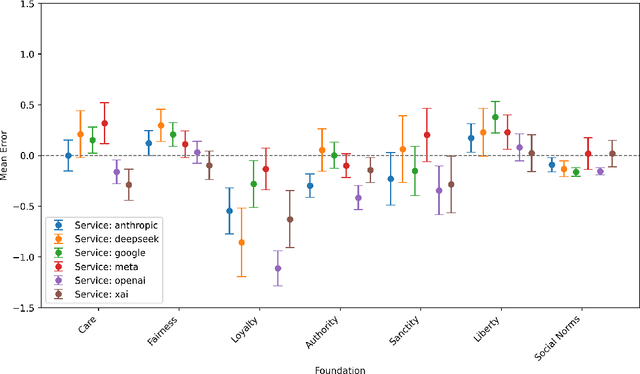
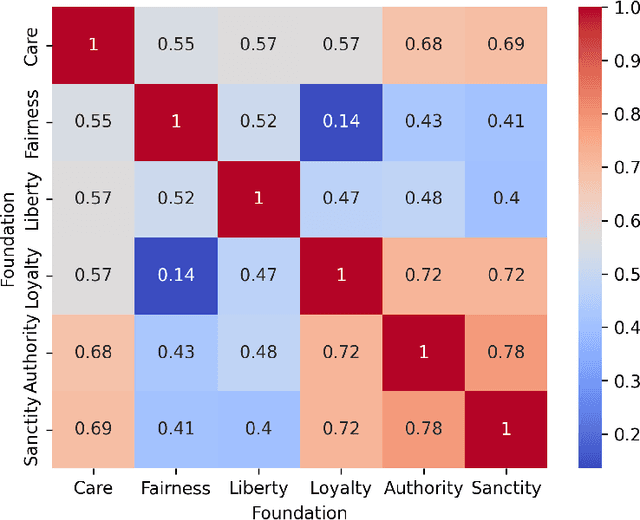
Large language models are increasingly being used in critical domains of politics, business, and education, but the nature of their normative ethical judgment remains opaque. Alignment research has, to date, not sufficiently utilized perspectives and insights from the field of moral psychology to inform training and evaluation of frontier models. I perform a synthetic experiment on a wide range of models from most major model providers using Jonathan Haidt's influential moral foundations theory (MFT) to elicit diverse value judgments from LLMs. Using multiple descriptive statistical approaches, I document the bias and variance of large language model responses relative to a human baseline in the original survey. My results suggest that models rely on different moral foundations from one another and from a nationally representative human baseline, and these differences increase as model capabilities increase. This work seeks to spur further analysis of LLMs using MFT, including finetuning of open-source models, and greater deliberation by policymakers on the importance of moral foundations for LLM alignment.