 Add to Chrome
 Add to Firefox
 Add to Edge
Active Learning of Dynamics Using Prior Domain Knowledge in the Sampling Process
Mar 25, 2024


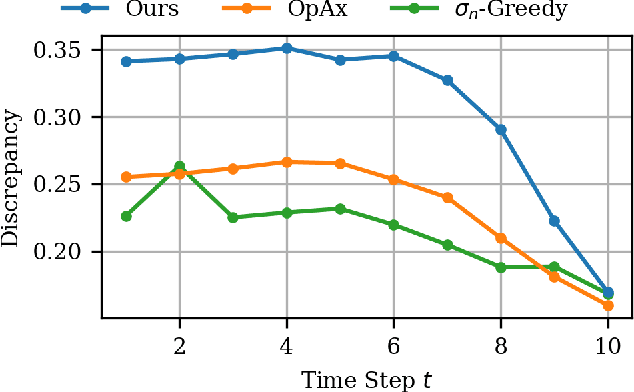

We present an active learning algorithm for learning dynamics that leverages side information by explicitly incorporating prior domain knowledge into the sampling process. Our proposed algorithm guides the exploration toward regions that demonstrate high empirical discrepancy between the observed data and an imperfect prior model of the dynamics derived from side information. Through numerical experiments, we demonstrate that this strategy explores regions of high discrepancy and accelerates learning while simultaneously reducing model uncertainty. We rigorously prove that our active learning algorithm yields a consistent estimate of the underlying dynamics by providing an explicit rate of convergence for the maximum predictive variance. We demonstrate the efficacy of our approach on an under-actuated pendulum system and on the half-cheetah MuJoCo environment.

Scalable Networked Feature Selection with Randomized Algorithm for Robot Navigation
Mar 18, 2024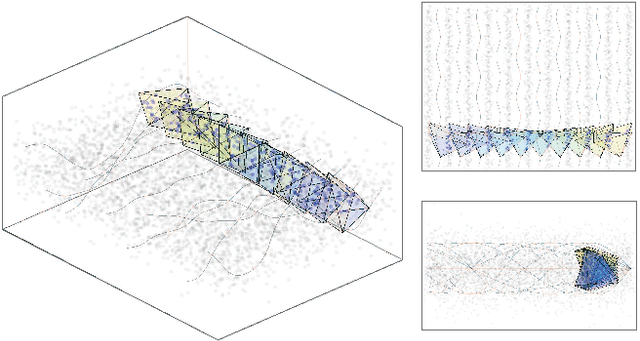

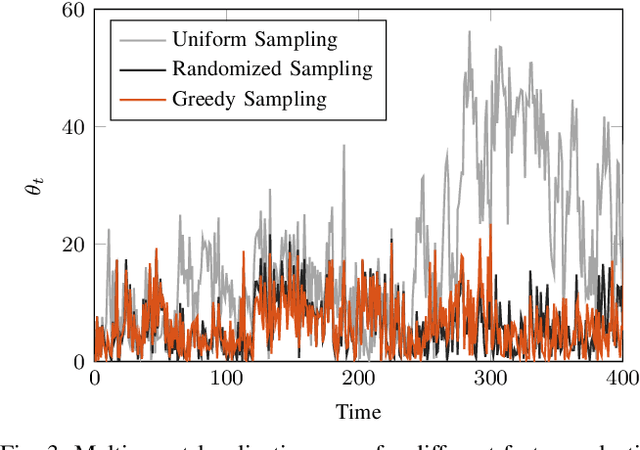
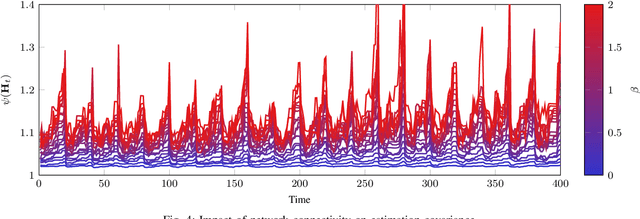
We address the problem of sparse selection of visual features for localizing a team of robots navigating an unknown environment, where robots can exchange relative position measurements with neighbors. We select a set of the most informative features by anticipating their importance in robots localization by simulating trajectories of robots over a prediction horizon. Through theoretical proofs, we establish a crucial connection between graph Laplacian and the importance of features. We show that strong network connectivity translates to uniformity in feature importance, which enables uniform random sampling of features and reduces the overall computational complexity. We leverage a scalable randomized algorithm for sparse sums of positive semidefinite matrices to efficiently select the set of the most informative features and significantly improve the probabilistic performance bounds. Finally, we support our findings with extensive simulations.
Auto-Encoding Bayesian Inverse Games
Feb 16, 2024When multiple agents interact in a common environment, each agent's actions impact others' future decisions, and noncooperative dynamic games naturally capture this coupling. In interactive motion planning, however, agents typically do not have access to a complete model of the game, e.g., due to unknown objectives of other players. Therefore, we consider the inverse game problem, in which some properties of the game are unknown a priori and must be inferred from observations. Existing maximum likelihood estimation (MLE) approaches to solve inverse games provide only point estimates of unknown parameters without quantifying uncertainty, and perform poorly when many parameter values explain the observed behavior. To address these limitations, we take a Bayesian perspective and construct posterior distributions of game parameters. To render inference tractable, we employ a variational autoencoder (VAE) with an embedded differentiable game solver. This structured VAE can be trained from an unlabeled dataset of observed interactions, naturally handles continuous, multi-modal distributions, and supports efficient sampling from the inferred posteriors without computing game solutions at runtime. Extensive evaluations in simulated driving scenarios demonstrate that the proposed approach successfully learns the prior and posterior objective distributions, provides more accurate objective estimates than MLE baselines, and facilitates safer and more efficient game-theoretic motion planning.
Online Foundation Model Selection in Robotics
Feb 13, 2024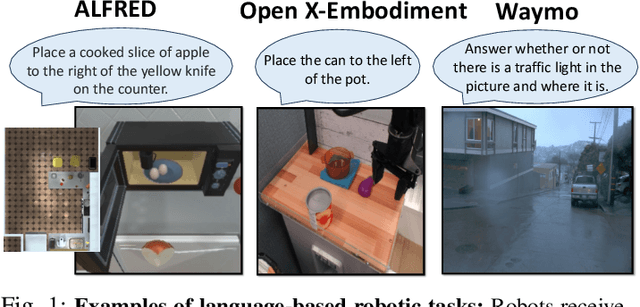
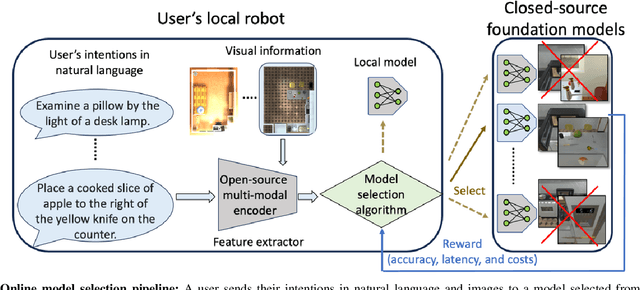
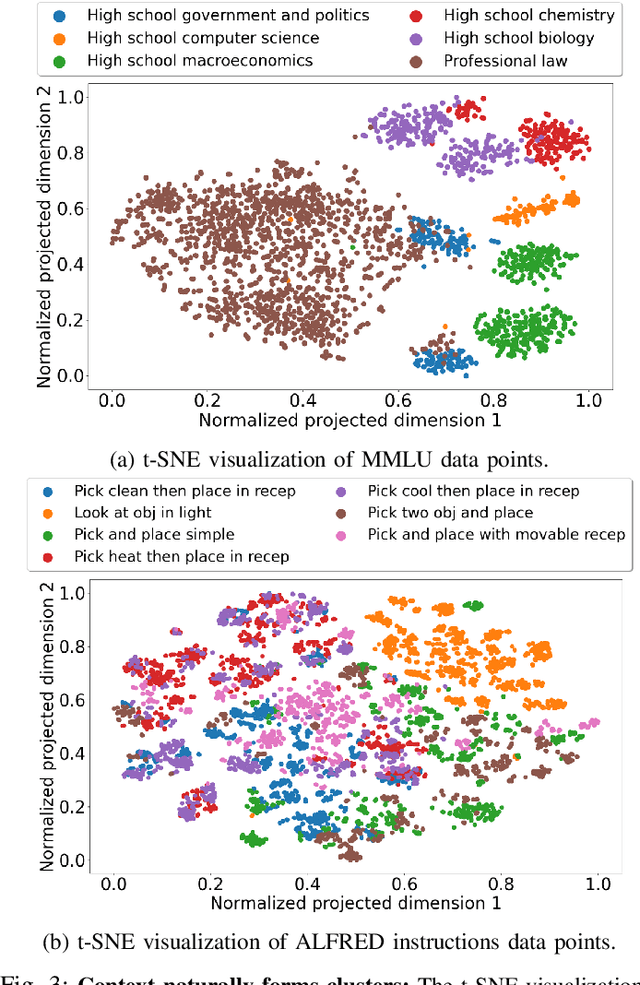

Foundation models have recently expanded into robotics after excelling in computer vision and natural language processing. The models are accessible in two ways: open-source or paid, closed-source options. Users with access to both face a problem when deciding between effective yet costly closed-source models and free but less powerful open-source alternatives. We call it the model selection problem. Existing supervised-learning methods are impractical due to the high cost of collecting extensive training data from closed-source models. Hence, we focus on the online learning setting where algorithms learn while collecting data, eliminating the need for large pre-collected datasets. We thus formulate a user-centric online model selection problem and propose a novel solution that combines an open-source encoder to output context and an online learning algorithm that processes this context. The encoder distills vast data distributions into low-dimensional features, i.e., the context, without additional training. The online learning algorithm aims to maximize a composite reward that includes model performance, execution time, and costs based on the context extracted from the data. It results in an improved trade-off between selecting open-source and closed-source models compared to non-contextual methods, as validated by our theoretical analysis. Experiments across language-based robotic tasks such as Waymo Open Dataset, ALFRED, and Open X-Embodiment demonstrate real-world applications of the solution. The results show that the solution significantly improves the task success rate by up to 14%.
Using Large Language Models to Automate and Expedite Reinforcement Learning with Reward Machine
Feb 11, 2024
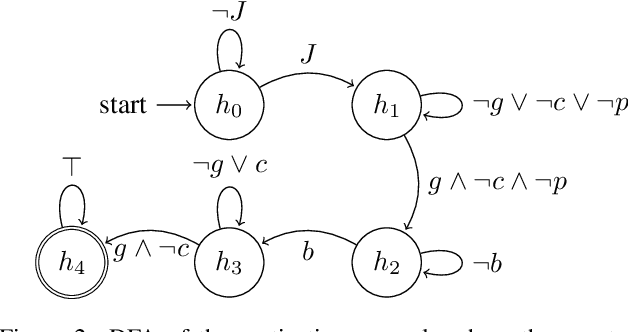


We present LARL-RM (Large language model-generated Automaton for Reinforcement Learning with Reward Machine) algorithm in order to encode high-level knowledge into reinforcement learning using automaton to expedite the reinforcement learning. Our method uses Large Language Models (LLM) to obtain high-level domain-specific knowledge using prompt engineering instead of providing the reinforcement learning algorithm directly with the high-level knowledge which requires an expert to encode the automaton. We use chain-of-thought and few-shot methods for prompt engineering and demonstrate that our method works using these approaches. Additionally, LARL-RM allows for fully closed-loop reinforcement learning without the need for an expert to guide and supervise the learning since LARL-RM can use the LLM directly to generate the required high-level knowledge for the task at hand. We also show the theoretical guarantee of our algorithm to converge to an optimal policy. We demonstrate that LARL-RM speeds up the convergence by 30% by implementing our method in two case studies.
News Source Credibility Assessment: A Reddit Case Study
Feb 07, 2024In the era of social media platforms, identifying the credibility of online content is crucial to combat misinformation. We present the CREDiBERT (CREDibility assessment using Bi-directional Encoder Representations from Transformers), a source credibility assessment model fine-tuned for Reddit submissions focusing on political discourse as the main contribution. We adopt a semi-supervised training approach for CREDiBERT, leveraging Reddit's community-based structure. By encoding submission content using CREDiBERT and integrating it into a Siamese neural network, we significantly improve the binary classification of submission credibility, achieving a 9% increase in F1 score compared to existing methods. Additionally, we introduce a new version of the post-to-post network in Reddit that efficiently encodes user interactions to enhance the binary classification task by nearly 8% in F1 score. Finally, we employ CREDiBERT to evaluate the susceptibility of subreddits with respect to different topics.
Zero-Shot Reinforcement Learning via Function Encoders
Jan 30, 2024Although reinforcement learning (RL) can solve many challenging sequential decision making problems, achieving zero-shot transfer across related tasks remains a challenge. The difficulty lies in finding a good representation for the current task so that the agent understands how it relates to previously seen tasks. To achieve zero-shot transfer, we introduce the function encoder, a representation learning algorithm which represents a function as a weighted combination of learned, non-linear basis functions. By using a function encoder to represent the reward function or the transition function, the agent has information on how the current task relates to previously seen tasks via a coherent vector representation. Thus, the agent is able to achieve transfer between related tasks at run time with no additional training. We demonstrate state-of-the-art data efficiency, asymptotic performance, and training stability in three RL fields by augmenting basic RL algorithms with a function encoder task representation.
A Multifidelity Sim-to-Real Pipeline for Verifiable and Compositional Reinforcement Learning
Dec 02, 2023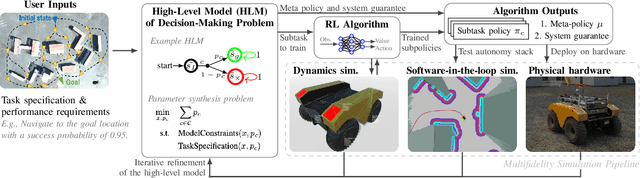
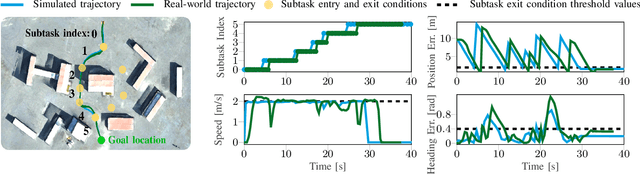


We propose and demonstrate a compositional framework for training and verifying reinforcement learning (RL) systems within a multifidelity sim-to-real pipeline, in order to deploy reliable and adaptable RL policies on physical hardware. By decomposing complex robotic tasks into component subtasks and defining mathematical interfaces between them, the framework allows for the independent training and testing of the corresponding subtask policies, while simultaneously providing guarantees on the overall behavior that results from their composition. By verifying the performance of these subtask policies using a multifidelity simulation pipeline, the framework not only allows for efficient RL training, but also for a refinement of the subtasks and their interfaces in response to challenges arising from discrepancies between simulation and reality. In an experimental case study we apply the framework to train and deploy a compositional RL system that successfully pilots a Warthog unmanned ground robot.
Formal Methods for Autonomous Systems
Nov 02, 2023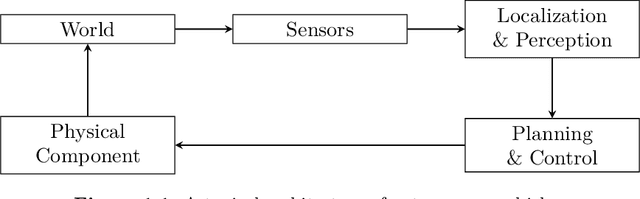

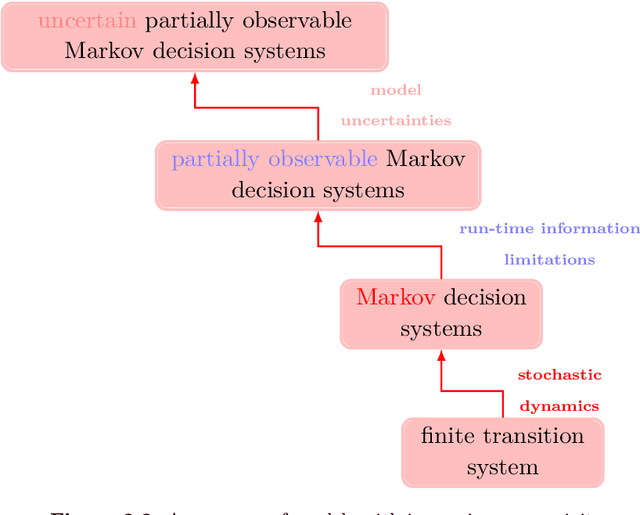
Formal methods refer to rigorous, mathematical approaches to system development and have played a key role in establishing the correctness of safety-critical systems. The main building blocks of formal methods are models and specifications, which are analogous to behaviors and requirements in system design and give us the means to verify and synthesize system behaviors with formal guarantees. This monograph provides a survey of the current state of the art on applications of formal methods in the autonomous systems domain. We consider correct-by-construction synthesis under various formulations, including closed systems, reactive, and probabilistic settings. Beyond synthesizing systems in known environments, we address the concept of uncertainty and bound the behavior of systems that employ learning using formal methods. Further, we examine the synthesis of systems with monitoring, a mitigation technique for ensuring that once a system deviates from expected behavior, it knows a way of returning to normalcy. We also show how to overcome some limitations of formal methods themselves with learning. We conclude with future directions for formal methods in reinforcement learning, uncertainty, privacy, explainability of formal methods, and regulation and certification.
Fine-Tuning Language Models Using Formal Methods Feedback
Oct 27, 2023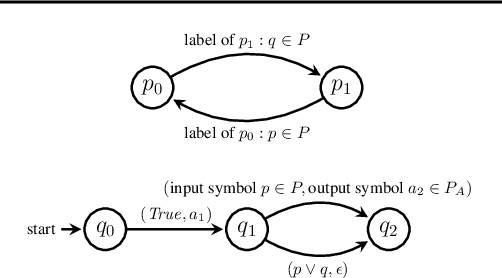
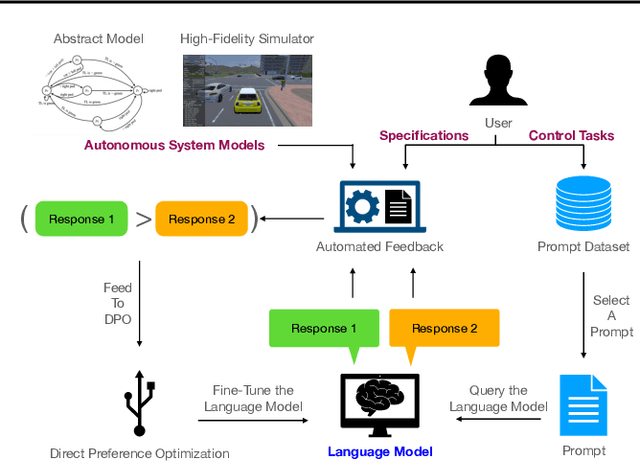
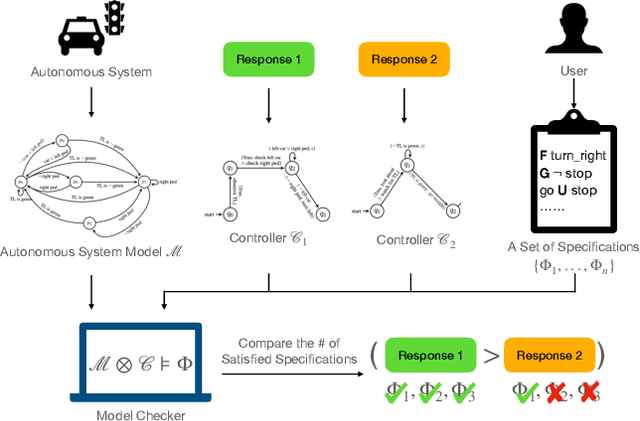
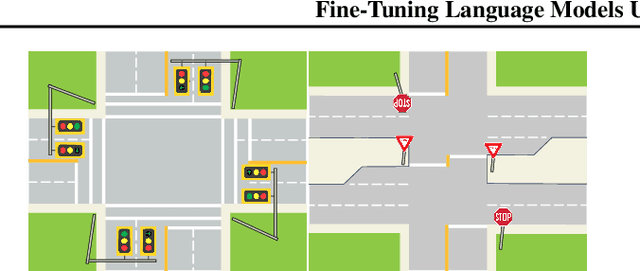
Although pre-trained language models encode generic knowledge beneficial for planning and control, they may fail to generate appropriate control policies for domain-specific tasks. Existing fine-tuning methods use human feedback to address this limitation, however, sourcing human feedback is labor intensive and costly. We present a fully automated approach to fine-tune pre-trained language models for applications in autonomous systems, bridging the gap between generic knowledge and domain-specific requirements while reducing cost. The method synthesizes automaton-based controllers from pre-trained models guided by natural language task descriptions. These controllers are verifiable against independently provided specifications within a world model, which can be abstract or obtained from a high-fidelity simulator. Controllers with high compliance with the desired specifications receive higher ranks, guiding the iterative fine-tuning process. We provide quantitative evidences, primarily in autonomous driving, to demonstrate the method's effectiveness across multiple tasks. The results indicate an improvement in percentage of specifications satisfied by the controller from 60% to 90%.