 Add to Chrome
 Add to Firefox
 Add to Edge
Whole-Body Planning for Humanoids Navigating Confined Spaces via Self-Collision Avoidance References
Aug 10, 2026
Humanoid locomotion in highly confined environments requires navigating dense environmental obstacles and complex self-collision bounds while maintaining multi-contact dynamic feasibility. Traditional trajectory optimizers frequently struggle in these restricted spaces, as navigating the large collision space with splines on particle abstractions is insufficient and leads to poor local minima. To address this, we propose a three-stage whole-body planning framework that formulates kinematic path planning directly over kinematically reachable rigid-body volumes. By integrating differentiable collision avoidance into a reachability-constrained formulation, our framework synthesizes volume-informed guides that reliably guide a full-order trajectory optimizer over long horizons. We show that these optimized plans serve as high-quality references to train a residual reinforcement learning policy for robust online execution. We validate our approach on the Unitree G1 humanoid across three benchmark testbeds exceeding NIST emergency response standards, achieving restricted confinement ratios ($C_r < 1.5$). Our framework generates feasible trajectories across 12-to-18-second tasks with complex foot and hand contacts where standard baselines fail, while the learned policy successfully tracks these plans under extensive domain randomization in physics simulation.

AeroMap3D: Anchoring Monocular UAV 6-DoF Localization to Visual-Geometric-Semantic Map Priors
Jul 15, 2026We present AeroMap3D, a monocular 6-DoF UAV localization system that anchors onboard imagery to visual, geometric, and semantic map priors for GNSS-denied navigation. AeroMap3D addresses two fundamental challenges in map-referenced aerial localization: the cross-view discrepancy between UAV imagery and satellite maps, and the structural inconsistency between bare-earth digital elevation models (DEMs) and urban scenes. First, we introduce a lightweight adapter that enables a dense matcher pretrained on internet-scale generic data to perform reliable UAV-to-map registration without finetuning. By estimating the scale ratio and yaw offset between the UAV image and map tile, the adapter removes the dominant geometric misalignment induced by altitude, camera field of view, and heading before dense correspondence estimation. Second, AeroMap3D lifts 2D UAV-map correspondences onto DEM terrain while using OpenStreetMap annotations to reject semantically unreliable matches before RANSAC-PnP pose estimation, thereby reducing errors caused by unmodeled building heights and off-nadir structures. Delayed map-based pose measurements are further fused with relative-motion priors using a delayed-state EKF for continuous trajectory estimation. Without UAV-Terra3D retraining or tuning, AeroMap3D localizes all trajectories across eight Austin sites within 50 m and achieves 5.88 m mean 3D error over 55 km of flight.
A Bilateral Teleoperation Framework for Dexterous Manipulation
Jun 13, 2026Dexterous teleoperation requires precise arm-hand coordination, low-latency feedback, and robust interaction in real-world contact-rich environments. This paper presents a modular bilateral teleoperation framework that integrates operator-side input interfaces with a robot-side dexterous hand and compliant robotic arm in a unified control architecture. The system supports position-based hand retargeting, differential arm control, multi-scale haptic feedback, and shared control for stable manipulation. We validate the framework through a real-world dexterous manipulation task, highlighting coordinated arm-hand control and contact-aware interaction. Beyond feasibility, we identify key design insights related to cross-embodiment mismatch, haptic feedback granularity, and shared control. The proposed platform provides a practical teleoperation system and a foundation for collecting high-quality demonstrations for future learning-from-demonstration research.
Too Much of a Good Thing: When sim2real Efforts Impede Policy Learning (And What to Do About It)
Jun 03, 2026While sim2real efforts are necessary for effective policy transfer to hardware, there is such a thing as too much of a good thing. We argue that sim2real efforts have led to misaligned incentives with policy learning, resulting in simulator lock in and poor policy exploration due to the unreasonable constraints imposed by the real world. We offer a diagnosis and explanation of the current status of the problem, and propose a potential solution via a sim2sim2real paradigm that leverages the robot's kinematics as the sole design constraint.
ARISTO Hand: Sensing-Driven Distal Hyperextension for Fine-Grained Manipulation
May 28, 2026Manipulating thin objects requires precise contact geometry and reliable force perception, yet many anthropomorphic robotic hands lack the mechanical and sensing capabilities needed for such interactions. We present the ARISTO Hand, a tendon-driven robotic hand that integrates active distal hyperextension with a hybrid fingertip-sensing architecture that combines a rigid, nail-mounted force-torque sensor and a soft capacitive tactile array. Active hyperextension enables controlled fingertip engagement beyond the kinematic limits of standard flexion, increasing pull-out force by 2.76x for object thicknesses of 1-20 mm while preserving the nominal grasp capability. The rigid nail-mounted sensor provides reliable force measurements during edge contacts, where the sensitivity of proprioceptive force estimation degrades as the contact geometry approaches kinematic singularities. We validate the proposed architecture through quantitative force characterization and a multi-stage SD card extraction and insertion task. Video and supplementary materials are available at: https://aristohand.github.io
PLATO Hand: Shaping Contact Behavior with Fingernails for Precise Manipulation
Feb 05, 2026We present the PLATO Hand, a dexterous robotic hand with a hybrid fingertip that embeds a rigid fingernail within a compliant pulp. This design shapes contact behavior to enable diverse interaction modes across a range of object geometries. We develop a strain-energy-based bending-indentation model to guide the fingertip design and to explain how guided contact preserves local indentation while suppressing global bending. Experimental results show that the proposed robotic hand design demonstrates improved pinching stability, enhanced force observability, and successful execution of edge-sensitive manipulation tasks, including paper singulation, card picking, and orange peeling. Together, these results show that coupling structured contact geometry with a force-motion transparent mechanism provides a principled, physically embodied approach to precise manipulation.
HARMONIC: A Content-Centric Cognitive Robotic Architecture
Sep 16, 2025This paper introduces HARMONIC, a cognitive-robotic architecture designed for robots in human-robotic teams. HARMONIC supports semantic perception interpretation, human-like decision-making, and intentional language communication. It addresses the issues of safety and quality of results; aims to solve problems of data scarcity, explainability, and safety; and promotes transparency and trust. Two proof-of-concept HARMONIC-based robotic systems are demonstrated, each implemented in both a high-fidelity simulation environment and on physical robotic platforms.
Task Hierarchical Control via Null-Space Projection and Path Integral Approach
Mar 28, 2025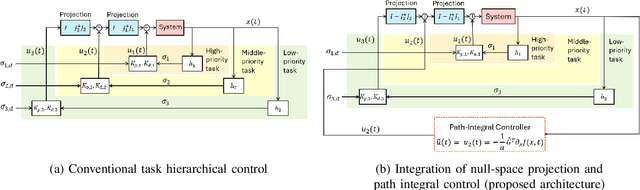
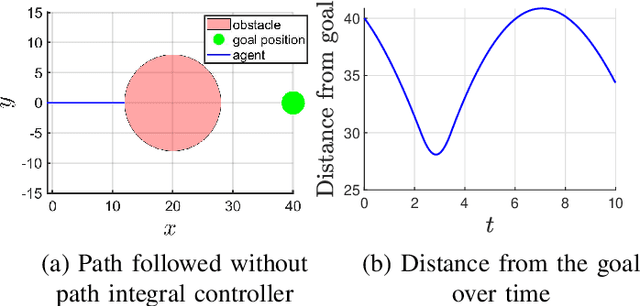
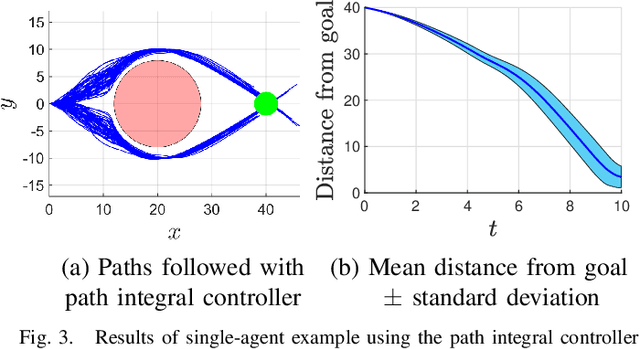
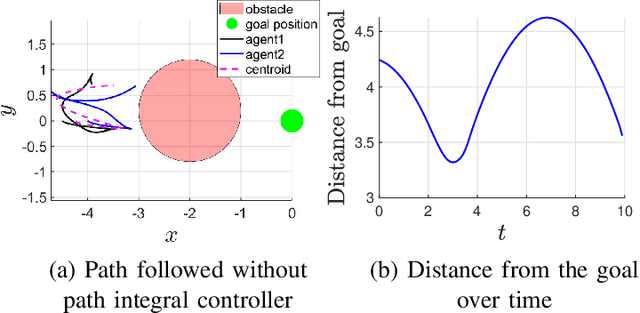
This paper addresses the problem of hierarchical task control, where a robotic system must perform multiple subtasks with varying levels of priority. A commonly used approach for hierarchical control is the null-space projection technique, which ensures that higher-priority tasks are executed without interference from lower-priority ones. While effective, the state-of-the-art implementations of this method rely on low-level controllers, such as PID controllers, which can be prone to suboptimal solutions in complex tasks. This paper presents a novel framework for hierarchical task control, integrating the null-space projection technique with the path integral control method. Our approach leverages Monte Carlo simulations for real-time computation of optimal control inputs, allowing for the seamless integration of simpler PID-like controllers with a more sophisticated optimal control technique. Through simulation studies, we demonstrate the effectiveness of this combined approach, showing how it overcomes the limitations of traditional
LEGATO: Cross-Embodiment Imitation Using a Grasping Tool
Nov 06, 2024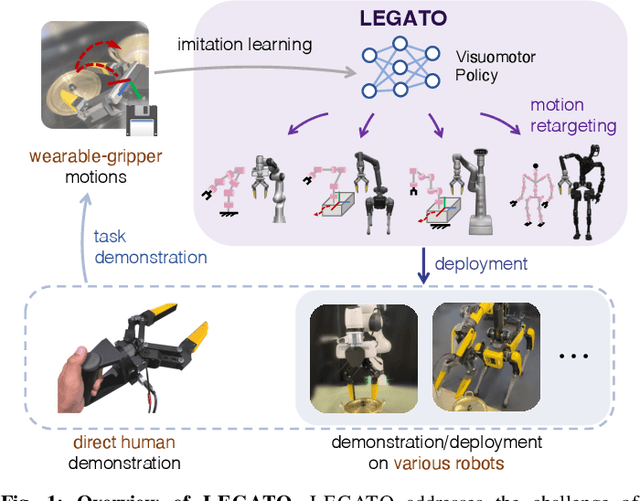
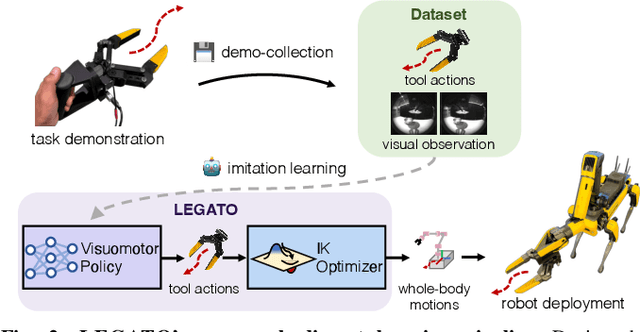
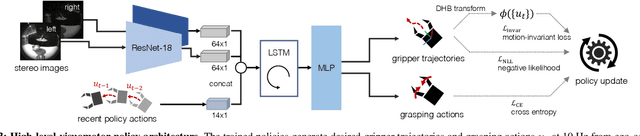
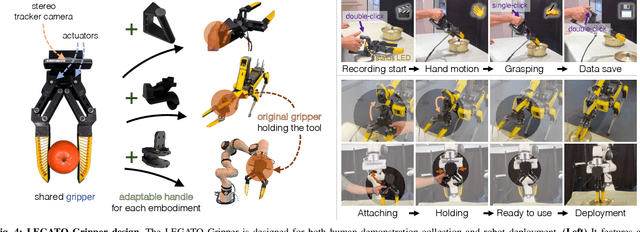
Cross-embodiment imitation learning enables policies trained on specific embodiments to transfer across different robots, unlocking the potential for large-scale imitation learning that is both cost-effective and highly reusable. This paper presents LEGATO, a cross-embodiment imitation learning framework for visuomotor skill transfer across varied kinematic morphologies. We introduce a handheld gripper that unifies action and observation spaces, allowing tasks to be defined consistently across robots. Using this gripper, we train visuomotor policies via imitation learning, applying a motion-invariant transformation to compute the training loss. Gripper motions are then retargeted into high-degree-of-freedom whole-body motions using inverse kinematics for deployment across diverse embodiments. Our evaluations in simulation and real-robot experiments highlight the framework's effectiveness in learning and transferring visuomotor skills across various robots. More information can be found at the project page: https://ut-hcrl.github.io/LEGATO.
Guiding Collision-Free Humanoid Multi-Contact Locomotion using Convex Kinematic Relaxations and Dynamic Optimization
Oct 10, 2024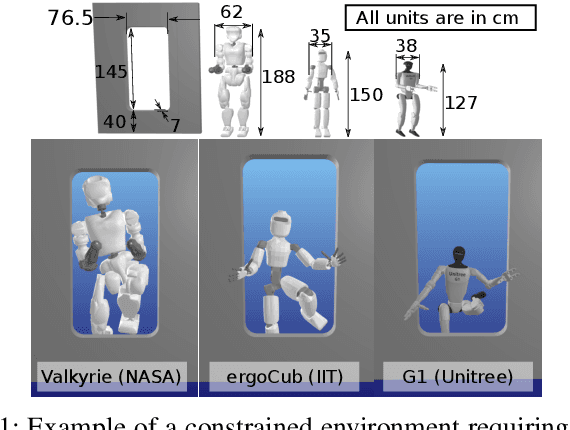
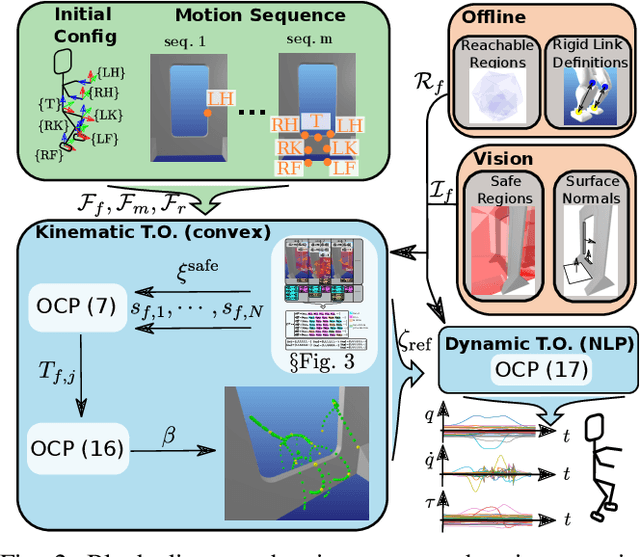
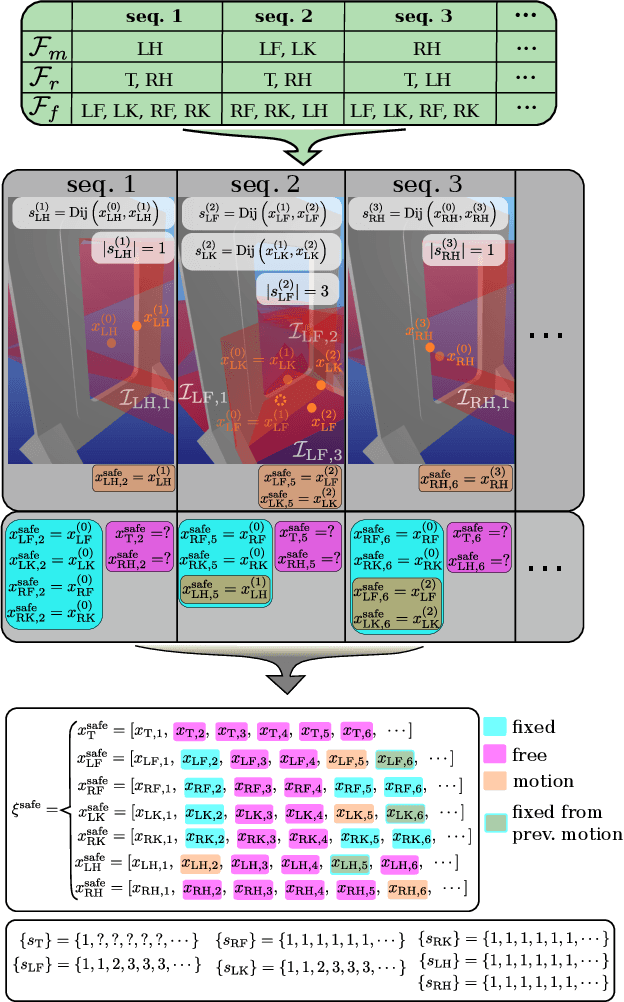

Humanoid robots rely on multi-contact planners to navigate a diverse set of environments, including those that are unstructured and highly constrained. To synthesize stable multi-contact plans within a reasonable time frame, most planners assume statically stable motions or rely on reduced order models. However, these approaches can also render the problem infeasible in the presence of large obstacles or when operating near kinematic and dynamic limits. To that end, we propose a new multi-contact framework that leverages recent advancements in relaxing collision-free path planning into a convex optimization problem, extending it to be applicable to humanoid multi-contact navigation. Our approach generates near-feasible trajectories used as guides in a dynamic trajectory optimizer, altogether addressing the aforementioned limitations. We evaluate our computational approach showcasing three different-sized humanoid robots traversing a high-raised naval knee-knocker door using our proposed framework in simulation. Our approach can generate motion plans within a few seconds consisting of several multi-contact states, including dynamic feasibility in joint space.