 Add to Chrome
 Add to Firefox
 Add to Edge
Fin-Analyst at FinMMEval 2026 Task 3: A Live Hybrid Trading Agent with LLM Specialists and Rule-Based Signals
Jul 14, 2026
Large language model (LLM) trading agents show promising performance in equity markets, yet remain narrowly focused on US equities with little evidence from live deployment. We present Fin-Analyst, a hybrid agent for FinMMEval 2026 Task 3: an eight-specialist LLM pipeline over news, SEC filings, fundamentals, analyst forecasts, technical indicators, and social sentiment, aggregated by a Meta-Agent for Tesla (TSLA), and a lightweight rule based three-signal vote for Bitcoin (BTC). On the final official leaderboard (accessed 2026-07-05), Fin-Analyst ranks first of all agents on TSLA with a +13.51% return, +28.33 points over Buy-and-Hold (Sharpe 4.10, 88% win rate), while the BTC vote ends flat yet well above a sharply falling baseline. Relative to the interim performance, the asset ranking reversed, indicating that short live windows yield volatility-sensitive rankings. Ablation identifies event-driven 8-K disclosures as the most influential TSLA signal. Error analysis shows that the memoryless agents repeat wrong calls for days at a time, and that the fixed-threshold BTC rules lost money by trading on noise in a sideways market while the LLM pipeline gained under similar conditions, motivating a memory-aware, LLM-based successor for both assets.

Beyond Refusal: A Same-Lineage Study of Aligned and Abliterated LLMs for Vulnerability Analysis
Jul 07, 2026Large language model (LLM)-assisted software security operates at a difficult boundary: the vulnerability-analysis terminology needed for legitimate code review, triage, and repair can closely resemble terminology associated with misuse. Existing safety and cybersecurity evaluations are difficult to interpret in this setting because they often compare unrelated model families, thereby conflating safety behavior with differences in architecture, scale, training data, and deployment. To isolate this factor, we study safety state: whether refusal behavior remains intact (Aligned) or has been refusal-ablated (Abliterated) within same-lineage models. We ask how this safety state affects defensive utility across software-security workflows. We compare aligned instruction-tuned models with publicly released refusal-ablated descendants from two model families, Gemma and Qwen. We evaluate Aligned and Abliterated states on vulnerability detection, CWE attribution, vulnerable-line localization, root-cause localization, and executable patch validation. We further treat prompt wording as a controlled framing dimension: prompts begin with neutral code-review language, add authorization context, and vary the density of cybersecurity terminology. In a Gemma-based Java/Vul4J repair-validation study, Abliterated achieves higher early-stage validation rates, with 67.8%, 65.0%, and 32.8% of patches judged usable, successfully applied, and successfully compiled, respectively, compared with 29.9%, 24.9%, and 9.0% for Aligned. In the Qwen pair, Abliterated improves localization performance, increasing line-level F1 from 2.08% to 3.91% and Top-1 accuracy from 4.10% to 6.95%. These findings suggest that evaluations of LLM-based security assistants should jointly measure whether models respond, whether their usable responses are correct, and whether their outputs remain actionable across the engineering workflow.
LongSumEval: Question-Answering Based Evaluation and Feedback-Driven Refinement for Long Document Summarization
Apr 28, 2026Evaluating long document summaries remains the primary bottleneck in summarization research. Existing metrics correlate weakly with human judgments and produce aggregate scores without explaining deficiencies or guiding improvement, preventing effective refinement in applications requiring verifiable accuracy. We introduce LongSumEval, a unified framework bridging evaluation and generation through structured question-answering feedback. The framework operationalizes summary quality as answerability and factual alignment of question-answer pairs, generating interpretable scores and actionable feedback that identifies coverage gaps and factual inconsistencies. This resolves the misalignment where evaluation operates independently of generation objectives. Meta-evaluation of our QA-based evaluation module across seven benchmarks demonstrates substantially stronger agreement with human judgments compared to established metrics. Structured feedback enables significant quality improvements through self-refinement without retraining. By demonstrating that evaluation feedback can serve as executable instructions for generation, this work establishes a generalizable paradigm for aligning assessment with improvement, with direct implications for controllable text generation requiring verifiable accuracy and transparent quality control. All code and datasets will be released in GitHub for reproducibility.
LLM-ReSum: A Framework for LLM Reflective Summarization through Self-Evaluation
Apr 28, 2026Reliable evaluation of large language model (LLM)-generated summaries remains an open challenge, particularly across heterogeneous domains and document lengths. We conduct a comprehensive meta-evaluation of 14 automatic summarization metrics and LLM-based evaluators across seven datasets spanning five domains, covering documents from short news articles to long scientific, governmental, and legal texts (2K-27K words) with over 1,500 human-annotated summaries. Our results show that traditional lexical overlap metrics (e.g., ROUGE, BLEU) exhibit weak or negative correlation with human judgments, while task-specific neural metrics and LLM-based evaluators achieve substantially higher alignment, especially for linguistic quality assessment. Leveraging these findings, we propose LLM-ReSum, a self-reflective summarization framework that integrates LLM-based evaluation and generation in a closed feedback loop without model finetuning. Across three domains, LLM-ReSum improves low-quality summaries by up to 33% in factual accuracy and 39% in coverage, with human evaluators preferring refined summaries in 89% of cases. We additionally introduce PatentSumEval, a new human-annotated benchmark for legal document summarization comprising 180 expert-evaluated summaries. All code and datasets will be released in GitHub.
MetaGAI: A Large-Scale and High-Quality Benchmark for Generative AI Model and Data Card Generation
Apr 26, 2026The rapid proliferation of Generative AI necessitates rigorous documentation standards for transparency and governance. However, manual creation of Model and Data Cards is not scalable, while automated approaches lack large-scale, high-fidelity benchmarks for systematic evaluation. We introduce MetaGAI, a comprehensive benchmark comprising 2,541 verified document triplets constructed through semantic triangulation of academic papers, GitHub repositories, and Hugging Face artifacts. Unlike prior single-source datasets, MetaGAI employs a multi-agent framework with specialized Retriever, Generator, and Editor agents, validated through four-dimensional human-in-the-loop assessment, including human evaluation of editor-refined ground truth. We establish a robust evaluation protocol combining automated metrics with validated LLM-as-a-Judge frameworks. Extensive analysis reveals that sparse Mixture-of-Experts architectures achieve superior cost-quality efficiency, while a fundamental trade-off exists between faithfulness and completeness. MetaGAI provides a foundational testbed for benchmarking, training, and analyzing automated Model and Data Card generation methods at scale. Our data and code are available at: https://github.com/haoxuan-unt2024/MetaGAI-Benchmark.
Digital Skin, Digital Bias: Uncovering Tone-Based Biases in LLMs and Emoji Embeddings
Apr 08, 2026Skin-toned emojis are crucial for fostering personal identity and social inclusion in online communication. As AI models, particularly Large Language Models (LLMs), increasingly mediate interactions on web platforms, the risk that these systems perpetuate societal biases through their representation of such symbols is a significant concern. This paper presents the first large-scale comparative study of bias in skin-toned emoji representations across two distinct model classes. We systematically evaluate dedicated emoji embedding models (emoji2vec, emoji-sw2v) against four modern LLMs (Llama, Gemma, Qwen, and Mistral). Our analysis first reveals a critical performance gap: while LLMs demonstrate robust support for skin tone modifiers, widely-used specialized emoji models exhibit severe deficiencies. More importantly, a multi-faceted investigation into semantic consistency, representational similarity, sentiment polarity, and core biases uncovers systemic disparities. We find evidence of skewed sentiment and inconsistent meanings associated with emojis across different skin tones, highlighting latent biases within these foundational models. Our findings underscore the urgent need for developers and platforms to audit and mitigate these representational harms, ensuring that AI's role on the web promotes genuine equity rather than reinforcing societal biases.
The Evolving Role of Large Language Models in Scientific Innovation: Evaluator, Collaborator, and Scientist
Jul 16, 2025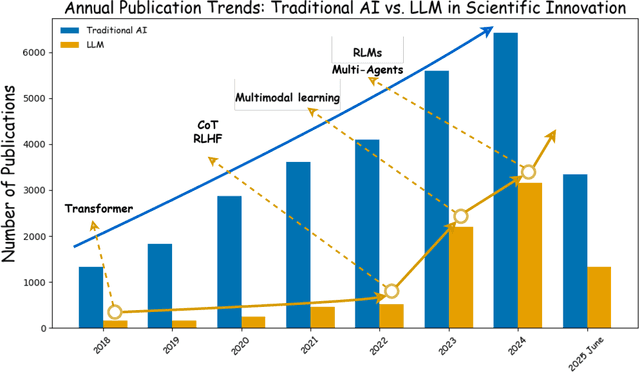
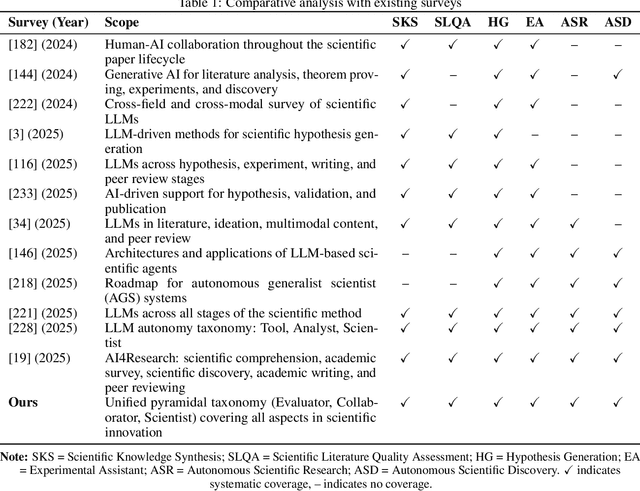
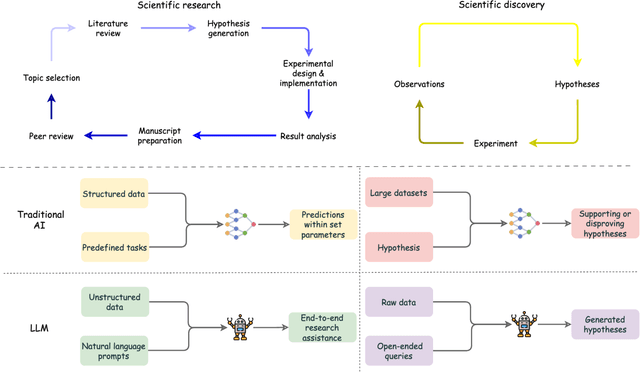
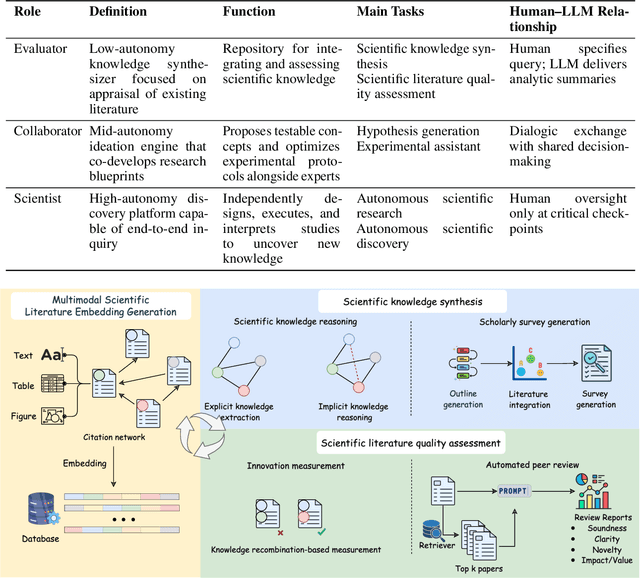
Scientific innovation is undergoing a paradigm shift driven by the rapid advancement of Large Language Models (LLMs). As science faces mounting challenges including information overload, disciplinary silos, and diminishing returns on conventional research methods, LLMs are emerging as powerful agents capable not only of enhancing scientific workflows but also of participating in and potentially leading the innovation process. Existing surveys mainly focus on different perspectives, phrases, and tasks in scientific research and discovery, while they have limitations in understanding the transformative potential and role differentiation of LLM. This survey proposes a comprehensive framework to categorize the evolving roles of LLMs in scientific innovation across three hierarchical levels: Evaluator, Collaborator, and Scientist. We distinguish between LLMs' contributions to structured scientific research processes and open-ended scientific discovery, thereby offering a unified taxonomy that clarifies capability boundaries, evaluation criteria, and human-AI interaction patterns at each level. Through an extensive analysis of current methodologies, benchmarks, systems, and evaluation metrics, this survey delivers an in-depth and systematic synthesis on LLM-driven scientific innovation. We present LLMs not only as tools for automating existing processes, but also as catalysts capable of reshaping the epistemological foundations of science itself. This survey offers conceptual clarity, practical guidance, and theoretical foundations for future research, while also highlighting open challenges and ethical considerations in the pursuit of increasingly autonomous AI-driven science. Resources related to this survey can be accessed on GitHub at: https://github.com/haoxuan-unt2024/llm4innovation.
DP-GTR: Differentially Private Prompt Protection via Group Text Rewriting
Mar 06, 2025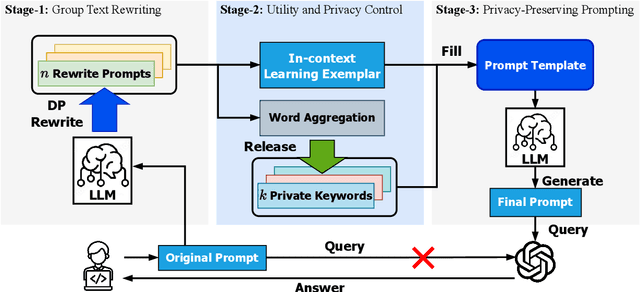
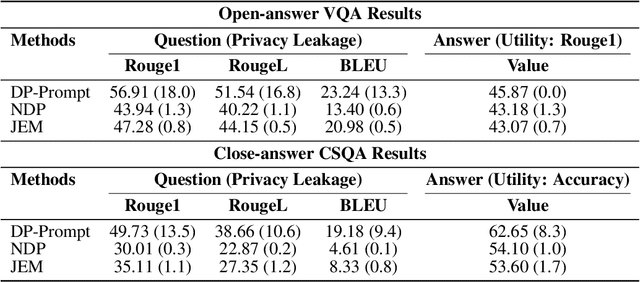
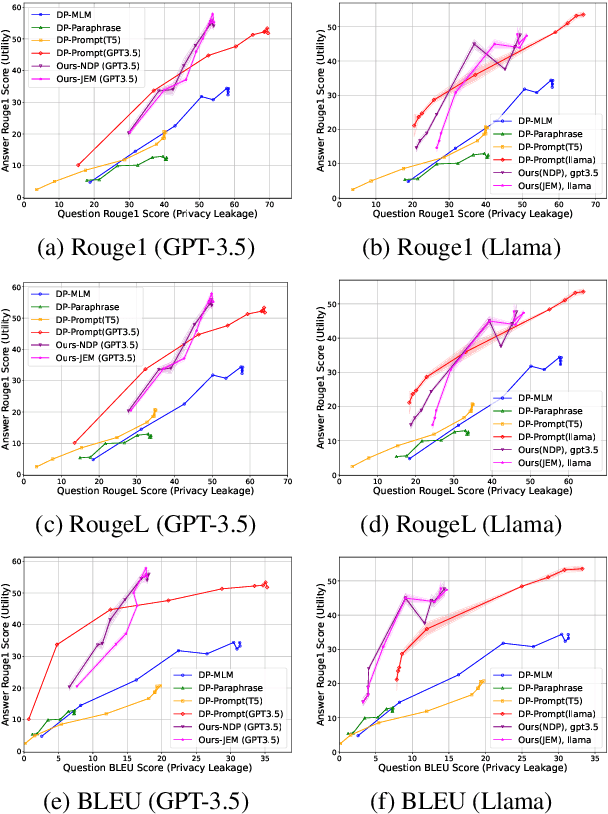
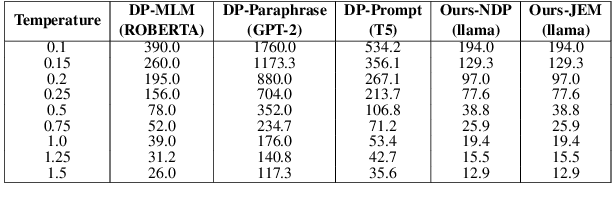
Prompt privacy is crucial, especially when using online large language models (LLMs), due to the sensitive information often contained within prompts. While LLMs can enhance prompt privacy through text rewriting, existing methods primarily focus on document-level rewriting, neglecting the rich, multi-granular representations of text. This limitation restricts LLM utilization to specific tasks, overlooking their generalization and in-context learning capabilities, thus hindering practical application. To address this gap, we introduce DP-GTR, a novel three-stage framework that leverages local differential privacy (DP) and the composition theorem via group text rewriting. DP-GTR is the first framework to integrate both document-level and word-level information while exploiting in-context learning to simultaneously improve privacy and utility, effectively bridging local and global DP mechanisms at the individual data point level. Experiments on CommonSense QA and DocVQA demonstrate that DP-GTR outperforms existing approaches, achieving a superior privacy-utility trade-off. Furthermore, our framework is compatible with existing rewriting techniques, serving as a plug-in to enhance privacy protection. Our code is publicly available at https://github.com/FatShion-FTD/DP-GTR for reproducibility.
GSOT3D: Towards Generic 3D Single Object Tracking in the Wild
Dec 03, 2024In this paper, we present a novel benchmark, GSOT3D, that aims at facilitating development of generic 3D single object tracking (SOT) in the wild. Specifically, GSOT3D offers 620 sequences with 123K frames, and covers a wide selection of 54 object categories. Each sequence is offered with multiple modalities, including the point cloud (PC), RGB image, and depth. This allows GSOT3D to support various 3D tracking tasks, such as single-modal 3D SOT on PC and multi-modal 3D SOT on RGB-PC or RGB-D, and thus greatly broadens research directions for 3D object tracking. To provide highquality per-frame 3D annotations, all sequences are labeled manually with multiple rounds of meticulous inspection and refinement. To our best knowledge, GSOT3D is the largest benchmark dedicated to various generic 3D object tracking tasks. To understand how existing 3D trackers perform and to provide comparisons for future research on GSOT3D, we assess eight representative point cloud-based tracking models. Our evaluation results exhibit that these models heavily degrade on GSOT3D, and more efforts are required for robust and generic 3D object tracking. Besides, to encourage future research, we present a simple yet effective generic 3D tracker, named PROT3D, that localizes the target object via a progressive spatial-temporal network and outperforms all current solutions by a large margin. By releasing GSOT3D, we expect to advance further 3D tracking in future research and applications. Our benchmark and model as well as the evaluation results will be publicly released at our webpage https://github.com/ailovejinx/GSOT3D.
A Comparative Study of Quality Evaluation Methods for Text Summarization
Jun 30, 2024
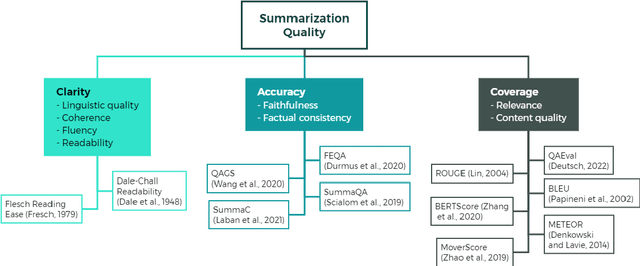


Evaluating text summarization has been a challenging task in natural language processing (NLP). Automatic metrics which heavily rely on reference summaries are not suitable in many situations, while human evaluation is time-consuming and labor-intensive. To bridge this gap, this paper proposes a novel method based on large language models (LLMs) for evaluating text summarization. We also conducts a comparative study on eight automatic metrics, human evaluation, and our proposed LLM-based method. Seven different types of state-of-the-art (SOTA) summarization models were evaluated. We perform extensive experiments and analysis on datasets with patent documents. Our results show that LLMs evaluation aligns closely with human evaluation, while widely-used automatic metrics such as ROUGE-2, BERTScore, and SummaC do not and also lack consistency. Based on the empirical comparison, we propose a LLM-powered framework for automatically evaluating and improving text summarization, which is beneficial and could attract wide attention among the community.