 Add to Chrome
 Add to Firefox
 Add to Edge
MetaGAI: A Large-Scale and High-Quality Benchmark for Generative AI Model and Data Card Generation
Apr 26, 2026
The rapid proliferation of Generative AI necessitates rigorous documentation standards for transparency and governance. However, manual creation of Model and Data Cards is not scalable, while automated approaches lack large-scale, high-fidelity benchmarks for systematic evaluation. We introduce MetaGAI, a comprehensive benchmark comprising 2,541 verified document triplets constructed through semantic triangulation of academic papers, GitHub repositories, and Hugging Face artifacts. Unlike prior single-source datasets, MetaGAI employs a multi-agent framework with specialized Retriever, Generator, and Editor agents, validated through four-dimensional human-in-the-loop assessment, including human evaluation of editor-refined ground truth. We establish a robust evaluation protocol combining automated metrics with validated LLM-as-a-Judge frameworks. Extensive analysis reveals that sparse Mixture-of-Experts architectures achieve superior cost-quality efficiency, while a fundamental trade-off exists between faithfulness and completeness. MetaGAI provides a foundational testbed for benchmarking, training, and analyzing automated Model and Data Card generation methods at scale. Our data and code are available at: https://github.com/haoxuan-unt2024/MetaGAI-Benchmark.

The Evolving Role of Large Language Models in Scientific Innovation: Evaluator, Collaborator, and Scientist
Jul 16, 2025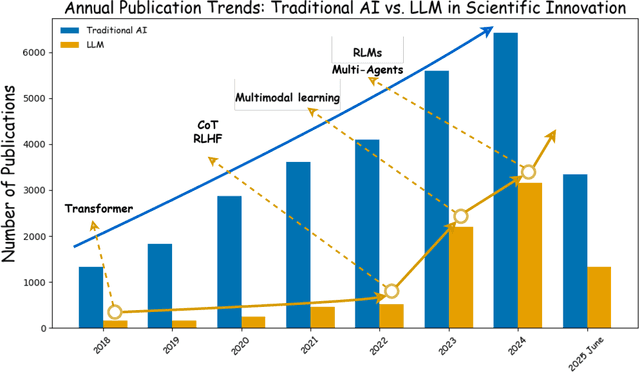
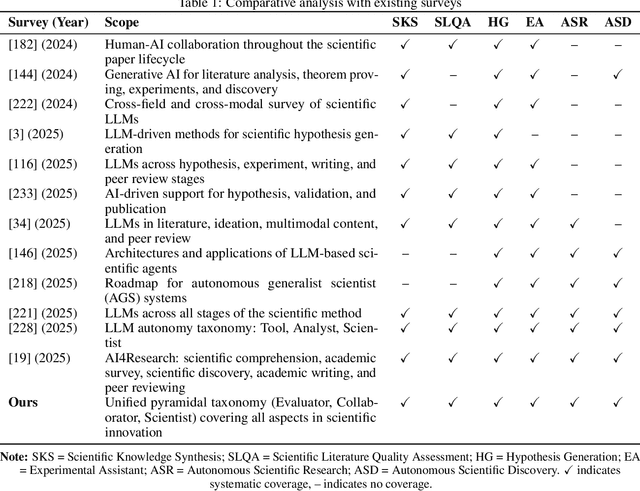
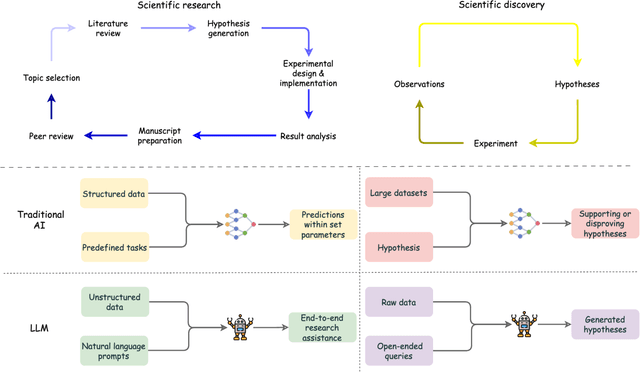
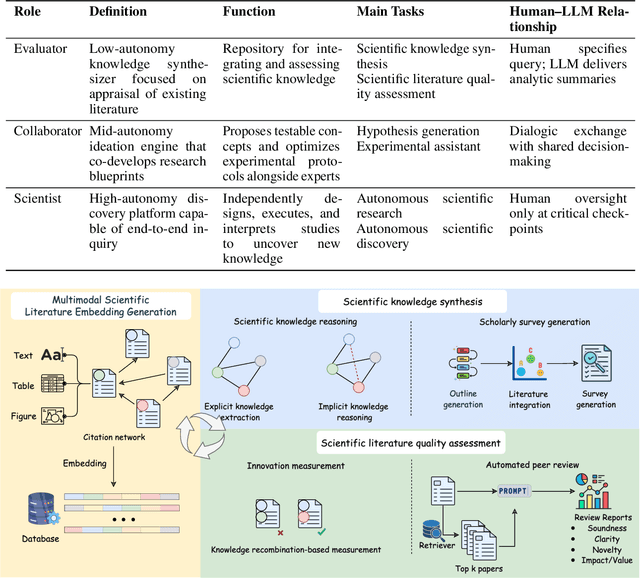
Scientific innovation is undergoing a paradigm shift driven by the rapid advancement of Large Language Models (LLMs). As science faces mounting challenges including information overload, disciplinary silos, and diminishing returns on conventional research methods, LLMs are emerging as powerful agents capable not only of enhancing scientific workflows but also of participating in and potentially leading the innovation process. Existing surveys mainly focus on different perspectives, phrases, and tasks in scientific research and discovery, while they have limitations in understanding the transformative potential and role differentiation of LLM. This survey proposes a comprehensive framework to categorize the evolving roles of LLMs in scientific innovation across three hierarchical levels: Evaluator, Collaborator, and Scientist. We distinguish between LLMs' contributions to structured scientific research processes and open-ended scientific discovery, thereby offering a unified taxonomy that clarifies capability boundaries, evaluation criteria, and human-AI interaction patterns at each level. Through an extensive analysis of current methodologies, benchmarks, systems, and evaluation metrics, this survey delivers an in-depth and systematic synthesis on LLM-driven scientific innovation. We present LLMs not only as tools for automating existing processes, but also as catalysts capable of reshaping the epistemological foundations of science itself. This survey offers conceptual clarity, practical guidance, and theoretical foundations for future research, while also highlighting open challenges and ethical considerations in the pursuit of increasingly autonomous AI-driven science. Resources related to this survey can be accessed on GitHub at: https://github.com/haoxuan-unt2024/llm4innovation.