 Add to Chrome
 Add to Firefox
 Add to Edge
Situation-Dependent Causal Influence-Based Cooperative Multi-agent Reinforcement Learning
Dec 15, 2023
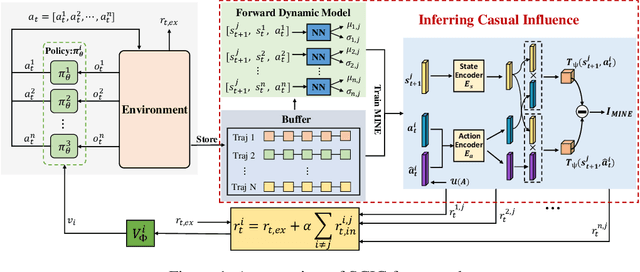
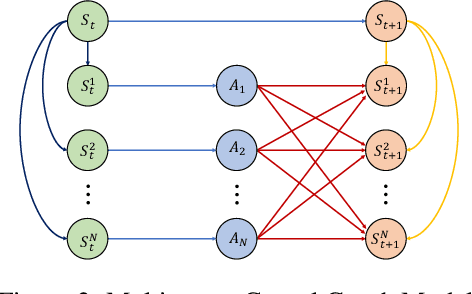


Learning to collaborate has witnessed significant progress in multi-agent reinforcement learning (MARL). However, promoting coordination among agents and enhancing exploration capabilities remain challenges. In multi-agent environments, interactions between agents are limited in specific situations. Effective collaboration between agents thus requires a nuanced understanding of when and how agents' actions influence others. To this end, in this paper, we propose a novel MARL algorithm named Situation-Dependent Causal Influence-Based Cooperative Multi-agent Reinforcement Learning (SCIC), which incorporates a novel Intrinsic reward mechanism based on a new cooperation criterion measured by situation-dependent causal influence among agents. Our approach aims to detect inter-agent causal influences in specific situations based on the criterion using causal intervention and conditional mutual information. This effectively assists agents in exploring states that can positively impact other agents, thus promoting cooperation between agents. The resulting update links coordinated exploration and intrinsic reward distribution, which enhance overall collaboration and performance. Experimental results on various MARL benchmarks demonstrate the superiority of our method compared to state-of-the-art approaches.

On the Difficulty of Defending Contrastive Learning against Backdoor Attacks
Dec 14, 2023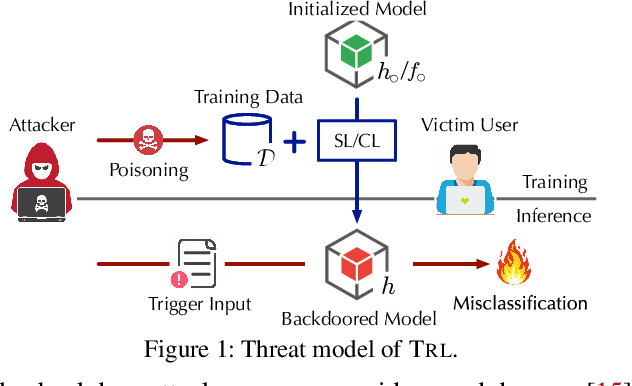
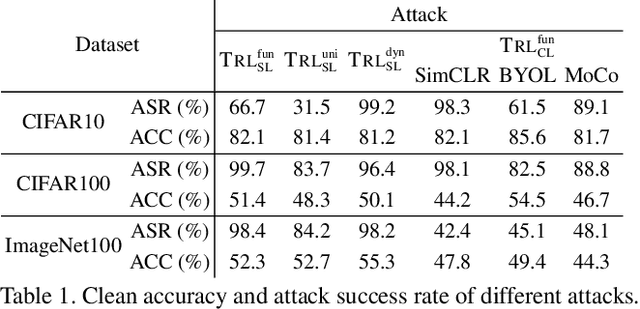
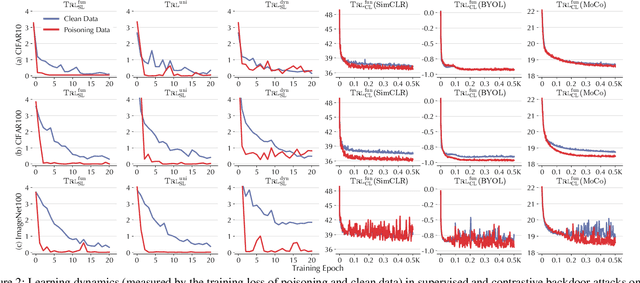
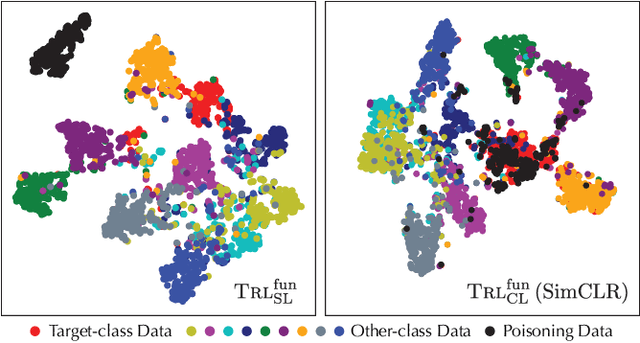
Recent studies have shown that contrastive learning, like supervised learning, is highly vulnerable to backdoor attacks wherein malicious functions are injected into target models, only to be activated by specific triggers. However, thus far it remains under-explored how contrastive backdoor attacks fundamentally differ from their supervised counterparts, which impedes the development of effective defenses against the emerging threat. This work represents a solid step toward answering this critical question. Specifically, we define TRL, a unified framework that encompasses both supervised and contrastive backdoor attacks. Through the lens of TRL, we uncover that the two types of attacks operate through distinctive mechanisms: in supervised attacks, the learning of benign and backdoor tasks tends to occur independently, while in contrastive attacks, the two tasks are deeply intertwined both in their representations and throughout their learning processes. This distinction leads to the disparate learning dynamics and feature distributions of supervised and contrastive attacks. More importantly, we reveal that the specificities of contrastive backdoor attacks entail important implications from a defense perspective: existing defenses for supervised attacks are often inadequate and not easily retrofitted to contrastive attacks. We also explore several alternative defenses and discuss their potential challenges. Our findings highlight the need for defenses tailored to the specificities of contrastive backdoor attacks, pointing to promising directions for future research.
Model Extraction Attacks Revisited
Dec 08, 2023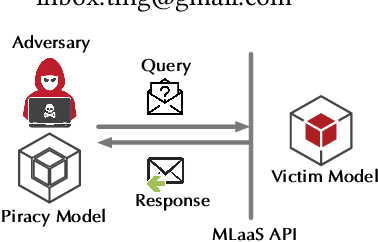
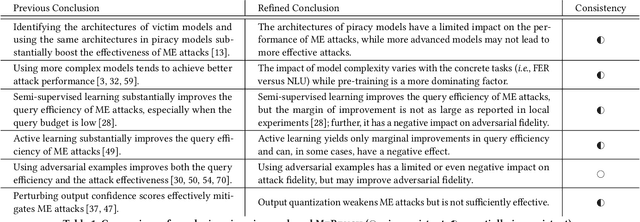
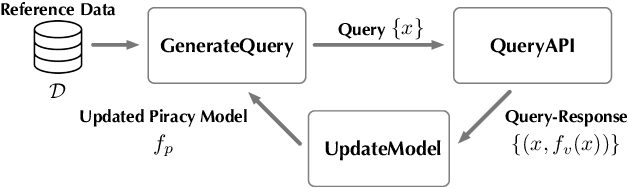
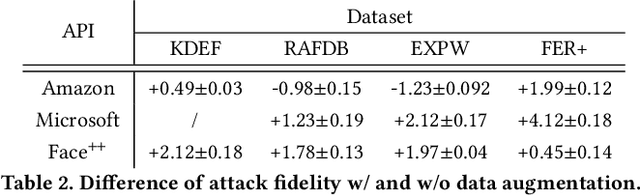
Model extraction (ME) attacks represent one major threat to Machine-Learning-as-a-Service (MLaaS) platforms by ``stealing'' the functionality of confidential machine-learning models through querying black-box APIs. Over seven years have passed since ME attacks were first conceptualized in the seminal work. During this period, substantial advances have been made in both ME attacks and MLaaS platforms, raising the intriguing question: How has the vulnerability of MLaaS platforms to ME attacks been evolving? In this work, we conduct an in-depth study to answer this critical question. Specifically, we characterize the vulnerability of current, mainstream MLaaS platforms to ME attacks from multiple perspectives including attack strategies, learning techniques, surrogate-model design, and benchmark tasks. Many of our findings challenge previously reported results, suggesting emerging patterns of ME vulnerability. Further, by analyzing the vulnerability of the same MLaaS platforms using historical datasets from the past four years, we retrospectively characterize the evolution of ME vulnerability over time, leading to a set of interesting findings. Finally, we make suggestions about improving the current practice of MLaaS in terms of attack robustness. Our study sheds light on the current state of ME vulnerability in the wild and points to several promising directions for future research.
Blueprinting the Future: Automatic Item Categorization using Hierarchical Zero-Shot and Few-Shot Classifiers
Dec 06, 2023In testing industry, precise item categorization is pivotal to align exam questions with the designated content domains outlined in the assessment blueprint. Traditional methods either entail manual classification, which is laborious and error-prone, or utilize machine learning requiring extensive training data, often leading to model underfit or overfit issues. This study unveils a novel approach employing the zero-shot and few-shot Generative Pretrained Transformer (GPT) classifier for hierarchical item categorization, minimizing the necessity for training data, and instead, leveraging human-like language descriptions to define categories. Through a structured python dictionary, the hierarchical nature of examination blueprints is navigated seamlessly, allowing for a tiered classification of items across multiple levels. An initial simulation with artificial data demonstrates the efficacy of this method, achieving an average accuracy of 92.91% measured by the F1 score. This method was further applied to real exam items from the 2022 In-Training Examination (ITE) conducted by the American Board of Family Medicine (ABFM), reclassifying 200 items according to a newly formulated blueprint swiftly in 15 minutes, a task that traditionally could span several days among editors and physicians. This innovative approach not only drastically cuts down classification time but also ensures a consistent, principle-driven categorization, minimizing human biases and discrepancies. The ability to refine classifications by adjusting definitions adds to its robustness and sustainability.
Improving the Robustness of Transformer-based Large Language Models with Dynamic Attention
Nov 30, 2023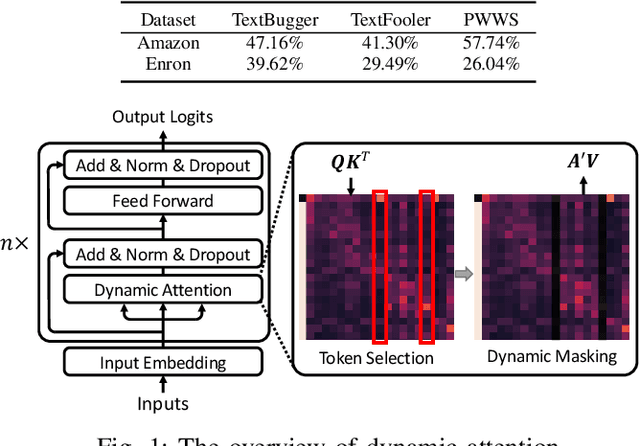
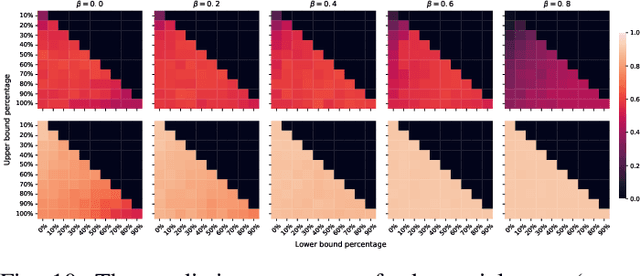
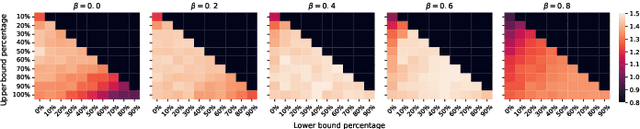

Transformer-based models, such as BERT and GPT, have been widely adopted in natural language processing (NLP) due to their exceptional performance. However, recent studies show their vulnerability to textual adversarial attacks where the model's output can be misled by intentionally manipulating the text inputs. Despite various methods that have been proposed to enhance the model's robustness and mitigate this vulnerability, many require heavy consumption resources (e.g., adversarial training) or only provide limited protection (e.g., defensive dropout). In this paper, we propose a novel method called dynamic attention, tailored for the transformer architecture, to enhance the inherent robustness of the model itself against various adversarial attacks. Our method requires no downstream task knowledge and does not incur additional costs. The proposed dynamic attention consists of two modules: (I) attention rectification, which masks or weakens the attention value of the chosen tokens, and (ii) dynamic modeling, which dynamically builds the set of candidate tokens. Extensive experiments demonstrate that dynamic attention significantly mitigates the impact of adversarial attacks, improving up to 33\% better performance than previous methods against widely-used adversarial attacks. The model-level design of dynamic attention enables it to be easily combined with other defense methods (e.g., adversarial training) to further enhance the model's robustness. Furthermore, we demonstrate that dynamic attention preserves the state-of-the-art robustness space of the original model compared to other dynamic modeling methods.
Improving Image Captioning via Predicting Structured Concepts
Nov 28, 2023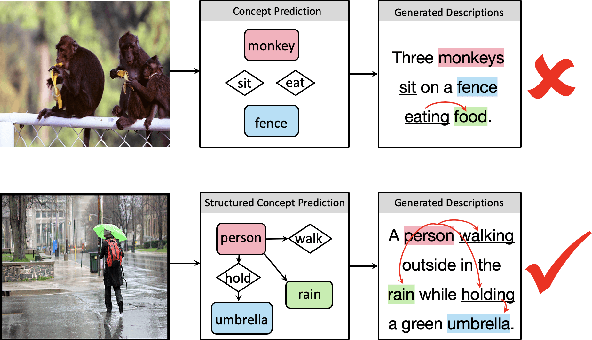
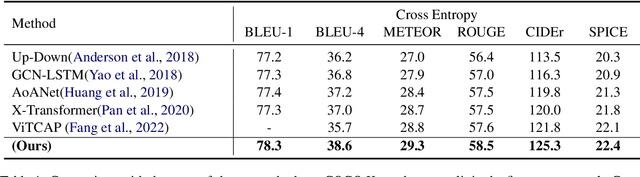
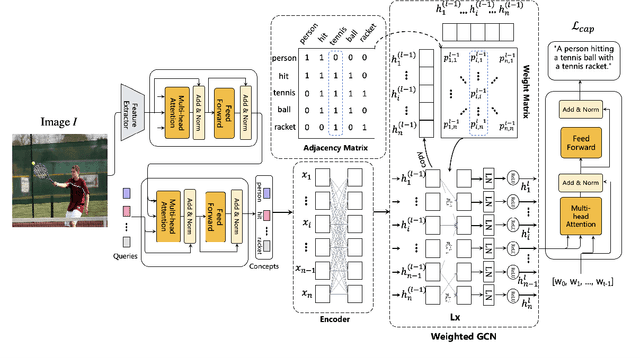

Having the difficulty of solving the semantic gap between images and texts for the image captioning task, conventional studies in this area paid some attention to treating semantic concepts as a bridge between the two modalities and improved captioning performance accordingly. Although promising results on concept prediction were obtained, the aforementioned studies normally ignore the relationship among concepts, which relies on not only objects in the image, but also word dependencies in the text, so that offers a considerable potential for improving the process of generating good descriptions. In this paper, we propose a structured concept predictor (SCP) to predict concepts and their structures, then we integrate them into captioning, so as to enhance the contribution of visual signals in this task via concepts and further use their relations to distinguish cross-modal semantics for better description generation. Particularly, we design weighted graph convolutional networks (W-GCN) to depict concept relations driven by word dependencies, and then learns differentiated contributions from these concepts for following decoding process. Therefore, our approach captures potential relations among concepts and discriminatively learns different concepts, so that effectively facilitates image captioning with inherited information across modalities. Extensive experiments and their results demonstrate the effectiveness of our approach as well as each proposed module in this work.
An Intelligent Social Learning-based Optimization Strategy for Black-box Robotic Control with Reinforcement Learning
Nov 11, 2023


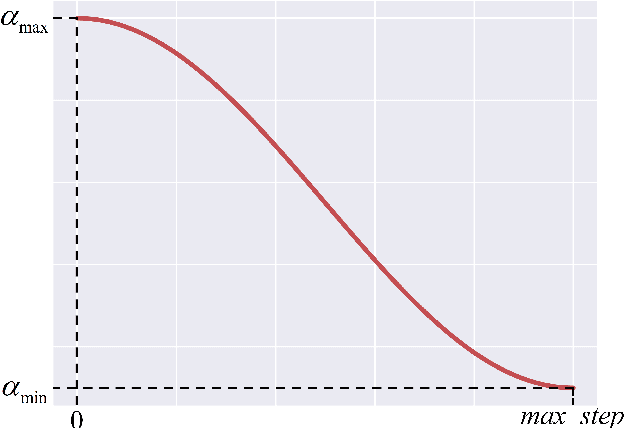
Implementing intelligent control of robots is a difficult task, especially when dealing with complex black-box systems, because of the lack of visibility and understanding of how these robots work internally. This paper proposes an Intelligent Social Learning (ISL) algorithm to enable intelligent control of black-box robotic systems. Inspired by mutual learning among individuals in human social groups, ISL includes learning, imitation, and self-study styles. Individuals in the learning style use the Levy flight search strategy to learn from the best performer and form the closest relationships. In the imitation style, individuals mimic the best performer with a second-level rapport by employing a random perturbation strategy. In the self-study style, individuals learn independently using a normal distribution sampling method while maintaining a distant relationship with the best performer. Individuals in the population are regarded as autonomous intelligent agents in each style. Neural networks perform strategic actions in three styles to interact with the environment and the robot and iteratively optimize the network policy. Overall, ISL builds on the principles of intelligent optimization, incorporating ideas from reinforcement learning, and possesses strong search capabilities, fast computation speed, fewer hyperparameters, and insensitivity to sparse rewards. The proposed ISL algorithm is compared with four state-of-the-art methods on six continuous control benchmark cases in MuJoCo to verify its effectiveness and advantages. Furthermore, ISL is adopted in the simulation and experimental grasping tasks of the UR3 robot for validations, and satisfactory solutions are yielded.
IMPRESS: Evaluating the Resilience of Imperceptible Perturbations Against Unauthorized Data Usage in Diffusion-Based Generative AI
Oct 30, 2023


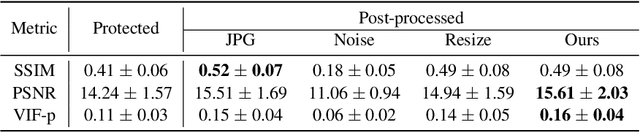
Diffusion-based image generation models, such as Stable Diffusion or DALL-E 2, are able to learn from given images and generate high-quality samples following the guidance from prompts. For instance, they can be used to create artistic images that mimic the style of an artist based on his/her original artworks or to maliciously edit the original images for fake content. However, such ability also brings serious ethical issues without proper authorization from the owner of the original images. In response, several attempts have been made to protect the original images from such unauthorized data usage by adding imperceptible perturbations, which are designed to mislead the diffusion model and make it unable to properly generate new samples. In this work, we introduce a perturbation purification platform, named IMPRESS, to evaluate the effectiveness of imperceptible perturbations as a protective measure. IMPRESS is based on the key observation that imperceptible perturbations could lead to a perceptible inconsistency between the original image and the diffusion-reconstructed image, which can be used to devise a new optimization strategy for purifying the image, which may weaken the protection of the original image from unauthorized data usage (e.g., style mimicking, malicious editing). The proposed IMPRESS platform offers a comprehensive evaluation of several contemporary protection methods, and can be used as an evaluation platform for future protection methods.
VLAttack: Multimodal Adversarial Attacks on Vision-Language Tasks via Pre-trained Models
Oct 07, 2023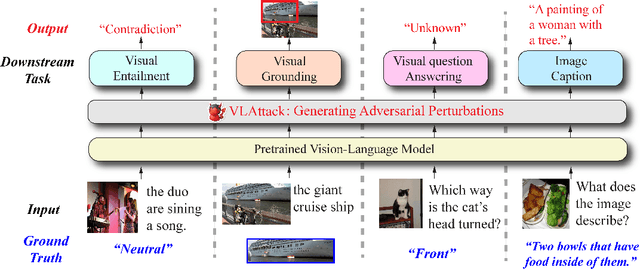
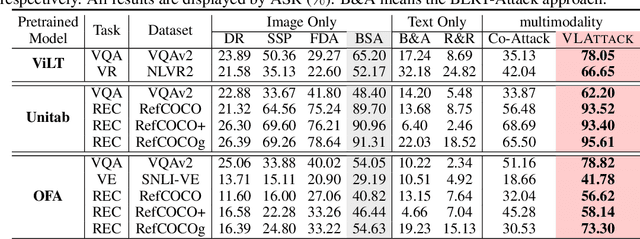
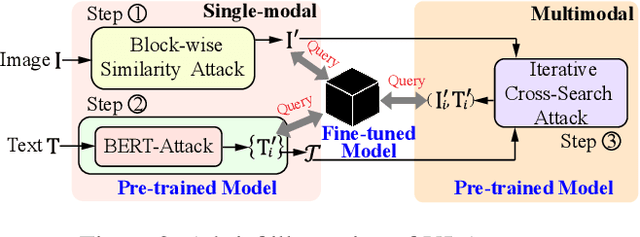
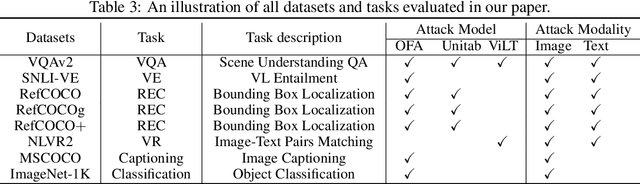
Vision-Language (VL) pre-trained models have shown their superiority on many multimodal tasks. However, the adversarial robustness of such models has not been fully explored. Existing approaches mainly focus on exploring the adversarial robustness under the white-box setting, which is unrealistic. In this paper, we aim to investigate a new yet practical task to craft image and text perturbations using pre-trained VL models to attack black-box fine-tuned models on different downstream tasks. Towards this end, we propose VLAttack to generate adversarial samples by fusing perturbations of images and texts from both single-modal and multimodal levels. At the single-modal level, we propose a new block-wise similarity attack (BSA) strategy to learn image perturbations for disrupting universal representations. Besides, we adopt an existing text attack strategy to generate text perturbations independent of the image-modal attack. At the multimodal level, we design a novel iterative cross-search attack (ICSA) method to update adversarial image-text pairs periodically, starting with the outputs from the single-modal level. We conduct extensive experiments to attack three widely-used VL pretrained models for six tasks on eight datasets. Experimental results show that the proposed VLAttack framework achieves the highest attack success rates on all tasks compared with state-of-the-art baselines, which reveals a significant blind spot in the deployment of pre-trained VL models. Codes will be released soon.
MedDiffusion: Boosting Health Risk Prediction via Diffusion-based Data Augmentation
Oct 05, 2023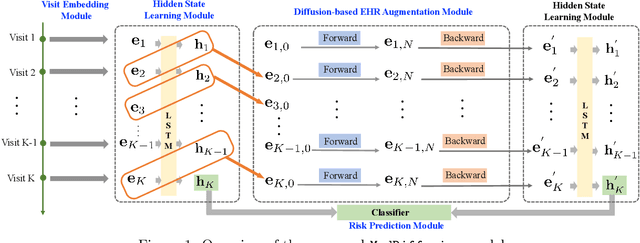

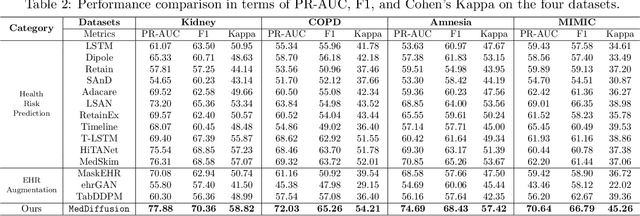
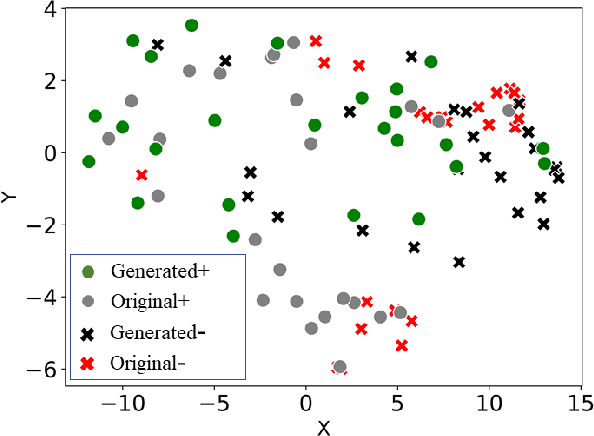
Health risk prediction is one of the fundamental tasks under predictive modeling in the medical domain, which aims to forecast the potential health risks that patients may face in the future using their historical Electronic Health Records (EHR). Researchers have developed several risk prediction models to handle the unique challenges of EHR data, such as its sequential nature, high dimensionality, and inherent noise. These models have yielded impressive results. Nonetheless, a key issue undermining their effectiveness is data insufficiency. A variety of data generation and augmentation methods have been introduced to mitigate this issue by expanding the size of the training data set through the learning of underlying data distributions. However, the performance of these methods is often limited due to their task-unrelated design. To address these shortcomings, this paper introduces a novel, end-to-end diffusion-based risk prediction model, named MedDiffusion. It enhances risk prediction performance by creating synthetic patient data during training to enlarge sample space. Furthermore, MedDiffusion discerns hidden relationships between patient visits using a step-wise attention mechanism, enabling the model to automatically retain the most vital information for generating high-quality data. Experimental evaluation on four real-world medical datasets demonstrates that MedDiffusion outperforms 14 cutting-edge baselines in terms of PR-AUC, F1, and Cohen's Kappa. We also conduct ablation studies and benchmark our model against GAN-based alternatives to further validate the rationality and adaptability of our model design. Additionally, we analyze generated data to offer fresh insights into the model's interpretability.