 Add to Chrome
 Add to Firefox
 Add to Edge
Intern-S1-Pro: Scientific Multimodal Foundation Model at Trillion Scale
Mar 26, 2026
We introduce Intern-S1-Pro, the first one-trillion-parameter scientific multimodal foundation model. Scaling to this unprecedented size, the model delivers a comprehensive enhancement across both general and scientific domains. Beyond stronger reasoning and image-text understanding capabilities, its intelligence is augmented with advanced agent capabilities. Simultaneously, its scientific expertise has been vastly expanded to master over 100 specialized tasks across critical science fields, including chemistry, materials, life sciences, and earth sciences. Achieving this massive scale is made possible by the robust infrastructure support of XTuner and LMDeploy, which facilitates highly efficient Reinforcement Learning (RL) training at the 1-trillion parameter level while ensuring strict precision consistency between training and inference. By seamlessly integrating these advancements, Intern-S1-Pro further fortifies the fusion of general and specialized intelligence, working as a Specializable Generalist, demonstrating its position in the top tier of open-source models for general capabilities, while outperforming proprietary models in the depth of specialized scientific tasks.

Unified Demonstration Retriever for In-Context Learning
May 16, 2023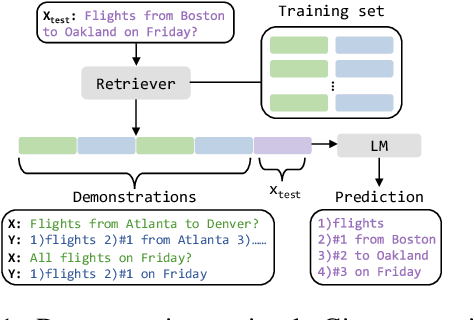
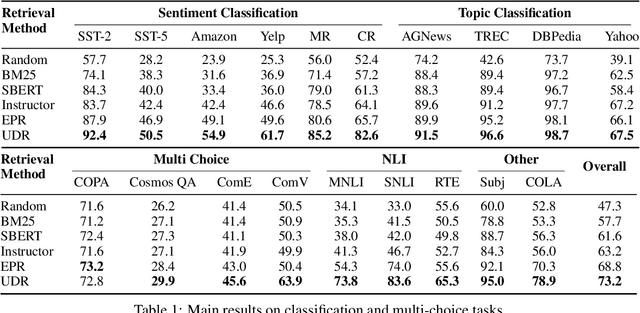
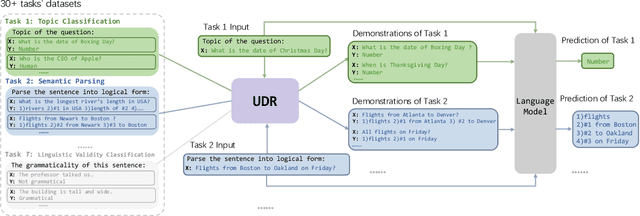
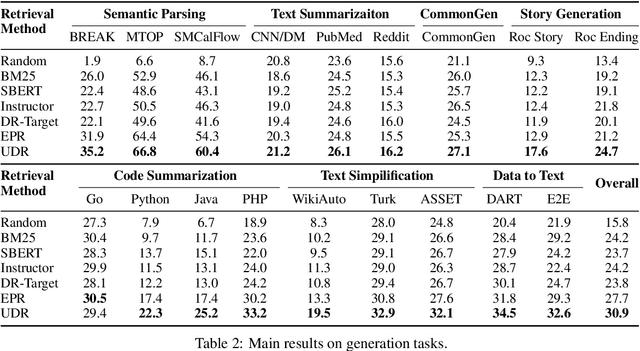
In-context learning is a new learning paradigm where a language model conditions on a few input-output pairs (demonstrations) and a test input, and directly outputs the prediction. It has been shown highly dependent on the provided demonstrations and thus promotes the research of demonstration retrieval: given a test input, relevant examples are retrieved from the training set to serve as informative demonstrations for in-context learning. While previous works focus on training task-specific retrievers for several tasks separately, these methods are often hard to transfer and scale on various tasks, and separately trained retrievers incur a lot of parameter storage and deployment cost. In this paper, we propose Unified Demonstration Retriever (\textbf{UDR}), a single model to retrieve demonstrations for a wide range of tasks. To train UDR, we cast various tasks' training signals into a unified list-wise ranking formulation by language model's feedback. Then we propose a multi-task list-wise ranking training framework, with an iterative mining strategy to find high-quality candidates, which can help UDR fully incorporate various tasks' signals. Experiments on 30+ tasks across 13 task families and multiple data domains show that UDR significantly outperforms baselines. Further analyses show the effectiveness of each proposed component and UDR's strong ability in various scenarios including different LMs (1.3B - 175B), unseen datasets, varying demonstration quantities, etc.
A Survey of Transformers
Jun 15, 2021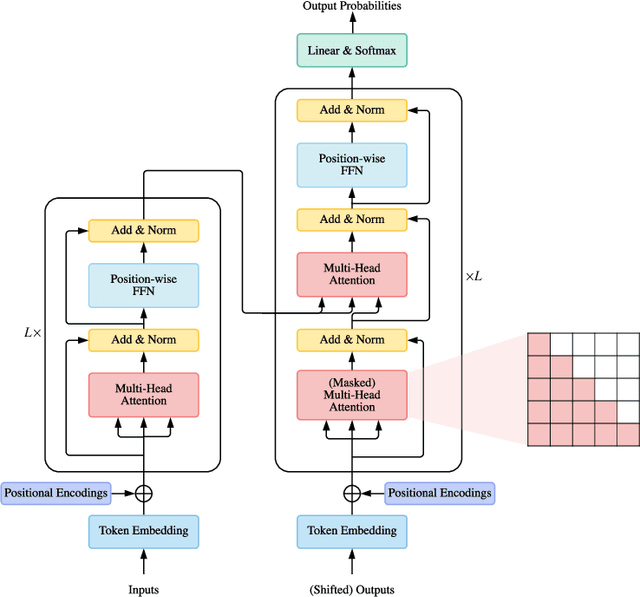

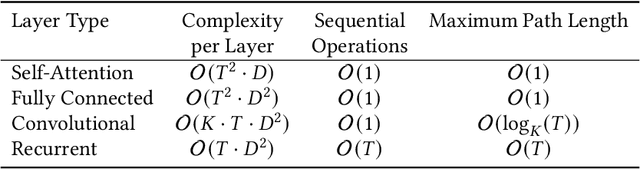
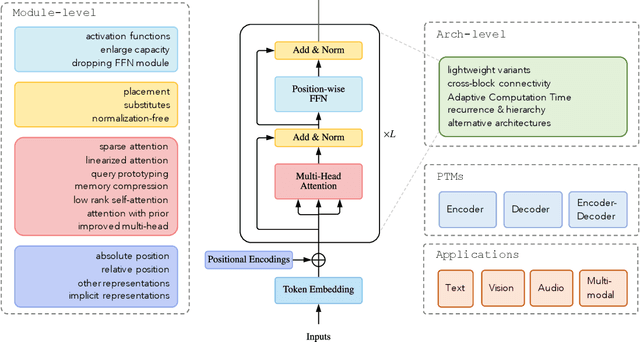
Transformers have achieved great success in many artificial intelligence fields, such as natural language processing, computer vision, and audio processing. Therefore, it is natural to attract lots of interest from academic and industry researchers. Up to the present, a great variety of Transformer variants (a.k.a. X-formers) have been proposed, however, a systematic and comprehensive literature review on these Transformer variants is still missing. In this survey, we provide a comprehensive review of various X-formers. We first briefly introduce the vanilla Transformer and then propose a new taxonomy of X-formers. Next, we introduce the various X-formers from three perspectives: architectural modification, pre-training, and applications. Finally, we outline some potential directions for future research.