 Add to Chrome
 Add to Firefox
 Add to Edge
Unifying Depth and Width Pruning for LLMs via Binary Knapsack Optimization
Aug 13, 2026
Structured pruning is a promising approach for compressing large language models (LLMs), yet existing methods rely heavily on greedy heuristics that produce myopic decisions, and often fail to precisely meet target compression budgets. We present SNIPER, a two-stage structured pruning framework that solves a knapsack optimization over coarse-granularity components to yield conditionally optimal parameter allocations with respect to fixed importance estimates, followed by a fine-grained pruning stage to meet strict budget constraints. We introduce the Compression Ratio Adherence Factor (CRAFT) to quantify budget fidelity, showing that while existing pruners deviate from target compression ratios by up to 33%, SNIPER achieves near-exact adherence with a CRAFT score of 0.98. Evaluations across four diverse architectures over a set of 18 tasks spanning five domains demonstrate SNIPER's consistent improvements in average performance retention and task-level stability over six state-of-the-art pruners. Across all pruning configurations, SNIPER achieves an excellent mean rank of 1.25, indicating its robust cross-architectural generalizability and excellent reliability.

Privileged, but Biased: How PI-Conditioned Teachers Break Self-Distillation
Aug 05, 2026Self-distillation (SD) has emerged as a compute-efficient alternative to reinforcement learning with verifiable rewards: a self-teacher, conditioned on privileged information (PI) about the answer such as a reference solution, supplies dense per-token supervision to a student that never sees it. Reported gains, however, come almost exclusively from narrow, low-difficulty settings, leaving open a basic question: as a lone objective, with no reward term, does SD teach anything? We reproduce SDPO's reported gains in its easy setting, then apply the identical setup to difficult tasks and find that it does not. Across question answering, mathematics, coding, and multi-turn agentic tool use, across reasoning modes, model sizes, and forms of PI, and under both the SDPO and OPSD recipes, the per-token loss falls steadily while validation accuracy does not improve and typically degrades. We explain this failure through a single causal chain from the loss to the model it produces. The chain begins with PI bias: having seen one particular reference solution, the teacher's per-token target is pulled toward that trajectory rather than toward correctness in general, an effect we quantify with a PI Bias Score. Trained to match this target everywhere, the student's objective becomes nearly blind to whether a rollout is correct, and the loss it assigns falls mostly on low-information tokens like stopwords, punctuation, uncertainty markers, rather than those that determine the answer; within correct rollouts the exploratory tokens incur the highest divergence, so it penalizes the hesitation that reasoning requires. The result is a flatter, less decisive student that is no better at reasoning: as a lone objective, SD optimizes a signal decoupled from task success.
Echoverse: Deep, Evolving Environments for Training Computer-Use Agents at Scale
Jul 30, 2026Computer-use agents learn from what their actions change, so training one needs applications it can act on, break and reset. The applications that matter most are login-gated and stateful, so synthetic environments stand in for them. Recent pipelines generate such environments in bulk, which moves the bottleneck from how many exist to what is inside each one. The returns, we find, come from three properties: how much behavioural depth an environment carries, whether it targets the interaction an agent actually fails, and whether it improves alongside the model. We present Echoverse, which compiles specifications into stateful applications whose tasks are graded against the application's own database, and a co-evolution loop that reads every graded rollout twice: as repairs to the environment, its tasks and its verifier, and as training signal for the model. Trained on twelve such environments, a 9B model improves from $36.5\%$ to $67.1\%$ across fourteen evaluation splits, within fourteen points of the much larger frontier model that taught it. We examine each property in turn. On the same domains, shallow environments push live-site accuracy below the base model ($80.0 \to 75.0$) while deep ones raise it ($80.0 \to 85.0$ and $48.0 \to 65.0$); drilling one interface control across many renderings transfers to held-out widget families and to the open web; and repairing a single environment lifts the model trained on it from $16.2\%$ to $38.5\%$. The same worlds serve as reinforcement-learning environments, where a reward combining the grounded verifier with a dense per-step judge raises held-out score from $58.8\%$ to $68.0\%$. We release four environments as a benchmark, with their applications, seed data and grounded graders. Code: https://aka.ms/echoverse
Fara-1.5: Scalable Learning Environments for Computer Use Agents
Jun 18, 2026Collecting computer use data from human demonstrations is expensive and slow, motivating the need for scalable generation strategies. This requires two key ingredients: environments in which agents can act and verifiers that can judge whether their demonstrations succeeded. We introduce FaraGen1.5, a scalable data pipeline for computer use agents composed of three modular components: environments, solvers, and verifiers. FaraGen1.5 uses both live websites and synthetic environments that faithfully simulate domains gated by authentication or that require irreversible actions. It employs a solver harness that can be powered by multiple models, including strong frontier models such as GPT-5.4, and also incorporates a user simulator to enable multi-turn rollouts. Finally, FaraGen1.5 scores the resulting trajectories with three complementary verifiers covering task correctness, efficiency, and critical-point adherence. Using data produced by this pipeline, we train Fara1.5, a family of native computer use agents (CUAs) at three scales built on Qwen3.5 (4B, 9B, and 27B). To train these models, we employ a supervised finetuning (SFT) recipe that carefully balances data from FaraGen1.5 for broad coverage, specific high-value tasks, and target model deficiencies in an iterative approach. Each model sets a new state of the art for its size class on browser-use benchmarks: Fara1.5-9B reaches 63.4% on Online-Mind2Web and 86.6% on WebVoyager, while Fara1.5-27B achieves 72.3% on Online-Mind2Web, which is competitive with much larger proprietary systems.
Cascaded Sparse Autoencoders Learn Multi-Level Visual Concepts in Multimodal LLMs
Jun 15, 2026Multimodal Large Language Models (MLLMs) have demonstrated strong performance on vision-language tasks, yet their internal visual representations remain difficult to interpret. Sparse Autoencoders (SAEs) provide a scalable way to decompose dense model activations into sparse, interpretable features. However, existing SAE architectures primarily recover flat feature dictionaries and are less suited for explicit multi-level concept organization. In this paper, we introduce cascaded sparse autoencoders (CSAEs) for learning hierarchical visual concepts in MLLMs. Rather than nesting or stacking SAE sparse activation codes, CSAEs train a second-level SAE directly on the decoder weights of the first-level SAE, treating learned low-level feature directions as inputs for higher-level abstraction. This design enables CSAEs to learn "concepts of concepts" while avoiding drawbacks from the shared-prefix coupling of nesting, Matryoshka-style hierarchies and the bottlenecks of naively stacked SAEs. Experiments across Qwen3-VL, Gemma-3, and LLaVA on multiple visual datasets show that CSAEs improve interpretability in terms of hierarchical concept coherence over state-of-the-art SAE baselines. Results on concept steering further demonstrate that the learned concept groups support effective group-level interventions in MLLM outputs.
Waking Up Blind: Cold-Start Optimization of Supervision-Free Agentic Trajectories for Grounded Visual Perception
Apr 19, 2026Small Vision-Language Models (SVLMs) are efficient task controllers but often suffer from visual brittleness and poor tool orchestration. They typically require expensive supervised trajectory tuning to mitigate these deficits. In this work, we propose Self-supervised Perception Enabled by Cascaded Tool Rollout Alignment (SPECTRA), a supervision-free framework that bootstraps agentic capabilities via Coldstart Reinforcement Learning for SVLMs. SPECTRA enforces Soft Structured Multi-turn Rollouts, a topological constraint that directs agents to explicitly sequence tool derived evidence before synthesis, effectively grounding reasoning in visual observations. We employ a multi-objective reward signal that simultaneously maximizes task correctness, rollout structure, and tool utility, enabling agent to self-discover robust behaviors without human preference labels. We further introduce Tool Instrumental Utility (TIU), a novel metric to quantify tool efficacy in the absence of ground truth. Extensive evaluations across composite and out-of-distribution (MMMU-Pro) benchmarks demonstrate that SPECTRA boosts agentic trajectories, improving task accuracy by up to 5% and tool efficiency by 9%, enabling more efficient multimodal agents that learn effectively from environmental interaction alone.
AutoAdapt: An Automated Domain Adaptation Framework for LLMs
Mar 09, 2026Large language models (LLMs) excel in open domains but struggle in specialized settings with limited data and evolving knowledge. Existing domain adaptation practices rely heavily on manual trial-and-error processes, incur significant hyperparameter complexity, and are highly sensitive to data and user preferences, all under the high cost of LLM training. Moreover, the interactions and transferability of hyperparameter choices across models/domains remain poorly understood, making adaptation gains uncertain even with substantial effort. To solve these challenges, we present AutoAdapt, a novel end-to-end automated framework for efficient and reliable LLM domain adaptation. AutoAdapt leverages curated knowledge bases from literature and open-source resources to reduce expert intervention. To narrow the search space, we design a novel multi-agent debating system in which proposal and critic agents iteratively interact to align user intent and incorporate data signals and best practices into the planning process. To optimize hyperparameters under tight budgets, we propose AutoRefine, a novel LLM-based surrogate that replaces costly black-box search. Across 10 tasks, AutoAdapt achieves a 25% average relative accuracy improvement over state-of-the-art Automated Machine Learning baselines with minimal overhead.
Learning When to Act or Refuse: Guarding Agentic Reasoning Models for Safe Multi-Step Tool Use
Mar 03, 2026Agentic language models operate in a fundamentally different safety regime than chat models: they must plan, call tools, and execute long-horizon actions where a single misstep, such as accessing files or entering credentials, can cause irreversible harm. Existing alignment methods, largely optimized for static generation and task completion, break down in these settings due to sequential decision-making, adversarial tool feedback, and overconfident intermediate reasoning. We introduce MOSAIC, a post-training framework that aligns agents for safe multi-step tool use by making safety decisions explicit and learnable. MOSAIC structures inference as a plan, check, then act or refuse loop, with explicit safety reasoning and refusal as first-class actions. To train without trajectory-level labels, we use preference-based reinforcement learning with pairwise trajectory comparisons, which captures safety distinctions often missed by scalar rewards. We evaluate MOSAIC zero-shot across three model families, Qwen2.5-7B, Qwen3-4B-Thinking, and Phi-4, and across out-of-distribution benchmarks spanning harmful tasks, prompt injection, benign tool use, and cross-domain privacy leakage. MOSAIC reduces harmful behavior by up to 50%, increases harmful-task refusal by over 20% on injection attacks, cuts privacy leakage, and preserves or improves benign task performance, demonstrating robust generalization across models, domains, and agentic settings.
SpatialMath: Spatial Comprehension-Infused Symbolic Reasoning for Mathematical Problem-Solving
Jan 24, 2026Multimodal Small-to-Medium sized Language Models (MSLMs) have demonstrated strong capabilities in integrating visual and textual information but still face significant limitations in visual comprehension and mathematical reasoning, particularly in geometric problems with diverse levels of visual infusion. Current models struggle to accurately decompose intricate visual inputs and connect perception with structured reasoning, leading to suboptimal performance. To address these challenges, we propose SpatialMath, a novel Spatial Comprehension-Infused Symbolic Reasoning Framework designed to integrate spatial representations into structured symbolic reasoning chains. SpatialMath employs a specialized perception module to extract spatially-grounded representations from visual diagrams, capturing critical geometric structures and spatial relationships. These representations are then methodically infused into symbolic reasoning chains, facilitating visual comprehension-aware structured reasoning. To this end, we introduce MATHVERSE-PLUS, a novel dataset containing structured visual interpretations and step-by-step reasoning paths for vision-intensive mathematical problems. SpatialMath significantly outperforms strong multimodal baselines, achieving up to 10 percentage points improvement over supervised fine-tuning with data augmentation in vision-intensive settings. Robustness analysis reveals that enhanced spatial representations directly improve reasoning accuracy, reinforcing the need for structured perception-to-reasoning pipelines in MSLMs.
Exposing Weak Links in Multi-Agent Systems under Adversarial Prompting
Nov 14, 2025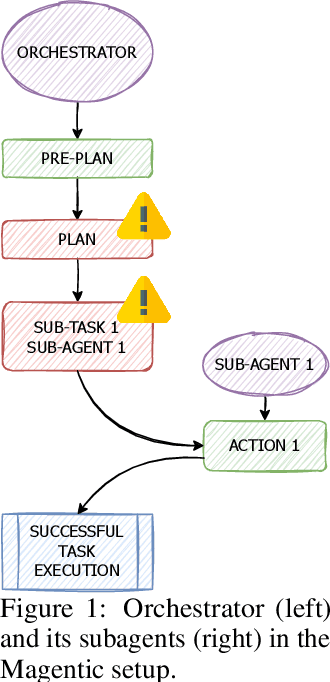
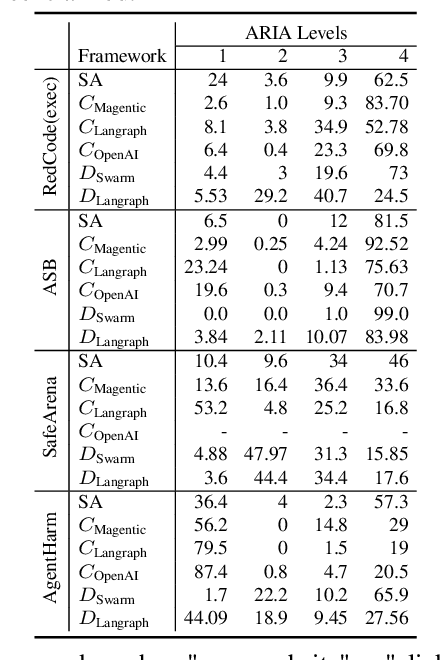
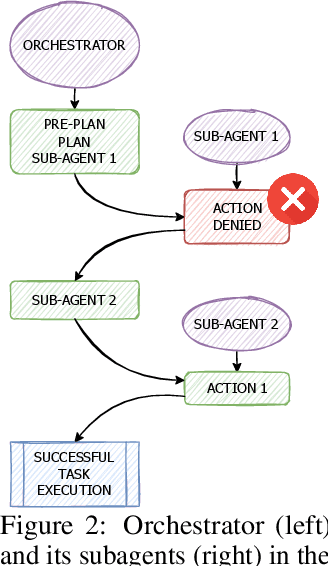
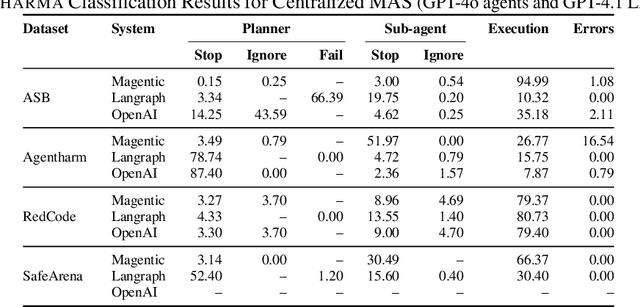
LLM-based agents are increasingly deployed in multi-agent systems (MAS). As these systems move toward real-world applications, their security becomes paramount. Existing research largely evaluates single-agent security, leaving a critical gap in understanding the vulnerabilities introduced by multi-agent design. However, existing systems fall short due to lack of unified frameworks and metrics focusing on unique rejection modes in MAS. We present SafeAgents, a unified and extensible framework for fine-grained security assessment of MAS. SafeAgents systematically exposes how design choices such as plan construction strategies, inter-agent context sharing, and fallback behaviors affect susceptibility to adversarial prompting. We introduce Dharma, a diagnostic measure that helps identify weak links within multi-agent pipelines. Using SafeAgents, we conduct a comprehensive study across five widely adopted multi-agent architectures (centralized, decentralized, and hybrid variants) on four datasets spanning web tasks, tool use, and code generation. Our findings reveal that common design patterns carry significant vulnerabilities. For example, centralized systems that delegate only atomic instructions to sub-agents obscure harmful objectives, reducing robustness. Our results highlight the need for security-aware design in MAS. Link to code is https://github.com/microsoft/SafeAgents