 Add to Chrome
 Add to Firefox
 Add to Edge
Spend Less, Fit Better: Budget-Efficient Scaling Law Fitting via Active Experiment Selection
Apr 24, 2026
Scaling laws are used to plan multi-million-dollar training runs, but fitting those laws can itself cost millions. In modern large-scale workflows, assembling a sufficiently informative set of pilot experiments is already a major budget-allocation problem rather than a routine preprocessing step. We formulate scaling-law fitting as budget-aware sequential experimental design: given a finite pool of runnable experiments with heterogeneous costs, choose which runs to execute so as to maximize extrapolation accuracy in a high-cost target region. We then propose an uncertainty-aware method for sequentially allocating experimental budget toward the runs most useful for target-region extrapolation. Across a diverse benchmark of scaling-law tasks, our method consistently outperforms classical design-based baselines, and often approaches the performance of fitting on the full experimental set while using only about 10% of the total training budget. Our code is available at https://github.com/PlanarG/active-sl.

Re-Prompting SAM 3 via Object Retrieval: 3rd of the 5th PVUW MOSE Track
Mar 24, 2026This technical report explores the MOSEv2 track of the PVUW 2026 Challenge, which targets complex semi-supervised video object segmentation. Built on SAM~3, we develop an automatic re-prompting framework to improve robustness under target disappearance and reappearance, severe transformation, and strong same-category distractors. Our method first applies the SAM~3 detector to later frames to identify same-category object candidates, and then performs DINOv3-based object-level matching with a transformation-aware target feature pool to retrieve reliable target anchors. These anchors are injected back into the SAM~3 tracker together with the first-frame mask, enabling multi-anchor propagation rather than relying solely on the initial prompt. This simple directly benefits several core challenges of MOSEv2. Our solution achieves a J&F of 51.17% on the test set, ranking 3rd in the MOSEv2 track.
Mostly Text, Smart Visuals: Asymmetric Text-Visual Pruning for Large Vision-Language Models
Mar 16, 2026Network pruning is an effective technique for enabling lightweight Large Vision-Language Models (LVLMs), which primarily incorporates both weights and activations into the importance metric. However, existing efforts typically process calibration data from different modalities in a unified manner, overlooking modality-specific behaviors. This raises a critical challenge: how to address the divergent behaviors of textual and visual tokens for accurate pruning of LVLMs. To this end, we systematically investigate the sensitivity of visual and textual tokens to the pruning operation by decoupling their corresponding weights, revealing that: (i) the textual pathway should be calibrated via text tokens, since it exhibits higher sensitivity than the visual pathway; (ii) the visual pathway exhibits high redundancy, permitting even 50% sparsity. Motivated by these insights, we propose a simple yet effective Asymmetric Text-Visual Weight Pruning method for LVLMs, dubbed ATV-Pruning, which establishes the importance metric for accurate weight pruning by selecting the informative tokens from both textual and visual pathways. Specifically, ATV-Pruning integrates two primary innovations: first, a calibration pool is adaptively constructed by drawing on all textual tokens and a subset of visual tokens; second, we devise a layer-adaptive selection strategy to yield important visual tokens. Finally, extensive experiments across standard multimodal benchmarks verify the superiority of our ATV-Pruning over state-of-the-art methods.
Towards Community-Driven Agents for Machine Learning Engineering
Jun 25, 2025Large language model-based machine learning (ML) agents have shown great promise in automating ML research. However, existing agents typically operate in isolation on a given research problem, without engaging with the broader research community, where human researchers often gain insights and contribute by sharing knowledge. To bridge this gap, we introduce MLE-Live, a live evaluation framework designed to assess an agent's ability to communicate with and leverage collective knowledge from a simulated Kaggle research community. Building on this framework, we propose CoMind, a novel agent that excels at exchanging insights and developing novel solutions within a community context. CoMind achieves state-of-the-art performance on MLE-Live and outperforms 79.2% human competitors on average across four ongoing Kaggle competitions. Our code is released at https://github.com/comind-ml/CoMind.
EventVAD: Training-Free Event-Aware Video Anomaly Detection
Apr 17, 2025Video Anomaly Detection~(VAD) focuses on identifying anomalies within videos. Supervised methods require an amount of in-domain training data and often struggle to generalize to unseen anomalies. In contrast, training-free methods leverage the intrinsic world knowledge of large language models (LLMs) to detect anomalies but face challenges in localizing fine-grained visual transitions and diverse events. Therefore, we propose EventVAD, an event-aware video anomaly detection framework that combines tailored dynamic graph architectures and multimodal LLMs through temporal-event reasoning. Specifically, EventVAD first employs dynamic spatiotemporal graph modeling with time-decay constraints to capture event-aware video features. Then, it performs adaptive noise filtering and uses signal ratio thresholding to detect event boundaries via unsupervised statistical features. The statistical boundary detection module reduces the complexity of processing long videos for MLLMs and improves their temporal reasoning through event consistency. Finally, it utilizes a hierarchical prompting strategy to guide MLLMs in performing reasoning before determining final decisions. We conducted extensive experiments on the UCF-Crime and XD-Violence datasets. The results demonstrate that EventVAD with a 7B MLLM achieves state-of-the-art (SOTA) in training-free settings, outperforming strong baselines that use 7B or larger MLLMs.
Enhancing Auto-regressive Chain-of-Thought through Loop-Aligned Reasoning
Feb 12, 2025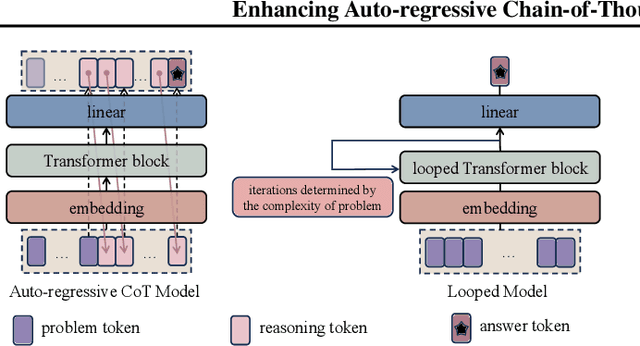
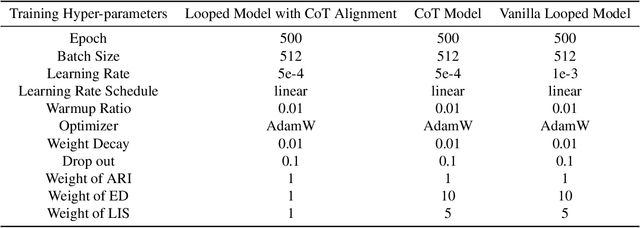
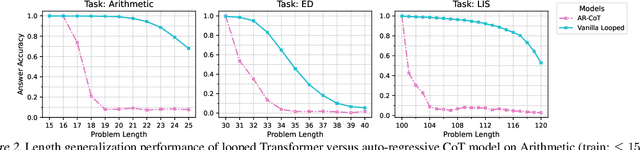
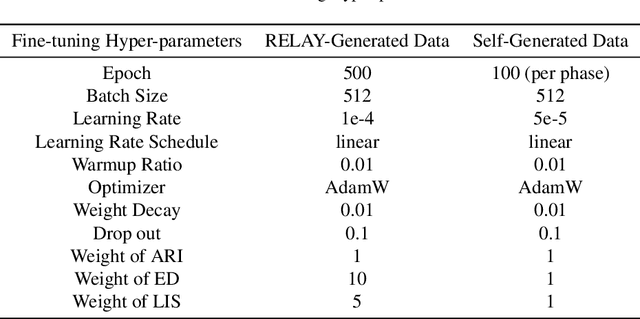
Chain-of-Thought (CoT) prompting has emerged as a powerful technique for enhancing language model's reasoning capabilities. However, generating long and correct CoT trajectories is challenging. Recent studies have demonstrated that Looped Transformers possess remarkable length generalization capabilities, but their limited generality and adaptability prevent them from serving as an alternative to auto-regressive solutions. To better leverage the strengths of Looped Transformers, we propose RELAY (REasoning through Loop Alignment iterativelY). Specifically, we align the steps of Chain-of-Thought (CoT) reasoning with loop iterations and apply intermediate supervision during the training of Looped Transformers. This additional iteration-wise supervision not only preserves the Looped Transformer's ability for length generalization but also enables it to predict CoT reasoning steps for unseen data. Therefore, we leverage this Looped Transformer to generate accurate reasoning chains for complex problems that exceed the training length, which will then be used to fine-tune an auto-regressive model. We conduct extensive experiments, and the results demonstrate the effectiveness of our approach, with significant improvements in the performance of the auto-regressive model. Code will be released at https://github.com/qifanyu/RELAY.
GarmentLab: A Unified Simulation and Benchmark for Garment Manipulation
Nov 02, 2024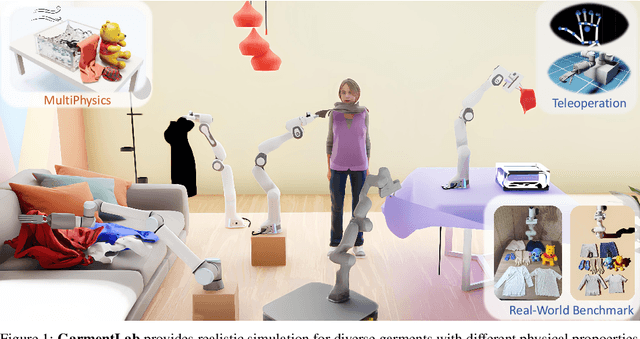
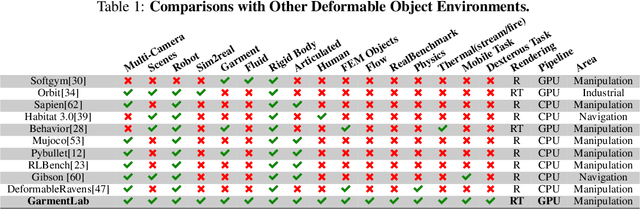


Manipulating garments and fabrics has long been a critical endeavor in the development of home-assistant robots. However, due to complex dynamics and topological structures, garment manipulations pose significant challenges. Recent successes in reinforcement learning and vision-based methods offer promising avenues for learning garment manipulation. Nevertheless, these approaches are severely constrained by current benchmarks, which offer limited diversity of tasks and unrealistic simulation behavior. Therefore, we present GarmentLab, a content-rich benchmark and realistic simulation designed for deformable object and garment manipulation. Our benchmark encompasses a diverse range of garment types, robotic systems and manipulators. The abundant tasks in the benchmark further explores of the interactions between garments, deformable objects, rigid bodies, fluids, and human body. Moreover, by incorporating multiple simulation methods such as FEM and PBD, along with our proposed sim-to-real algorithms and real-world benchmark, we aim to significantly narrow the sim-to-real gap. We evaluate state-of-the-art vision methods, reinforcement learning, and imitation learning approaches on these tasks, highlighting the challenges faced by current algorithms, notably their limited generalization capabilities. Our proposed open-source environments and comprehensive analysis show promising boost to future research in garment manipulation by unlocking the full potential of these methods. We guarantee that we will open-source our code as soon as possible. You can watch the videos in supplementary files to learn more about the details of our work. Our project page is available at: https://garmentlab.github.io/