 Add to Chrome
 Add to Firefox
 Add to Edge
Intrinsic Selection and Particle Resampling for Inference-Time Scaling Beyond Domain Verifiability
Jun 07, 2026
Inference-Time Scaling (ITS) has largely succeeded in verifiable domains like math and coding, where cheap verification enables scalable output selection. However, extending ITS to tasks prone to systematic failure - driven by faulty initial assumptions or unmet multidimensional constraints - typically relies on costly external solvers or brittle, model-based verifiers. Our key insight is that the intrinsic statistics of parallel sample sets, specifically length-adjusted tail entropy, provide a robust discriminative signal for solution quality without access to ground truth. Crucially, these statistics serve as a difficulty gate for adaptive compute allocation, dynamically routing problems across scaling regimes. First, Intrinsic Selection (iS) ranks candidates post-hoc, matching consensus-based algorithms across three domains and improving engineering design selection by 20% over pass@1 baselines. Second, Intrinsic Particle Filtering (iPF) generalizes this to step-level resampling, guiding generation toward high-confidence reasoning trajectories to improve pass@1 by 6.1 points on average on hard math problems. Finally, Particle Distillation (dPF) injects privileged guidance via early logit blending and KL-guided resampling, steering generation past systematic reasoning errors to satisfy expert rubrics, yielding up to 26.5% gains on complex clinical responses. Our pipeline applies seamlessly across broad-purpose, domain-specialized, and multimodal architectures, successfully extending ITS to open-ended domains without requiring trained reward models or exact ground-truth verification.

sGPO: Trading Inference FLOPs for Training Efficiency in RLVR
Jun 07, 2026Standard Reinforcement Learning with Verifiable Rewards (RLVR) training allocates a fixed rollout budget to every query, without regard for what each query's difficulty means for the current policy. This leads to two symmetric failure modes: easy queries produce near-zero advantage because the policy already solves them, while unsolvable queries produce no signal because the policy never solves them. Both regimes waste training FLOPs without contributing to a learning gradient. We introduce sorted Group Policy Optimization (sGPO), a compute-efficient strategy that trades a small budget of inference FLOPs for a large reduction in wasted training FLOPs. The key insight is that cheap inference compute can serve as a single offline proxy for query difficulty. By generating a small batch of parallel samples per query under the initial policy, we obtain a model-aware empirical success rate. This motivates setting the training rollout group size to the inverse of this success rate, a practical rule that maximizes sample efficiency by extracting the most advantage per generated rollout. This single profiling pass simultaneously drives data filtering (removing trivial queries and sub-sampling unsolvable ones), adaptive group size allocation, and curriculum construction (scheduling queries from easy to hard). sGPO matches or exceeds baseline performance while reducing total training compute by a factor of three, with the upfront inference profiling cost included.
A Probabilistic Inference Approach to Inference-Time Scaling of LLMs using Particle-Based Monte Carlo Methods
Feb 04, 2025Large language models (LLMs) have achieved significant performance gains via scaling up model sizes and/or data. However, recent evidence suggests diminishing returns from such approaches, motivating scaling the computation spent at inference time. Existing inference-time scaling methods, usually with reward models, cast the task as a search problem, which tends to be vulnerable to reward hacking as a consequence of approximation errors in reward models. In this paper, we instead cast inference-time scaling as a probabilistic inference task and leverage sampling-based techniques to explore the typical set of the state distribution of a state-space model with an approximate likelihood, rather than optimize for its mode directly. We propose a novel inference-time scaling approach by adapting particle-based Monte Carlo methods to this task. Our empirical evaluation demonstrates that our methods have a 4-16x better scaling rate over our deterministic search counterparts on various challenging mathematical reasoning tasks. Using our approach, we show that Qwen2.5-Math-1.5B-Instruct can surpass GPT-4o accuracy in only 4 rollouts, while Qwen2.5-Math-7B-Instruct scales to o1 level accuracy in only 32 rollouts. Our work not only presents an effective method to inference-time scaling, but also connects the rich literature in probabilistic inference with inference-time scaling of LLMs to develop more robust algorithms in future work. Code and further information is available at https://probabilistic-inference-scaling.github.io.
Unveiling the Secret Recipe: A Guide For Supervised Fine-Tuning Small LLMs
Dec 17, 2024The rise of large language models (LLMs) has created a significant disparity: industrial research labs with their computational resources, expert teams, and advanced infrastructures, can effectively fine-tune LLMs, while individual developers and small organizations face barriers due to limited resources. In this paper, we aim to bridge this gap by presenting a comprehensive study on supervised fine-tuning of LLMs using instruction-tuning datasets spanning diverse knowledge domains and skills. We focus on small-sized LLMs (3B to 7B parameters) for their cost-efficiency and accessibility. We explore various training configurations and strategies across four open-source pre-trained models. We provide detailed documentation of these configurations, revealing findings that challenge several common training practices, including hyperparameter recommendations from TULU and phased training recommended by Orca. Key insights from our work include: (i) larger batch sizes paired with lower learning rates lead to improved model performance on benchmarks such as MMLU, MTBench, and Open LLM Leaderboard; (ii) early-stage training dynamics, such as lower gradient norms and higher loss values, are strong indicators of better final model performance, enabling early termination of sub-optimal runs and significant computational savings; (iii) through a thorough exploration of hyperparameters like warmup steps and learning rate schedules, we provide guidance for practitioners and find that certain simplifications do not compromise performance; and (iv) we observed no significant difference in performance between phased and stacked training strategies, but stacked training is simpler and more sample efficient. With these findings holding robustly across datasets and models, we hope this study serves as a guide for practitioners fine-tuning small LLMs and promotes a more inclusive environment for LLM research.
Fantastic LLMs for Preference Data Annotation and How to (not) Find Them
Nov 04, 2024Preference tuning of large language models (LLMs) relies on high-quality human preference data, which is often expensive and time-consuming to gather. While existing methods can use trained reward models or proprietary model as judges for preference annotation, they have notable drawbacks: training reward models remain dependent on initial human data, and using proprietary model imposes license restrictions that inhibits commercial usage. In this paper, we introduce customized density ratio (CDR) that leverages open-source LLMs for data annotation, offering an accessible and effective solution. Our approach uses the log-density ratio between a well-aligned LLM and a less aligned LLM as a reward signal. We explores 221 different LLMs pairs and empirically demonstrate that increasing the performance gap between paired LLMs correlates with better reward generalization. Furthermore, we show that tailoring the density ratio reward function with specific criteria and preference exemplars enhances performance across domains and within target areas. In our experiment using density ratio from a pair of Mistral-7B models, CDR achieves a RewardBench score of 82.6, outperforming the best in-class trained reward functions and demonstrating competitive performance against SoTA models in Safety (91.0) and Reasoning (88.0) domains. We use CDR to annotate an on-policy preference dataset with which we preference tune Llama-3-8B-Instruct with SimPO. The final model achieves a 37.4% (+15.1%) win rate on ArenaHard and a 40.7% (+17.8%) win rate on Length-Controlled AlpacaEval 2.0, along with a score of 8.0 on MT-Bench.
LAB: Large-Scale Alignment for ChatBots
Mar 06, 2024
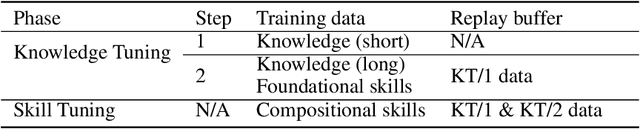


This work introduces LAB (Large-scale Alignment for chatBots), a novel methodology designed to overcome the scalability challenges in the instruction-tuning phase of large language model (LLM) training. Leveraging a taxonomy-guided synthetic data generation process and a multi-phase tuning framework, LAB significantly reduces reliance on expensive human annotations and proprietary models like GPT-4. We demonstrate that LAB-trained models can achieve competitive performance across several benchmarks compared to models trained with traditional human-annotated or GPT-4 generated synthetic data. Thus offering a scalable, cost-effective solution for enhancing LLM capabilities and instruction-following behaviors without the drawbacks of catastrophic forgetting, marking a step forward in the efficient training of LLMs for a wide range of applications.
Post-processing Private Synthetic Data for Improving Utility on Selected Measures
May 24, 2023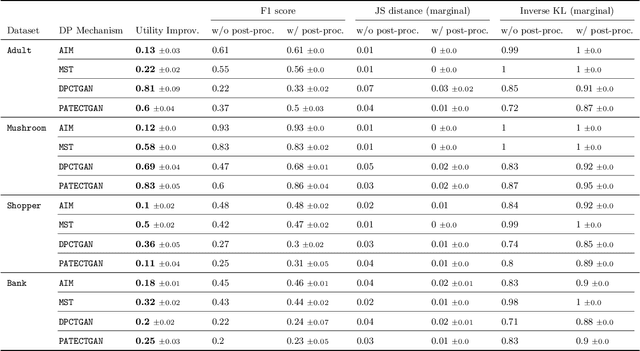


Existing private synthetic data generation algorithms are agnostic to downstream tasks. However, end users may have specific requirements that the synthetic data must satisfy. Failure to meet these requirements could significantly reduce the utility of the data for downstream use. We introduce a post-processing technique that improves the utility of the synthetic data with respect to measures selected by the end user, while preserving strong privacy guarantees and dataset quality. Our technique involves resampling from the synthetic data to filter out samples that do not meet the selected utility measures, using an efficient stochastic first-order algorithm to find optimal resampling weights. Through comprehensive numerical experiments, we demonstrate that our approach consistently improves the utility of synthetic data across multiple benchmark datasets and state-of-the-art synthetic data generation algorithms.
Constructive Assimilation: Boosting Contrastive Learning Performance through View Generation Strategies
Apr 08, 2023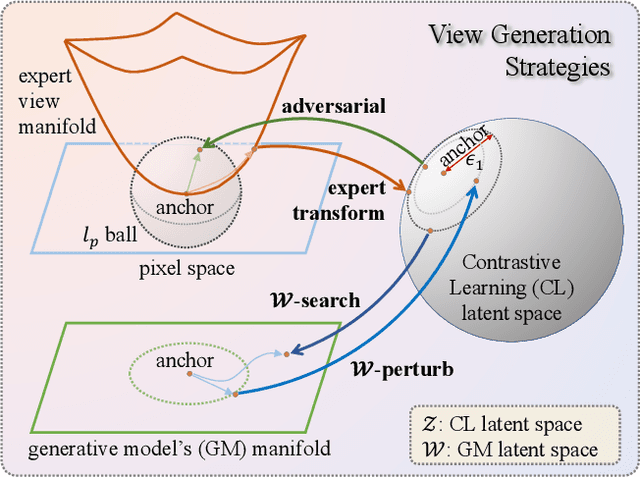
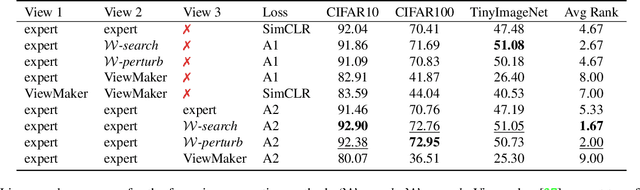
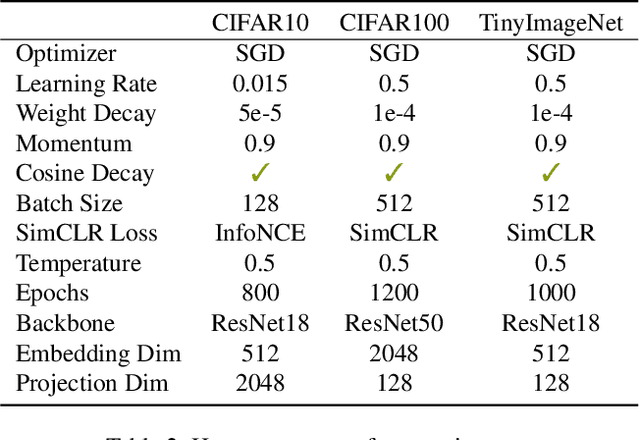
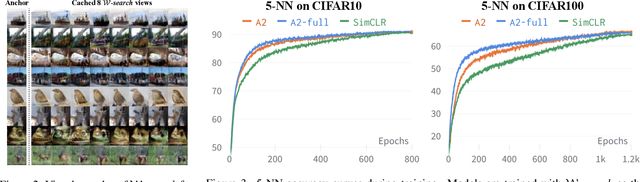
Transformations based on domain expertise (expert transformations), such as random-resized-crop and color-jitter, have proven critical to the success of contrastive learning techniques such as SimCLR. Recently, several attempts have been made to replace such domain-specific, human-designed transformations with generated views that are learned. However for imagery data, so far none of these view-generation methods has been able to outperform expert transformations. In this work, we tackle a different question: instead of replacing expert transformations with generated views, can we constructively assimilate generated views with expert transformations? We answer this question in the affirmative and propose a view generation method and a simple, effective assimilation method that together improve the state-of-the-art by up to ~3.6% on three different datasets. Importantly, we conduct a detailed empirical study that systematically analyzes a range of view generation and assimilation methods and provides a holistic picture of the efficacy of learned views in contrastive representation learning.
Multi-Symmetry Ensembles: Improving Diversity and Generalization via Opposing Symmetries
Mar 04, 2023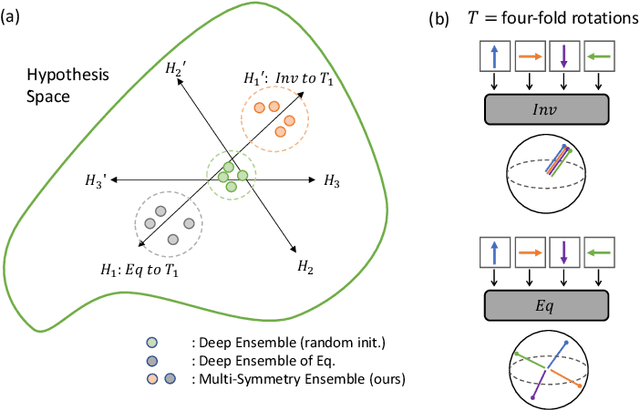
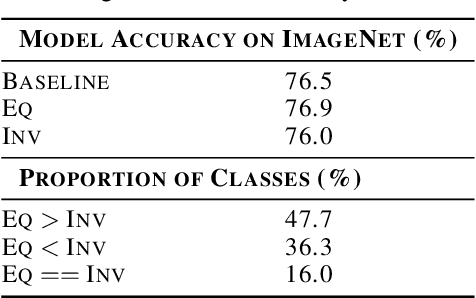
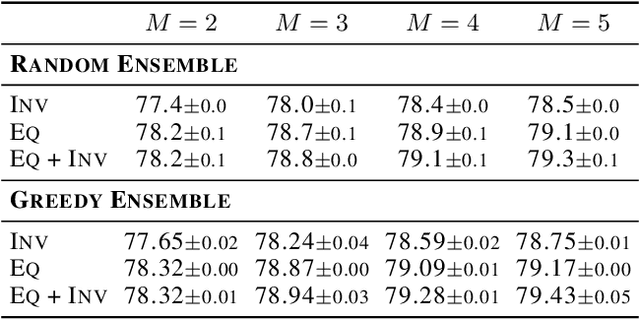
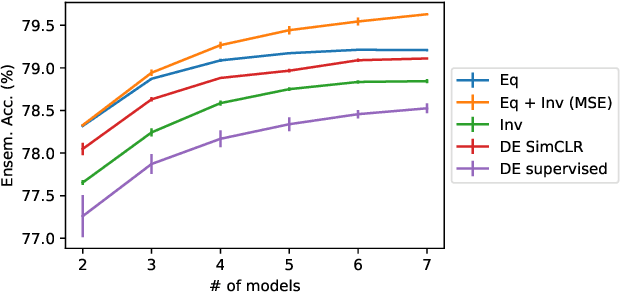
Deep ensembles (DE) have been successful in improving model performance by learning diverse members via the stochasticity of random initialization. While recent works have attempted to promote further diversity in DE via hyperparameters or regularizing loss functions, these methods primarily still rely on a stochastic approach to explore the hypothesis space. In this work, we present Multi-Symmetry Ensembles (MSE), a framework for constructing diverse ensembles by capturing the multiplicity of hypotheses along symmetry axes, which explore the hypothesis space beyond stochastic perturbations of model weights and hyperparameters. We leverage recent advances in contrastive representation learning to create models that separately capture opposing hypotheses of invariant and equivariant symmetries and present a simple ensembling approach to efficiently combine appropriate hypotheses for a given task. We show that MSE effectively captures the multiplicity of conflicting hypotheses that is often required in large, diverse datasets like ImageNet. As a result of their inherent diversity, MSE improves classification performance, uncertainty quantification, and generalization across a series of transfer tasks.
Grafting Vision Transformers
Oct 28, 2022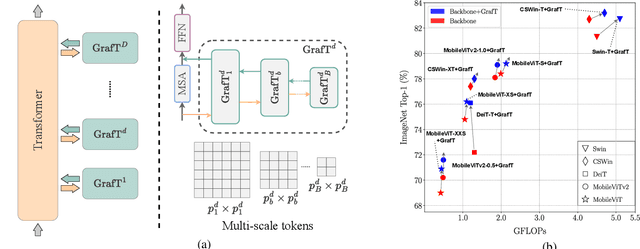
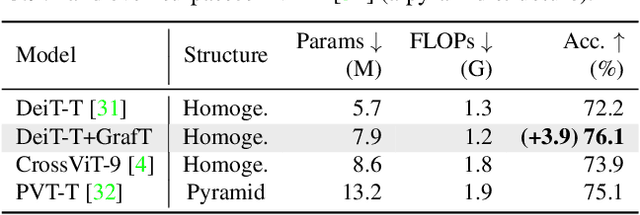
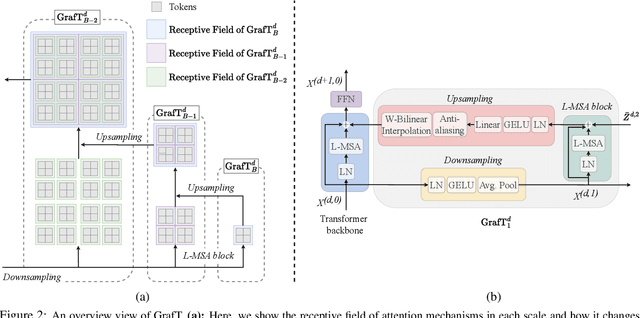
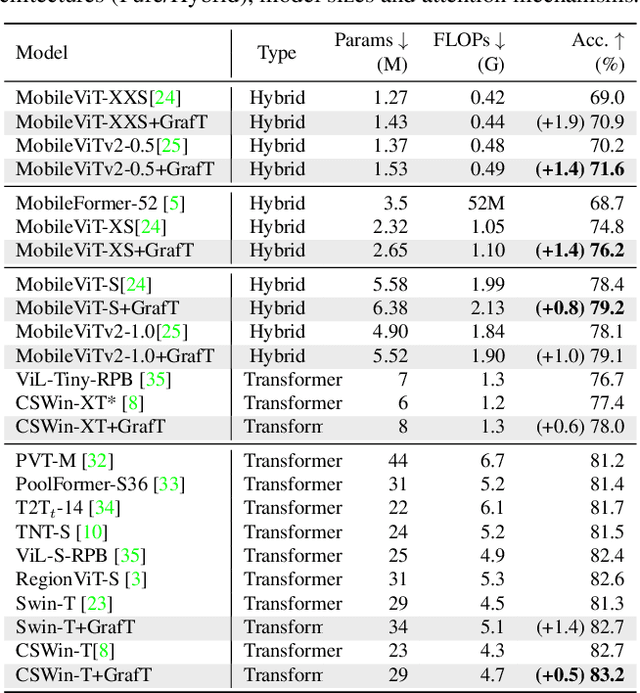
Vision Transformers (ViTs) have recently become the state-of-the-art across many computer vision tasks. In contrast to convolutional networks (CNNs), ViTs enable global information sharing even within shallow layers of a network, i.e., among high-resolution features. However, this perk was later overlooked with the success of pyramid architectures such as Swin Transformer, which show better performance-complexity trade-offs. In this paper, we present a simple and efficient add-on component (termed GrafT) that considers global dependencies and multi-scale information throughout the network, in both high- and low-resolution features alike. GrafT can be easily adopted in both homogeneous and pyramid Transformers while showing consistent gains. It has the flexibility of branching-out at arbitrary depths, widening a network with multiple scales. This grafting operation enables us to share most of the parameters and computations of the backbone, adding only minimal complexity, but with a higher yield. In fact, the process of progressively compounding multi-scale receptive fields in GrafT enables communications between local regions. We show the benefits of the proposed method on multiple benchmarks, including image classification (ImageNet-1K), semantic segmentation (ADE20K), object detection and instance segmentation (COCO2017). Our code and models will be made available.