 Add to Chrome
 Add to Firefox
 Add to Edge
Intrinsic Selection and Particle Resampling for Inference-Time Scaling Beyond Domain Verifiability
Jun 07, 2026
Inference-Time Scaling (ITS) has largely succeeded in verifiable domains like math and coding, where cheap verification enables scalable output selection. However, extending ITS to tasks prone to systematic failure - driven by faulty initial assumptions or unmet multidimensional constraints - typically relies on costly external solvers or brittle, model-based verifiers. Our key insight is that the intrinsic statistics of parallel sample sets, specifically length-adjusted tail entropy, provide a robust discriminative signal for solution quality without access to ground truth. Crucially, these statistics serve as a difficulty gate for adaptive compute allocation, dynamically routing problems across scaling regimes. First, Intrinsic Selection (iS) ranks candidates post-hoc, matching consensus-based algorithms across three domains and improving engineering design selection by 20% over pass@1 baselines. Second, Intrinsic Particle Filtering (iPF) generalizes this to step-level resampling, guiding generation toward high-confidence reasoning trajectories to improve pass@1 by 6.1 points on average on hard math problems. Finally, Particle Distillation (dPF) injects privileged guidance via early logit blending and KL-guided resampling, steering generation past systematic reasoning errors to satisfy expert rubrics, yielding up to 26.5% gains on complex clinical responses. Our pipeline applies seamlessly across broad-purpose, domain-specialized, and multimodal architectures, successfully extending ITS to open-ended domains without requiring trained reward models or exact ground-truth verification.

CADBench: A Multimodal Benchmark for AI-Assisted CAD Program Generation
May 11, 2026Recovering editable CAD programs from images or 3D observations is central to AI-assisted design, but progress is difficult to measure because existing evaluations are fragmented across datasets, modalities, and metrics. We introduce CADBench, a unified benchmark for multimodal CAD program generation. CADBench contains 18,000 evaluation samples spanning six benchmark families derived from DeepCAD, Fusion 360, ABC, MCB, and Objaverse; five input modalities including clean meshes, noisy meshes, single-view renders, photorealistic renders, and multi-view renders; and six metrics covering geometric fidelity, executability, and program compactness. STEP-based families are stratified by B-rep face count and all families are diversity-sampled to support controlled analysis across complexity and object variation. We benchmark eleven CAD-specialized and general-purpose vision-language systems, generating more than 1.4 million CAD programs. Under idealized inputs, specialized mesh-to-CAD models substantially outperform code-generating VLMs, which remain far from reliable CAD program reconstruction. CADBench further reveals three recurring failure modes: reconstruction quality degrades with geometric complexity, CAD-specialized models can be brittle under modality shift, and model rankings change across metrics. Together, these results position CADBench as a diagnostic testbed for measuring progress in editable 3D reconstruction and multimodal CAD understanding. The benchmark is publicly available at https://huggingface.co/datasets/DeCoDELab/CADBench.
CAD-Coder: An Open-Source Vision-Language Model for Computer-Aided Design Code Generation
May 20, 2025Efficient creation of accurate and editable 3D CAD models is critical in engineering design, significantly impacting cost and time-to-market in product innovation. Current manual workflows remain highly time-consuming and demand extensive user expertise. While recent developments in AI-driven CAD generation show promise, existing models are limited by incomplete representations of CAD operations, inability to generalize to real-world images, and low output accuracy. This paper introduces CAD-Coder, an open-source Vision-Language Model (VLM) explicitly fine-tuned to generate editable CAD code (CadQuery Python) directly from visual input. Leveraging a novel dataset that we created--GenCAD-Code, consisting of over 163k CAD-model image and code pairs--CAD-Coder outperforms state-of-the-art VLM baselines such as GPT-4.5 and Qwen2.5-VL-72B, achieving a 100% valid syntax rate and the highest accuracy in 3D solid similarity. Notably, our VLM demonstrates some signs of generalizability, successfully generating CAD code from real-world images and executing CAD operations unseen during fine-tuning. The performance and adaptability of CAD-Coder highlights the potential of VLMs fine-tuned on code to streamline CAD workflows for engineers and designers. CAD-Coder is publicly available at: https://github.com/anniedoris/CAD-Coder.
DesignQA: A Multimodal Benchmark for Evaluating Large Language Models' Understanding of Engineering Documentation
Apr 11, 2024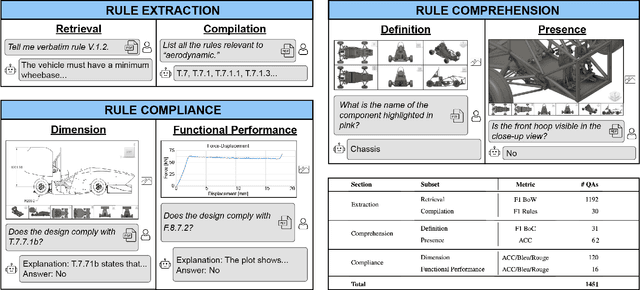
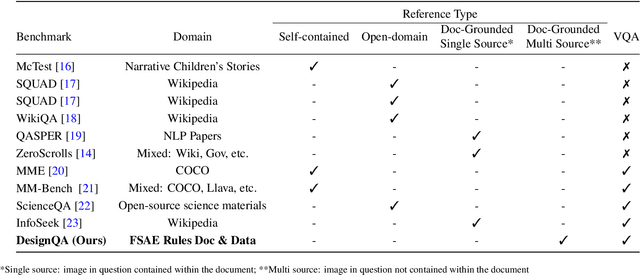
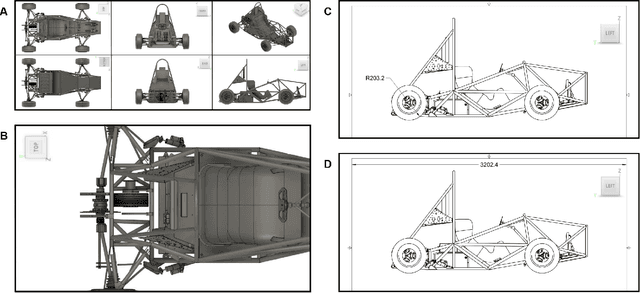

This research introduces DesignQA, a novel benchmark aimed at evaluating the proficiency of multimodal large language models (MLLMs) in comprehending and applying engineering requirements in technical documentation. Developed with a focus on real-world engineering challenges, DesignQA uniquely combines multimodal data-including textual design requirements, CAD images, and engineering drawings-derived from the Formula SAE student competition. Different from many existing MLLM benchmarks, DesignQA contains document-grounded visual questions where the input image and input document come from different sources. The benchmark features automatic evaluation metrics and is divided into segments-Rule Comprehension, Rule Compliance, and Rule Extraction-based on tasks that engineers perform when designing according to requirements. We evaluate state-of-the-art models like GPT4 and LLaVA against the benchmark, and our study uncovers the existing gaps in MLLMs' abilities to interpret complex engineering documentation. Key findings suggest that while MLLMs demonstrate potential in navigating technical documents, substantial limitations exist, particularly in accurately extracting and applying detailed requirements to engineering designs. This benchmark sets a foundation for future advancements in AI-supported engineering design processes. DesignQA is publicly available at: https://github.com/anniedoris/design_qa/.
From Concept to Manufacturing: Evaluating Vision-Language Models for Engineering Design
Nov 21, 2023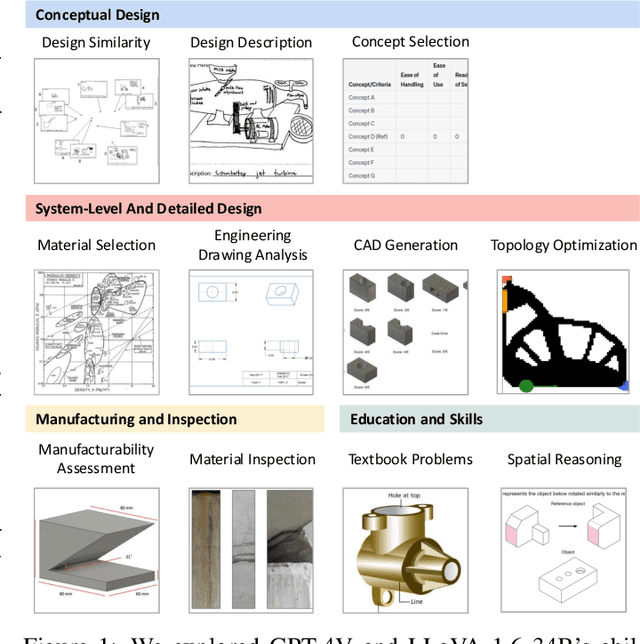
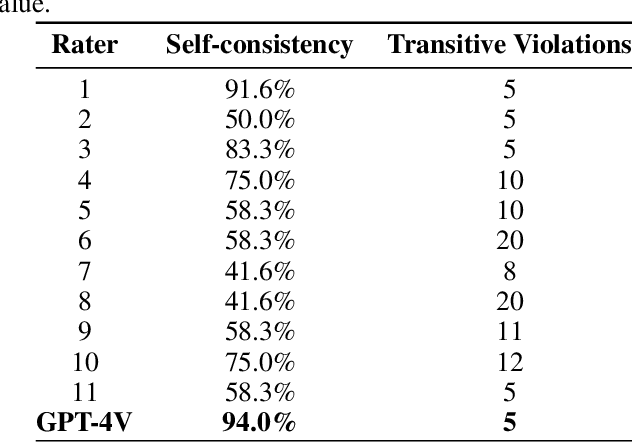
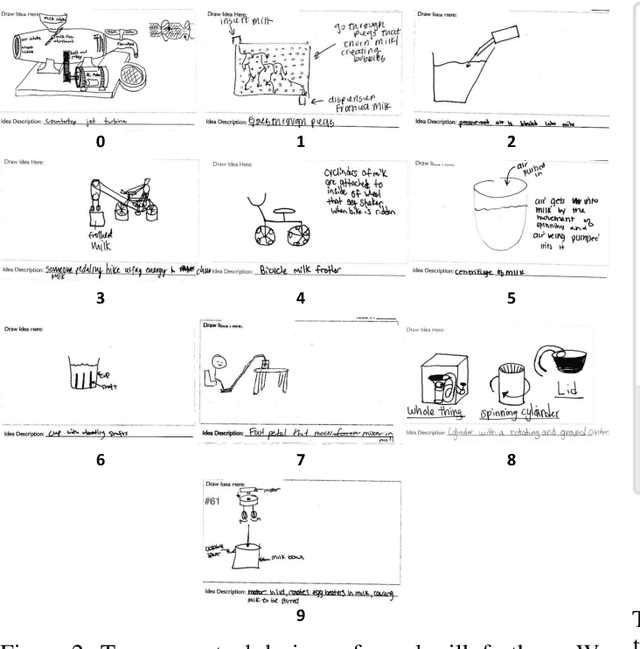
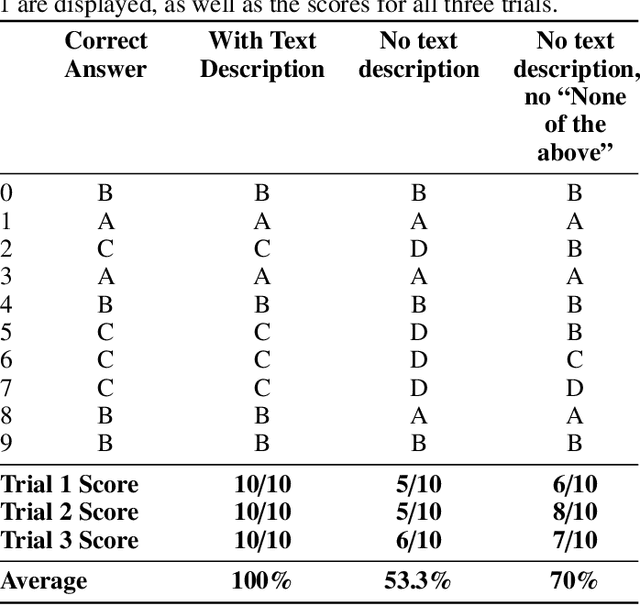
Engineering Design is undergoing a transformative shift with the advent of AI, marking a new era in how we approach product, system, and service planning. Large language models have demonstrated impressive capabilities in enabling this shift. Yet, with text as their only input modality, they cannot leverage the large body of visual artifacts that engineers have used for centuries and are accustomed to. This gap is addressed with the release of multimodal vision language models, such as GPT-4V, enabling AI to impact many more types of tasks. In light of these advancements, this paper presents a comprehensive evaluation of GPT-4V, a vision language model, across a wide spectrum of engineering design tasks, categorized into four main areas: Conceptual Design, System-Level and Detailed Design, Manufacturing and Inspection, and Engineering Education Tasks. Our study assesses GPT-4V's capabilities in design tasks such as sketch similarity analysis, concept selection using Pugh Charts, material selection, engineering drawing analysis, CAD generation, topology optimization, design for additive and subtractive manufacturing, spatial reasoning challenges, and textbook problems. Through this structured evaluation, we not only explore GPT-4V's proficiency in handling complex design and manufacturing challenges but also identify its limitations in complex engineering design applications. Our research establishes a foundation for future assessments of vision language models, emphasizing their immense potential for innovating and enhancing the engineering design and manufacturing landscape. It also contributes a set of benchmark testing datasets, with more than 1000 queries, for ongoing advancements and applications in this field.