 Add to Chrome
 Add to Firefox
 Add to Edge
Disentangled Fine-Grained Prototype Learning for Incomplete Image-Tabular Classification
Jun 03, 2026
The missing-modality problem poses a significant challenge in image-tabular multimodal learning across a wide range of multimedia applications, including product understanding, recommendation systems, and medical diagnosis. This challenge is particularly pronounced when the two modalities are highly heterogeneous, as images and tabular attributes differ substantially in their semantic granularity and data distributions. Existing methods learn modality-invariant representations through disentanglement and alignment over global token-averaged features, capturing only coarse cross-modal consistency and overlooking fine-grained semantic and distributional misalignment, which hampers the exploitation of complementary cues under missing modalities. To address this, we propose DFPL, a novel framework for fine-grained prototype learning. Specifically, Shared-Specific Prototype Modeling (SSPM) extracts compact and diverse shared and modality-specific prototypes, and further performs prototype-level disentanglement to suppress redundant intra-modality correlations. Additionally, we propose a Prototype-guided Fine-grained Alignment (PFA) module that jointly enforces prototype-level distribution matching and prototype-to-class semantic alignment within a unified prototype space, thereby preserving both fine-grained distributional and semantic consistency across modalities. We further introduce a Class-aware Multi-scale Aggregation (CMA) module to adaptively aggregate shared semantics and modality-specific characteristics from global and prototype levels for robust predictions. Extensive experiments on three diverse image-tabular benchmarks demonstrate the superiority of our method compared to the previous approaches under various missing-modality settings. Code will be made publicly available.

Online Controller Synthesis for Robot Collision Avoidance: A Case Study
Feb 08, 2025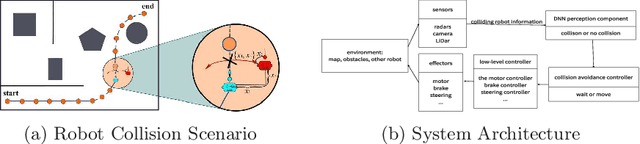
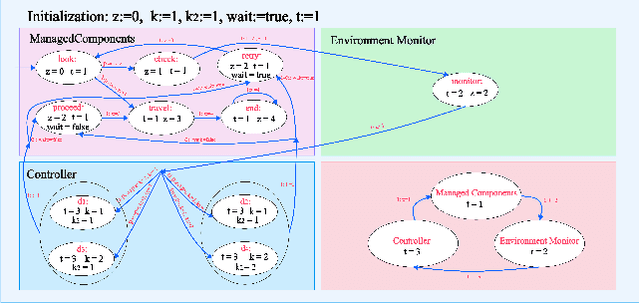
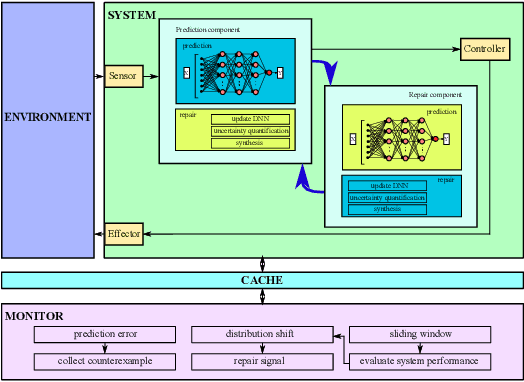
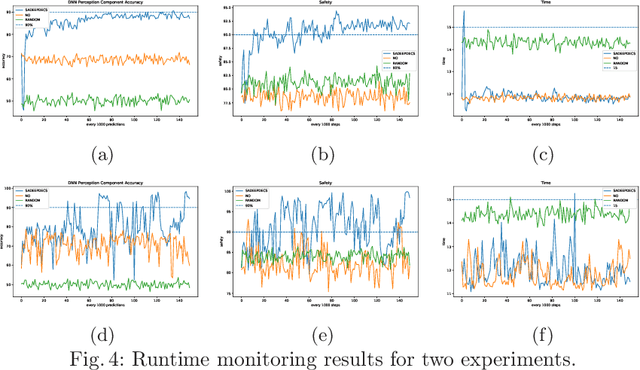
The inherent uncertainty of dynamic environments poses significant challenges for modeling robot behavior, particularly in tasks such as collision avoidance. This paper presents an online controller synthesis framework tailored for robots equipped with deep learning-based perception components, with a focus on addressing distribution shifts. Our approach integrates periodic monitoring and repair mechanisms for the deep neural network perception component, followed by uncertainty reassessment. These uncertainty evaluations are injected into a parametric discrete-time markov chain, enabling the synthesis of robust controllers via probabilistic model checking. To ensure high system availability during the repair process, we propose a dual-component configuration that seamlessly transitions between operational states. Through a case study on robot collision avoidance, we demonstrate the efficacy of our method, showcasing substantial performance improvements over baseline approaches. This work provides a comprehensive and scalable solution for enhancing the safety and reliability of autonomous systems operating in uncertain environments.
Sensing-Assisted Beam Tracking with Real-Time Beamwidth Adaptation for THz Communications
Nov 13, 2024Terahertz (THz) communications, with their substantial bandwidth, are essential for meeting the ultra-high data rate demands of emerging high-mobility scenarios such as vehicular-to-everything (V2X) networks. In these contexts, beamwidth adaptation has been explored to address the problem that high-mobility targets frequently move out of the narrow THz beam range. However, existing approaches cannot effectively track targets due to a lack of real-time motion awareness. Consequently, we propose a sensing-assisted beam tracking scheme with real-time beamwidth adaptation. Specifically, the base station (BS) periodically collects prior sensing information to predict the target's motion path by applying a particular motion model. Then, we build a pre-calculated codebook by optimising precoders to align the beamwidth with various predicted target paths, thereby maximising the average achievable data rates within each sensing period. Finally, the BS selects the optimal precoder from the codebook to maintain stable and continuous connectivity. Simulation results show that the proposed scheme significantly improves the rate performance and reduces outage probability compared to existing approaches under various target mobility.
A Survey of Emerging Applications of Diffusion Probabilistic Models in MRI
Nov 19, 2023


Diffusion probabilistic models (DPMs) which employ explicit likelihood characterization and a gradual sampling process to synthesize data, have gained increasing research interest. Despite their huge computational burdens due to the large number of steps involved during sampling, DPMs are widely appreciated in various medical imaging tasks for their high-quality and diversity of generation. Magnetic resonance imaging (MRI) is an important medical imaging modality with excellent soft tissue contrast and superb spatial resolution, which possesses unique opportunities for diffusion models. Although there is a recent surge of studies exploring DPMs in MRI, a survey paper of DPMs specifically designed for MRI applications is still lacking. This review article aims to help researchers in the MRI community to grasp the advances of DPMs in different applications. We first introduce the theory of two dominant kinds of DPMs, categorized according to whether the diffusion time step is discrete or continuous, and then provide a comprehensive review of emerging DPMs in MRI, including reconstruction, image generation, image translation, segmentation, anomaly detection, and further research topics. Finally, we discuss the general limitations as well as limitations specific to the MRI tasks of DPMs and point out potential areas that are worth further exploration.