 Add to Chrome
 Add to Firefox
 Add to Edge
DREvo: Distilling Recalibrated Historical Experience for Harness Self-Evolution
Jul 29, 2026
Harness plays a critical role in large language model agent performance, and building a high-performing harness requires substantial expert effort. Therefore, recent research has increasingly explored harness self-evolution, which iteratively proposes, evaluates, and improves harnesses using historical trial experience. However, accumulated historical experience does not always translate into stable search guidance, and performance often fluctuates substantially across evolution iterations, making it difficult to reliably discover high-performing harnesses under a limited evolution budget. We identify two limitations in how existing harness self-evolution methods leverage historical experience: (1) Lack of dynamic reassessment of whether historical experience remains valid for the current harness, and (2) Lack of explicit mechanisms for translating valid historical experience into actionable search directions. To address these limitations, we propose a new harness self-evolution method, named DREvo, which integrates function-level evidence anchoring, state-dependent evidence recalibration, and role-conditioned search intent distillation to determine which historical evidence remains valid and where the harness should evolve next. Under limited evolution budgets, DREvo exhibits smoother evolution trajectories, achieves the highest accuracy on all five benchmarks, and delivers average gains of 16.2% and 14.2% over the evaluated baselines on domain reasoning and agentic tasks, respectively.

RemoteZero: Geospatial Reasoning with Zero Human Annotations
May 06, 2026Geospatial reasoning requires models to resolve complex spatial semantics and user intent into precise target locations for Earth observation. Recent progress has liberated the reasoning path from manual curation, allowing models to generate their own inference chains. Yet a final dependency remains: they are still supervised by human-annotated ground-truth coordinates. This leaves the reasoning process autonomous, but not its spatial endpoint, and prevents true self-evolution on abundant unlabeled remote sensing data. To break this bottleneck, we introduce RemoteZero, a box-supervision-free framework for geospatial reasoning. RemoteZero is motivated by a simple asymmetry: an MLLM is typically better at verifying whether a region satisfies a query than at directly generating precise coordinates. Leveraging this stronger discriminative ability, RemoteZero replaces geometric supervision with intrinsic semantic verification and enables GRPO training without box annotations. The resulting framework further supports iterative self-evolution, allowing the model to improve from unlabeled remote sensing imagery through its own verification signal. Experiments show that RemoteZero achieves competitive performance against strong supervised methods, demonstrating the potential of self-verifying training for geospatial reasoning localization.
RemoteAgent: Bridging Vague Human Intents and Earth Observation with RL-based Agentic MLLMs
Apr 09, 2026Earth Observation (EO) systems are essentially designed to support domain experts who often express their requirements through vague natural language rather than precise, machine-friendly instructions. Depending on the specific application scenario, these vague queries can demand vastly different levels of visual precision. Consequently, a practical EO AI system must bridge the gap between ambiguous human queries and the appropriate multi-granularity visual analysis tasks, ranging from holistic image interpretation to fine-grained pixel-wise predictions. While Multi-modal Large Language Models (MLLMs) demonstrate strong semantic understanding, their text-based output format is inherently ill-suited for dense, precision-critical spatial predictions. Existing agentic frameworks address this limitation by delegating tasks to external tools, but indiscriminate tool invocation is computationally inefficient and underutilizes the MLLM's native capabilities. To this end, we propose RemoteAgent, an agentic framework that strategically respects the intrinsic capability boundaries of MLLMs. To empower this framework to understand real user intents, we construct VagueEO, a human-centric instruction dataset pairing EO tasks with simulated vague natural-language queries. By leveraging VagueEO for reinforcement fine-tuning, we align an MLLM into a robust cognitive core that directly resolves image- and sparse region-level tasks. Consequently, RemoteAgent processes suitable tasks internally while intelligently orchestrating specialized tools via the Model Context Protocol exclusively for dense predictions. Extensive experiments demonstrate that RemoteAgent achieves robust intent recognition capabilities while delivering highly competitive performance across diverse EO tasks.
Learning to Compose for Cross-domain Agentic Workflow Generation
Feb 11, 2026Automatically generating agentic workflows -- executable operator graphs or codes that orchestrate reasoning, verification, and repair -- has become a practical way to solve complex tasks beyond what single-pass LLM generation can reliably handle. Yet what constitutes a good workflow depends heavily on the task distribution and the available operators. Under domain shift, current systems typically rely on iterative workflow refinement to discover a feasible workflow from a large workflow space, incurring high iteration costs and yielding unstable, domain-specific behavior. In response, we internalize a decompose-recompose-decide mechanism into an open-source LLM for cross-domain workflow generation. To decompose, we learn a compact set of reusable workflow capabilities across diverse domains. To recompose, we map each input task to a sparse composition over these bases to generate a task-specific workflow in a single pass. To decide, we attribute the success or failure of workflow generation to counterfactual contributions from learned capabilities, thereby capturing which capabilities actually drive success by their marginal effects. Across stringent multi-domain, cross-domain, and unseen-domain evaluations, our 1-pass generator surpasses SOTA refinement baselines that consume 20 iterations, while substantially reducing generation latency and cost.
Sci-VLA: Agentic VLA Inference Plugin for Long-Horizon Tasks in Scientific Experiments
Feb 10, 2026Robotic laboratories play a critical role in autonomous scientific discovery by enabling scalable, continuous experimental execution. Recent vision-language-action (VLA) models offer a promising foundation for robotic laboratories. However, scientific experiments typically involve long-horizon tasks composed of multiple atomic tasks, posing a fundamental challenge to existing VLA models. While VLA models fine-tuned for scientific tasks can reliably execute atomic experimental actions seen during training, they often fail to perform composite tasks formed by reordering and composing these known atomic actions. This limitation arises from a distributional mismatch between training-time atomic tasks and inference-time composite tasks, which prevents VLA models from executing necessary transitional operations between atomic tasks. To address this challenge, we propose an Agentic VLA Inference Plugin for Long-Horizon Tasks in Scientific Experiments. It introduces an LLM-based agentic inference mechanism that intervenes when executing sequential manipulation tasks. By performing explicit transition inference and generating transitional robotic action code, the proposed plugin guides VLA models through missing transitional steps, enabling reliable execution of composite scientific workflows without any additional training. This inference-only intervention makes our method computationally efficient, data-efficient, and well-suited for open-ended and long-horizon robotic laboratory tasks. We build 3D assets of scientific instruments and common scientific operating scenes within an existing simulation environment. In these scenes, we have verified that our method increases the average success rate per atomic task by 42\% during inference. Furthermore, we show that our method can be easily transferred from the simulation to real scientific laboratories.
PeroMAS: A Multi-agent System of Perovskite Material Discovery
Feb 10, 2026As a pioneer of the third-generation photovoltaic revolution, Perovskite Solar Cells (PSCs) are renowned for their superior optoelectronic performance and cost potential. The development process of PSCs is precise and complex, involving a series of closed-loop workflows such as literature retrieval, data integration, experimental design, and synthesis. However, existing AI perovskite approaches focus predominantly on discrete models, including material design, process optimization,and property prediction. These models fail to propagate physical constraints across the workflow, hindering end-to-end optimization. In this paper, we propose a multi-agent system for perovskite material discovery, named PeroMAS. We first encapsulated a series of perovskite-specific tools into Model Context Protocols (MCPs). By planning and invoking these tools, PeroMAS can design perovskite materials under multi-objective constraints, covering the entire process from literature retrieval and data extraction to property prediction and mechanism analysis. Furthermore, we construct an evaluation benchmark by perovskite human experts to assess this multi-agent system. Results demonstrate that, compared to single Large Language Model (LLM) or traditional search strategies, our system significantly enhances discovery efficiency. It successfully identified candidate materials satisfying multi-objective constraints. Notably, we verify PeroMAS's effectiveness in the physical world through real synthesis experiments.
RemoteTrimmer: Adaptive Structural Pruning for Remote Sensing Image Classification
Dec 17, 2024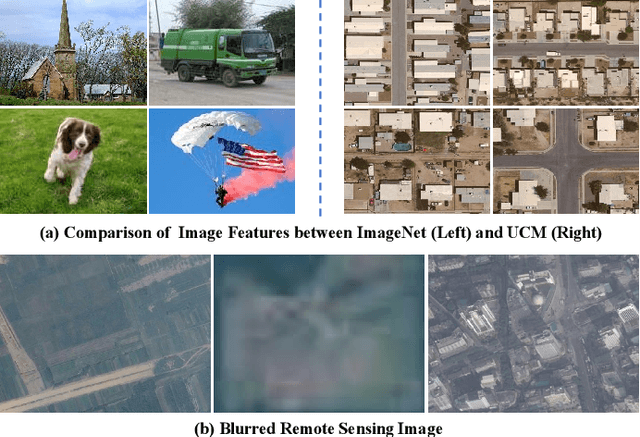
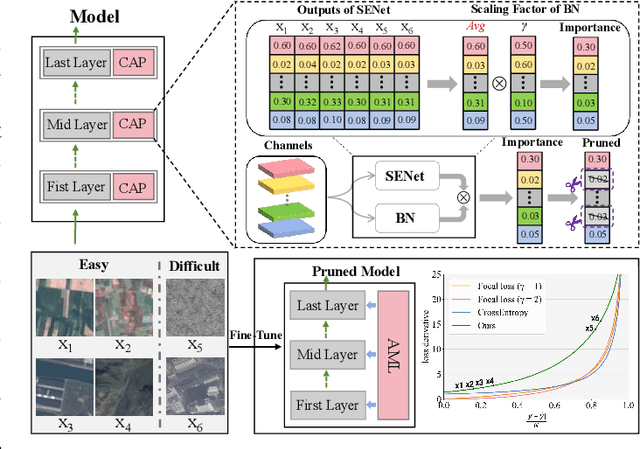
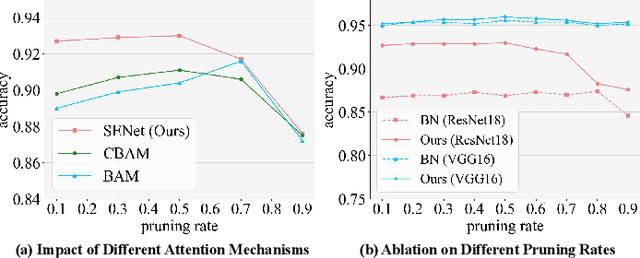
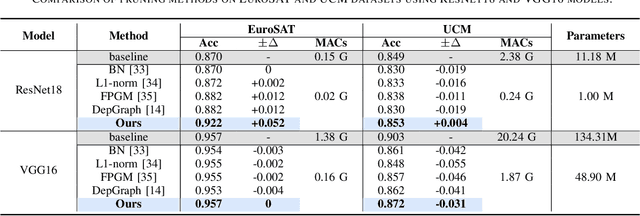
Since high resolution remote sensing image classification often requires a relatively high computation complexity, lightweight models tend to be practical and efficient. Model pruning is an effective method for model compression. However, existing methods rarely take into account the specificity of remote sensing images, resulting in significant accuracy loss after pruning. To this end, we propose an effective structural pruning approach for remote sensing image classification. Specifically, a pruning strategy that amplifies the differences in channel importance of the model is introduced. Then an adaptive mining loss function is designed for the fine-tuning process of the pruned model. Finally, we conducted experiments on two remote sensing classification datasets. The experimental results demonstrate that our method achieves minimal accuracy loss after compressing remote sensing classification models, achieving state-of-the-art (SoTA) performance.
UEMM-Air: A Synthetic Multi-modal Dataset for Unmanned Aerial Vehicle Object Detection
Jun 10, 2024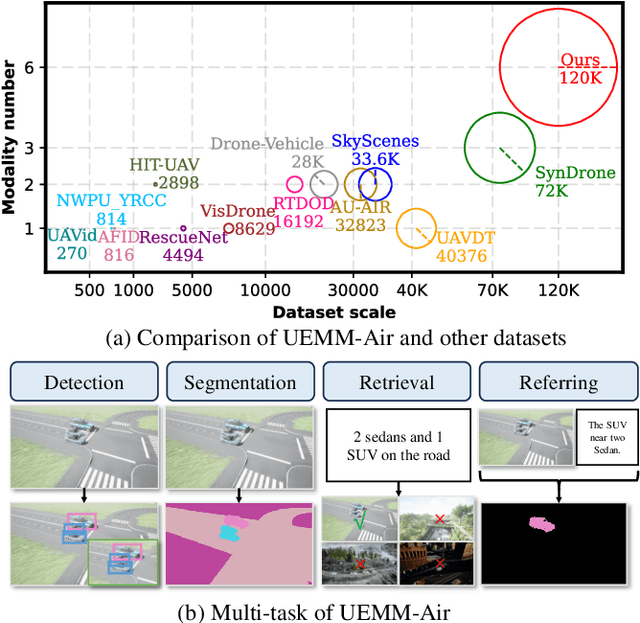
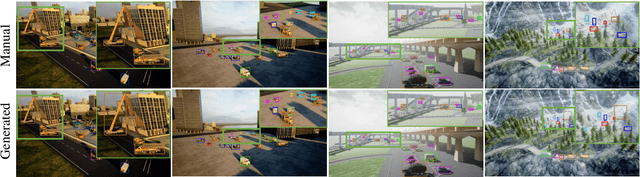
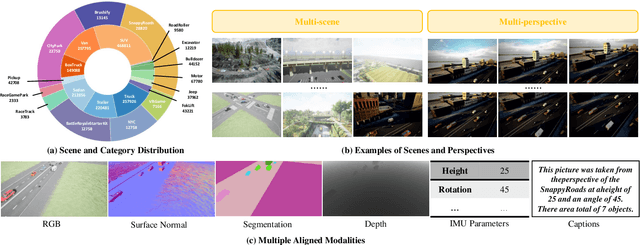
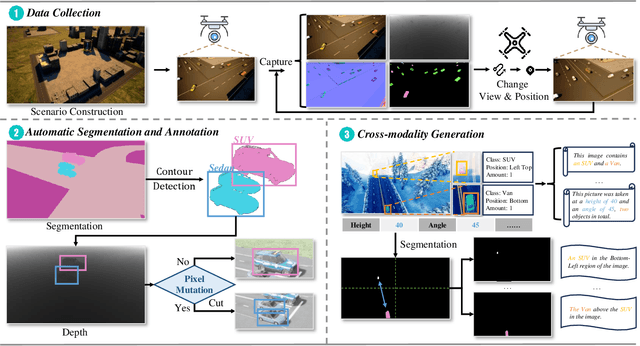
The development of multi-modal object detection for Unmanned Aerial Vehicles (UAVs) typically relies on a large amount of pixel-aligned multi-modal image data. However, existing datasets face challenges such as limited modalities, high construction costs, and imprecise annotations. To this end, we propose a synthetic multi-modal UAV-based object detection dataset, UEMM-Air. Specially, we simulate various UAV flight scenarios and object types using the Unreal Engine (UE). Then we design the UAV's flight logic to automatically collect data from different scenarios, perspectives, and altitudes. Finally, we propose a novel heuristic automatic annotation algorithm to generate accurate object detection labels. In total, our UEMM-Air consists of 20k pairs of images with 5 modalities and precise annotations. Moreover, we conduct numerous experiments and establish new benchmark results on our dataset. We found that models pre-trained on UEMM-Air exhibit better performance on downstream tasks compared to other similar datasets. The dataset is publicly available (https://github.com/1e12Leon/UEMM-Air) to support the research of multi-modal UAV object detection models.