 Add to Chrome
 Add to Firefox
 Add to Edge
Sci-VLA: Agentic VLA Inference Plugin for Long-Horizon Tasks in Scientific Experiments
Feb 10, 2026
Robotic laboratories play a critical role in autonomous scientific discovery by enabling scalable, continuous experimental execution. Recent vision-language-action (VLA) models offer a promising foundation for robotic laboratories. However, scientific experiments typically involve long-horizon tasks composed of multiple atomic tasks, posing a fundamental challenge to existing VLA models. While VLA models fine-tuned for scientific tasks can reliably execute atomic experimental actions seen during training, they often fail to perform composite tasks formed by reordering and composing these known atomic actions. This limitation arises from a distributional mismatch between training-time atomic tasks and inference-time composite tasks, which prevents VLA models from executing necessary transitional operations between atomic tasks. To address this challenge, we propose an Agentic VLA Inference Plugin for Long-Horizon Tasks in Scientific Experiments. It introduces an LLM-based agentic inference mechanism that intervenes when executing sequential manipulation tasks. By performing explicit transition inference and generating transitional robotic action code, the proposed plugin guides VLA models through missing transitional steps, enabling reliable execution of composite scientific workflows without any additional training. This inference-only intervention makes our method computationally efficient, data-efficient, and well-suited for open-ended and long-horizon robotic laboratory tasks. We build 3D assets of scientific instruments and common scientific operating scenes within an existing simulation environment. In these scenes, we have verified that our method increases the average success rate per atomic task by 42\% during inference. Furthermore, we show that our method can be easily transferred from the simulation to real scientific laboratories.

Component Fourier Neural Operator for Singularly Perturbed Differential Equations
Sep 07, 2024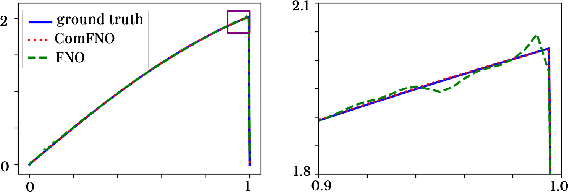
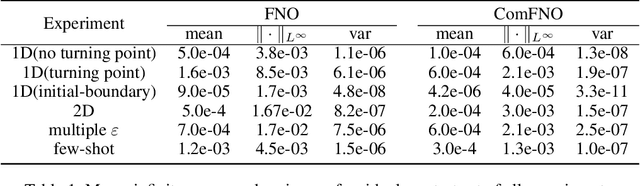
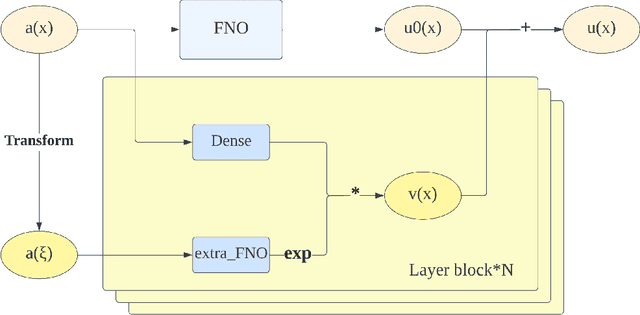
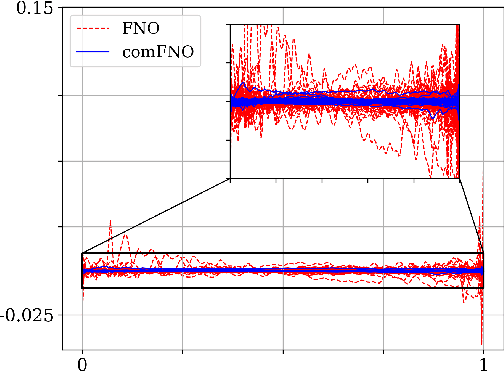
Solving Singularly Perturbed Differential Equations (SPDEs) poses computational challenges arising from the rapid transitions in their solutions within thin regions. The effectiveness of deep learning in addressing differential equations motivates us to employ these methods for solving SPDEs. In this manuscript, we introduce Component Fourier Neural Operator (ComFNO), an innovative operator learning method that builds upon Fourier Neural Operator (FNO), while simultaneously incorporating valuable prior knowledge obtained from asymptotic analysis. Our approach is not limited to FNO and can be applied to other neural network frameworks, such as Deep Operator Network (DeepONet), leading to potential similar SPDEs solvers. Experimental results across diverse classes of SPDEs demonstrate that ComFNO significantly improves accuracy compared to vanilla FNO. Furthermore, ComFNO exhibits natural adaptability to diverse data distributions and performs well in few-shot scenarios, showcasing its excellent generalization ability in practical situations.
Physics-guided Data Augmentation for Learning the Solution Operator of Linear Differential Equations
Dec 08, 2022Neural networks, especially the recent proposed neural operator models, are increasingly being used to find the solution operator of differential equations. Compared to traditional numerical solvers, they are much faster and more efficient in practical applications. However, one critical issue is that training neural operator models require large amount of ground truth data, which usually comes from the slow numerical solvers. In this paper, we propose a physics-guided data augmentation (PGDA) method to improve the accuracy and generalization of neural operator models. Training data is augmented naturally through the physical properties of differential equations such as linearity and translation. We demonstrate the advantage of PGDA on a variety of linear differential equations, showing that PGDA can improve the sample complexity and is robust to distributional shift.
* Nanjing University of Aeronautics and Astronautics