 Add to Chrome
 Add to Firefox
 Add to Edge
SRSNetwork: Siamese Reconstruction-Segmentation Networks based on Dynamic-Parameter Convolution
Dec 04, 2023
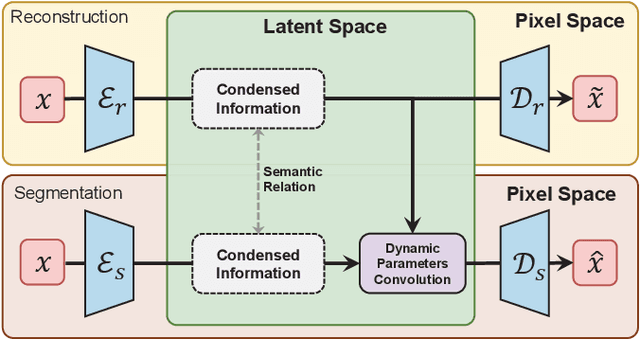
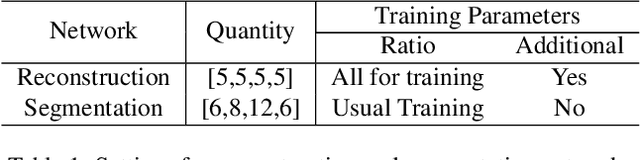
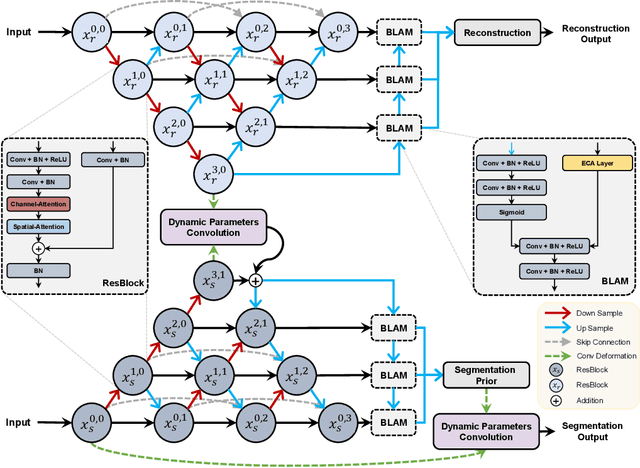
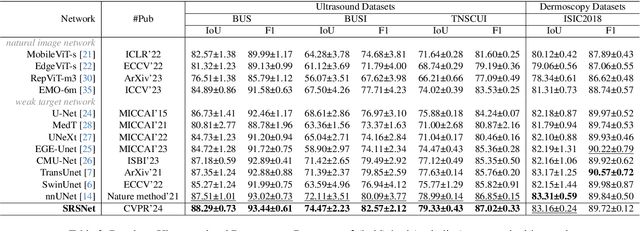
In this paper, we present a high-performance deep neural network for weak target image segmentation, including medical image segmentation and infrared image segmentation. To this end, this work analyzes the existing dynamic convolutions and proposes dynamic parameter convolution (DPConv). Furthermore, it reevaluates the relationship between reconstruction tasks and segmentation tasks from the perspective of DPConv, leading to the proposal of a dual-network model called the Siamese Reconstruction-Segmentation Network (SRSNet). The proposed model is not only a universal network but also enhances the segmentation performance without altering its structure, leveraging the reconstruction task. Additionally, as the amount of training data for the reconstruction network increases, the performance of the segmentation network also improves synchronously. On seven datasets including five medical datasets and two infrared image datasets, our SRSNet consistently achieves the best segmentation results. The code is released at https://github.com/fidshu/SRSNet.

Adversarial Medical Image with Hierarchical Feature Hiding
Dec 04, 2023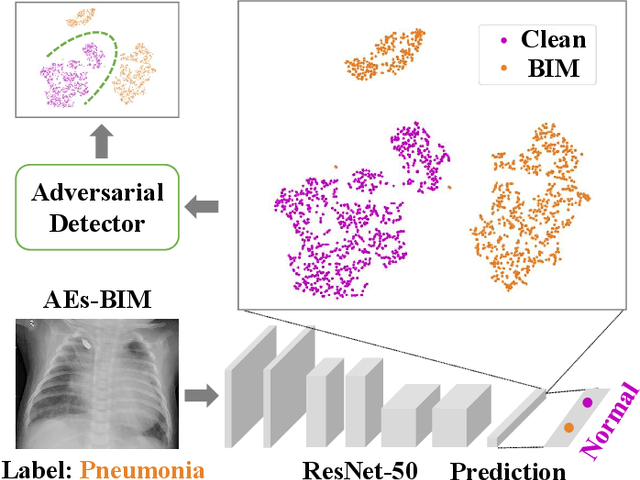
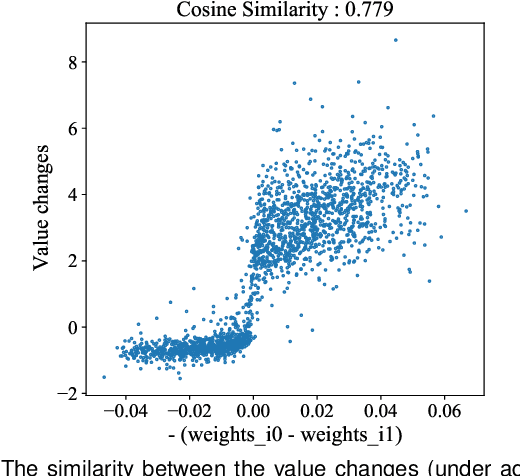
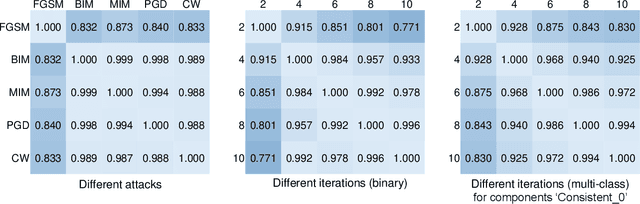
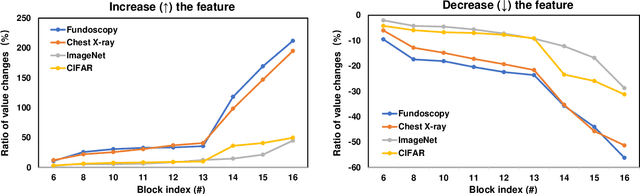
Deep learning based methods for medical images can be easily compromised by adversarial examples (AEs), posing a great security flaw in clinical decision-making. It has been discovered that conventional adversarial attacks like PGD which optimize the classification logits, are easy to distinguish in the feature space, resulting in accurate reactive defenses. To better understand this phenomenon and reassess the reliability of the reactive defenses for medical AEs, we thoroughly investigate the characteristic of conventional medical AEs. Specifically, we first theoretically prove that conventional adversarial attacks change the outputs by continuously optimizing vulnerable features in a fixed direction, thereby leading to outlier representations in the feature space. Then, a stress test is conducted to reveal the vulnerability of medical images, by comparing with natural images. Interestingly, this vulnerability is a double-edged sword, which can be exploited to hide AEs. We then propose a simple-yet-effective hierarchical feature constraint (HFC), a novel add-on to conventional white-box attacks, which assists to hide the adversarial feature in the target feature distribution. The proposed method is evaluated on three medical datasets, both 2D and 3D, with different modalities. The experimental results demonstrate the superiority of HFC, \emph{i.e.,} it bypasses an array of state-of-the-art adversarial medical AE detectors more efficiently than competing adaptive attacks, which reveals the deficiencies of medical reactive defense and allows to develop more robust defenses in future.
MobileUtr: Revisiting the relationship between light-weight CNN and Transformer for efficient medical image segmentation
Dec 04, 2023

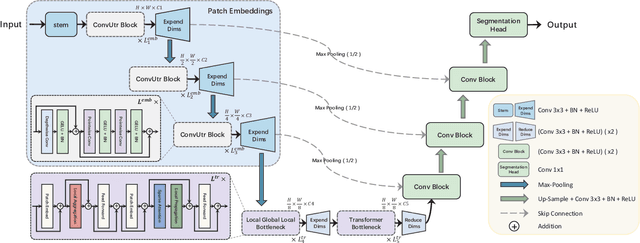
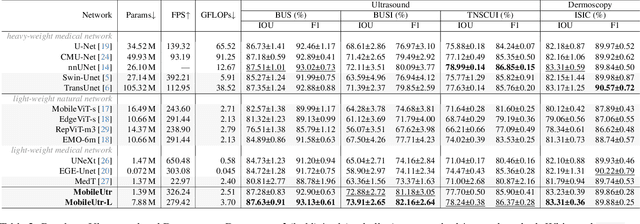
Due to the scarcity and specific imaging characteristics in medical images, light-weighting Vision Transformers (ViTs) for efficient medical image segmentation is a significant challenge, and current studies have not yet paid attention to this issue. This work revisits the relationship between CNNs and Transformers in lightweight universal networks for medical image segmentation, aiming to integrate the advantages of both worlds at the infrastructure design level. In order to leverage the inductive bias inherent in CNNs, we abstract a Transformer-like lightweight CNNs block (ConvUtr) as the patch embeddings of ViTs, feeding Transformer with denoised, non-redundant and highly condensed semantic information. Moreover, an adaptive Local-Global-Local (LGL) block is introduced to facilitate efficient local-to-global information flow exchange, maximizing Transformer's global context information extraction capabilities. Finally, we build an efficient medical image segmentation model (MobileUtr) based on CNN and Transformer. Extensive experiments on five public medical image datasets with three different modalities demonstrate the superiority of MobileUtr over the state-of-the-art methods, while boasting lighter weights and lower computational cost. Code is available at https://github.com/FengheTan9/MobileUtr.
LoCo: Locally Constrained Training-Free Layout-to-Image Synthesis
Nov 21, 2023Recent text-to-image diffusion models have reached an unprecedented level in generating high-quality images. However, their exclusive reliance on textual prompts often falls short in accurately conveying fine-grained spatial compositions. In this paper, we propose LoCo, a training-free approach for layout-to-image synthesis that excels in producing high-quality images aligned with both textual prompts and spatial layouts. Our method introduces a Localized Attention Constraint to refine cross-attention for individual objects, ensuring their precise placement in designated regions. We further propose a Padding Token Constraint to leverage the semantic information embedded in previously neglected padding tokens, thereby preventing the undesired fusion of synthesized objects. LoCo seamlessly integrates into existing text-to-image and layout-to-image models, significantly amplifying their performance and effectively addressing semantic failures observed in prior methods. Through extensive experiments, we showcase the superiority of our approach, surpassing existing state-of-the-art training-free layout-to-image methods both qualitatively and quantitatively across multiple benchmarks.
CMUNeXt: An Efficient Medical Image Segmentation Network based on Large Kernel and Skip Fusion
Aug 03, 2023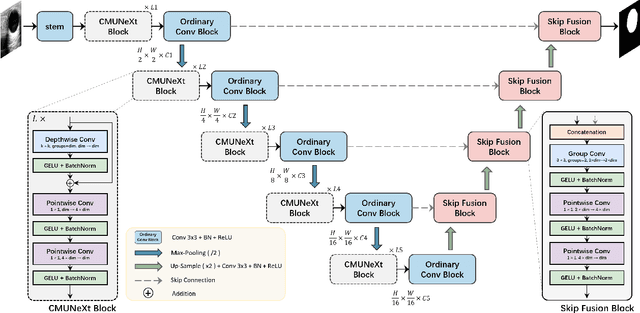
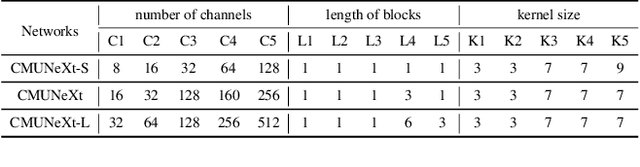
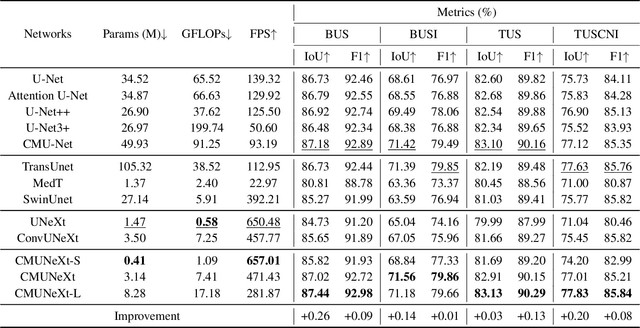
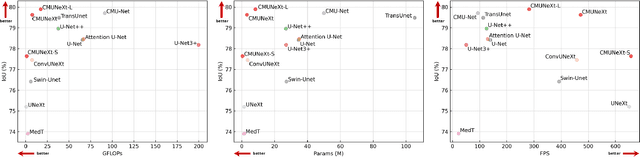
The U-shaped architecture has emerged as a crucial paradigm in the design of medical image segmentation networks. However, due to the inherent local limitations of convolution, a fully convolutional segmentation network with U-shaped architecture struggles to effectively extract global context information, which is vital for the precise localization of lesions. While hybrid architectures combining CNNs and Transformers can address these issues, their application in real medical scenarios is limited due to the computational resource constraints imposed by the environment and edge devices. In addition, the convolutional inductive bias in lightweight networks adeptly fits the scarce medical data, which is lacking in the Transformer based network. In order to extract global context information while taking advantage of the inductive bias, we propose CMUNeXt, an efficient fully convolutional lightweight medical image segmentation network, which enables fast and accurate auxiliary diagnosis in real scene scenarios. CMUNeXt leverages large kernel and inverted bottleneck design to thoroughly mix distant spatial and location information, efficiently extracting global context information. We also introduce the Skip-Fusion block, designed to enable smooth skip-connections and ensure ample feature fusion. Experimental results on multiple medical image datasets demonstrate that CMUNeXt outperforms existing heavyweight and lightweight medical image segmentation networks in terms of segmentation performance, while offering a faster inference speed, lighter weights, and a reduced computational cost. The code is available at https://github.com/FengheTan9/CMUNeXt.
WeakPolyp: You Only Look Bounding Box for Polyp Segmentation
Jul 20, 2023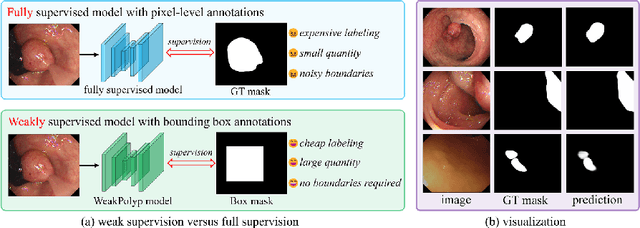
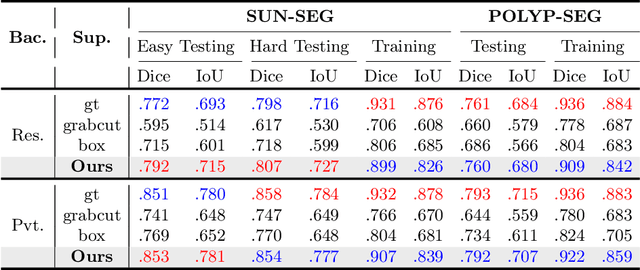
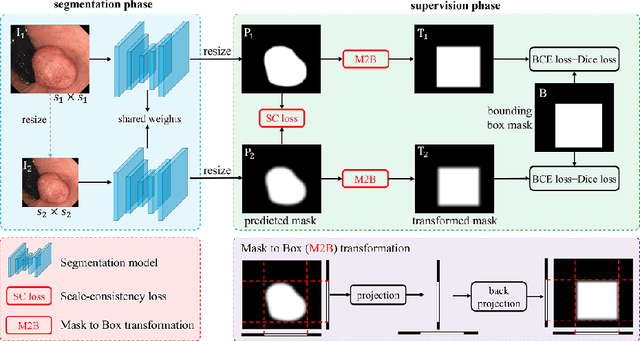
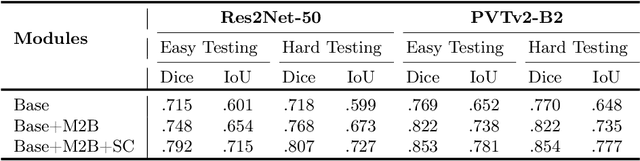
Limited by expensive pixel-level labels, polyp segmentation models are plagued by data shortage and suffer from impaired generalization. In contrast, polyp bounding box annotations are much cheaper and more accessible. Thus, to reduce labeling cost, we propose to learn a weakly supervised polyp segmentation model (i.e., WeakPolyp) completely based on bounding box annotations. However, coarse bounding boxes contain too much noise. To avoid interference, we introduce the mask-to-box (M2B) transformation. By supervising the outer box mask of the prediction instead of the prediction itself, M2B greatly mitigates the mismatch between the coarse label and the precise prediction. But, M2B only provides sparse supervision, leading to non-unique predictions. Therefore, we further propose a scale consistency (SC) loss for dense supervision. By explicitly aligning predictions across the same image at different scales, the SC loss largely reduces the variation of predictions. Note that our WeakPolyp is a plug-and-play model, which can be easily ported to other appealing backbones. Besides, the proposed modules are only used during training, bringing no computation cost to inference. Extensive experiments demonstrate the effectiveness of our proposed WeakPolyp, which surprisingly achieves a comparable performance with a fully supervised model, requiring no mask annotations at all.
Unsupervised Polychromatic Neural Representation for CT Metal Artifact Reduction
Jun 27, 2023Emerging neural reconstruction techniques based on tomography (e.g., NeRF, NeAT, and NeRP) have started showing unique capabilities in medical imaging. In this work, we present a novel Polychromatic neural representation (Polyner) to tackle the challenging problem of CT imaging when metallic implants exist within the human body. The artifacts arise from the drastic variation of metal's attenuation coefficients at various energy levels of the X-ray spectrum, leading to a nonlinear metal effect in CT measurements. Reconstructing CT images from metal-affected measurements hence poses a complicated nonlinear inverse problem where empirical models adopted in previous metal artifact reduction (MAR) approaches lead to signal loss and strongly aliased reconstructions. Polyner instead models the MAR problem from a nonlinear inverse problem perspective. Specifically, we first derive a polychromatic forward model to accurately simulate the nonlinear CT acquisition process. Then, we incorporate our forward model into the implicit neural representation to accomplish reconstruction. Lastly, we adopt a regularizer to preserve the physical properties of the CT images across different energy levels while effectively constraining the solution space. Our Polyner is an unsupervised method and does not require any external training data. Experimenting with multiple datasets shows that our Polyner achieves comparable or better performance than supervised methods on in-domain datasets while demonstrating significant performance improvements on out-of-domain datasets. To the best of our knowledge, our Polyner is the first unsupervised MAR method that outperforms its supervised counterparts.
Unsupervised augmentation optimization for few-shot medical image segmentation
Jun 08, 2023
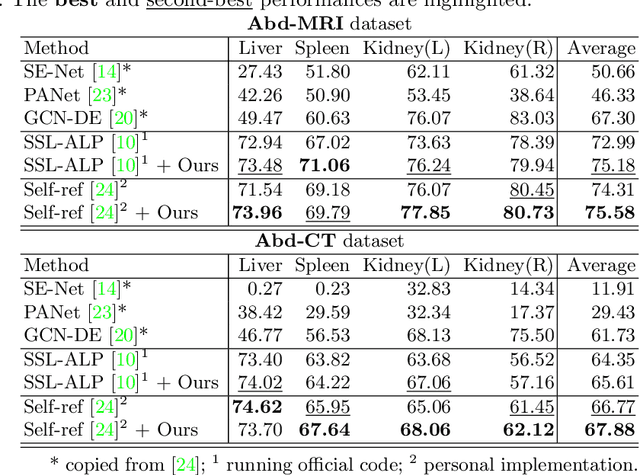
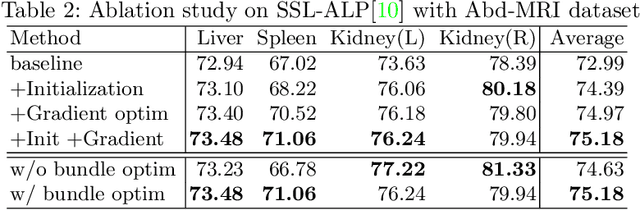
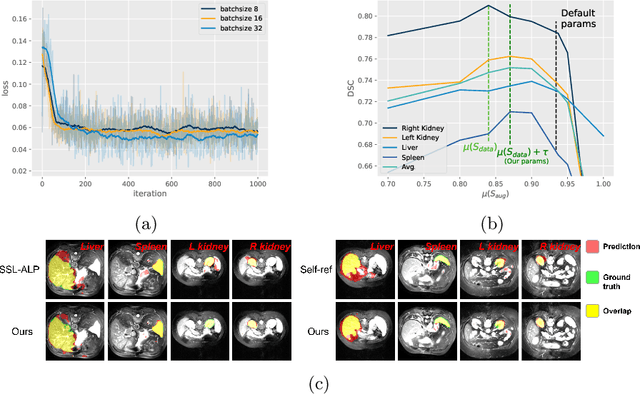
The augmentation parameters matter to few-shot semantic segmentation since they directly affect the training outcome by feeding the networks with varying perturbated samples. However, searching optimal augmentation parameters for few-shot segmentation models without annotations is a challenge that current methods fail to address. In this paper, we first propose a framework to determine the ``optimal'' parameters without human annotations by solving a distribution-matching problem between the intra-instance and intra-class similarity distribution, with the intra-instance similarity describing the similarity between the original sample of a particular anatomy and its augmented ones and the intra-class similarity representing the similarity between the selected sample and the others in the same class. Extensive experiments demonstrate the superiority of our optimized augmentation in boosting few-shot segmentation models. We greatly improve the top competing method by 1.27\% and 1.11\% on Abd-MRI and Abd-CT datasets, respectively, and even achieve a significant improvement for SSL-ALP on the left kidney by 3.39\% on the Abd-CT dataset.
Meta-hallucinator: Towards Few-Shot Cross-Modality Cardiac Image Segmentation
May 11, 2023Domain shift and label scarcity heavily limit deep learning applications to various medical image analysis tasks. Unsupervised domain adaptation (UDA) techniques have recently achieved promising cross-modality medical image segmentation by transferring knowledge from a label-rich source domain to an unlabeled target domain. However, it is also difficult to collect annotations from the source domain in many clinical applications, rendering most prior works suboptimal with the label-scarce source domain, particularly for few-shot scenarios, where only a few source labels are accessible. To achieve efficient few-shot cross-modality segmentation, we propose a novel transformation-consistent meta-hallucination framework, meta-hallucinator, with the goal of learning to diversify data distributions and generate useful examples for enhancing cross-modality performance. In our framework, hallucination and segmentation models are jointly trained with the gradient-based meta-learning strategy to synthesize examples that lead to good segmentation performance on the target domain. To further facilitate data hallucination and cross-domain knowledge transfer, we develop a self-ensembling model with a hallucination-consistent property. Our meta-hallucinator can seamlessly collaborate with the meta-segmenter for learning to hallucinate with mutual benefits from a combined view of meta-learning and self-ensembling learning. Extensive studies on MM-WHS 2017 dataset for cross-modality cardiac segmentation demonstrate that our method performs favorably against various approaches by a lot in the few-shot UDA scenario.
* Accepted by MICCAI 2022 (top 13% paper; early accept)
PELE scores: Pelvic X-ray Landmark Detection by Pelvis Extraction and Enhancement
May 07, 2023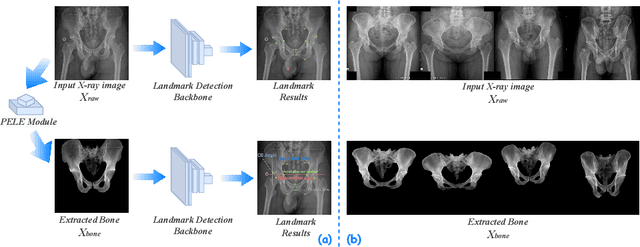
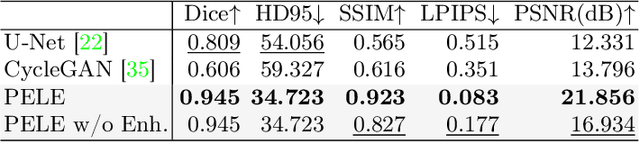
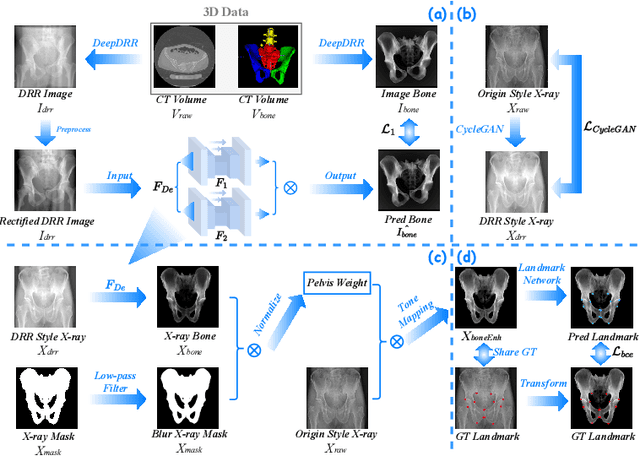
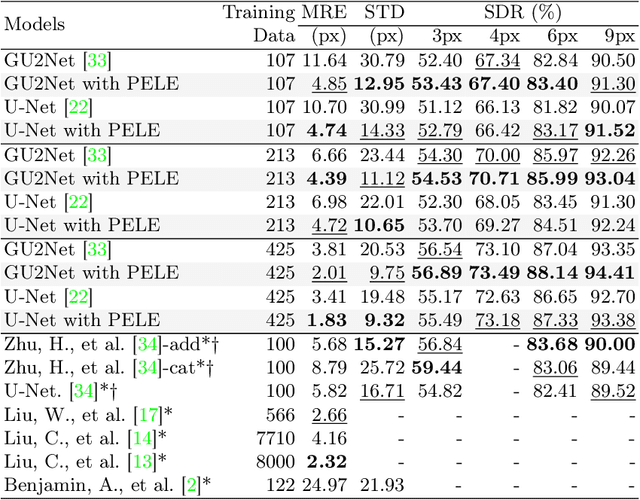
The pelvis, the lower part of the trunk, supports and balances the trunk. Landmark detection from a pelvic X-ray (PXR) facilitates downstream analysis and computer-assisted diagnosis and treatment of pelvic diseases. Although PXRs have the advantages of low radiation and reduced cost compared to computed tomography (CT) images, their 2D pelvis-tissue superposition of 3D structures confuses clinical decision-making. In this paper, we propose a PELvis Extraction (PELE) module that utilizes 3D prior anatomical knowledge in CT to guide and well isolate the pelvis from PXRs, thereby eliminating the influence of soft tissue. We conduct an extensive evaluation based on two public datasets and one private dataset, totaling 850 PXRs. The experimental results show that the proposed PELE module significantly improves the accuracy of PXRs landmark detection and achieves state-of-the-art performances in several benchmark metrics, thus better serving downstream tasks.