 Add to Chrome
 Add to Firefox
 Add to Edge
Chain-of-Look Spatial Reasoning for Dense Surgical Instrument Counting
Feb 11, 2026
Accurate counting of surgical instruments in Operating Rooms (OR) is a critical prerequisite for ensuring patient safety during surgery. Despite recent progress of large visual-language models and agentic AI, accurately counting such instruments remains highly challenging, particularly in dense scenarios where instruments are tightly clustered. To address this problem, we introduce Chain-of-Look, a novel visual reasoning framework that mimics the sequential human counting process by enforcing a structured visual chain, rather than relying on classic object detection which is unordered. This visual chain guides the model to count along a coherent spatial trajectory, improving accuracy in complex scenes. To further enforce the physical plausibility of the visual chain, we introduce the neighboring loss function, which explicitly models the spatial constraints inherent to densely packed surgical instruments. We also present SurgCount-HD, a new dataset comprising 1,464 high-density surgical instrument images. Extensive experiments demonstrate that our method outperforms state-of-the-art approaches for counting (e.g., CountGD, REC) as well as Multimodality Large Language Models (e.g., Qwen, ChatGPT) in the challenging task of dense surgical instrument counting.

Recognize Any Surgical Object: Unleashing the Power of Weakly-Supervised Data
Jan 25, 2025
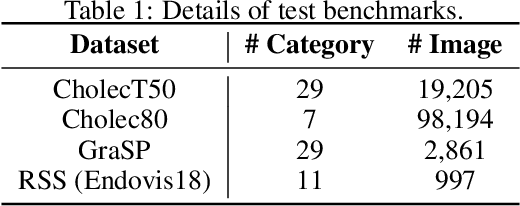

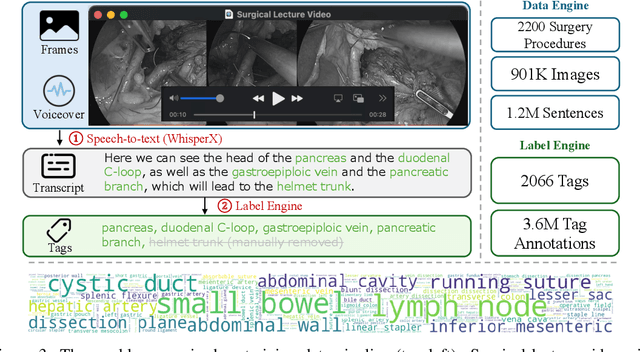
We present RASO, a foundation model designed to Recognize Any Surgical Object, offering robust open-set recognition capabilities across a broad range of surgical procedures and object classes, in both surgical images and videos. RASO leverages a novel weakly-supervised learning framework that generates tag-image-text pairs automatically from large-scale unannotated surgical lecture videos, significantly reducing the need for manual annotations. Our scalable data generation pipeline gatherers to 2,200 surgical procedures and produces 3.6 million tag annotations across 2,066 unique surgical tags. Our experiments show that RASO achieves improvements of 2.9 mAP, 4.5 mAP, 10.6 mAP, and 7.2 mAP on four standard surgical benchmarks respectively in zero-shot settings, and surpasses state-of-the-art models in supervised surgical action recognition tasks. We will open-source our code, model, and dataset to facilitate further research.
LLaVA-Surg: Towards Multimodal Surgical Assistant via Structured Surgical Video Learning
Aug 15, 2024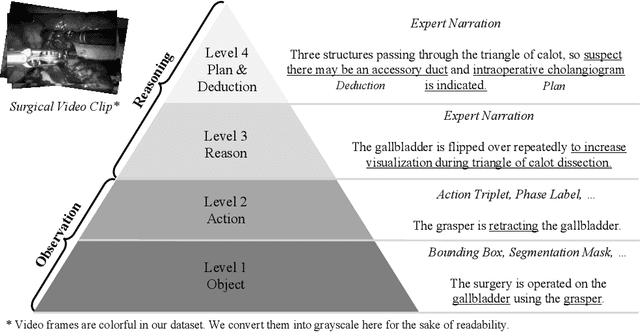
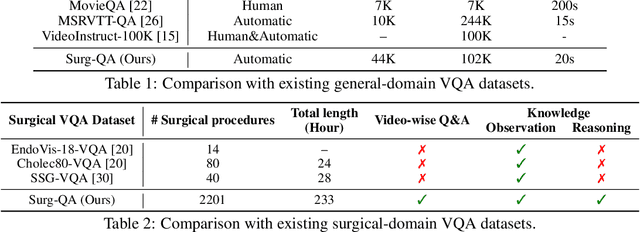
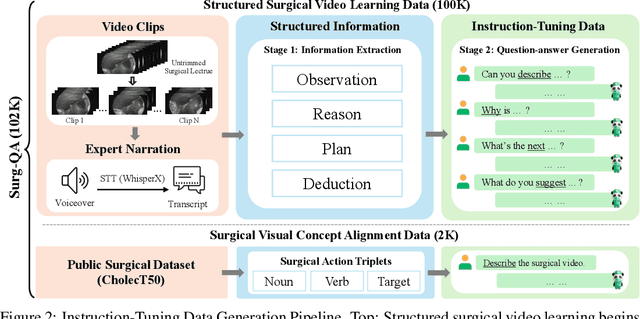
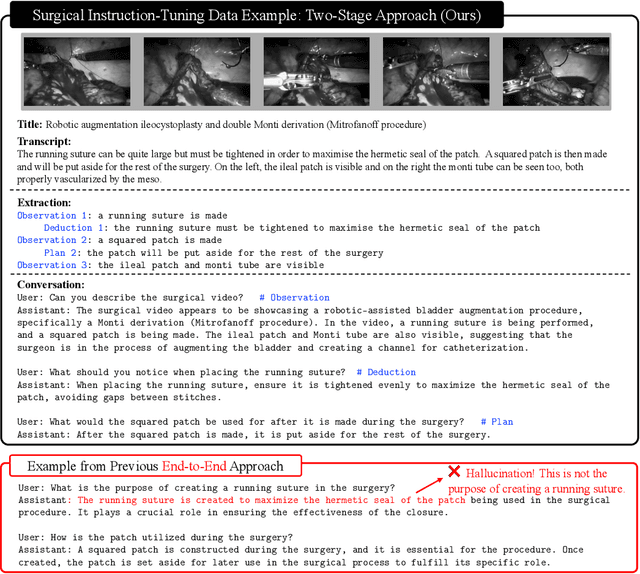
Multimodal large language models (LLMs) have achieved notable success across various domains, while research in the medical field has largely focused on unimodal images. Meanwhile, current general-domain multimodal models for videos still lack the capabilities to understand and engage in conversations about surgical videos. One major contributing factor is the absence of datasets in the surgical field. In this paper, we create a new dataset, Surg-QA, consisting of 102,000 surgical video-instruction pairs, the largest of its kind so far. To build such a dataset, we propose a novel two-stage question-answer generation pipeline with LLM to learn surgical knowledge in a structured manner from the publicly available surgical lecture videos. The pipeline breaks down the generation process into two stages to significantly reduce the task complexity, allowing us to use a more affordable, locally deployed open-source LLM than the premium paid LLM services. It also mitigates the risk of LLM hallucinations during question-answer generation, thereby enhancing the overall quality of the generated data. We further train LLaVA-Surg, a novel vision-language conversational assistant capable of answering open-ended questions about surgical videos, on this Surg-QA dataset, and conduct comprehensive evaluations on zero-shot surgical video question-answering tasks. We show that LLaVA-Surg significantly outperforms all previous general-domain models, demonstrating exceptional multimodal conversational skills in answering open-ended questions about surgical videos. We will release our code, model, and the instruction-tuning dataset.